12 Ridges Vineyard (2019 edition)

It’s not often I get to visit a brand-new winery. I’ve been on a multi-year quest to visit every winery in the state, making first-time visits are rare. So obviously when a brand new place popped up on my wine app it was as if my phone was making me an offer I couldn’t refuse.

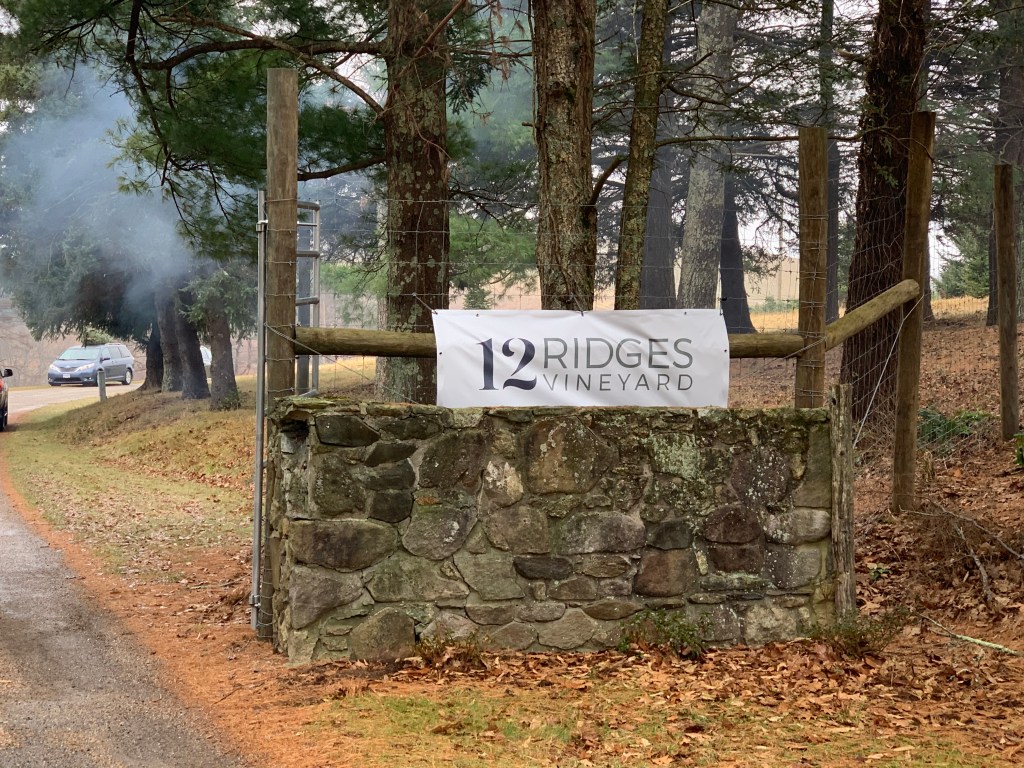
12 Ridges is definitely a destination winery. Not just because it’s in a physically stunning location, but it’s far enough off the beaten path that only dedicated wine connoisseurs (or hikers looking for a diversion) are likely to make the trip.

What sets 12 Ridges apart from the rest of the Virginia wine scene is the tasting room tops out at 3300 feet, making it the highest altitude winery in the state. The soil is a mix of clay and volcanic green rock with excellent drainage. Why is this important? Well, when wine luminaries like Michael Shaps and Jake Busching first examined the site they practically salivated over its growing potential, so you know this place is going to produce great wine.

Besides the view, why did they pick this site? Well, the altitude provides the vineyard with a cool climate and windy slopes, both of which allow its vines to resist disease pressure. Also, mountaintops often have rocky, well-drained soil which facilitate minerality in their grape’s flavor profile, and forces vines to struggle – allowing them to produce berries with high flavor concentration.

It wasn’t a vineyard until recently. Owner Craig Colberg purchased the former event center in 2009, but it took time for this current vision to take hold. Even now when you drive in, you pass a Christmas tree farm before arriving at the tasting building.

That tasting building adroitly takes advantage of the view. Sadly, clouds prevented me from enjoying the scenery, but on a clear day I’m certain it’s amazing. Besides; you’re right off the Blue Ridge parkway, so the drive alone is worth it.
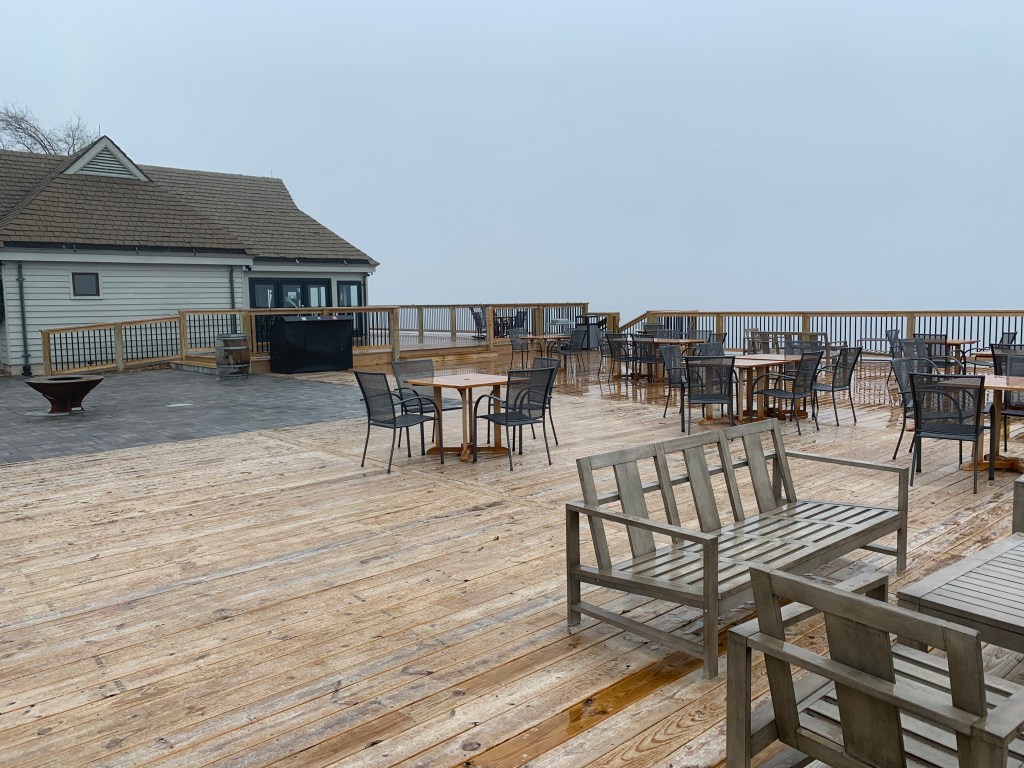
Operations manager Sam Hanny greeted me when I arrived. Sam is a self-described ‘vineyard geek’, which is a trait that I can definitely appreciate. He gave me the low-down of the vineyard as he poured.

As the vines are very young, 12 Ridges doesn’t yet produce its own wines. But in keeping with its theme of a high altitude winery, they serve a variety of wines from other high altitude locations around the world. When I was visiting, a nice assortment including a Tempranillo, Riesling, Malbec, a French high-elevation sparkling, and Pinot Grigio were being served.

But when 12 Ridges’ vines become ready – watch out! Its 12 acres include Pinot Noir, Pinot Gris, Chardonnay and Riesling – all varietals that should thrive in this climate.  I’m especially excited at the Pinot Noir, since it’s a grape you rarely find in Virginia. Their first vintage probably won’t be available until 2021, so a revisit (or several) is a necessity.

See you in another two years – if not sooner!
The Ben Jordan Experience: Lightwell Survey and Midland Construction Wines

Ben Jordan is a busy guy. You’d think being the winemaker for one of the largest wineries in Virginia would be enough. But wait – there’s more!

Ben is also involved with two separate wine ventures; Lightwell Survey and Midland Construction. Both labels use Shenandoah Valley grapes; the former utilizing fruit from different parts of the valley (and maybe some red grapes from Early Mountain’s Quaker Run vineyard), the later from his family farm in Ft. Defiance, just north of Staunton.

The two lines mostly use somewhat similar grape varietals. But both share one big similarity – both are WEIRD, and I say that in a very good way. Ben has a flare for blending and demonstrates his talent here. It’s rare to see Riesling and Petit Manseng made together, but both Lightwell and Midland have bottles made in that style. But things get doubly weird with Lightwell’s Syrah-Riesling “Los Idiots” and Midland’s Cabernet Franc-Blaufränkisch blend.

Unfortunately neither label has a dedicated tasting room, so you have to watch their social media feeds for events where they are being served. Lucky for me, I was able to taste both Lightwell’s and Midland’s wines barely a week apart.

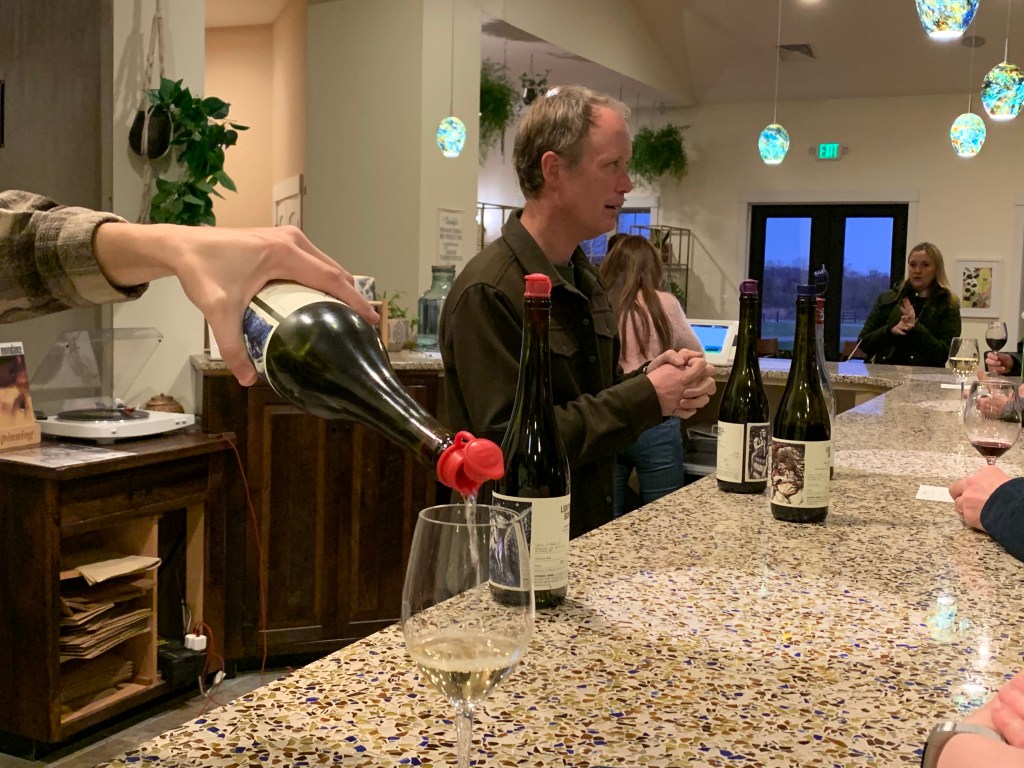
My experience with Lightwell came when Ben was visiting Walsh Family Wine. Walsh has a cool program where they invite winemakers who lack tasting rooms to pour their wines during special ‘bar takeover’ events; needless to say, I got my tickets as soon as they were available.

The combo of wines from Nate Walsh and Ben Jordan is a totally win-win scenario. I feel they could have placed their entire lineup on the counter, let me grab a random bottle blindfolded, and I would have been happy with whatever I got. I’m saving Nate’s wines for a future blog, so I’ll just concentrate on Lightwell.

Lightwell’s tasting descriptions are lighthearted and whimsical – like several of their wines. Ben was even behind the counter pouring. What I tried:

Goodbye Horses: A dry Riesling, which I found to be exceptionally rich and yummy.

EMV 2018 Young Wine: OK, NOT a Lightwell wine but nevertheless made by Ben. BIG fruit notes; seemed to live up to its name. Beaujolais style, perhaps?

2017 Los Idiots: Interesting blend of 59% Syrah/41% Riesling. Light, with the cherry notes very apparent.

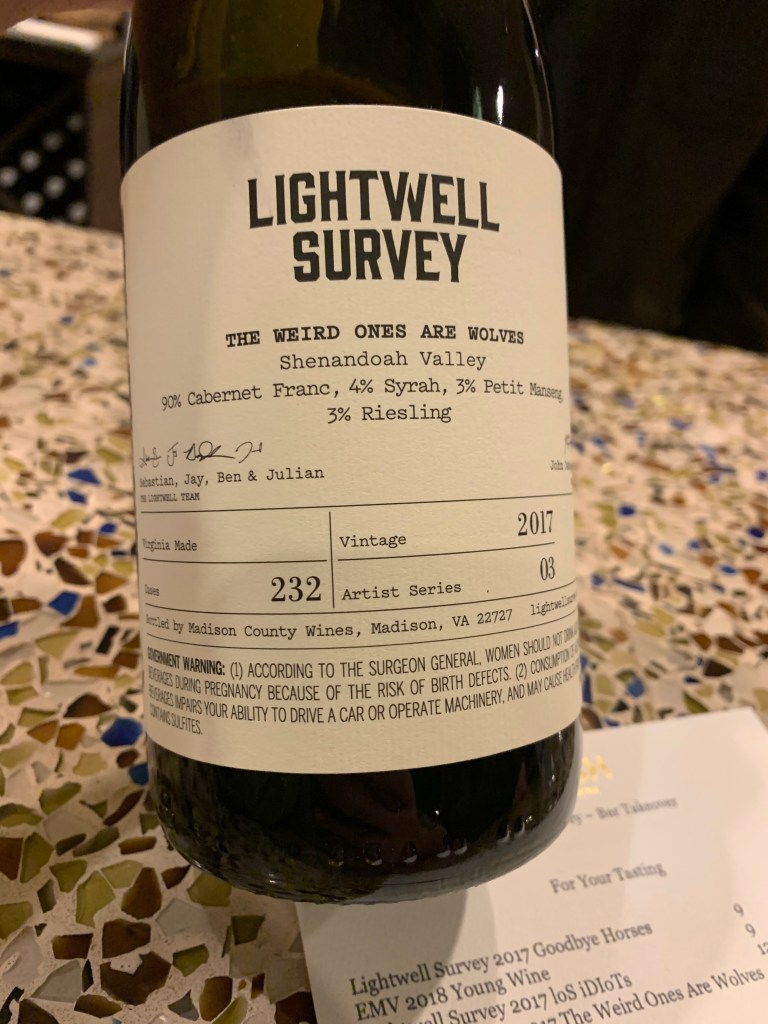
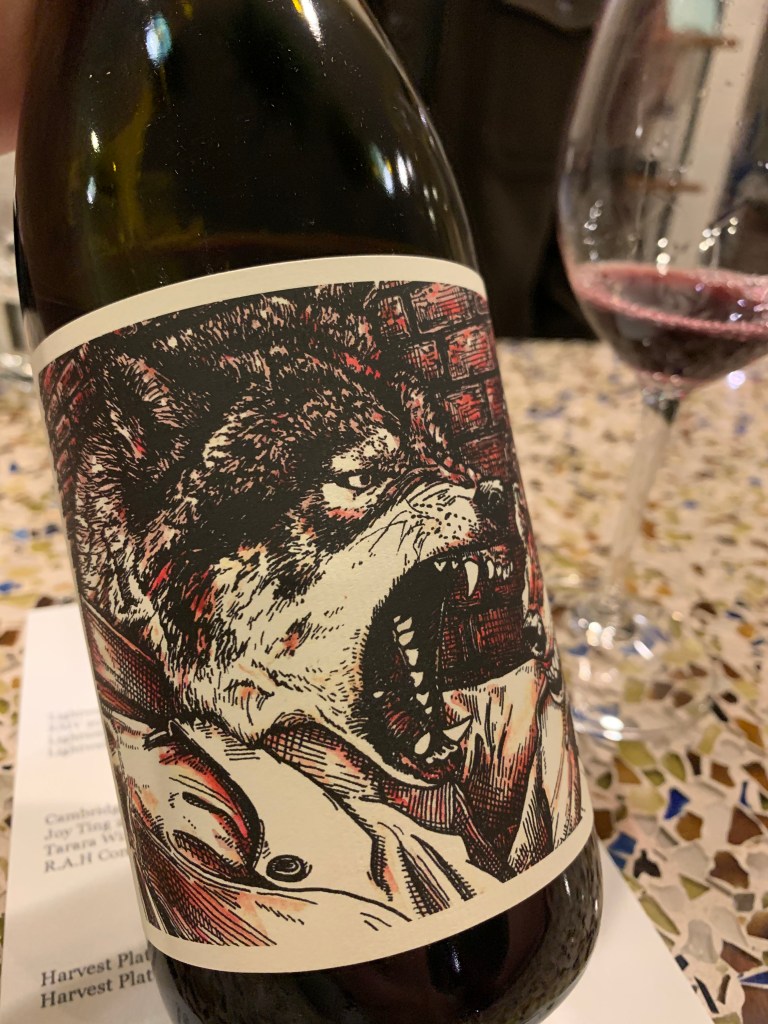
2017 Weird Ones Are Wolves: 90% Cabernet Franc but dashes of Syrah, Petit Manseng and Riesling. Bright and spicy at the same time, with noticeable acidity.

My visit to Midland Construction occurred just a week later at their farm in Ft Defiance. Ben is also the winemaker but he runs the business with his brothers Tim and Grayson. The family roots go beyond the wine business; this was their grandfather’s farm, and the wine is named after his former construction company.

The farm has 10 acres planted; 6 of vinifera and 4 acres of hybrid. The location is very non-descript as vineyards go; wandering around I almost walked into the family home next door. The ‘tasting room’ must have been an old garage, with a paper sign announcing that you have arrived.

As I walked in I saw Ben and Tim pouring at the tables. It was a bigger event than I had expected; I guess they have a pretty decent social media following for so many to take this hike. I didn’t ask what their production is, but it’s most certainly a smaller operation.

The lineup included a trio of wines plus a selection of his aperitif “War & Rust” series. Ben must have recognized me because I got a “Hey, I know you!” look as I walked by. See what happens when you drink a lot of Virginia wine? Even the winemakers recognize their regular lushes!

What I tried:

2017 Riesl-eng: (69% Riesling/31% Petit Manseng): Think of a regular Riesling, but less apple-y and fuller. Different but liked it.

2017 Chardonnay: My favorite of the lineup. It had enough oak to make it noticeable but didn’t overpower it. I ended up with a glass of this as I walked around.

2017 Cabernet Frankisch (75% Cab Franc/25% Blaufränkisch): Spicy notes dominate here. Ben explained this was a product of necessity, as he didn’t have enough fruit to make wines from either varietal so he blended them together. I liked it but again it’s definitely different – but in a good way.

War & Rust series: Not sure how to describe these wines. Ben called them aperitifs, which is as good a description as any. Not sure what grapes they used either; apparently there are many. And it’s impossible to give you a vintage year since they are fermented solera-style, meaning every series is made of juice from multiple batches. Its sort of like a port-style, but not really.

I CAN tell you the flavors are bitter and heavy on the herbs, although the older bottles are more fruit-forward. I personally preferred the older bottles for that reason, but to each their own.

And so there you have it!

Enjoying the firepit at Walsh Family Wine

October One Vineyard

Pssst…I have a secret. Would you like to know about a winery that’s the definition of a hidden gem? Since word is starting to get out, I may as well spill the beans.

I encountered October One about a year ago while having lunch at The Wine Kitchen in Leesburg. Always a fan of drinking local, I perused its Virginia wine list and saw a Cabernet Sauvignon from a place called “October One Vineyard” and was surprised – there’s a Virginia winery that’s escaped my radar! After a glass I excitedly texted a friend exclaiming “Have you heard of this place!?! This Cab is outstanding!”.

Despite that epiphany, finding their wine again proved to be difficult. Unlike most other wineries, October One doesn’t have a tasting room; you can only find them at special events, select restaurants, or a few Leesburg area farmer’s markets. As co-owner and winegrower Bob Rupy says, it’s a “winery without walls”, with its publicity primary driven by word of mouth.

But that ‘word of mouth’ is getting louder. This past October the Loudoun Wineries Association awarded Bob with its Chairman’s Grand Award for his 2018 Viognier. That’s an especially outstanding achievement given what a tough growing year 2018 was. After hearing that news, I decided it was time to track this wine down.

Several days and some Instagram-messages later, I met Bob and his wife Loree at a Leesburg farmers market and he gave me the background on October One. Bob actually helped set up Bluemont Vineyards some years back before starting this new venture. October One’s vineyard is actually on the same slope as Bluemont.

Right now they have 10 acres under vine and make around 500 cases/year (100% estate) – making for a VERY limited distribution. Currently their wine is made by Nate Walsh of Walsh Family Wine. Nate’s an awesome winemaker so it shouldn’t surprise anyone that the 2018 Viognier came from him.

What I tried:

2018 Albariño: Very bright; pretty darn good for a 2018 vintage.

2018 Cabernet Franc Rose: Fuller body than I’d expect of a Rose; made in a dry style.

2018 Merlot Rose: Fantastic color! Heck, it was almost too pretty to drink.

2017 Cabernet Sauvignon: Medium body; fruity and easy drinking. Drinkable now but another year of aging wouldn’t hurt.

2016 Merlot: Strong black cherry notes.

Sadly the 2018 Viognier wasn’t for sale, as they have to hoard the remaining stock to qualify for the 2020 Governor’s Cup wine competition. But I’m sure Bob is going to save me a bottle. Right Bob? Right?

So there you are; you can consider yourself to be ‘in the know’.

Eagletree Farm Vineyards

Eagletree isn’t your typical winery experience. Whereas most wineries have charcuterie plates & baguettes, perhaps paninis or pizza, this place is a full service restaurant with cuisine made by a guy with a culinary degree (who doubles as the winemaker). Think of it as a restaurant which happens to have home-made wine as opposed to a taste-and-go winery, because EVERYTHING here revolves around food.

As they say in real estate – it’s all about LOCATION LOCATION LOCATION. Although the farm is in a somewhat residential nook north of Leesburg, it’s surrounded by other wineries with Hidden Brook, Lost Creek, Winery 32 and Fabbioli just minutes away. Suffice to say, you won’t go hungry OR thirsty in these parts.

While the vineyard has around since 1999, the restaurant is a new edition. Owners Jeff Judge and Lori McKeever previously ran McKeever’s Pub in McLean, but decided they wanted to work closer to home. Since they had plenty of available land, opening a restaurant/tasting room seemed a natural choice.

Today Eagletree has 6.5 acres under vine – so except for some upcoming Merlot all their wines are 100% estate. They even have (when in season) blueberries you can pick on your own. As Lori explained, grape vines and blueberries are a good way to help your property pay for itself, so it looked like their planning paid off.

Dining is as much about the experience as the food – and this place delivers. Eagletree feels like a mix of quaint French country cuisine meets your home dining room. When I said this to Lori she gave me a big smile because that’s exactly the vibe they were hoping for.

The oven-made pizza is very popular, but there are other options as well. I was deliberating between the Bahn Mi Thit and French onion soup until Jeff convinced me to go with the later, and ended up adding a pear & pistachio salad as well.

And yes – of course they have wine! But again, things are different here. I suppose you COULD visit for only a wine tasting…but you wouldn’t want to. These wines are designed to complement their dishes, so come hungry. When I visited, a Chardonnay, Cabernet Franc, Tannat and red-blend were all available (their Viognier wasn’t available on this trip). My favorite was the peppery Cabernet Franc, although I suspect their Chardonnay would have been an equally good pairing with my salad.

I enjoyed the wine, but this was definitely a culinary experience first and foremost. If you’re ever looking for a place to eat while winery-hoping in the Leesburg area, skip the cheese plates or food trucks and visit here instead!

Sunset Hills Vineyard

Sunset Hills is one of the most recognizable wineries in Loudoun. After all, how many places have tasting rooms based on a 150 year old barn, renovated by Amish craftsmen?

As one of the larger and more established wineries in the region, it’s also one of the busier ones. Lucky for me, I was able to visit on a Friday when things were relatively slow. I originally arranged a chat with tasting room manager Kevin Donley, but as luck would have it co-owner Mike Canney was around so he sat down with me as well.

Sunset planted its first vines in 1999, with 2005 being their first vintage. Doug Fabbioli was their first winemaker but now that title goes to Corry Craighill – recent winner of the 2019 Loudoun County winemaker of the year. Mike was exceptionally proud how Sunset is an ‘all woman managed winery’, specifically referring to their general manager, vineyard manager, and winemaker. Mike might add his wife Diane to that mix, although the two of them seem to take a hands-off approach to day to day operations.

I was surprised to learn their production of 10,000 cases/year is 100% estate; for a winery this size you’d think they’d need to purchase fruit. But with 5 separate vineyards scattered across the state they are actually in a position to sell fruit. Sunset’s production also covers sister winery 50 West, not far away in Middleburg. Although Corry makes wines from both locations using the same vineyards, she keeps the two wineries stylistically different from one another, to the point that certain grape varietals may only go to one or the other.

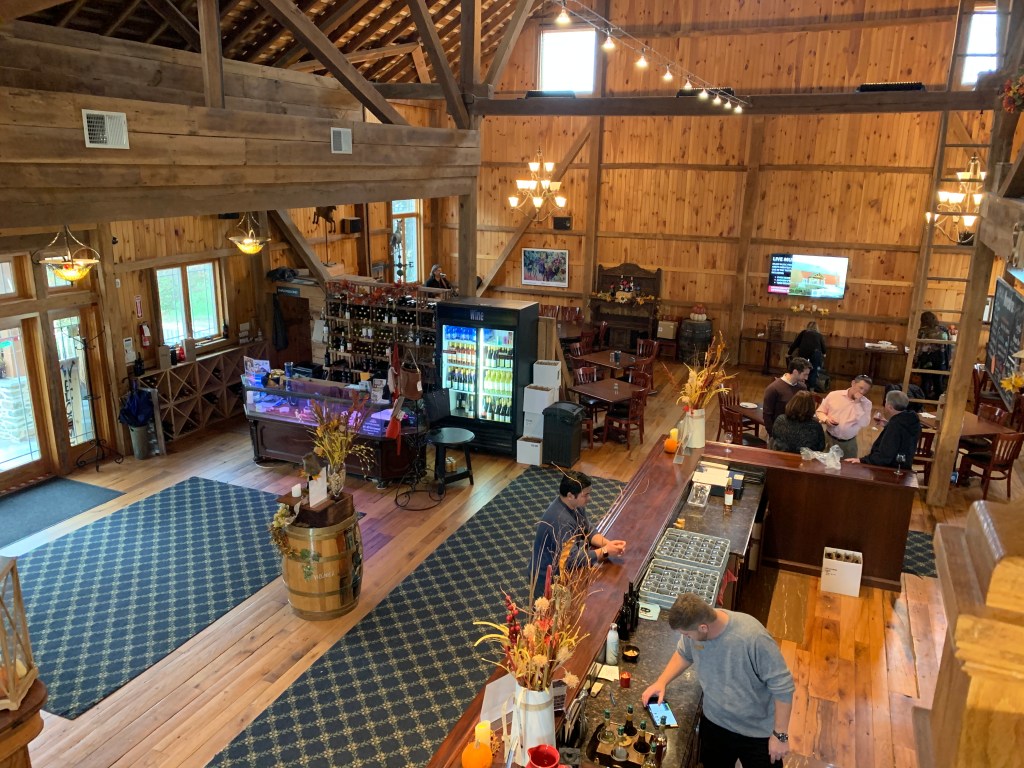
After I told Mike I had just come from Creek’s Edge, he explained my current surroundings should seem familiar; after all, Sunset’s barn was refurbished by the same Amish crew that built Creek’s Edge. As I looked from the 2nd floor loft it was impossible not to admire their handiwork; the high vaulted ceilings created sense of spaciousness, even when it was busy. They even had food options in the form of paninis and lighter fare.

The grounds outside are equally spacious; in good weather they have an outdoor tasting barn with a covered fire pit. Mike also gave me a quick tour of their barrel room.

Almost all the wines were made in a dry style, with a few off-dry exceptions. Sadly no Tannat or Petit Verdot on today’s menu!

2017 Chardonnay: Fermented half in steel and half in the barrel. Soft with some creaminess.

NV “Sunset White”: Blend of 50% Traminette, with smaller portions of Viognier, Vidal, and a splash of Albariño. It has less than 1% sugar but it could probably fool a sweet drinker.

2018 Sunset Rose: Surprising complexity for a Rose; 45% Merlot but also Cabernet Franc and some Cab Sauv.

NV Sunset Red: The first of their Bordeaux-blends, but made in a light, easy drinking style.

2016 Cabernet Franc: Kinda fruity with some pepper to it.

2015 Mosaic: Their flagship wine. The nose advertised its complexity before I even had a taste of it. Needless to say this was my favorite.

2014 Dusk: Chambourcin-based port style. Up until this point I thought the Mosaic had the best nose of the bunch, but this definitely came close.

Creek’s Edge Winery

Creek’s Edge is the result of mixing together a bunch of Amish craftsman, a chef, and an up and coming winemaker. Located only 15 minutes away from other wineries in the Leesburg cluster, it makes a great book-end (or the start) of a wine day trip. It’s also one of the most physically stunning tasting rooms anywhere in Virginia.

Jeremy Ligon has been their winemaker since 2015, not long after they opened. Ironically I learned about him during an interview with his family, who own Hunting Creek Vineyard (way down in southern Virginia). If that isn’t enough, none other than Jason Murray of Arterra Wines (perhaps my favorite winemaker in the state) helped convince Jeremy to take the path of a winemaker. Small world!

We started with a discussion of my favorite part of any winery – the vineyard. Creek’s Edge has 34 acres under vine; 4 on site and the rest at a vineyard just down the road. As of 2019 they were making around 4000 cases/year, with 80% of their grapes estate-grown. They previously used some out of state grapes to augment their harvest, but have been gradually weening themselves off of that for several years. While some older bottles are labeled as “American wine” (due to the use of these out of state grapes), Jeremy explained that even back then, this comprised only a small portion of the juice.

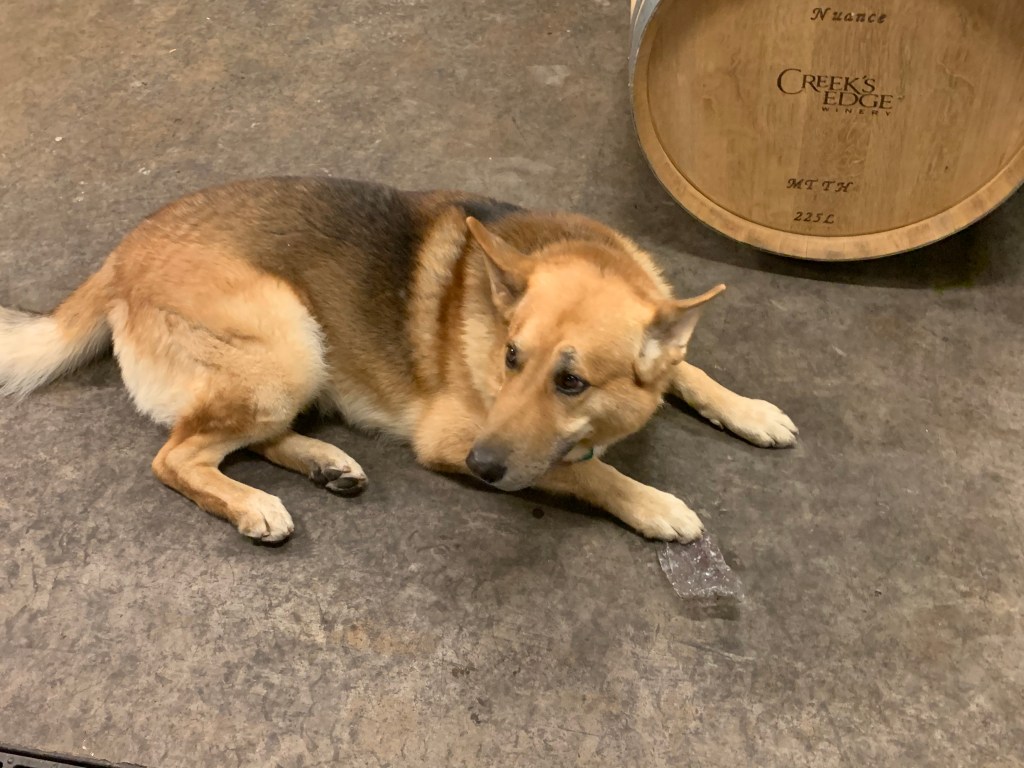
Jeremy treated me to an impromptu barrel tasting of juice from the 2019 vines. This year’s crop had turned out great and he was psyched about the quality of his future wines. And joining us on this tasting was none other than Boone, the winery wonder dog! Have I mentioned I’m totally a dog person? Heck, I should have an Instagram dedicated to winery pets.

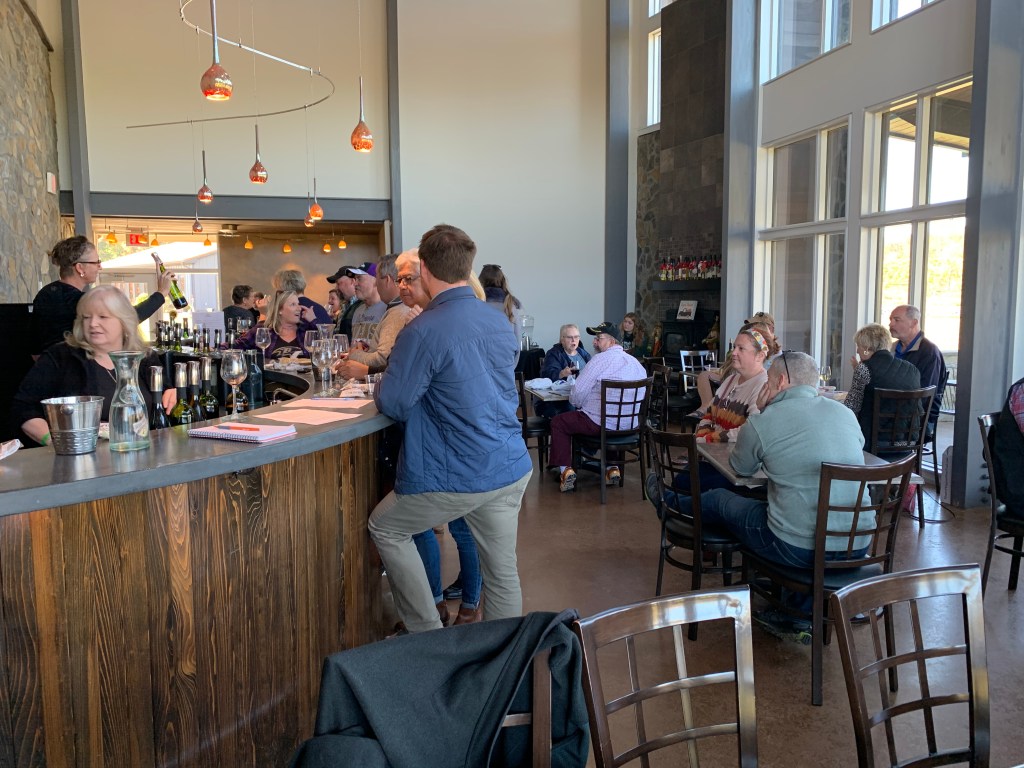
As we ascended the stairs to the main tasting room, it was impossible not to admire the architecture. The tower-like stairwell is the signature structure of the building, but everything is a marvel to behold. The tasting area is huge, buttressed by the fireplace on one end and the tasting bar at the other. The tables were made of black walnut taken from the property. The entire room felt like a cross between an Amish barn and a dream hunting cabin, complete with what looked like a chandelier made of antlers.

Jeremy had to depart early, but not before he went over what’s cooking in the kitchen. As the General Manager, he was especially proud of the food options. While most wineries have your standard baguettes and charcuterie plates, Creek’s Edge went all out with a full-fledged kitchen. Before we left, a friend & I ended up feasted on pork shoulder and deviled eggs near the fireplace while enjoying some glasses.

Jeremy passed me over to Mercedes, who guided me through a very extensive tasting of Jeremy’s wines. What we tried:

Sparkling Viognier: I swear this was cider! The nose and taste was dead on as cider.

2017 Vidal: Although Vidal us usually sweet this was at best off-dry; I found melon notes and it had some weight to it.

2018 Rose: Orange-colored, reminded me of a Provenance-style Rose. Strong notes of rose water.

2017 Viognier: Dark lemon color and fresh honey nose.

2017 Chardonnay: 60/40 split between fermented in steel tanks and neutral oak. Crisp and light apple notes. I liked this a lot.

2017 Water’s Edge: A Vidal that Jeremy called a ‘starter wine’, mostly because it was less than 1% sugar.

2017 Estate Cabernet Franc: Tiny bit of fruit up front, with cherry notes. But no pepper and spice notes which I often find in other Cab Francs.

2017 Reserve Cabernet Franc: Bramble fruit notes, and this time I found those spice notes.

2016 Petit Verdot: Nice nose! Medium-full body, nice pepper notes. I ended up with a glass of this.

2016 Vintner’s Blend: The black cherry notes came on strong; I swear I found strong acid or tannin as well.

2018 Sweet Caroline: A Vidal desert wine to satisfy those with a sweet tooth; it has 5% sugar!

2015 Hunting Hull: Chambourcin port-style that I liked, even though it was on the sweeter side.

Fifty-Third Winery and Vineyard

The opportunity to visit Fifty-Third (formerly known as Cooper Vineyards) poised an interesting question for me; if a winery rebrands, does it count as a ‘new’ winery on my checklist? I’d been to (and enjoyed) Cooper years back, but hadn’t revisited since they changed names in 2017. As I’m on a quest to visit every winery in Virginia, the opportunity to add another check-mark on my roster was irresistible.

Fifty-Third is so named because – wait for it – it was the 53rd farm winery in the state, planted back in 1999. David and Susan Drillock purchased the winery in 2015 and gradually made it their own. The rebranding was slowly rolled out, and even now their website and Facebook advertises them as Cooper Vineyard.

A new name wasn’t their only adjustment, as around that time the Drillocks hired Chelsey Belvins as their assistant wine maker. A former ‘cellar rat’ who started in the wine industry by cleaning tanks, Chelsey’s resume includes being a former Wine Librarian at Barboursville (which has to be the best library job ever) to recently becoming head wine maker at Fifty-Third.

The change of ownership brought other benefits as well. David and Susan brought with them a 23 acre vineyard in the Monticello AVA, most of which is vinifera. Coupled with the 20 acres on site, they have enough to produce 5000 cases/year of mostly estate wine.

Marie guided me through my tasting. I must have that ‘wine geek’ look about me, because she waived me over as soon as I walked in. The tasting room was PACKED, but we found an empty corner to tell me not only about the wine, but the building itself.

See, their tasting room isn’t just fancy; it’s one of the most eco-friendly tasting rooms on the east coast. We went over the checklist that certified them as “LEED Platinum” and it was impressive; solar panels, geothermal heating-cooling, pellet stoves, recycled wood, the whole shebang. And it looks good!

But time to talk wine!

The tasting menu gives you a tremendous bang-for-your-buck, and the funny thing is she didn’t pour anything that wasn’t already open. I’m glad I didn’t have any follow on events to attend to, as this was more than enough for a day.

We started with 8 white wines, plus a rose. There was something here for every palate, be it the 2018 Albarino with strong lemon notes, the light 2017 Chardonnel, dry 2017 Chardonnay, or 2018 Vidal with orange peel and apricot notes. Rounding out the whites was the Shannon Hill white blend with a nice vanilla nose, and the 2017 Rose made with Chardonnel. All the wines were very wallet-friendly as well.

I was particularly taken by the 2017 Viognier/Chardonnay blend, which had just enough oak to give it some nice mouthfeel. My ‘runner up’ was the 2017 Petit Manseng which was heavy on the tongue and had lots of tropical fruit.

Moving on to the reds, we tried their “Two Springs” red blend, a Cab Franc, Chambourcin, Norton and a Petit Verdot. The PV surprised me as the tannins didn’t overpower the fruit notes, while the Cab Franc was soft for this varietal.  But the biggest surprise was the Norton; ‘Virginia’s most well behaved Norton’ as Marie put it. It was very soft, which she attributes to a splash of Tannat.

Finishing things off were an assortment of sweet/desert wines. At 9% the “Sweet Louisa” was high on sugar and made with some Concord. The “Vida” was an ice-style wine that begs to be paired with desert. The Exodus was a Norton port-style that was super rich – and I liked it a lot. The Red Genesis was another Norton desert wine that had less alcohol content but more sugar.

Last was the bottle that ‘built the new tasting room’, their “Noche” Norton-based chocolate wine. Let me tell you; I’m not a chocolate wine drinker, or a sweet wine drinker in general. In the future I’ll make an exception to this. It was rich and desert-y, kinda like eating a chocolate cheesecake.

Great visit to an exceptional place!

Fox Meadow Winery

A revisit to Fox Meadow had been on my radar for a bit, but good fortune allowed me to get there sooner than I anticipated. Not only were they participating at a high-tier wine tasting at L’auberge Provencale, owners Cheryl and Dan Mortland were the ones pouring. Needless to say I couldn’t pass up an opportunity to schmooze, and an appointment was set for the next morning.

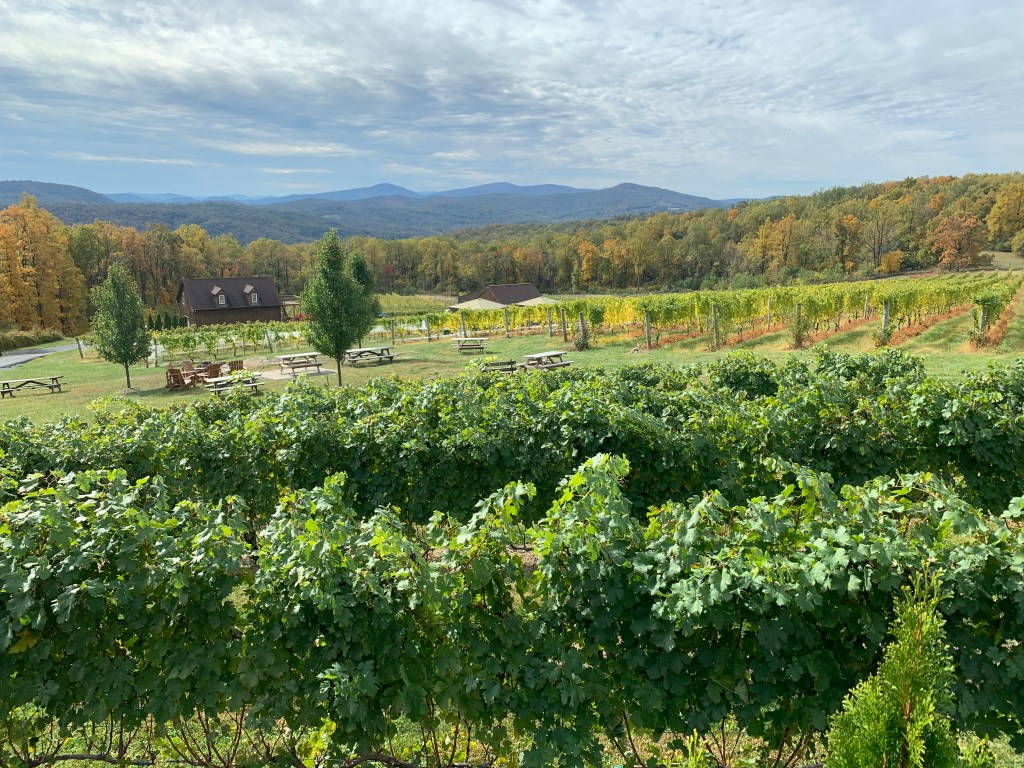
As you drive in the first thing you notice is the scenery. Located around 1700 feet on the Blue Ridge Mountains, it has one of the most amazing views I’ve ever seen in the state. I’ve admired it so much that when I set up this blog, I even made it my site’s profile picture. The view is just THAT good.

Look at that view!

When I arrived Dan was seated at a table near one of the windows, busily typing away. I’m not sure how he was able to get any work done since if it was me, I’d have just sat there all day and enjoyed the fall colors. Nevertheless, he greeted me and gave the background on their operation.

Wine making is definitely in the family’s blood; Dan proudly showed me a certificate on the wall detailing how the family was now in its 8th generation in the wine business, with roots going back to Germany. Today, his son Bob manages the business while Tom Payette, a well-known east coast consultant, is the wine maker.

As they say in real estate – it’s all about LOCATION LOCATION LOCATION. I suppose that’s always true, but it’s doubly accurate for vineyards. Fox Meadow produces around 3000 cases/year (mostly estate fruit) using 12.5 acres under vine. Most of the vineyard is composed of French varietals, although they have some Pinto Grigio and Vidal as well. Sadly their Riesling will soon be a thing of the past, as it doesn’t grow well enough to warrant keeping it.

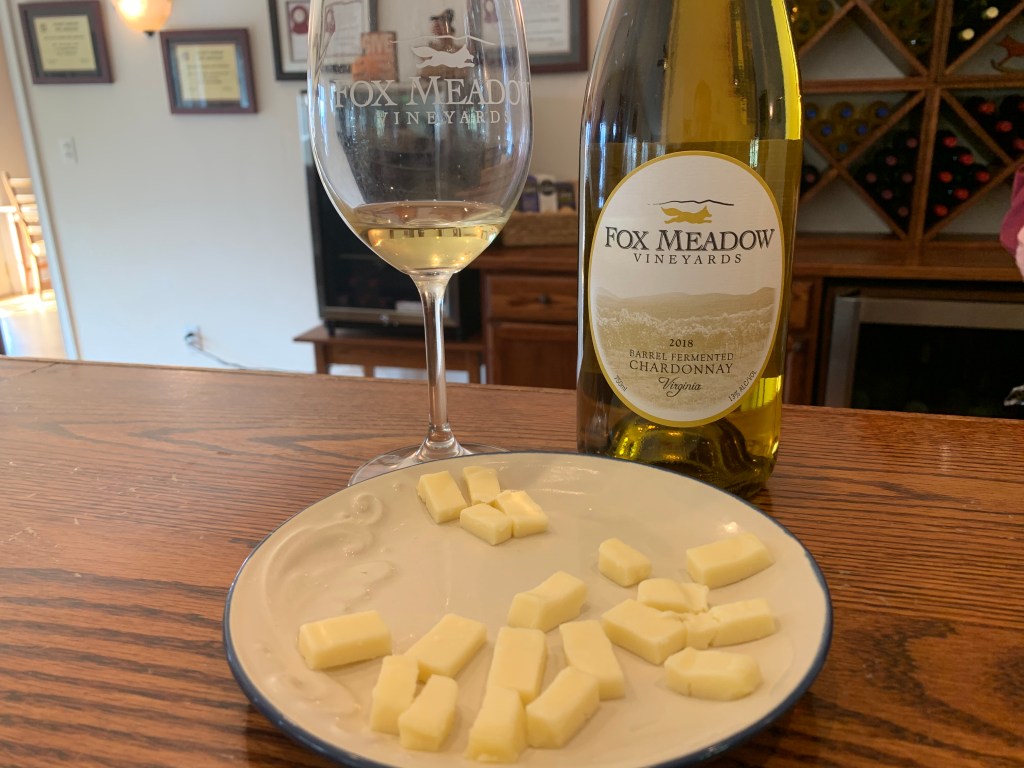
After chit-chatting about the vineyard we delved into the wines. Here, wines are paired with a tiny bite of food to bring out the more subtle flavors of both. My favorite was the Amish cheddar, which accentuated the creaminess of the Chardonnay it was paired with. It’s a nice touch that only a handful of Virginia wineries do.

What I tried:

2018 Pinot Grigio: Bright, with nectar notes. Paired with a Tuscan cheddar which softened the finish.

2018 Chardonnay, made in new-ish French oak. Although 2018 was a horribly wet year this came out very nicely.

2017 Riesling: Made in a semi-sweet style with notes of citrus and flowers.

2017 Chambourcin: Made in American Oak. Full bodied and had a big mouthfeel. Pomegranate notes.

2018 Sunset: Not sure what the grapes were, but I think it was a blend. Reminded me of fruit punch.

2017 Merlot: Not part of the main tasting – but I had an opportunity taste it the night before and I kept going back for refills. A few glasses made the price of admission to an otherwise pricy event well worth it.

We polished off the tasting with a dry rose which had an amazing cherry color.

Dan finished my visit with a visit to the barrel room and bottling line. They had only recently harvested and the wines were just beginning their multi-month fermentation process; periodically we’d hear a ‘glug glug glug’ from the barrels. I was heartened to hear the 2019 growing season was especially awesome here, perhaps the best they’ve ever had in the 14 years they’ve been making wine. While these wines will take another 2-3 years before they’ll be behind the tasting counter, I’m planning on returning a lot sooner than that.

Well Hung Wine Tasting Room

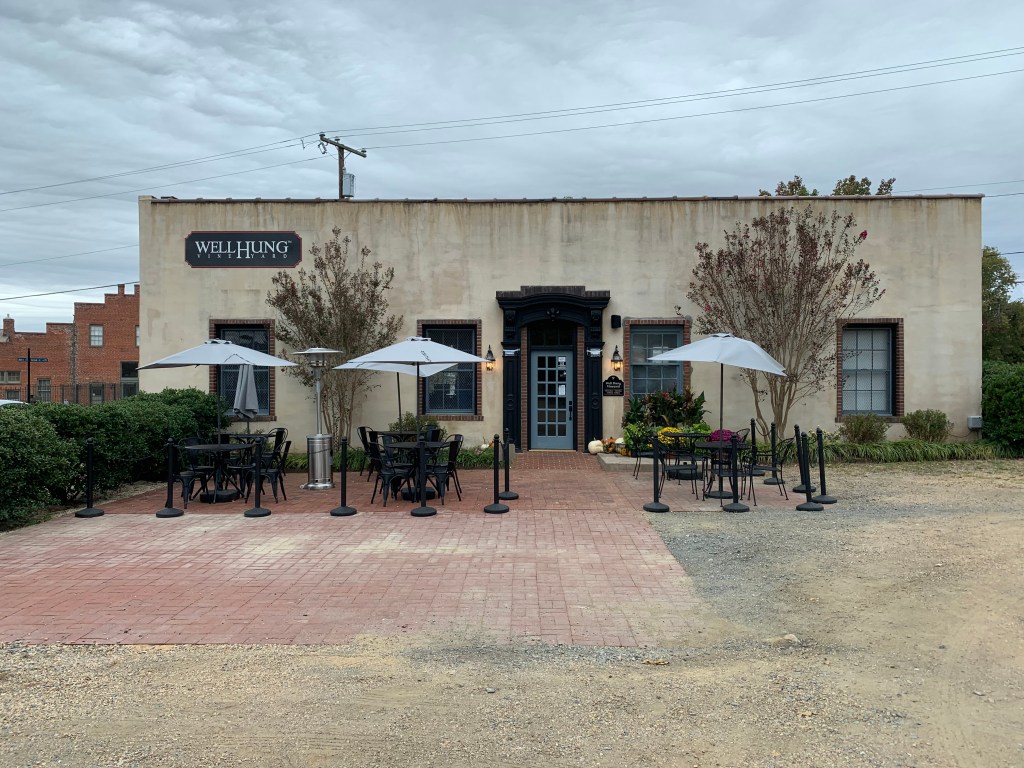
Well Hung is the cheekiest name in the Virginia wine scene. Established in 2008, it only recently found a brick-and-mortar home in Gordonsville, right down the road from the BBQ Exchange.

If you’ve been around the Charlottesville wine scene for a while, you’ve probably heard of the name. Well Hung was started by a trio of ladies with a sense of humor (and taste for wine). The name came from a comment about how the grape bunches were ‘well hung’ (off the vines, that is). The name took off…and there you go!

More recently, Well Hung’s wines have been made at Prince Michel Vineyard, using grapes sourced from all over Virginia and sometimes Washington State. No word on where the ‘nuts’ come from, though…

This isn’t just a tasting room; it has a kitchen that serves mostly flatbreads and sandwiches.  I ended up with the “French Kiss” chicken breast with brie, which was quite scrumptious.

Janice was the manager that day; she guided me through a tasting of their wines as well as the backstory of the place. Only open since September 2019, they seemed busy when I first entered but fortunately it quieted down after the lunch-crowd mostly departed. She started off as a govie, but (unlike me) she decided she decided to chase that dream in the hospitality industry, while I still toil behind a desk (at least it pays my wine bills, though).

What I tried:

2018 Viognier: Very soft

Well Hung White (VA and Washington fruit): Citrusy

Rose: Pinot Noir: Cranberry/rhubarb notes

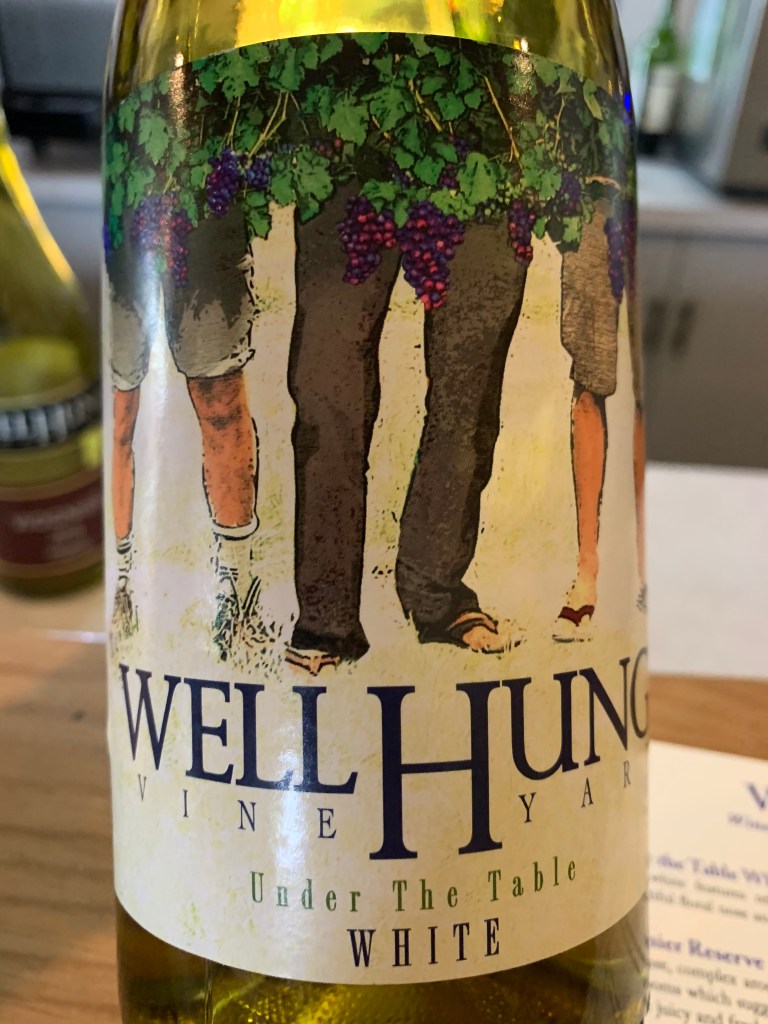
Under the Table Red: Janice called this a “gateway red”, as its versatile enough for white and red drinkers. Also good as a mulled wine, or chilled.

Red Tryst: Cab heavy blend; I liked this a lot

2017 PV: Powerful!

Wishful thinking: Very sweet

I can’t do a blog on Well Hung without talking about their…nuts. This is the funniest label I’ve ever seen, and I can’t help but pick them up as a gag-gift for friends.

Otium Cellars

Otium Cellars has one of the best ‘this is who we are’ views I’ve ever encountered. You drive up the dirt road past the horse barn and find yourself at what looks like an alpine ski lodge. It’s like you’ve taken a trip to Bavaria, except you’re here to drink wine instead of beer.

The German theme doesn’t stop there. Otium has a total of 18 acres under vine (and a production of 2-4000/year), with a decided focus on German varietals. Grüner Veltliner, Blaufränkisch, and Dornfelder all have a home here (not Riesling though; not cool enough). Saying these grapes are “rare” in Virginia is an understatement; a handful of VA wineries have one or two of these, but I dare you to find another place in the state that concentrates on German-style grapes like Otium does.

Of course, this makes perfect sense once you realize who the owner is. Gerhard Bauer is an immigrant from Germany who was living here in Loudoun with acreage to spare. When the tax bill came he decided to put that land to good use. His solution? Grow grapes! And not just any grapes, but ones from his homeland.

Tasting room manager Chris explained that opening a winery wasn’t the original plan; Gerhard wanted to stick with only operating a vineyard. But when it came time to sell their fruit – surprise! Nobody was familiar with German grapes, so Gerhard couldn’t find a buyer. So quite accidentally, the vineyard became a winery.

Otium opened its tasting room in 2012 – and the place is stunning, both inside and out. It’s a tribute to the quality he put into his wines (and the local’s thirst for vino) that what Gerhard thought was a 2-year stock in wine only lasted 8 months. I don’t blame them one bit – Otium’s wines here tend to be exceptionally well aged, with a tendency towards full bodied reds. Gerhard’s son Max may not have set out to be a wine maker, but he learned to become an exceptional one.

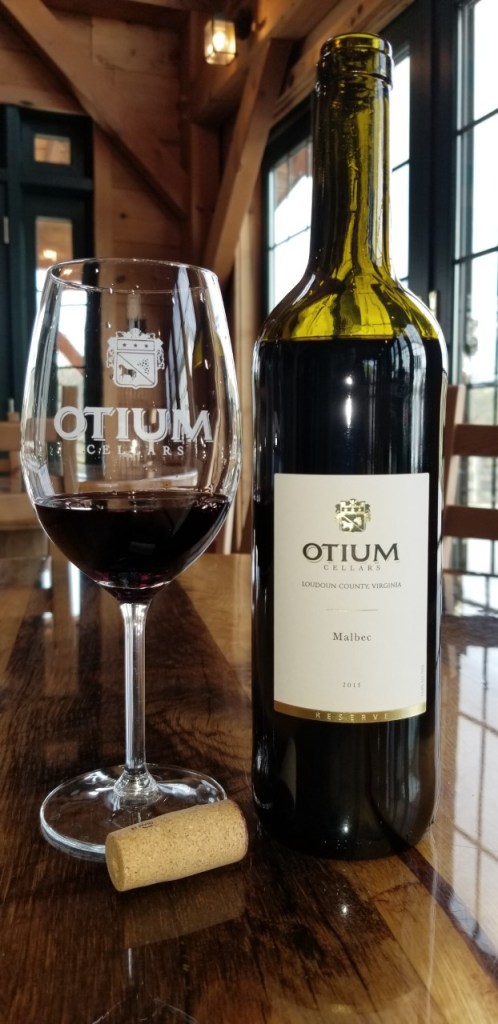
After my tasting I sat down at one of the inside tables with my picnic lunch and enjoyed the view – accompanied by a bottle of the Malbec. I wish we could have visited the horses’ stabled next door, but as Otium doesn’t own them we couldn’t get up close. I suppose admiring the log-cabin room would have to suffice. The Riedel-style glasses were a nice added touch.

I spoke at length about the German varietals, but I’m going to give a special shout-out to that Malbec. This is another hard to find varietal in Virginia, especially as a 100% vintage. I thought they were going to rip it out because of its difficulty, but – surprise! – it’s going to stay!

2017 Grüner Veltliner: Pineapple-y notes, made in steel.

2016 Chardonnay: Creamy but smooth, butterscotch ending.

2015 Chardonnay: Also nice but toastier.

2014 Blaufränkisch: Lots of black cherry; 24 months in Hungarian oak, cranberry-ish notes.

2014 Merlot: Black currant, some oakiness to it (but in a good way), and good mouthfeel.

2015 Malbec: Favorite of the day! Very different from other Malbecs; full bodied but less fruit notes except that strong emphasis on black cherry.

2015 Cabernet Sauvignon: More black currant notes, also lots of tannin.

2015 Dornfelder: Some pepper notes, but even more earth.

2015 Merlot Reserve: Cherry notes