2025 was the year I began my deep dive into Oregon wine, specifically the Willamette Valley American Vinicultural Area (AVA). I knew Oregon is the 5th largest wine-producing state in the US, and this particular AVA is synonymous with pinot noir. Unfortunately, that was the extent of my knowledge.
I soon learned how terroir-specific Willamette wines can be. The larger Willamette Valley AVA alone has 11 smaller AVAs embedded within its borders, each with their own unique terroir (by comparison, Napa has 16 sub-AVAs, yet produces more than 10 x as much wine).
I also didn’t realize Oregon is an up-and-coming sparkling wine producer, with production more than doubling since 2022. To better promote this trend, in July 2025 Oregon producers banded together for the inaugural launch of “Method Oregon”, which featured over 50 sparkling wines made in the Méthode Traditionnelle.
One winery that showcases both of these revelations is Trisaetum Winery, located about an hour SW of Portland. Trisaetum also makes sparkling wine under its Pashey Wine portfolio.
While the winery is in the Ribbon Ridge AVA, Trisaetum also has vineyards in the Dundee Hills and Yamhill-Carton AVAs. They make both vineyard-specific wines and ones that combine all three sites, with pinot, riesling, and chardonnay planted at each (plus some gamay at Ribbon Ridge, and pinot meunier at their Yamhill-Carton site).
Founder James Frey must get a lot of inspiration from his family, since he named both labels after family members. “Trisaetum” is a merger of the names of his two children, Tristen and Tatum. “Pashey” is named after his grandmother, a Romani woman who accepted exile from her community so she could marry James’ grandfather (her photo is tagged to the cork).
My friends and I enjoyed two wines from Trisaetum; their 2023 Willamette Valley Pinot Noir, and their 2021 Pashey Estate Cuvée sparkling.
2023 Willamette Valley Pinot
This bottle is one of Triseatum’s multi-AVA wine. We found it had a ripe-sweet nose with notes of cranberry or purple flower, perhaps accompanied by some black or red cherry, even candied plums.
I thought it had a light earthy palate with soft notes fruit, especially those candied plums again. Those fruit notes were backed by silky smooth tannins, a good mid palate, and some spice notes to accompany a long, persistent finish.
Wine critics note that Oregon pinot is reminiscent of Burgundy, but I think that’s both a compliment and a crutch. I think wines like this demonstrate Oregon doesn’t need the validation of being compared with Burgundy, no matter how high a praise that may be.
Winemaking details: 57% whole cluster press (for added tannin), aged 10 months in 17% new French oak, blended from fruit from all three estate vineyards.
Photo credit: Trisaetum Winery
2021 Pashey EstatesCuvée
This wine is red fruit driven, on the nose and palate. For me, raspberries were prominent on the initial ‘attack’, with a finish that was more mineral driven. My friends had additional notes of their own, with notes of chalk or allspice thrown in.
The winemaker was extremely restrained on the dosage. If you prefer very dry sparkling wines, this is a great choice (I later looked it up and was unsurprised it was only 3.0 grams per liter).
Winemaking details: 72% pinot noir, 14% chardonnay, 14% pinot meunier sourced from all three estate vineyards. It had 3.0 g/L, putting it in the Extra Brut range (translation: it’s pretty darn dry).
One downside of living in Virginia is small west coast producers don’t have a lot of local distribution, so your best bet is to purchase online.
Virginia is enjoying a sparkling wine renaissance, especially in NOVA. A sparkling wine house named Petit Domaine recently opened in Loudoun, Stinson Vineyards has recently introduced a sparkling label named Lido Deck, and Stone Tower now has an entire facility dedicated to producing bubbly. These are just a few data points on what looks to be a shift from lower-cost sparkling formats such as pet-nats and charmat-style wine to higher-end, more ‘champagne’-style sparkings.
“High end” may be a bold statement. Champagne is still the default setting for high-end sparkling wine, and Virginia’s terroir is radically different from the world’s most famous sparkling region.
Moreover, I still think many Virginia sparkling producers are still tweaking their game. With the exception of a few standouts (looking at you, Thibault-Janisson, Trump Winery, and Veritas), most Virginia sparkling producers have only recently joined the ‘méthode traditionnelle’ club.
Most of these higher-end bottles price around $60, with Early Mountain Vineyards and Trump Winery amongst the most notable producers in this price range. Consumers can also find good quality $35-40 bottles from Thibault-Janisson, King Family, and broader cast of wineries.
Tasting & Scoring Methodology
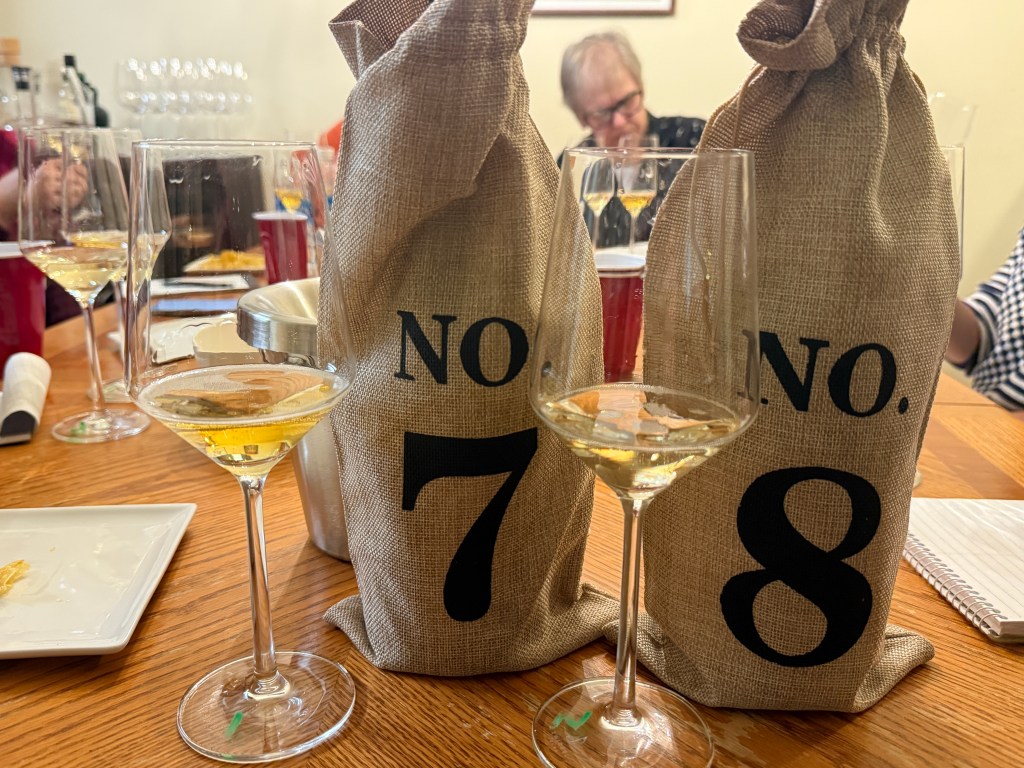
A group of friends & I blind tasted 8 wines in 4 flights. All the flights were bagged.
To make it even more challenging, we mixed the French and Virginia wines up. This meant our rounds included France vs Virginia, Virginia vs Virginia, or France vs France, all depending on luck of the draw. After the last pairing, we voted on a “Top 2” from these 8 to go into the finalist round (as a last-minute change I added the 3rd favorite to join these finalists).
This mixing had the unexpected benefit of preventing us from obsessing over “Which is Virginia?”. We ended up spending more time on the actual wine, and less worrying where it came from.
I didn’t use a fancy scoring system. I did ask which was the favorite per round, but the goal was always to choose the “Top 2” of the day.
When I created this event, I specified the French sparklings be in the ~$50 range (although one of them was in the ~$70 range) and the Virginia bottles in the ~$60 range. This meant the comparing French bottles were lower-end champagnes and one higher-end cremant. I gave Virginia a higher price-point to account for how these are more boutique operations.
I figured this price range would even the playing field, keeping out the higher-end Champagnes but still having some strong contenders.
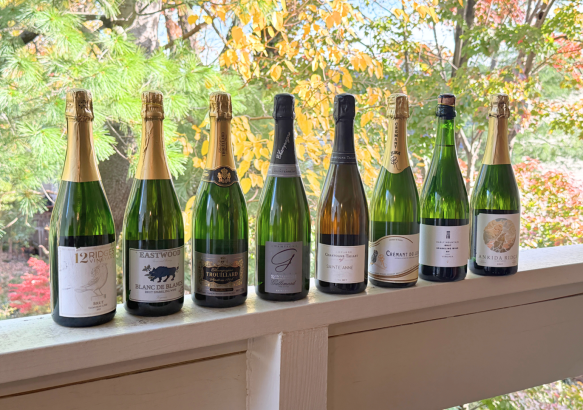
I ultimately selected 12 Ridges, Early Mountain Vineyards, Eastwood Farm (using a sparkling made by Thibault-Janisson), and Ankida Ridge, since these haven’t been in my earlier blinds.
All the participating bottles made in the traditional method, although the blends often differed.
The Contenders
Crémant du Jura “Harmonie” by Domaine Pierre Richard (Jura; 100% Chardonnay; ~$30)
Bottle #1: Crémant du Jura “Harmonie” by Domaine Pierre Richard (0 votes)
Bottle #2: Ankida Ridge Brut (7 votes)
Our opening round was France vs Virginia. I wish the Ankida had gone up against a higher price point wine, but such is the nature of blind tastings that it randomly went up against the cheapest French wine in our group.
Bottle #1/Crémant du Jura “Harmonie“ by Domaine Pierre Richard: Lots of apple notes, including bruised apple, specifically yellow or green apple. Someone mentioned it was soft; maybe even tropical. Lower acidity. It was “pithy” and had a shorter finish.
Everything about this wine was on the up-front ‘attack’. If anything, it reminded me more of a sparkling cider than a sparkling wine.
Bottle #2/Ankida Ridge Brut: There was some funkiness on the nose initially, but that soon blew off. This wine had a longer finish, and presented as tart, with notes of toasty white bread, maybe back by some oak. We also found orchard and pear notes. Someone mentioned a hint of nutmeg.
#2 was higher in acidity than #1 but was not a tremendously high-acid wine. It was structured and ‘old world’ in nature. This also had a big initial ‘attack’, which isn’t the style some of us enjoyed. Comparatively speaking, we enjoyed this much more than #1.
I will say that while we *liked* this wine, we didn’t *love* it initially. We later discovered it needed time to open up, which made all the difference. When we re-tasted, especially with food, we liked this wine far more.
Bottle #4: Trouillard Brut Extra Selection (7 votes)
This round was a Champagne vs Champagne event. We enjoyed these two wines more than the previous round, at least on the first sips (although we later decided we enjoyed Ankida Ridge’s Brut more than the Gallimard).
#3 was a softer expression of sparkling wine; more like the kind of wine you bring to a party that everyone will likely enjoy it.
Bottle #3/Champagne Gallimard Quintessence: Blue cheese-like nose? This wine was YEASTY, almost pungent. Someone mentioned “antibiotics on steroids” on the palate. Another mentioned caramel corn or butter. Another said it had a bruised apple nose. Maybe notes of yellow apple on the palate.
On the flip side it had good balance, plus was fresh and clean. Everything was ‘up front’ for this wine.
Bottle #4/Trouillard Brut Extra Selection: Notes of ginger. Lots of positive notes including balanced, elegant, and layered. Flinty. Someone mentioned notes of strudel or pastry. Bright, maybe some honey on the nose. Another mentioned this was red fruit-driven.
This bottle also had more of the traditional autolytic characteristics you’d expect in Champagne, something we hadn’t seen thus far. We suspect it had a bit of age to it as well.
Flight #3
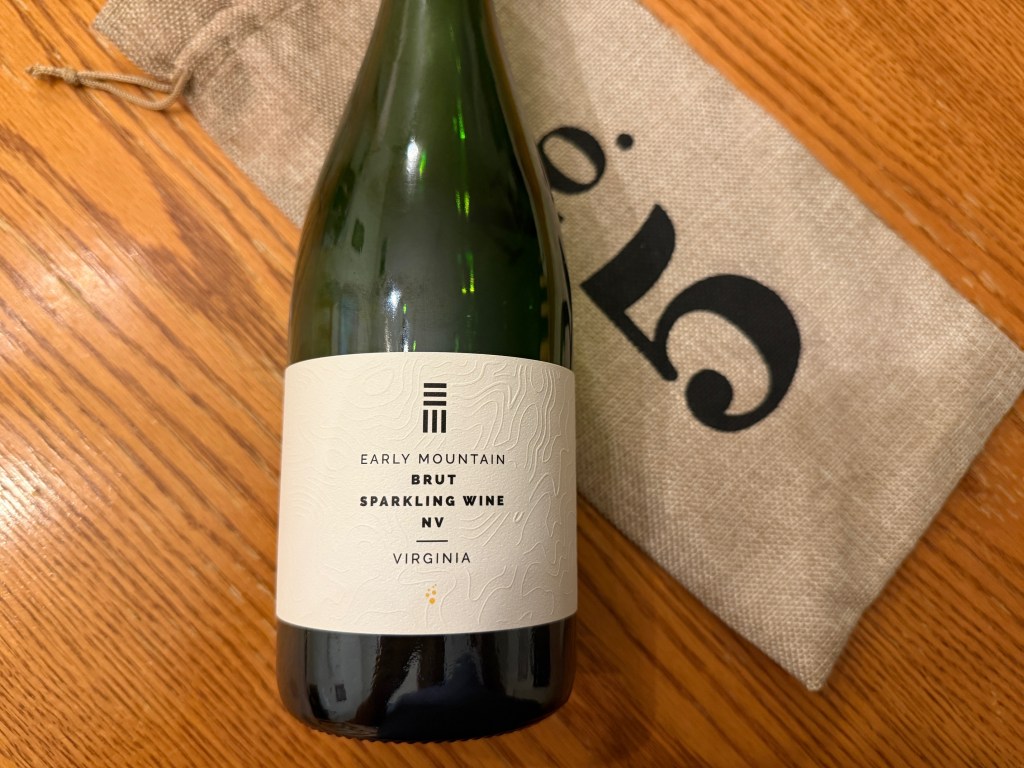
Bottle #5: Early Mountain Brut Sparkling (7 votes)
Bottle #6: Chartogne-Taillet Cuvée Sainte Anne Brut NV (0 votes)
The bubbles on both of these were FROTHY, especially #5. This was probably our highest-rated round of the day, although in this pairing we universally favored #5/Early Mountain.
Bottle #5/Early Mountain Brut Sparkling: Zingy; very bubbly and lively. Lemon-citrus notes; someone mentioned dragon fruit. Notes of citrus, but a ripe citrus. Good minerality and nice finish. Someone guessed it may have gone through a partial malolactic fermentation, but just a guess.
This was also a crowd pleaser of a wine, although it had lots of positive notes for wine snobs. One guest described this wine as ‘playful’, and I think that was the best description so far.
Bottle #6/Chartogne-Taillet Cuvée Sainte Anne Brut NV: Yeasty. Notes of pair; anise was also mentioned. High acidity and very bright. Notes of baking spice, even smoke, was mentioned. It seemed slightly on the higher alcohol side.
The flavor profile was very up front. Very rich; maybe backed by some oak? But overall, this wine was defined by its acidity. This was the most expensive Champagne of the day, so I’m glad it was compared to the EMV.
Flight #4
Bottle #7: Eastwood Blanc de Blancs (2 votes)
Bottle #8: 12 Ridges Brut (5 votes)
This round was Virginia vs Virginia. It also compared two very different wines; a moderately-priced Blanc de Blanc vs a higher price point from a unique vineyard situated at 3,300’ feet elevation.
Bottle #7/Eastwood Blanc de Blancs: Deep straw color. At least one guest mentioned a “fresh bread nose”. Several mentioned notes of spice, even turmeric. It was heavier bodied; maybe with a popcorn-quality to it. We suspected this might have been made in a warmer climate.
Initially we didn’t love this wine, but as it opened up we started to appreciate the richness of it more.
Bottle #8/12 Ridges Brut: Very clean and balanced, with a nice finish. Citrus palate. Good floral notes; reminded us of fresh flowers, even dried flowers.
One guest described it as a ‘baby champagne’, since it had all the notes you’d want in a champagne, but they were still learning to express themselves. Lots of potential here. Maybe it needs more time.
Finalist Round
Bottle #2: Ankida Ridge Brut (3rd place)
Bottle #4: Trouillard Brut Extra Selection (2nd place)
Bottle #5: Early Mountain Brut Sparkling (1st place; overall winner)
I asked my guests for their “Top 3” favorites. I used data to narrow it down to two finalists, which we would retry.
Top 3 going into the finalist (but not the actual final vote)
#4/Trouillard and #5/Early Mountain Vineyard were universally our top 2 picks. But picking a 3rd choice was difficult because these 3rd choices were a very distant preferences to the Top 2. I struggled to find a clear 3rd favorite myself.
Then I did something I’ve never done before. We put #4/Trouillard and #5/Early Mountain aside and started sipping the remainder of the wines. At that point, I realized #2/Ankida Ridge had totally changed.
At this point the Ankida was practically a different wine. So much so that if this was how it initially tasted, I may have selected this over one of my other picks. We liked it so much I put it into the finalist round, making it a trio of ‘finalists’.
After our food break we did a final tasting and voted. Here was the breakdown.
Finalist round (Listed as the judge’s Favorite, Second Favorite, and Third Favorite)
Several guests who initially voted for #4 switched to #5 (Early Mountain). I’m not sure if the Early Mountain got better or the Trouillard started dying off. But we just loved Early Mountain even more in the finalist round.
Early Mountain’s Brut was the event winner.
Lessons Learned
I admit it; I wasn’t sure how this would play out. Topping Champagne in the sparkling category is a tall order. I made sure to exclude super high-end Champagnes to even the playing field, but even Champagne’s $50-range should have been hard to beat.
So imagine my surprise when Virginia came in with the 2 of the top 3, including the winner.
I have to give credit where credit is due. Early Mountain Vineyards makes exceptional wine. While it’s not known as a sparkling house, good winemaking goes a long way, so I shouldn’t be *too* surprised.
Ankida Ridge is another exceptional producer, plus they also have a very unique terroir. That shined through here. I love that the Vroomans came in as our 3rd pick.
When it comes to good sparkling, I’m a believer that there is a measurable difference between what you get in the $50-range vs the $75-range. This event gives me confidence that Virginia can compete against these lower to mid-priced Champagnes.
I wrote in the opening sentence of my 2022 Finger Lakes blog that “The Finger Lakes is a region I can continually return to.” Well, 2 years later, I was back for my 3rd trip.
For this trip, I was the ‘tour guide’ to a group of 4 friends, none of whom had visited the area. The entire trip was 5 days, including a travel day of travel to get there, 3 full ‘winery days’, and departing the morning of the 5th day. We ended up visiting places on Days #1 and #5 as well.
To give my group their best bang-for-your-buck, I created an itinerary that mixed-in what I considered the Finger Lakes ‘greatest hits’ and added a few places that I hadn’t been to before. A total of 16 locations were visited.
Day 1: Keuka Lake
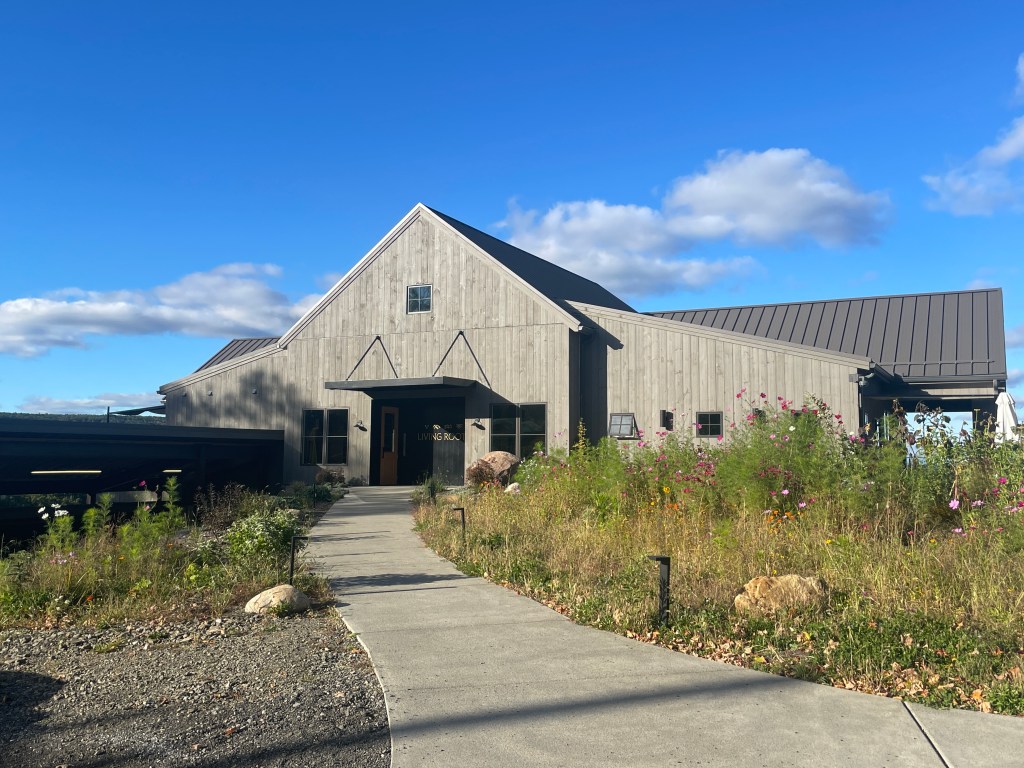
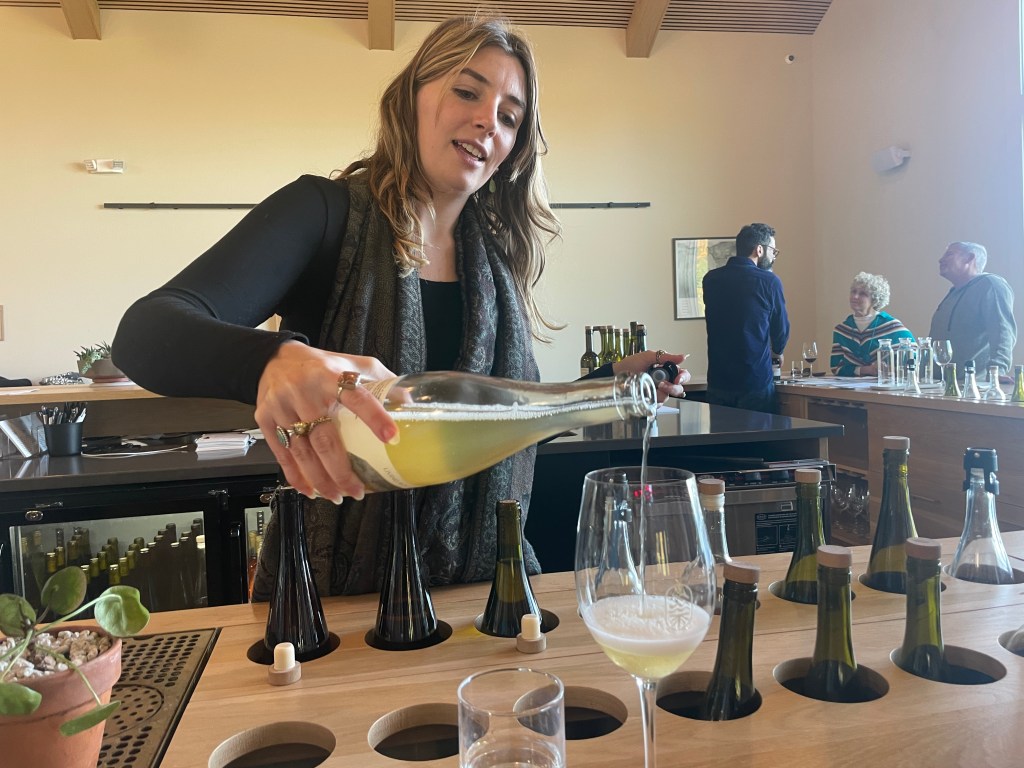
Living Roots Finger Lakes: Since this was our travel day, we only had time to visit Living Roots on our way to our Air B&B. This was someplace I’d wanted to visit, plus it didn’t close until 6 PM.
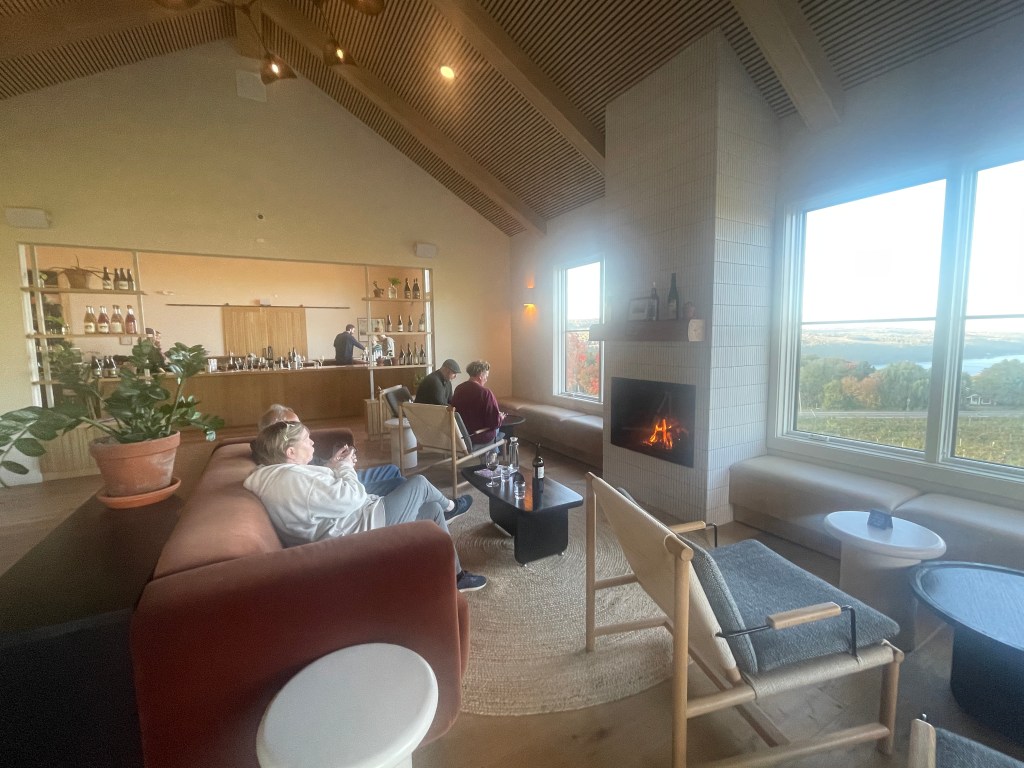
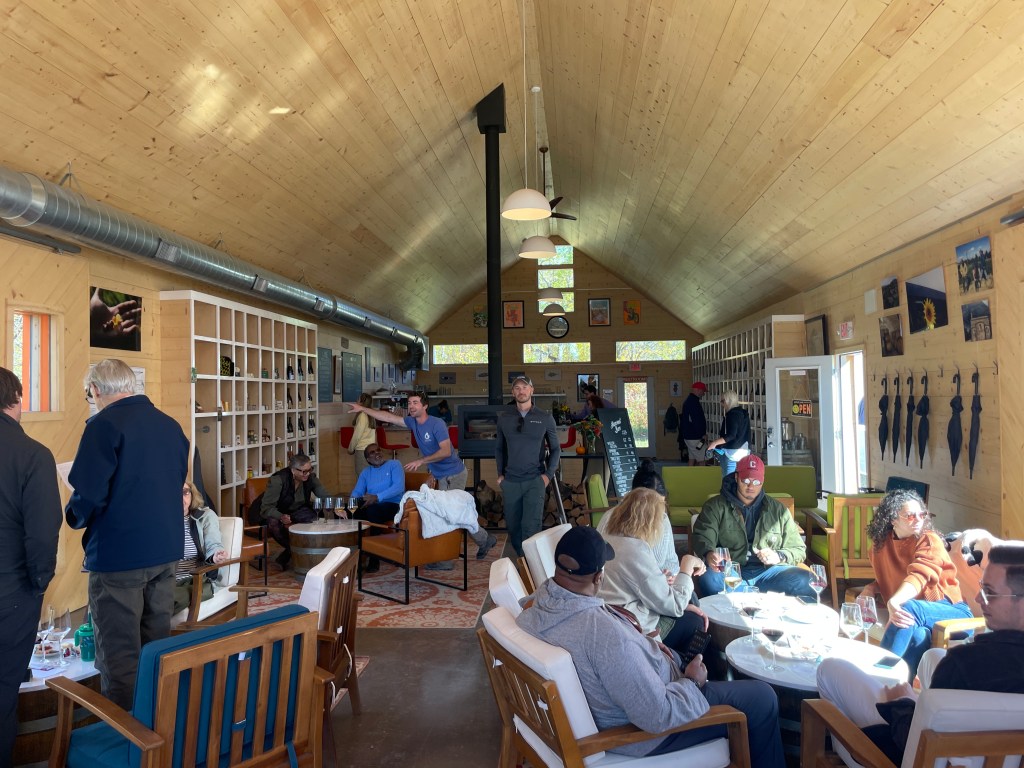
Living Roots easily had one of the prettiest tasting rooms of the trip, with a fantastic view of Keuka Lake. It also had more of modernistic aesthetic, as opposed to the rustic barns that most other wineries had.
They also had the greatest meet-cute story I heard on the entire trip. The owners had this parcel of land overlooking Keuka but no long-term plans on what to do with it. While their daughter was in Australia she met up with a local guy, fell in love, and they eventually got married.
The property turned out to be a great place for vines. They turned it into a winery, with their new son-in-law as their winemaker. They also import some wine from Australia, a nod to his heritage.
The wines were uniformly good, with my favorite was their pet-nat riesling. I sat back to enjoy gazing at the lake with a glass of it, plus got a bottle to go.
Day 2: South-West Seneca/Keuka
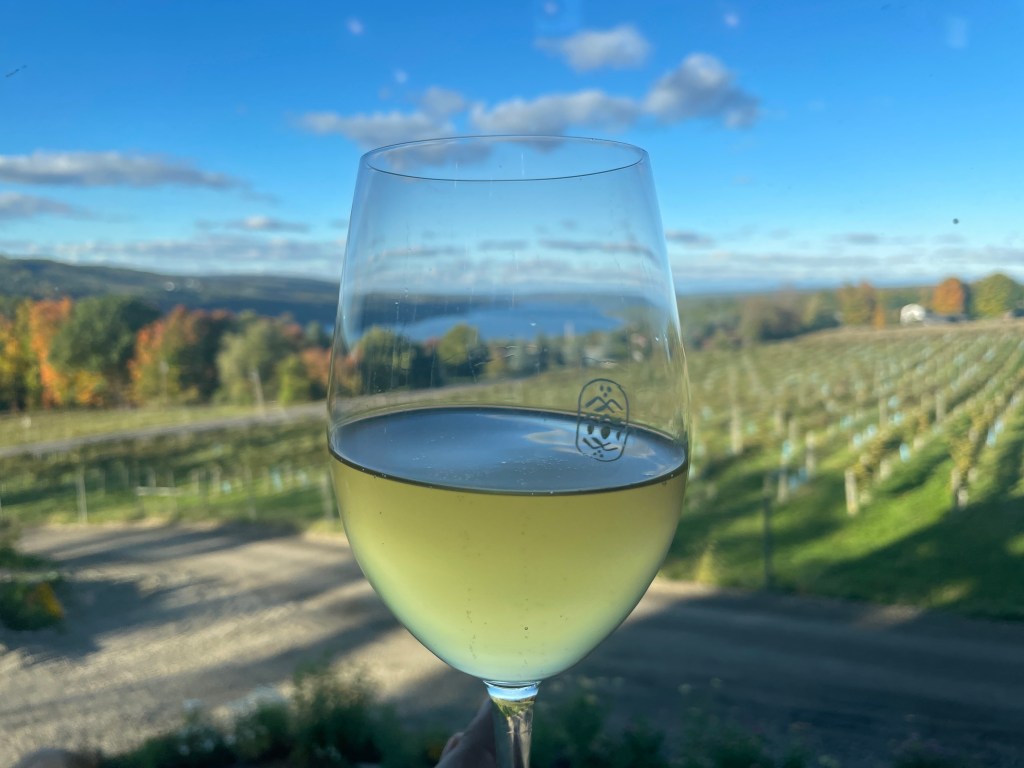
Stop #1: Herman J Wiemer
As one of the Finger Lake’s most famous wineries, Herman J shouldn’t require any explanation. It was one of my favorite wineries during my previous trip, and I wanted my group to likewise enjoy a visit.
Reservations are definitely recommended, but not necessarily required. Since we didn’t have reservations we sat in their open-aired barn with a space heater. It was OK for the early fall but not something I’d want on a cool day.
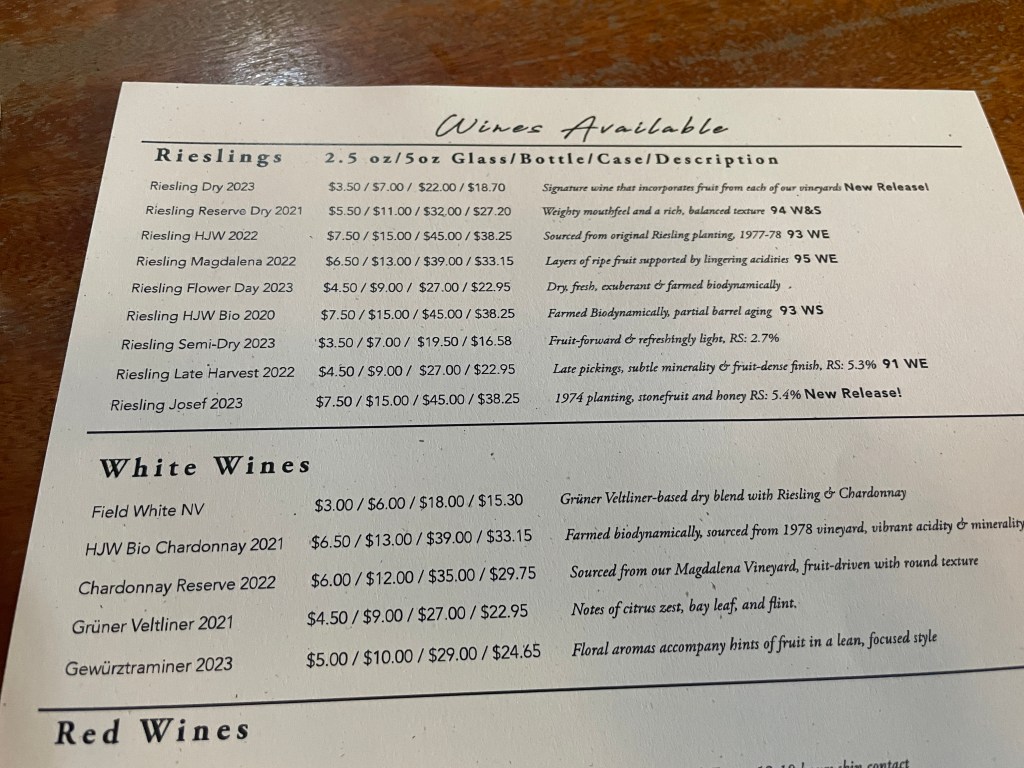
Herman J’s tastings are actually self-guided flights where you pick the wine and they are served in mini flight bottles. Since we had a large group this turned out to be a good deal, as we were able to pick out a bunch of wines and share them.
My favorites were the Magdalena Cabernet Franc and Magdalena Riesling. The former had all the traditional cab franc notes, with nice fruit and earthiness. The riesling was smooth, lemony, and had a great mouthfeel.
We also tried their Grüner, Reserve Riesling, Dry Riesling, Semi-Dry Riesling, and an Extra Brut sparkling.
Stop #2: Kemmeter Wines
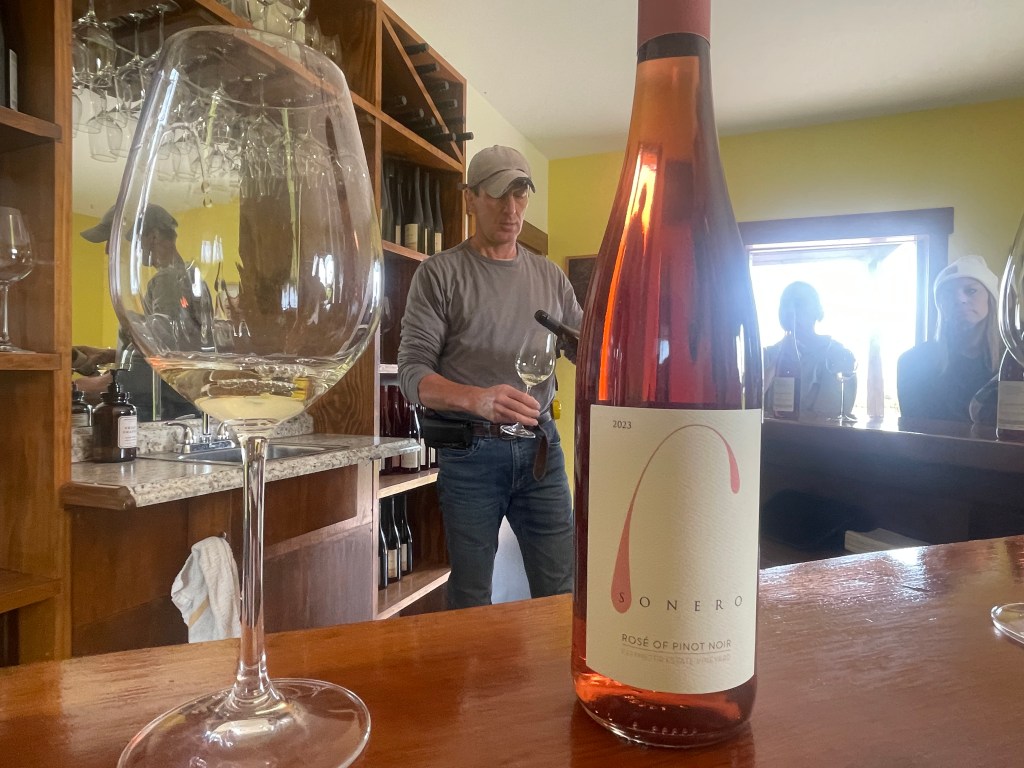
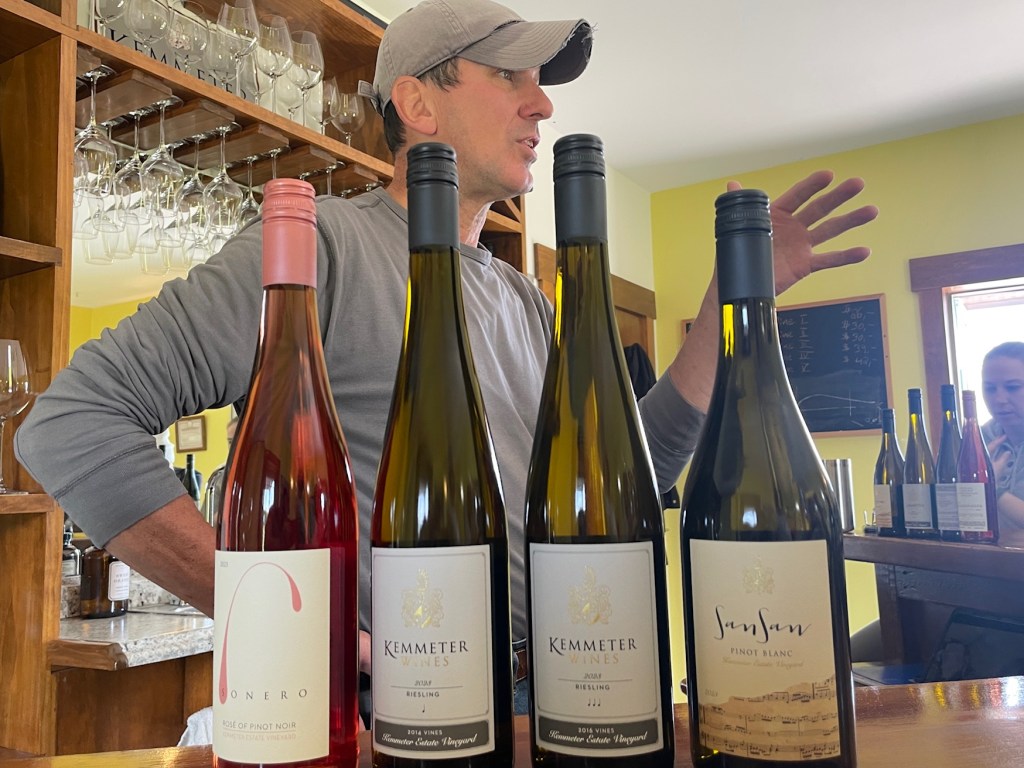
One of the few stops I absolutely insisted on. Owner/winemaker Johannes Rienhardt did a great lineup against a backdrop of classical German music. One of the top visits of the entire trip.
Visits to Kemmeter aren’t just about wine tastings; they are about education. Johannes even will avoid tasting notes during a tasting because he doesn’t want to bias your opinion what to expect. Johannes also told us he was planning to start using cork for his wines in the future, since they preserved his wine more effectively.
He also took us through an impromptu comparison of two rosés; one of which had been opened for 24 hours and another he just opened. The consensus was most people enjoyed the one that had been opened longer, because the oxidation brought out a different flavor profile.
We tasted 4 wines; a rosé (0.2% sugar but didn’t taste like it), his “2014 Vines” riesling (more on the savory side), his “2016 vines” (off dry, more fruit-forward), and a pinot blanc (amazing color, felt even drier than it was because of its thickness). The cab franc and blau will likely be non-vintage blends, so he can get the best fruit from each year.
Turns out he’s also planting zweigelt, cab franc, and blaufränkisch in the future, and he was long sold-out of his limited pinot noir. I left with a bottle of rosé and one of the rieslings.
Make sure to order the Sans dumplings in advance!
Stop #3: Weis Vineyards
Weis was another high-priority stop. The winery was really busy, but we waited on the balcony until we were able to get a spot in the tasting room. Reservations definitely recommended!
We tried six wines, but my favorite were the very full and lush “Special K” and their Terroir Riesling “Limestone”. I also liked their 2023 Perele sparkling, which for $22 was a great buy.
Stops 4 and 5: Keuka Lake Vineyard and Dr Frank
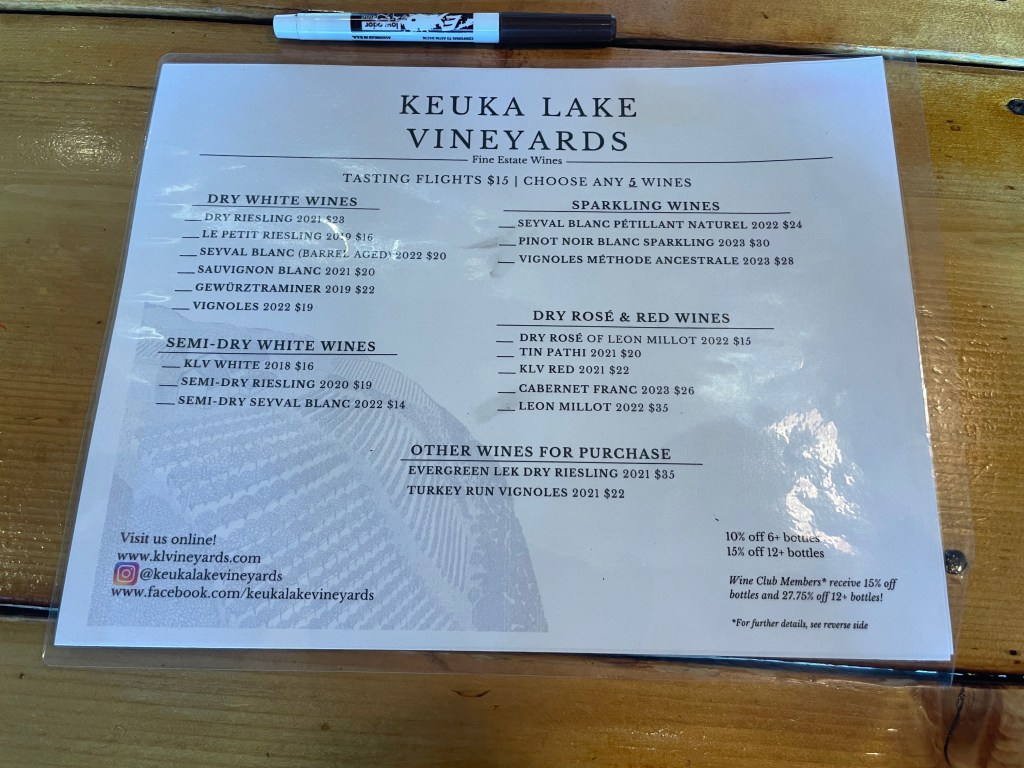
Not a lot of notes here. I insisted on a stop to Keuka Lake Vineyard because I really wanted their vignoles pet-nat and their 2021 Riesling. Extra Points for being dog friendly.
By the time we made it to Dr Frank, it was too late to do a tasting so we just got a glass.
Dinner: Glenora Wine Cellars/Veraisons
A little on the expensive side but it was our 2nd night in town, so we decided to treat ourselves.
The Aurora Borealis also showed up this evening!
Day 3/Saturday: Eastern Seneca and West Cayuga
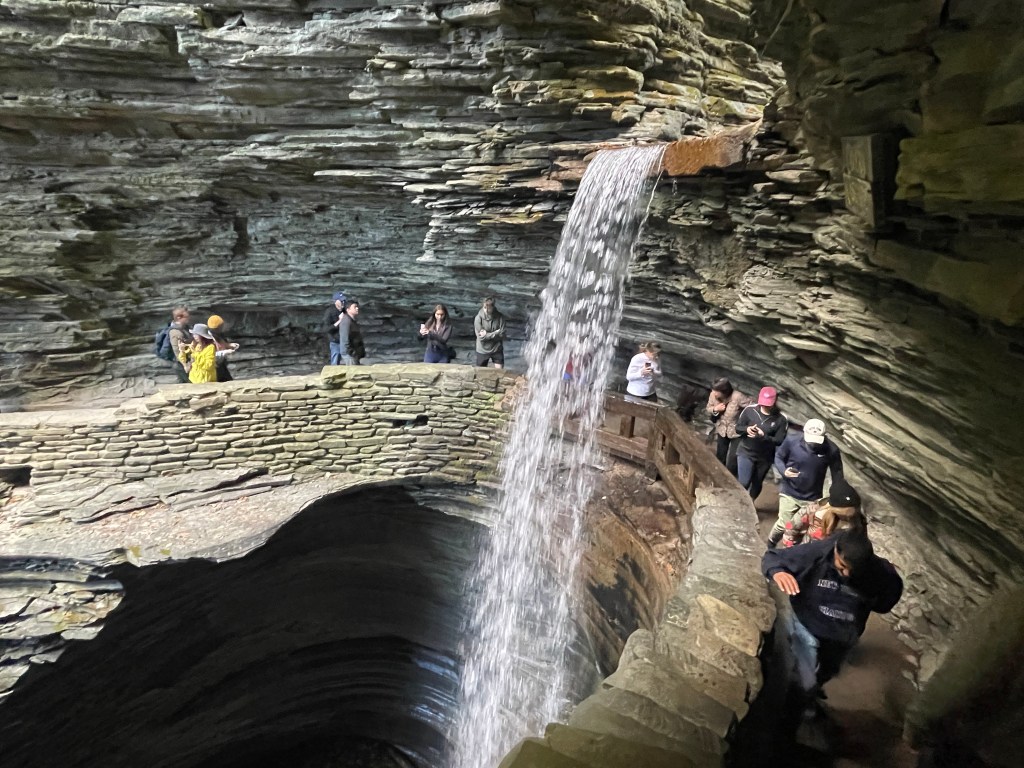
We started with a morning hike at Watkins Glen State Park, which is a must-visit for anyone. You can go as far as you want, or make it a short trip. An hour was good enough for us.
Stop #1: Boundary Breaks
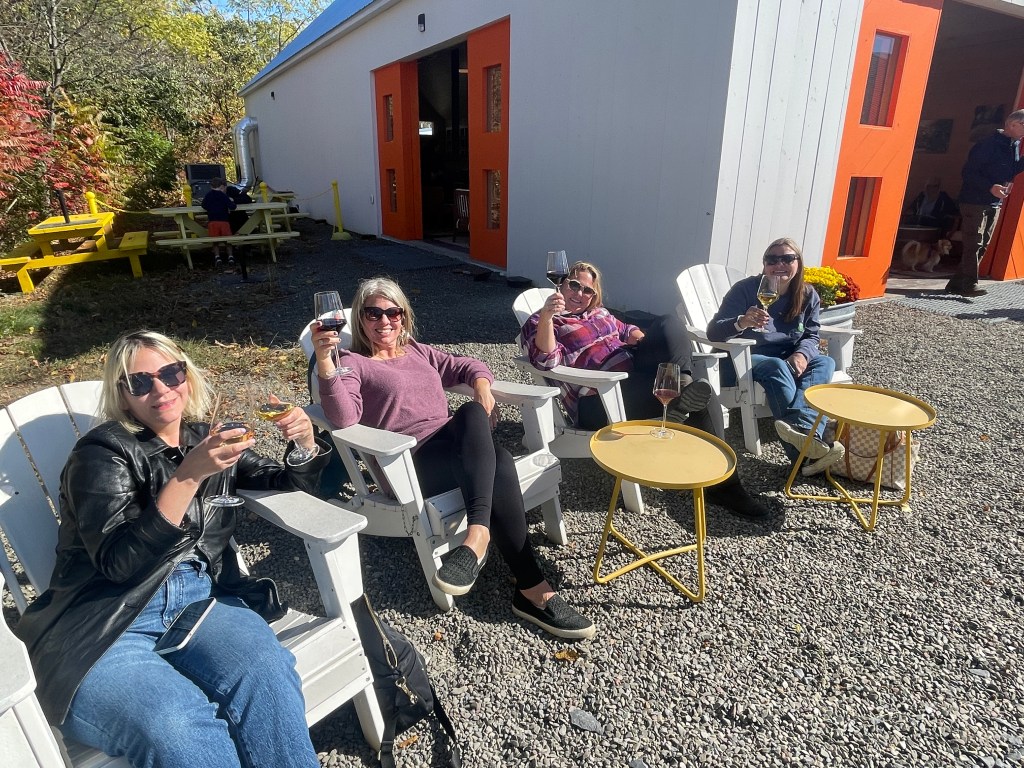
This was easily one of the prettiest visits of the trip, since it had a great view of the lake. It helped they had a food truck that served lobster rolls, which we dined on while drinking sparkling and lounging on Adirondack chairs with a view of the lake. 55 acres of vines planted.
No one wine spoke to me, but we enjoyed several. They had a Bordeaux blend that was on the softer side and a dry gewürztraminer that I liked.
But the highlight were their three sparklings, with the “356” dry sparkling riesling being my favorite.
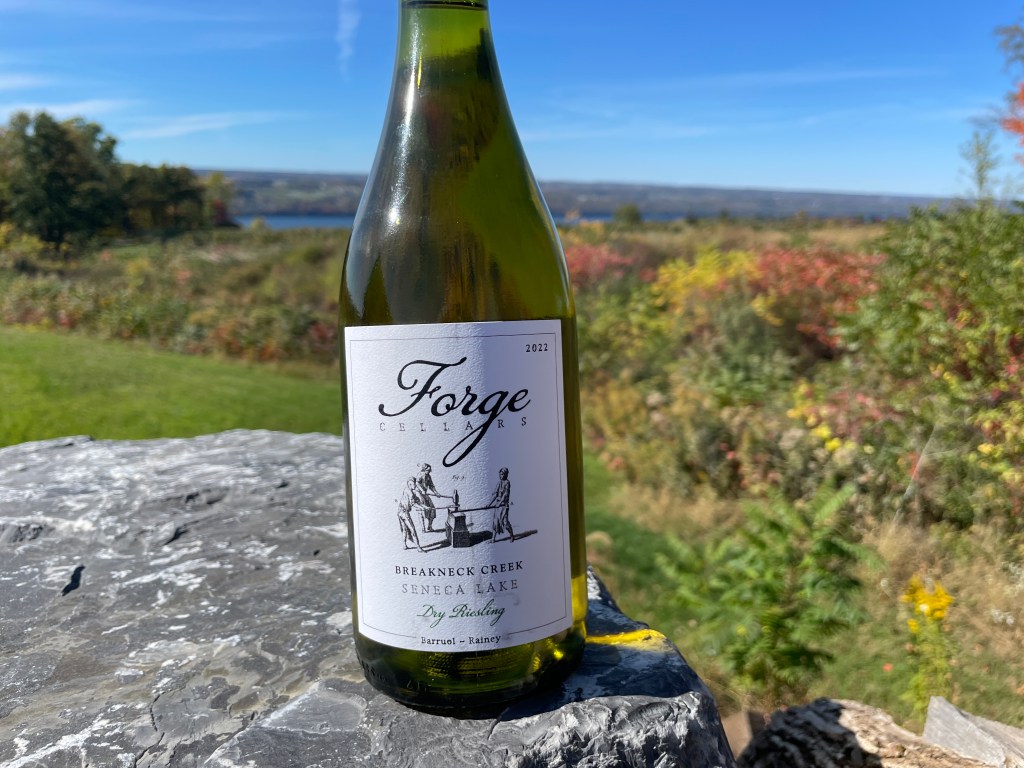
Stop #2: Forge Cellars
This was easily one of the top 3 visits of the trip, with a strong argument for the #1 spot for overall quality of wine. Definitely had the best reisling selection of the trip.
The main tasting room was being used for harvest, but we still were able to hang out at the ‘salon’. While it’s not on the lake, the views still impressed. Loved the laid-back vibe.
The assortment of vineyard-specific options here is impressive. There are too many to taste on your own, so bring friends to share! On top of that they also do a lot of club-only wines, a few of which I was fortunate to sample.
My favorites:
Willow Riesling: At first I thought it had some tropical notes, but those faded fast
Caywood Chardonnay: Herbal notes; just ok
Tango Oaks Riesling: Very fruit driven, citrusy. Bought a bottle
Breakneak Riesling: Salty and minerally; really good. I think this was a club bottle but snagged a taste. Bought a bottle.
Liedenfrost Pinot: On the young side, lots of red fruit
Tout Nu: A red wine brought in from the Rhône. Notes of graphite and earth, with a long finish.
Stop #3: Standing Stone Vineyards
We originally tried visiting here before Forge but it was so busy we had to get a later reservation. Fortunately our table was ready for us when we were done with Forge.
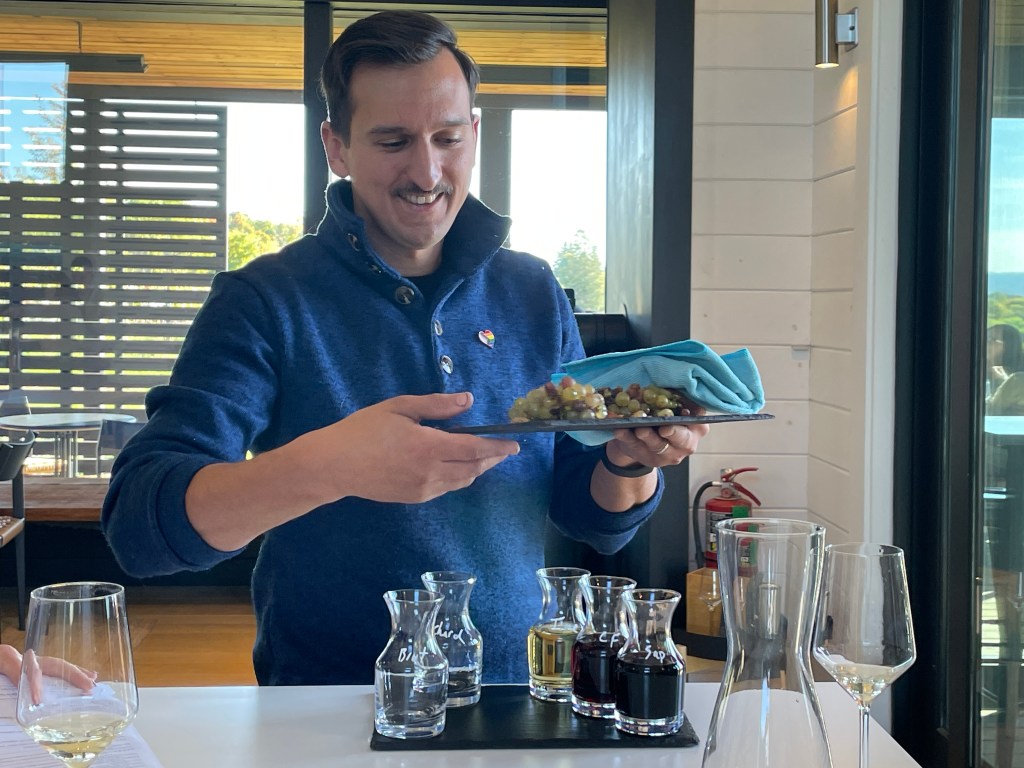
Julian was our server, and the dude was awesome. He gave us a great deal of education, including bringing out refractometer and some grapes in the later stages of noble rot. Julian also explained how Herman J now owns the winery, purchased in large part because their vineyard is on a warmer spot that is especially good for reds.
We kicked things off with sparkling, including a sparkling rosés and a Blanc de blanc made in the traditional-style. The later was excellent; with the lees giving it some weight.
For reds, we tried a cab franc and their saparavi. The later had great color; earthy but soft. The chardonnay was OK.
We also had a few dessert wines. Nice late harvest; like a lighter Sauternes. We also enjoyed a very rich port-style.
The favorite here was the Timeline Riesling. Very complex and weighty.
Stop #4: Silver ThreadWinery
A smaller winery that we tried since it was close by. 10 acres planted but they purchase more fruit. They make 3000 cases/year.
I liked the vibe a lot. They really lean into sustainability, and their owner/winemaker was our server.
My favorite was their Blanc de Blanc riesling, that I got a bottle of to enjoy that evening. I also thought their estate riesling was good.
Day 4/Sunday: NE Cayuga and NW Seneca
Stop #1 Hearts and Hands Wine Company
Another highlight of the trip, so much so I wrote a separate blog about them rather than make them one of many entries in this trip report. One of my Top 3 visits of the entire trip, top place for service, and had the best blanc to blanc out of 16 places visited.
The quick version is since they are on east side of Cayuga, Heart and Hand is less crowded. The downside is a visit needs to be planned out, since they are further away.
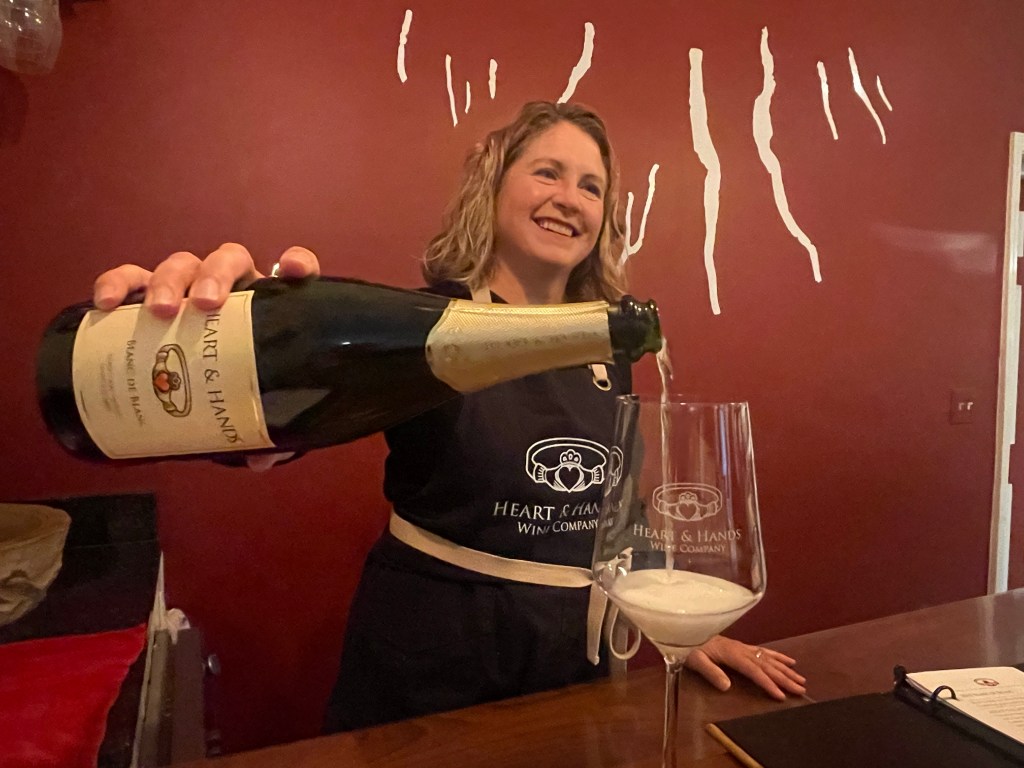
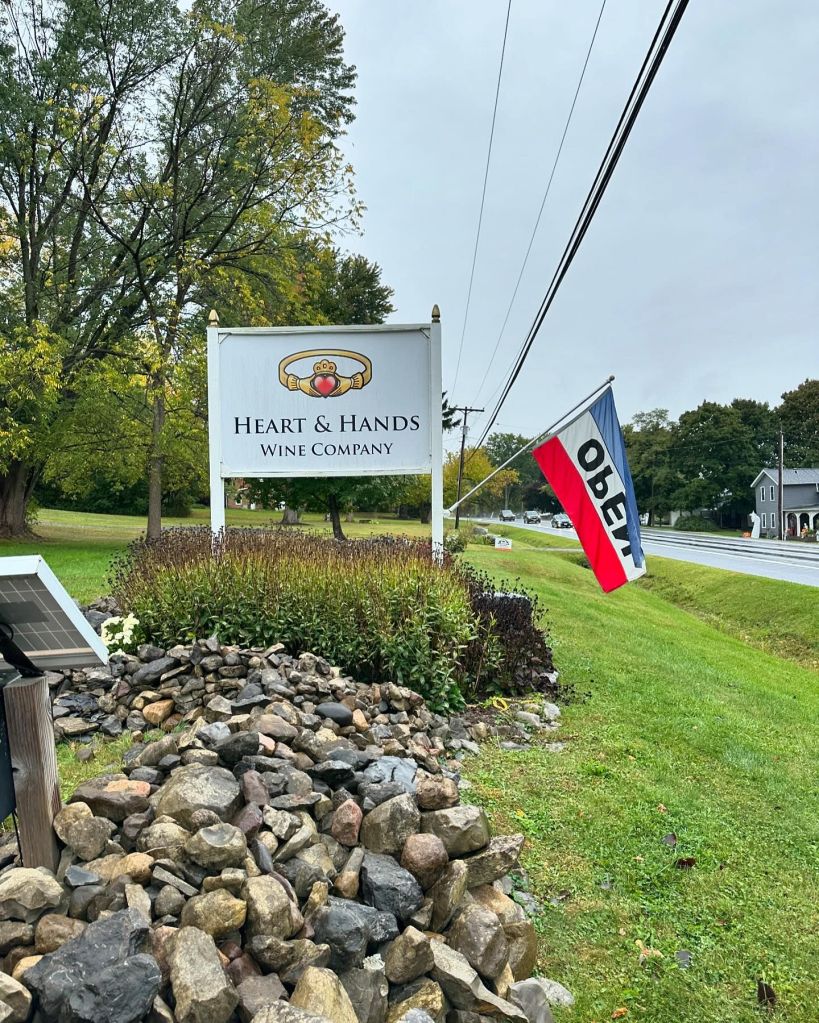
The name “Hearts and Hands” is a reference to a Claddagh ring, which is an Irish symbol of love. Co-owner Susan Higgins did our tasting, and was kind enough to open a little early since we were trying to make the most of our day.
What makes H&H’s growing location so great is their vineyard is on a limestone slab, which gives them somewhat different growing conditions. They make lots of sparkling, including a blanc de blanc which was one of the best wines of my trip.
That said, picking a favorite of ANYTHING was tough since everything was exceptional. My crew took maybe 2 cases worth of wine. I suspect this visit resulted in the single biggest haul of the trip.
Stop #2: Quarry Ridge Winery
Quarry Ridge wasn’t on our original itinerary, but since it was next to Heart & Hands we figured it was worth a shot.
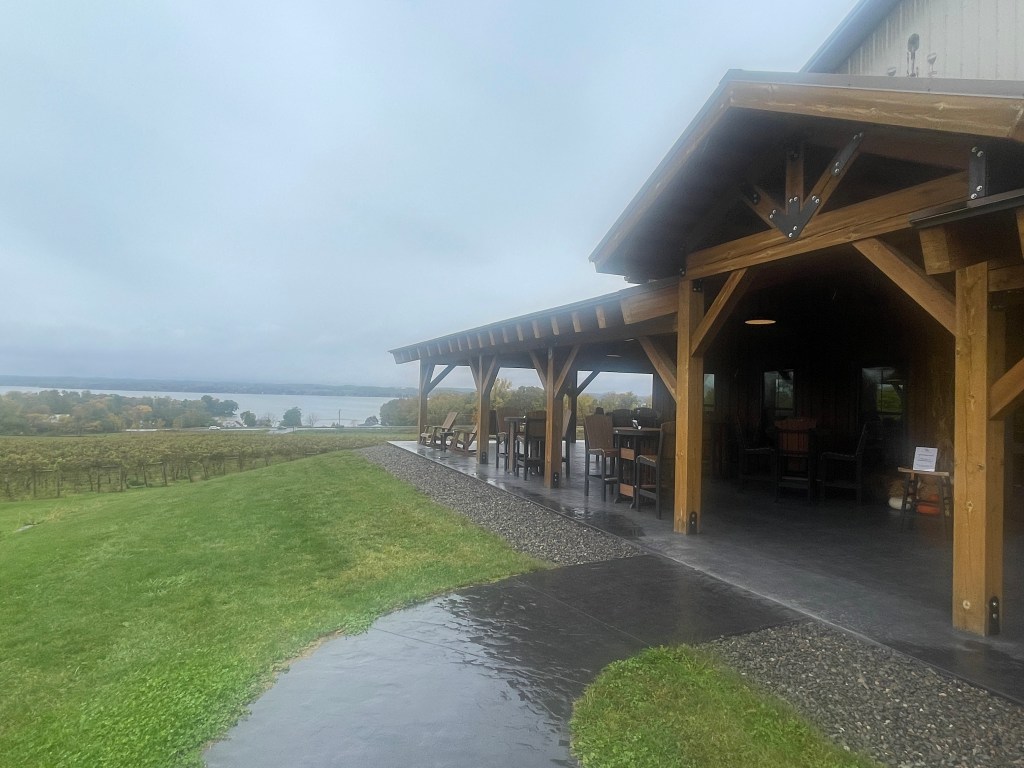
It’s a shame that we visited when it was pouring rain, because the tasting room had a fantastic view of Cayuga Lake. On a nicer day, I’d have happily stayed longer on one of the Adirondack chairs and just enjoy the scenery. It helped that the tasting room was stunning as well.
Owner Gary Cuthbert saw my group come in and he came over to say ‘hi’ and tell us about his property. Turns out, the name was inspired by the limestone soil the vineyard is planted on, just like nearby H&H. Such soil is somewhat of a rarity in the Finger Lakes and is great for making high-quality fruit. They have 28 acres of vines are planted.
Several flights were available, but since we had a big group we were able to order all of them and share. All told, we shared samples of 9 wines.
I thought their dry Riesling was good, and the 2022 “11S” Pinot was nicely balanced and fruit-forward. But I thought the real standout was his cask Riesling, which was very dry yet ‘full’, with notes of mango.
Stop #3 Ravines Wine Cellars (Barracks Road)
This place was busy! We had to wait for a table to open up but eventually got one. Reservations are definitely recommended. Even so, those tables were pretty small for the number of people they are supposed to accommodate.
I thought their 17 Brut had a great brioche nose, and their ‘regular’ Riesling was really good. Kudos also to the Maximilian red blend and the very earthy Cab Franc.
The tastings and food were not cheap, but wine was good. Reservations definitely recommended.
Stop #4: Fox RunVineyards
Too tired for notes at this point!
Day 5: Red Tail Ridge Winery
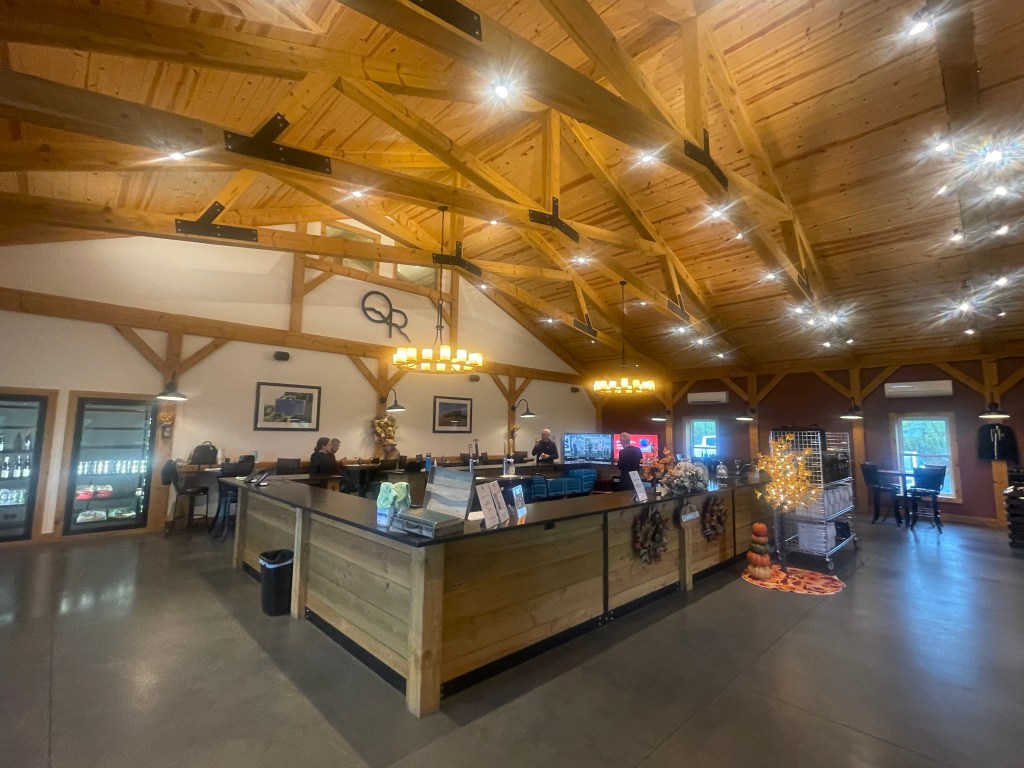
I had wanted to visit here earlier, but timing didn’t allow. Fortunately I was able to convince my driver to swing by on the way home. Red Tail does reservations, but this early it was unnecessary.
Kristin Evans did our tasting and gave us a lot of great info in a short time. I’d say Red Tail had the widest and best overall selection of sparkling of the entire trip, although the dry wines were both good and interesting. We also got to meet their winemaker, Nancy Irelan.
A number of flights were available, including one of ‘Innovative’ wines. I leaned into the sparkling options. Fortunately, with multiple members of my group available, we were able to get a wide selection and share.
Many in my group put this visit in their Top 3 of the 5-day/16 winery trip. Personally, I say they were tied for #3, maybe just below Forge and Heart & Hands, but tied with Kemmeter.
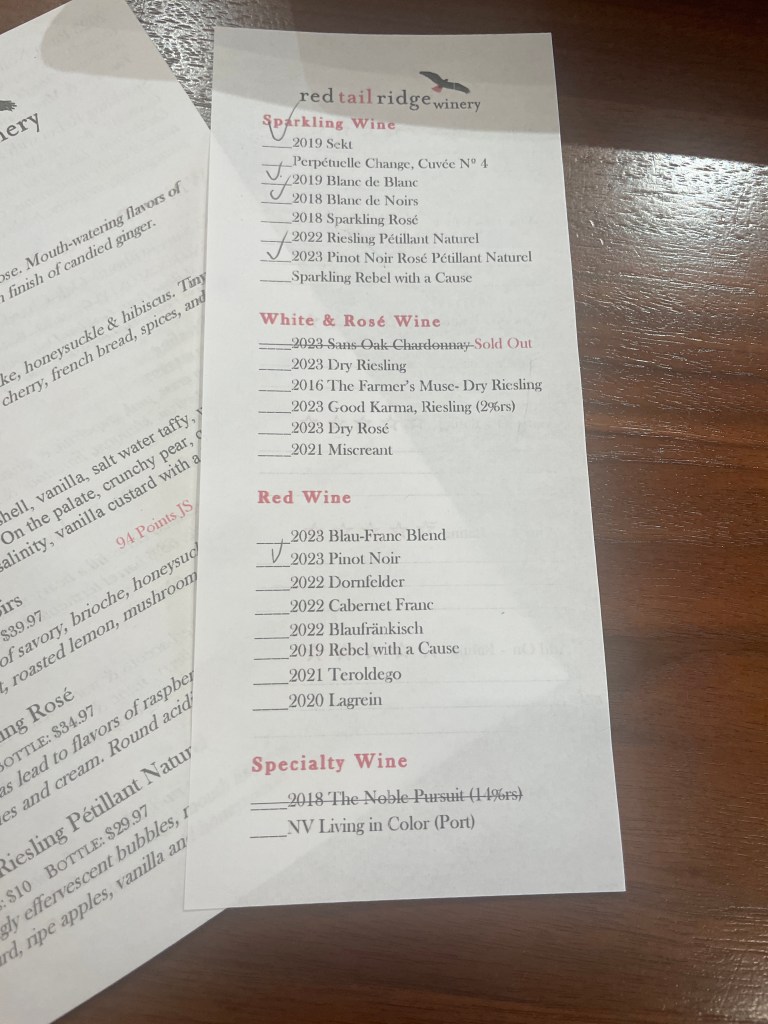
2019 Sekt (Traditional Method): Very nice, bright; orange notes
“Perpetual Change” NV Sparkling (Traditional Method): Interesting, but in a great way
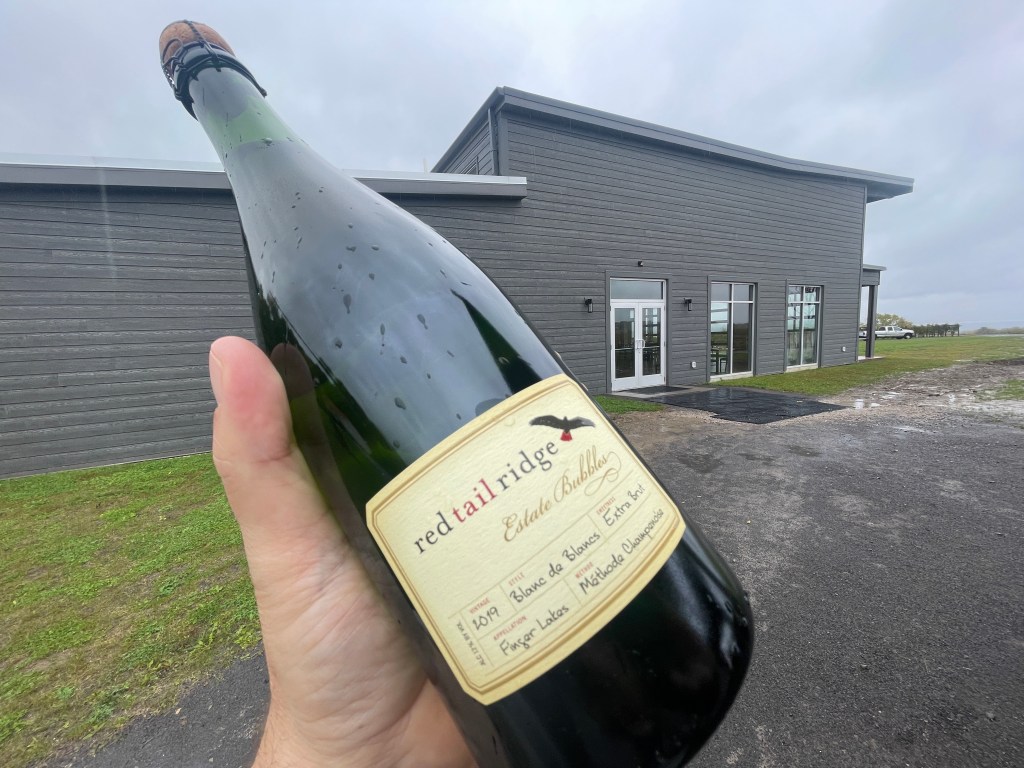
2019 Blanc de Blanc (Traditional Method): Bought a bottle home! Lots of brioche notes
2018 Blanc de Noir (Traditional Method): Tarter, also had lots of brioche.
2021 Miscreant. An interesting gewürztraminer blend/orange wine
2018 Sparkling Rosés’: Fruity and refreshing
Riesling Pet-Nat: Pineapple notes; not lee-sy at all.
Pinot Noir Pet-Nat: Juicy
2023 Pinot Noir: Young
2020 Langrine: Lots of depth and tannin
Next time I’ll have to try Once Finger wine bar, and revisit Heron Hill.
When planning my 2024 Finger Lakes trip, I made a list of old favorites and places that I’d heard good things about but never been. Heart & Hands was part of the later category. But it wasn’t until I heard rave reviews from a pair of friends who visited them months earlier that I decided they were a ‘must visit’.
Considering this turned out to be on of my Top 3 visits (along with Forge and Kemmeter) on a 5-day, 16-winery trip, I’d say I chose well.
Heart and Hands is located on the NE side of Cayuga, which added a good 30-minutes to our Day #4 trip itinerary. I know that seems far, but it’s worth the extra time. Not only did we avoid the crowds, it was some of the best wine of the trip.
The name “Hearts and Hands” is a reference to a Claddagh ring, which is an Irish symbol of love. Co-owner Susan Higgins did our tasting and was kind enough to open a little early since we were trying to make the most of our day.
When I asked Susan what they have planted, she said “Lots of fun things! We are a nerdy winery.” They concentrate on pinot and riesling, but also have some aligoté, langrein, petit arvine, and a little chardonnay.
Most of their fruit is estate, although they do source some from nearby vineyards. Heart & Hand makes between 2,500-3,000 cases/year, mostly (and increasingly) based on their 11 acres of vines.
During most of my Finger Lakes visits, people talked a lot about the lake’s importance in reflecting heat on the shoreline vineyards. That’s true at Heart & Hands, but a lot of credit also goes to their limestone soil that’s rare to this area. Limestone drains well, and minimal water retention is important to keeping the vines healthy.
The tasting room is small, but that’s fine with me. Heart & Hands didn’t design the winery to entertain masses of visitors; it’s all about the wine.
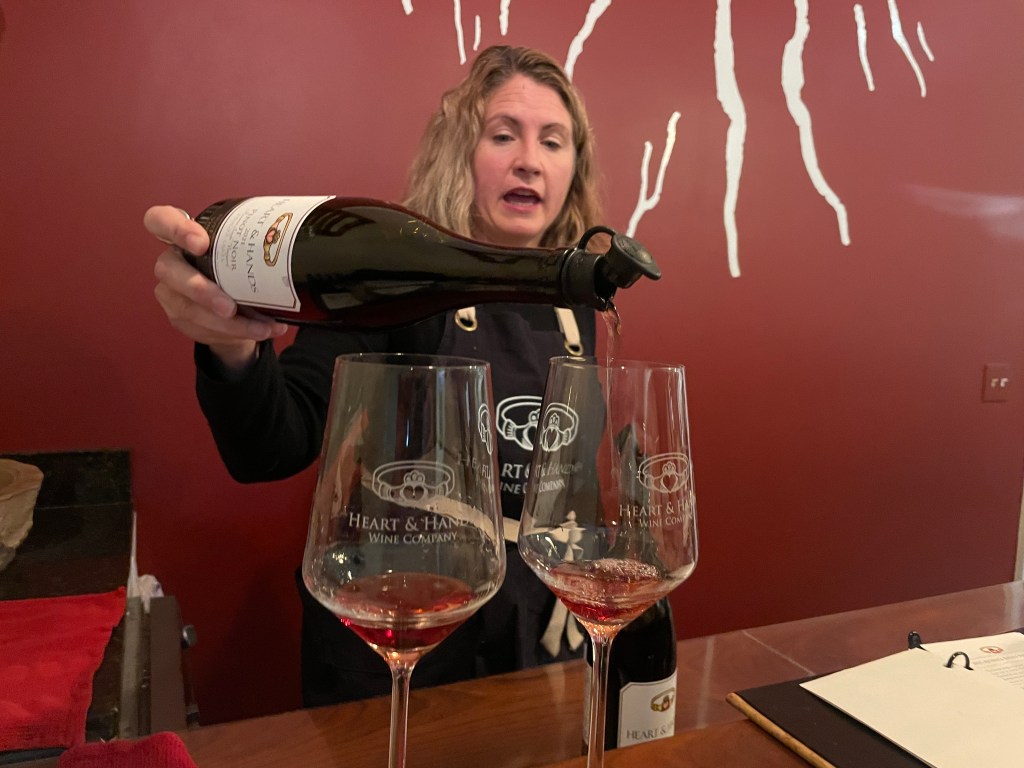
Susan walked us through multiple side-by-side comparison tastings, either from different years or different growing sites for the same grape. They make lots of sparkling, but plenty of dry wines as well.
My tasting notes:
2015 Blanc de blanc (traditional): Very nice; one of the best sparklings I had on the trip. Not tried was a blanc de noir.
Sparkling Riesling; also very nice; wonderful nose
2019 Auxerrois: This grape is a cross between pinot noir and gouais blanc. Interesting, but not a favorite.
2020 Chardonnay: French oak; somewhat lees-y.
Pinot comparison #1: 2021 H&H Pinot (estate and local fruit), vs their 2021 Nutt Road Vineyard Pinot. The ‘standard’ pint had lots of bright fruit, while the vineyard-specific one had fruit but was earthier. I took home a bottle of the ‘standard’.
Pinot comparison #2: 2021 Hedrick Pinot, which had 20% stem inclusion for extra tannin. It was a great balance between fruit and tannin. Paired against it was a 2021 Estate Pinot (forgot the specific name), which was heavier, had a longer finish, and more tannin. 100% stem inclusion on the later.
Riesling comparison: The 2022 was drier, with more petrol notes. The 2021 was more layered, with notes of tangerine.
This was certainly one of the best sparkling wineries I’ve visited in the Finger Lakes, alongside Red Tail Ridge. My tasting crew took almost 2 cases worth of wine between us in what was the greatest single-winery haul of our entire 5-day trip.
I confined myself to buying a blanc de blanc and pinot noir, but I’ll be back for more.
A big part of this growth is driven by changing views of when sparkling wine should be consumed. Sparkling is moving away from its traditional role as a ‘special event’ wine to something wine lovers should casually enjoy.
I have nothing against lower-cost sparklings such as Cava, Pét-Nats, Prosecco, and various charmat-style wines which are helping drive this trend. But Champagne-style sparklings are still my favorite, much to my wallet’s dismay.
While Champagne is the world’s most famous sparkling region, Virginia has a number of excellent ‘traditional-method’ sparklings as well. A few years back I hosted a blind tasting and Virginia-based Claude Thibaut’s Xtra Brut was picked our favorite. Last year a Trump Blanc de Blanc was favored over a comparable champagne during a France vs Virginia lineup.
Tasting & Scoring Methodology
This time around I expanded the number of options. A group of friends & I blind tasted 9 wines in 3 flights. One flight represented some of the best of Virginia, a second represented Champagne, and the third was mixed-flight with sparklings from Argentina, California, and the UK.
All of these wines were 100% chardonnay, with the exception of the champagnes which blended with pinot noir and perhaps pinot meunier (blanc de blanc brut champagnes in my price point were hard to find, although I tried keeping the participating champagnes chardonnay-heavy). All were Brut (0-12 grams of added sugar per liter) or Extra Brut (0-6 grams). Lastly, everything we tried was made in the traditional method.
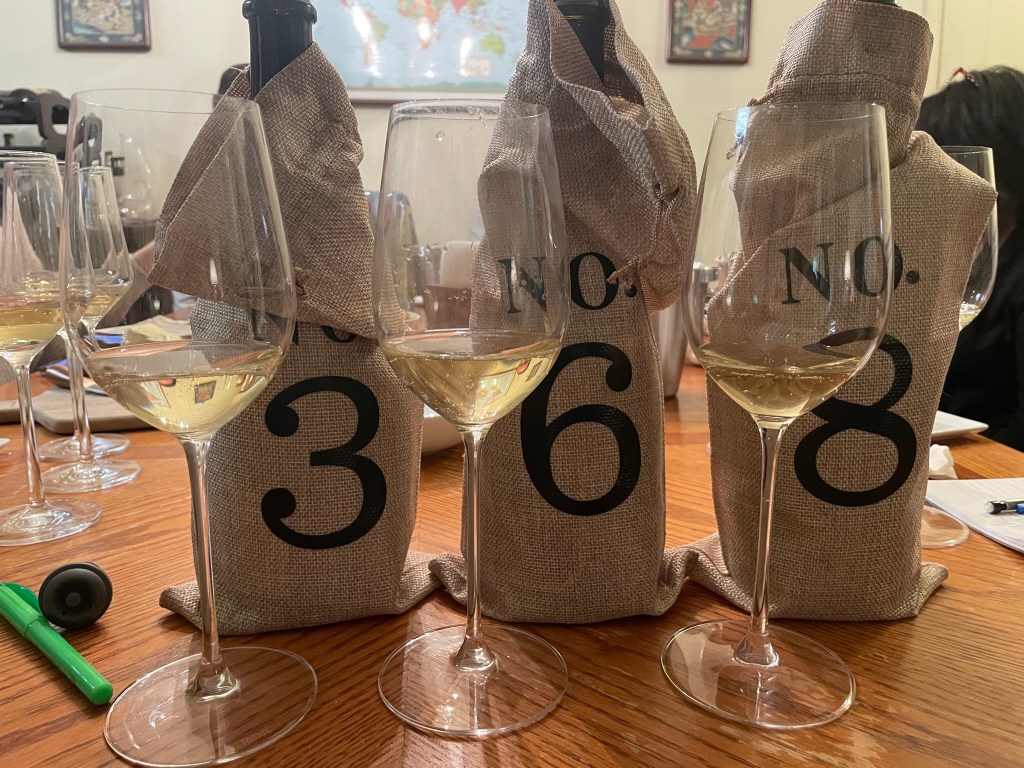
All the flights were bagged blind, although they stayed in their respective regional groups. We picked the favorite of each round to move to a ‘finalist round’. We didn’t know which group we were tasting until the unveiling.
My fellow blind tasters were a mixture of wine industry professionals and local wine enthusiasts, so we had a strong contingent of tasters. Many had only limited exposure to Virginia wine.
We didn’t have a fancy scoring system. The goal was to pick a ‘favorite’ every round, as opposed to rating them and determining the ‘best’.
The contenders:
2018 “Under the Wire” Alder Springs Vineyard (Mendocino California, $64 per Vivino)
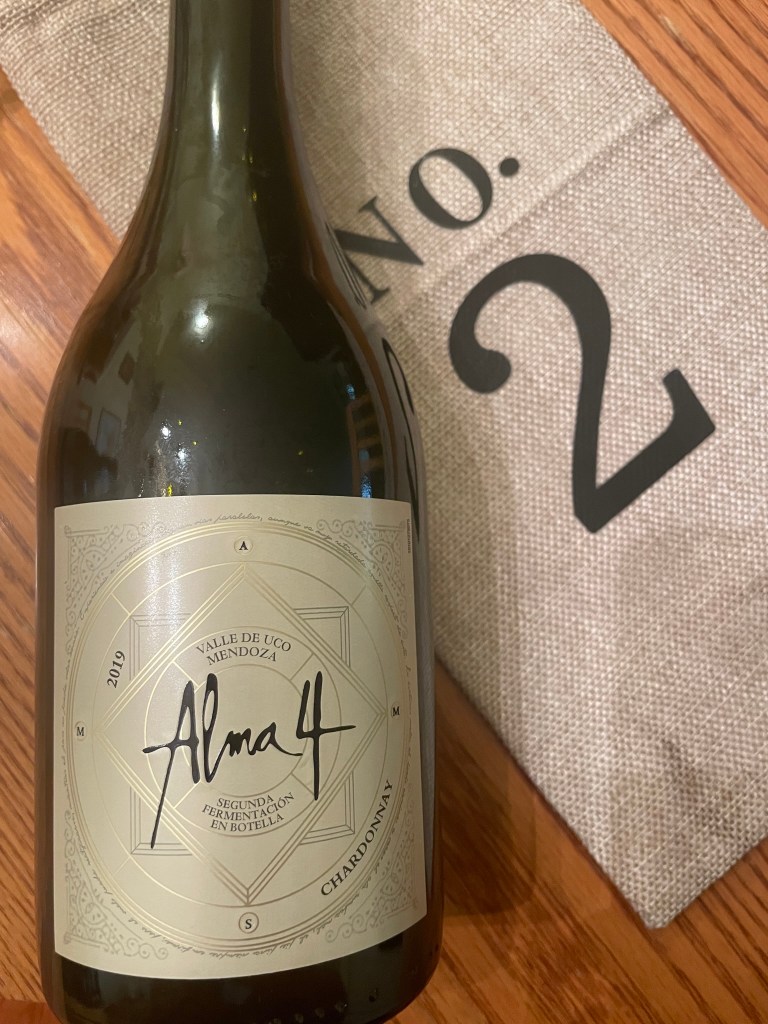
2019 Alma4 (Mendoza Argentina, $26 per Wine.com)
2018 Gusbourne Brut Reserve (England, $70 per Wine.com)
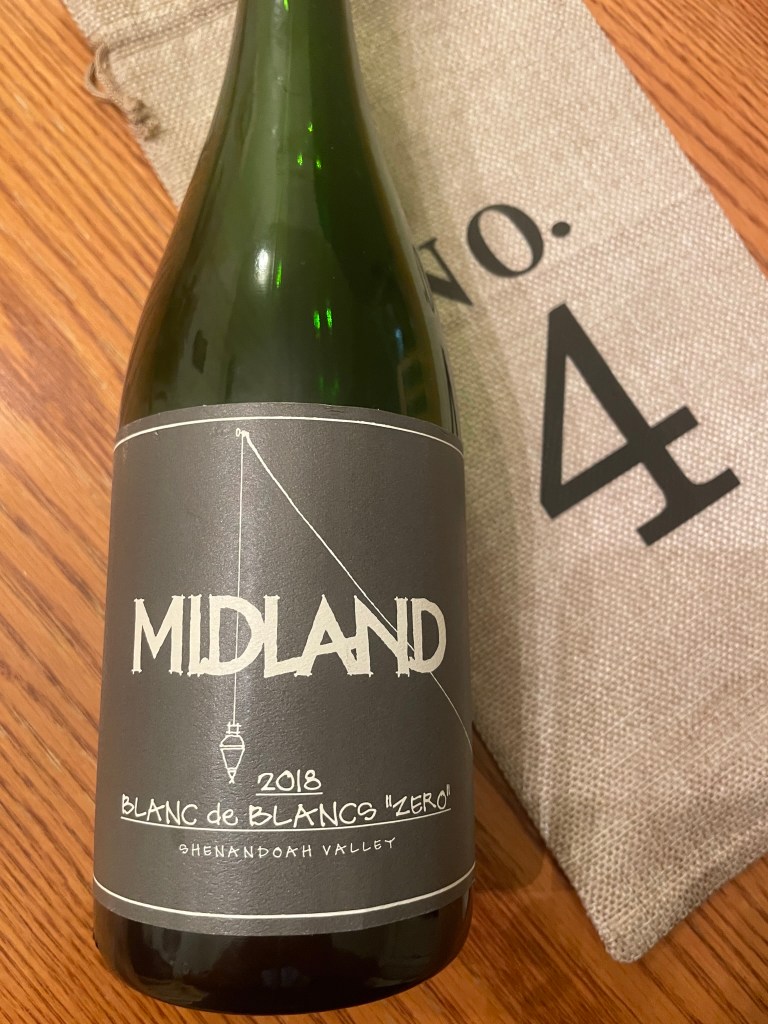
2018 Blanc de Blancs “Zero” Midland Wine (Shenandoah Valley Virginia, $45 at Commonwealth Crush)
NV Thibaut-Janisson Xtra Brut (Virginia, $36 per Timeless Wines)
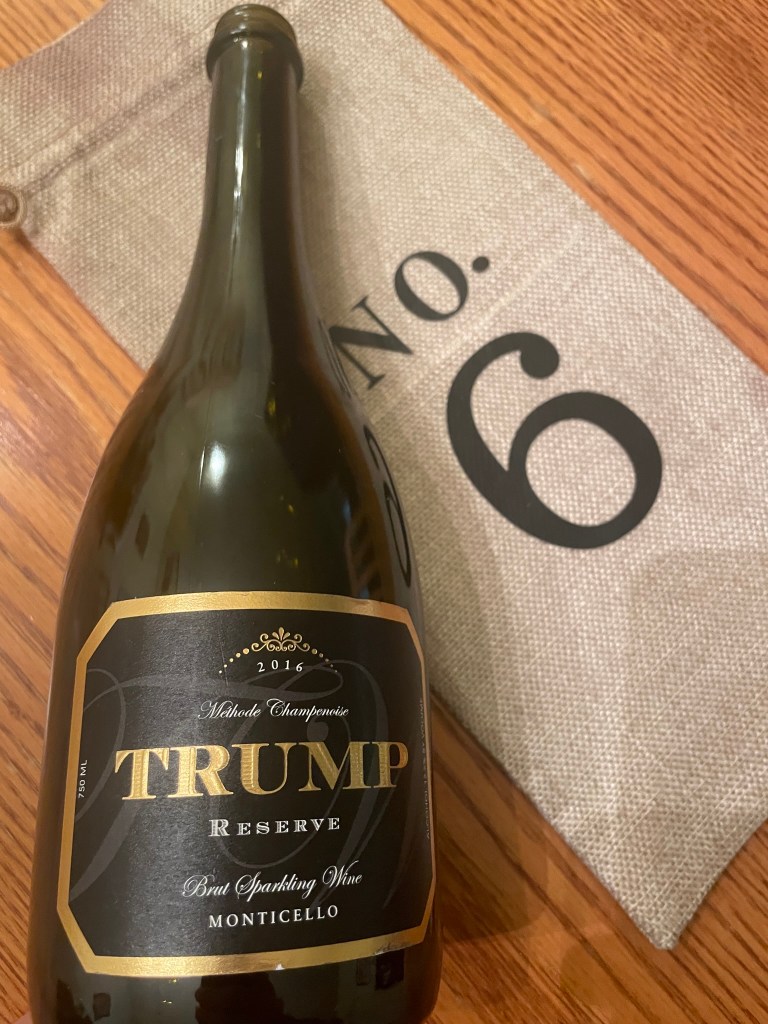
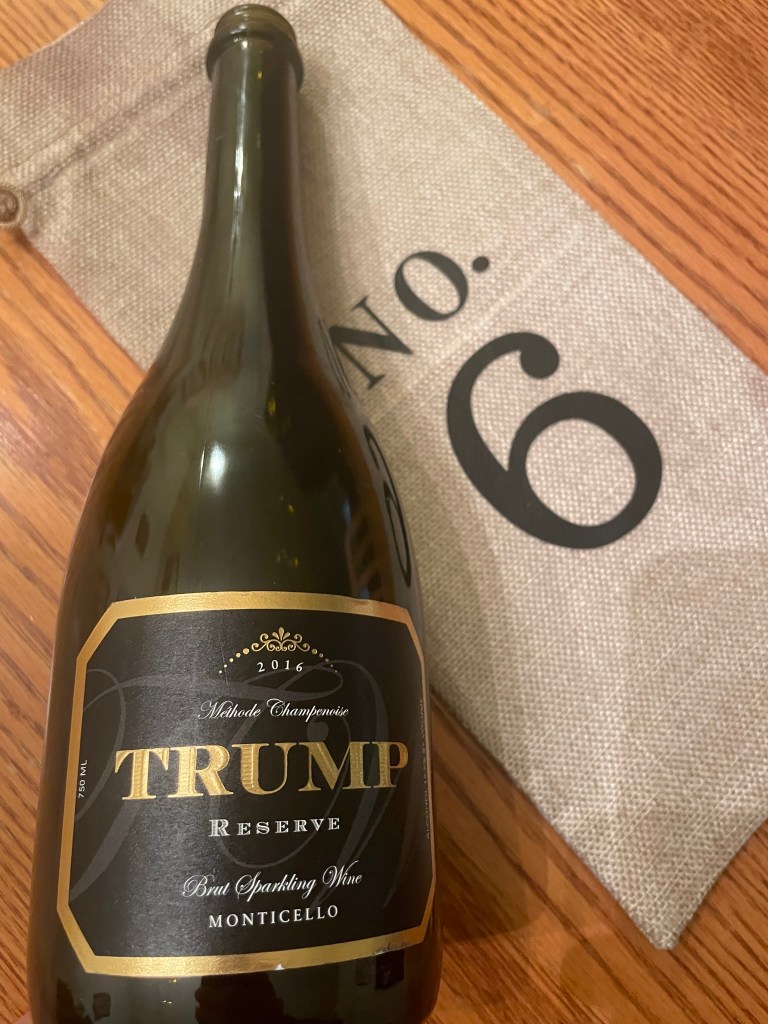
2016 Trump Sparkling Reserve (Monticello Virginia, $75 at Trump Winery)
De Saint-Gall Blanc De Blancs Grand Cru Brut Champagne (Champagne France, $45 at Total Wine)
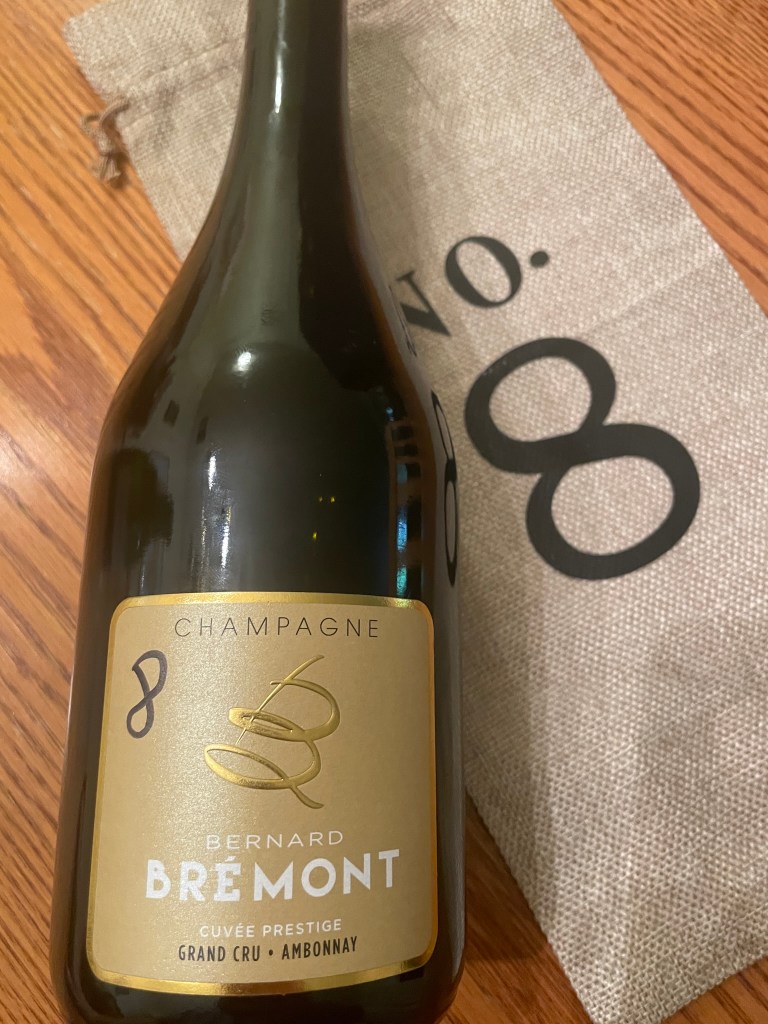
BernardBrémont Grand Cru ‘Cuvee Prestige’ Champagne (Champagne France, $62 at Total Wine)
Taittinger La Francaise Brut Champagne (Champagne France, $56 at Total Wine)
Flight #1: International Round
Bottle #1: 2018 “Under the Wire” Alder Springs Vineyard
The thing that struck me in this round is none had the full-on toastiness that I’m accustomed to in sparklings. There was some cream in them, but the nose and palate of these three wines didn’t line up with what I was expecting.
Bottle #1/Alder Springs: Lemony; bubbles were short-lived. Lighter on the palate. Many commented it had an outstanding nose but the finish left them wanting. Some noted an herbal note to this nose, maybe some greenness.
Bottle #2/Alma4: Fresh, “Smells like a floral white”. Not toasty at all; if anything I found yeast on the nose. Others noted it had a grassy nose, maybe even bell pepper. Nothing really stood out in this wine.
Bottle #3/Gusbourne Brut Reserve: Someone noted it may have spent some extra time in oak. Many complimented its balance and structure. Notes of lemon curd and citrus were mentioned, or more generically ‘orchard fruit’.
Guest #1: 3/1/2. Thought the nose started off as sweet but that blew off.
Guest #2: 3/1/2. Felt #2 would be a generic crowd pleaser.
Guest #3: 3/1/2
Guest #4: 3/1/2.
Guest #5: 3/1/2. Thought #1 was aggressive, while #3 was creamy & lemony.
Guest #6: 3/1/2 Felt #3 was the most ‘familiar’ for someone who likes traditional-method sparklings, and enjoyed its balance.
Guest #7: 3/1/2
Flight #2: Virgina Round
Bottle #4: 2018 Blanc de Blancs “Zero” Midland Wine
This round was easily better than our previous one, with only #3 being comparable.
The result was almost a toss-up between the Thibaut-Janisson and the Trump Reserve, but I gave the win to Trump Winery as it had more 1st place votes.
That said, T-J was consistently nearly everyone’s favorite runner-up. The T-J was more crowd-friendly, while the robustness of the Trump Reserve was a turn-off for some people. Ironically, the Trump wine had the most 1st place votes and tied for most 3rd place votes in our flight of 3 wines, while votes for the T-J Brut were more evenly distributed.
Even though the Midland wine came in 3rd in this round we universally enjoyed it. If anything, many of us put the Midland ahead of many others of the evenings.
I did a quiz at the end of the night on which flight corresponded to which region before revealing the wines. Many felt this was the Champagne round, which is one of the greatest compliments I can think of.
Bottle #4/Midland “Zero”: Some brioche notes, although they didn’t linger. Stone fruit with only a little apple; more nectarine or pear. Notes of lemon zest, apricot were mentioned. The only real negative was people felt the bubbles fizzled out quickly.
Bottle #5/Thibaut-Janisson X-Brut: There was an herbal note on the nose although the brioche was still there. Notes of straw; maybe a bit reductive. Very palate-friendly and an overall crowd-pleaser of a wine (note: at $36 this was arguably the best value of the night).
Bottle #6/Trump Sparkling Reserve: This was a complex, ‘mature’ wine with very consistent bubbles. Creamy & silky, but with intensity. Probably the most intense wine of the entire evening. The main negative is it arguably had too much going on for guests who preferred something easier-drinking.
Guest #1: 5/4/6. Liked the nose of 4 but voted for 5 because of the caramel notes.
Guest #2: 5/4/6. Felt #6 had notes of apple tart and the best nose of the bunch. #5 was yeastier on the nose but very drinkable.
Guest #3: 4/5/6. #6 had great structure but felt it got tired, while #4 aged well in the glass.
Guest #4: 6/5/4. Loved the nose of #4 but the palate didn’t keep up. Felt #6 was ‘big’ and needed food.
Guest #5: 6/4/5. Thought #6 “Is what sparkling should be”.
Guest #6: 6/5/4. On #6, “I want to get to know this wine better”. Felt #5 was a great crowd-pleaser.
Guest #7: 6/5/4. Thought #6 was complex; agreed #5 was a crowd pleaser.
Flight #3: Champagne Round
Bottle #7: NV De Saint-Gall Blanc De Blancs Grand Cru Brut Champagne
Bottle #9: NV Taittinger La Francaise Brut Champagne
Unfortunately, we had our first wine with a flaw – #9/Taittinger had something off about it. So really this was a competition between #7 and #8. All of the wines had a familiar brioche note to them.
Bottle #7/NV De Saint-Gall Blanc De Blancs Grand Cru Brut Champagne: I said it reminded me of a sparkling cider; someone else mentioned crab apple. Yeasty. Slightly bitter finish. Many commented the finish was on the shorter side.
Bottle #8/NV BernardBrémont Grand Cru ‘Cuvee Prestige’ Champagne: Notes of apple; someone mentioned apple sauce. Good structure and mouthfeel. Fine bubbles. Bright. Notes of lemon initially but that moved to apple. Great mousse (the foam that forms after a sparkling wine or champagne has been poured out of the bottle). Super creamy and great aromatics.
Bottle #9/NV Taittinger La Francaise Brut Champagne: Not sure what happened here, but it seemed corked. Bland; short-lived on the palate. Some white flower notes. Olive on the nose.
Guest #1: 8/7/9. #8 had all the great things that #6 had, but was more complex.
Guest #2: 8/7/9
Guest #3: 8/7/9. Felt #8 had great mouthfeel.
Guest #4: 8/7/9
Guest #5: 8/9/7
Guest #6: 8/7/9. Felt #8 was comforting and familiar in the way a sparkling wine should be.
We all loved this round. The three wines before us were outstanding; picking a favorite was entirely a measure of personal preference and mood.
All of the participants praised #8/Brémont for its great texture and balance. #6/Trump was ‘bigger’ and more complex. #3 could easily have fooled us for being from Champagne.
I asked everyone to guess which round represented which region, and the votes were all over the place. Several people (including the wine industry professionals amongst us) felt the 2nd round (Virginia) was our Champagne round. Only one out of seven of us correctly identified the region each round came from.
It was a very close race between Gusbourne and Trump for favorite of the day, but Trump won out. Trump had more 1st place votes than Gusbourne, although they were nearly neck-in neck.
Assigning 1 ‘point’ for 3rd place, 2 points for 2nd place, and 3 points for 1st place, the scores were 16 points for Trump, 15 points for Gusbourne, and 11 points for Brémont. It was far closer than many of my other comparisons and a tribute to the quality of these wines.
Guest #1: 8/3/6
Guest #2: 6/3/8
Guest #3: 3/6/8.
Guest #4: 8/6/3. Toss-up between #6 and #8, depending on my mood for balance vs. complexity.
Guest #5: 3/6/8
Guest #6: 6/3/8
Guest #7: 6/3/8
Lessons Learned:
As a Virginia wine aficionado I was incredibly pleased so many people thought our Virginia flight was actually from Champagne. I’m confident the top 3 wines of the evening made it into the final round, although we easily could have added the Thibaut-Janisson Xtra Brut in there.
The quality of the British sparkling was something of a surprise but probably shouldn’t have been. Sparkling wine grown in the UK has the same soil qualities as Champagne, plus they are somewhat cooler so the acidity is prominent.
Not coincidentally, the finalist wines were also the most expensive, and the winning Trump wine was the oldest (which probably contributed to its complexity). I guess you really do get what you pay for (although I do need to give the Virgina T-J Xtra Brut special mention for being arguably the best value of the evening).
Also not coincidentally, both Thibaut-Janisson and the Trump sparkling have French roots. Patricia Kluge of Kluge Estate (now Trump Winery) started the trend for high-end Virginia sparklings by inviting French winemaker Claude Thibaut to Virginia as a consultant. Claude later went on to co-found Thibaut-Janisson.
Today, Jonathan Wheeler is Trump’s winemaker and he’s taken their sparkling program to new heights. During my previous blind tasting using a Trump wine, I wrote that “Trump sparkling can go toe-to-toe with anything”. Here, it proved it.
It’s not just my opinion either. The 2023 San Francisco Wine Chronical competition selected the 2016 Sparkling Reserve as Best in Class in the Brut category. The 2015 Blanc de Noir won the overall Sparkling Sweepstakes in the 2021 competition. Nearly year after year, a Trump sparkling is selected for the Virginia Governor’s Case (top 12 wines in the state).
Yes – their sparkling is just that good.
Next up…reds maybe? Perhaps a Governors Cup winners round?
All of my blind tastings have a theme. France vs Virginia. Virginia Tannats vs The World. Cabernet Franc Comparison; ect ect. But it’s almost always a ‘like vs like’ event, even if the regions involved are different.
This time I mixed things up. It was still ‘like with like’ because all were sparkling wines of some sort. Yet it was a departure from my normal blind tastings as these sparklings were about as different as I could possibly make them.
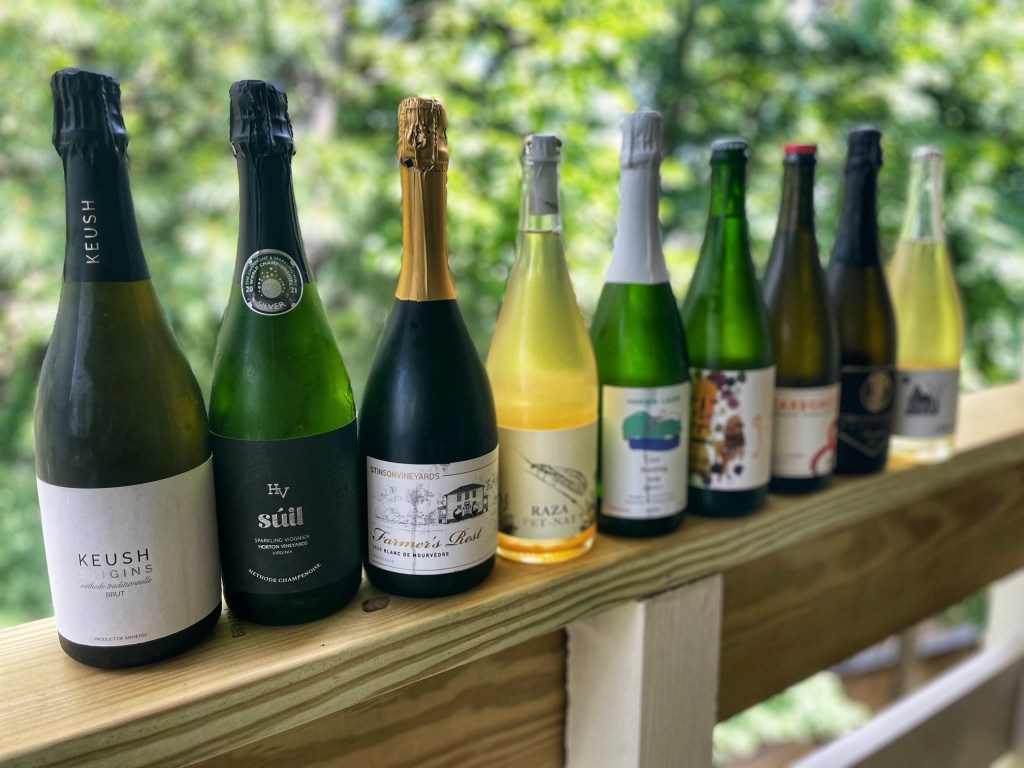
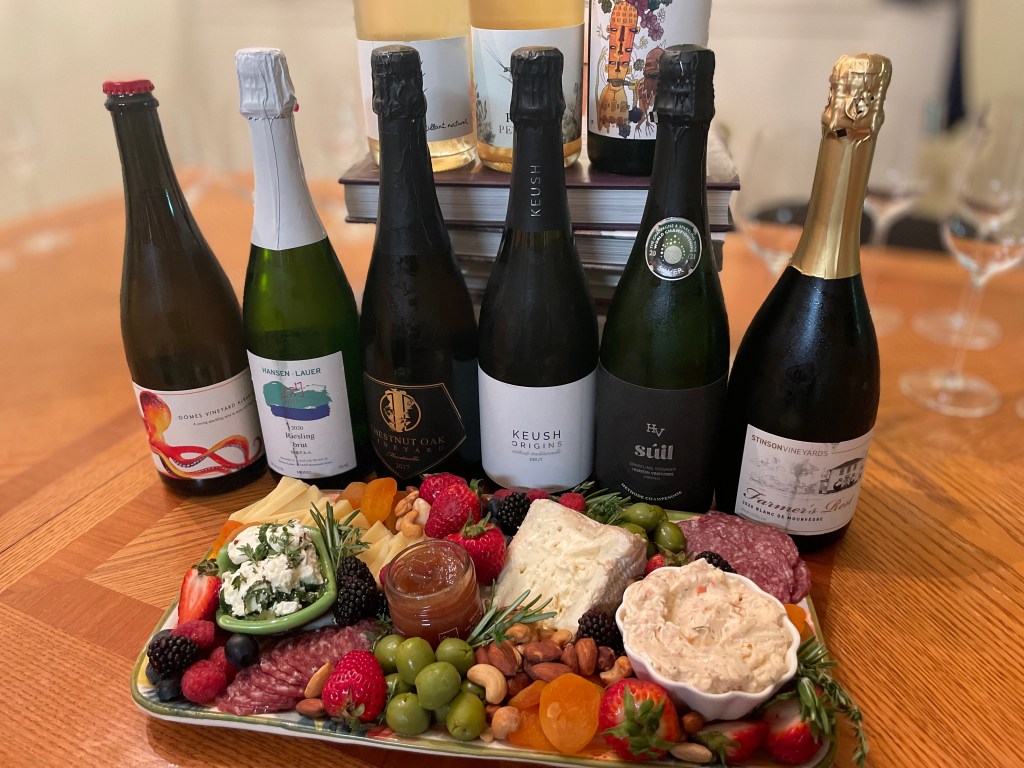
Of our 9 wines, 6 of the wines were traditional-method and 3 were pet-nats. More importantly, all 9 were made with different grapes. We had everything from Albariño to Voskehat.
I put the pet-nats in the same flight but otherwise all the wines were randomized. We had two flights of traditional method sparklings and a pet-nat flight at the end.
As always – this event was the product of this day, with this group. We could have repeated it the next day and come up with different results. After the 3rd round, we paused for some charcuterie, sushi, and oysters.
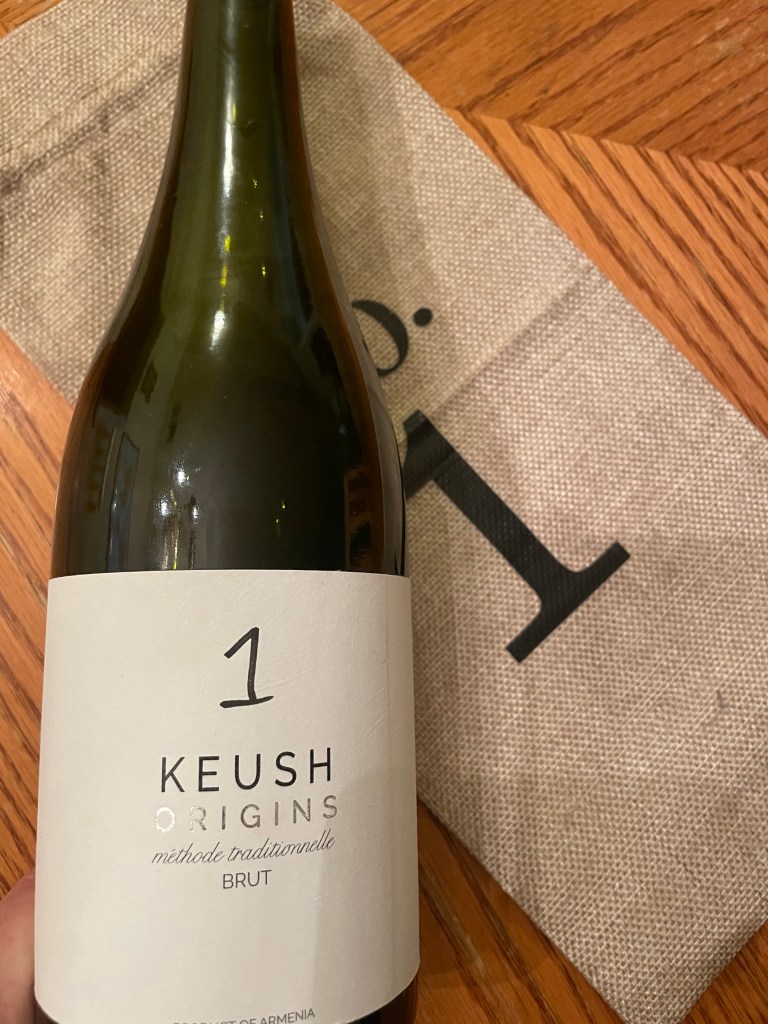
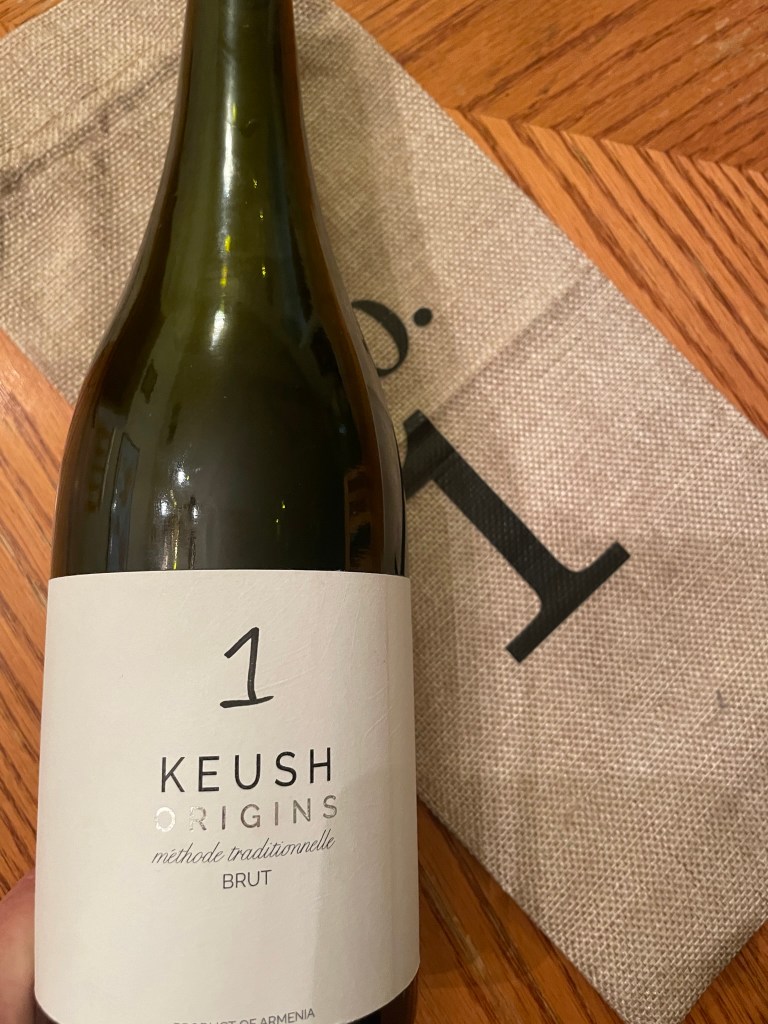
Bottle #1: Keush Origins, 60/40 blend of Voskehat and Khatouni (Winner)
Bottle #2: Gomes Vineyard, Albariño (tied for runner up)
Bottle #3: Horton Vineyards, Viognier (tied for runner up)
Excellent start to the event. Each of the three sparklings had something unique about them. Many of us gravitated to the Armenian Keush from the get-go, so this round was more of a contest for the #2 spot between the Virginia Horton Viognier and the California Albariño.
We couldn’t get over how different these three were. It wasn’t just the tasting profile but the finish and acidity.
We picked the Keush as the favorite mostly because it was the most complex of the trio and reminded us of a blanc de blanc in terms of the complexity and brioche notes.
Bottle #1: Keush Origins. The nose presented notes of brioche, which I think caused us to automatically gravitate towards it since it was familiar to sparkling lovers. I found grapefruit on the palate; others said green apple. As it opened up it also had notes of peach.
It may also have been the oldest of the trio (and the day) which contributed to its complexity. I felt it was also ‘big’, which was mostly a compliment but I could see that as being a distraction as well.
Fun fact – this wine came from one of the highest elevation vineyards (5740 feet) in the northern hemisphere!
Bottle #2: Gomes Vineyard. I thought it had a lemon nose, although I heard everything from grapefruit to orange zest. Definitely grapefruit on the palate, maybe citrus as well.
We were in LOVE with the nose of this one. But at the same time, the finish left us disappointed. There was just nothing on the back end. The bubbles also didn’t last very long, comparatively speaking.
I do have to point something out; when I paired this with oysters (which didn’t happen till much later in the day), this was arguably my favorite wine of the event. Those flavors just absolutely popped out with the right seafood.
Bottle #3: Horton Vineyards. Faint citrus nose. Very lemon-y and maybe some minerality.
This was our crowd-pleaser wine. While the Keush I thought was ‘too much’ for some and the Gomes had nothing on the back-end, I felt this was the easiest to drink through-and-through.
Rankings:
Christina: 1/2/3
Kyle: 1/3/2
Lieven: 1/3/2. Loved the brioche and complexity. Loved the nose of #2 but it dropped off.
Lindsay: 1/2/3. Thought #1 was complex and was ‘never bored’ with it. #2 was very bright.
Matt: 1/2/3
Stephanie: 1/3/2
Round 1 / Flight 2
Bottle #4: Chestnut Oak, Petit Verdot (runner up)
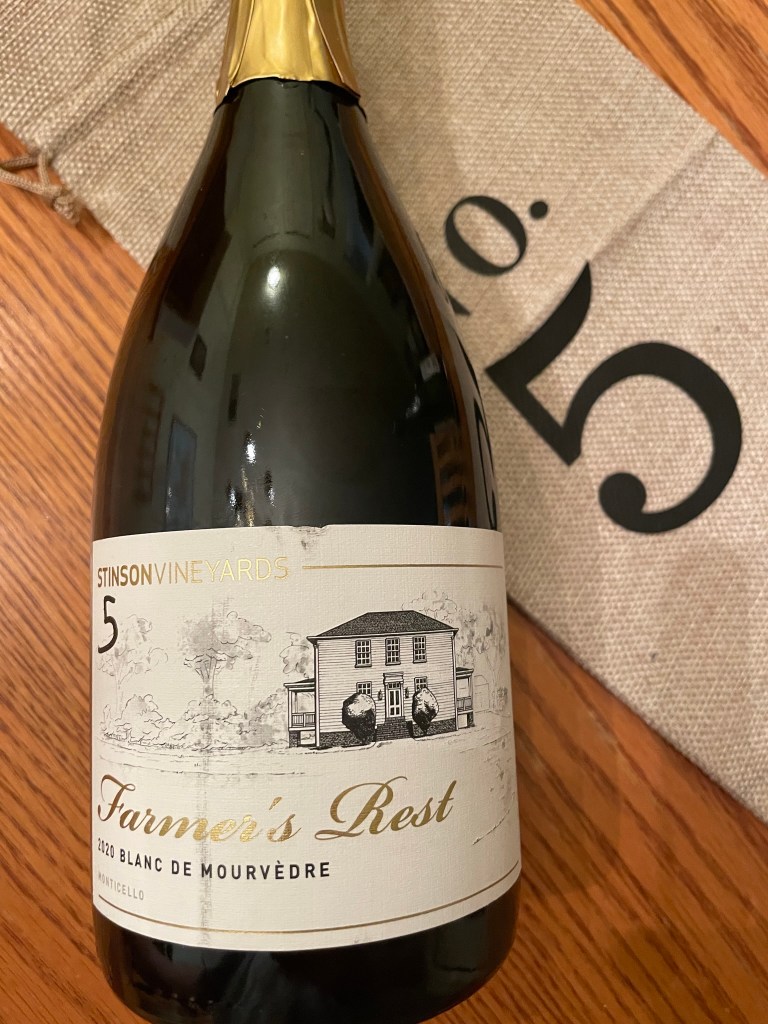
Bottle #5: Stinston Vineyard, Mourvèdre (winner)
Bottle #6: Hansen-Lauer, Riesling (3rd place)
This was a really tough round to pick a favorite. If wines of the first round were different, this was REALLY different. What made it especially difficult is many of us had never tried these wines before, so we didn’t know what to expect.
There wasn’t any chart to rate ‘best’ here; it all came down to personal preference. Stinson came out as the favorite by a tiny hair, but a one-vote change could have resulted in a 3-way tie.
Bottle #4: Chestnut OakVineyard. We immediately noticed an orange tint to the color. On the palate there was a lot going on, which made it difficult to identify. Aromatic and flavorful.
Someone said the wine was ‘confused’ as to what it wanted to be, but ironically that wasn’t meant as a bad thing. It was just not what we’d expected from a sparkling.
Bottle #5: Stinson Vineyard. I found grapefruit on the nose and palate. Maybe a little yeasty? Others said they detected notes of white peach and lemon. Balanced. Some brioche notes.
I had lots of opinions on its complexity. Some felt it was well balanced but others felt there was just a lot going on, almost too much.
Bottle #6: Hansen-Lauer. One of the most acidic wines of the day. Mineral-y; someone mentioned it reminded him of a Greek wine. Some brioche notes came out eventually.
Not a lot going on for the nose, but overall a pleasant wine.
Rankings:
Christina: 5/4/6. Liked all of them, but for different reasons.
Kyle: 5/6/4
Lieven: 6/5/4/. Loved the acidity of #6, even if it wasn’t as complex. Thought #5 was good all-around, with depth and complexity.
Lindsay: 4/6/5. Felt food impacted the choices here.
Matt: 4/6/5. Tough choice. Could have gone for any of these. But since #4 was ‘big’ and different, that put it over the top for me.
Stephanie: 5/6/4
Round 1 / Flight 3
Bottle #7: Early Mountain, Malvasia Bianca (runner up)
Bottle #8: Guide Wine, Chardonel and peaches (last place)
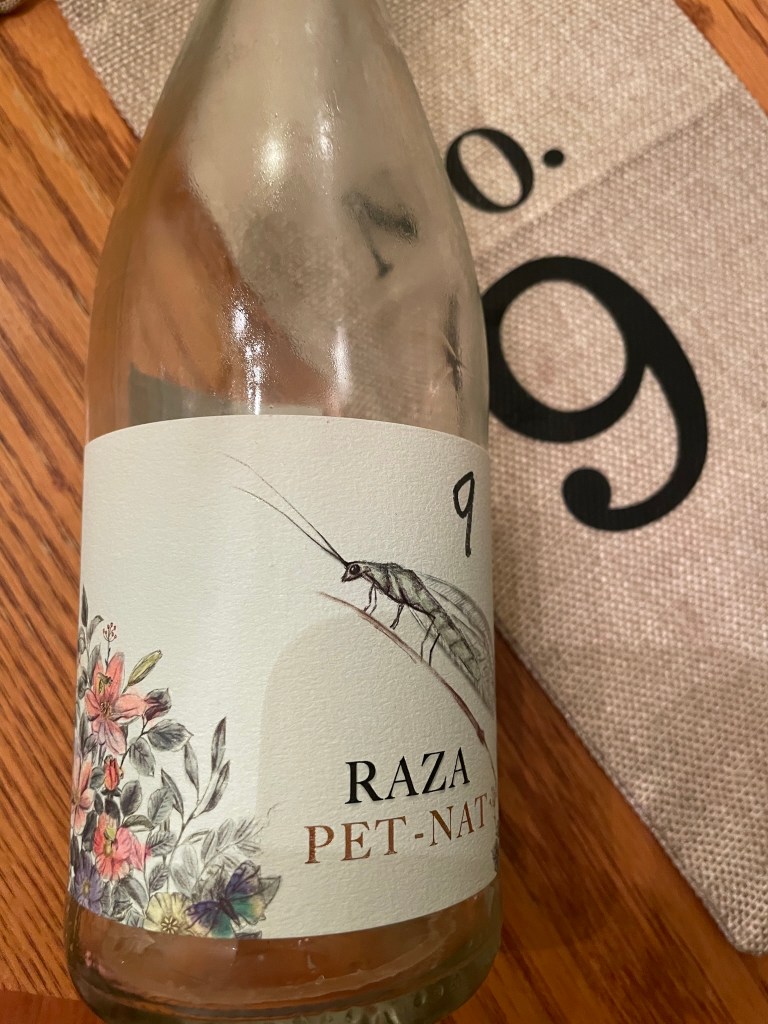
Bottle #9: Raza, Trajadura (winner)
This was our pet-nat round. If I had thought about it more carefully I would have done this round first…but it’s a blind tastings, so where’s the fun in that?
Granted, pet-nats are sparkling wines. But make no mistake – there’s a world of difference between a pet-nat and a traditional method sparkling. I wondered exactly how different this round would be from the earlier one, but there was no mistaking the difference.
Pet-nats are fun, easy drinking wines for when you just want bubbles. So putting them at the end of a round of ‘serious’ traditional method sparklings did them tasting notes a disservice. After we took a food break we revisited some of them and enjoyed them more just for what they were.
Bottle #7: Early Mountain Vineyard. Pale gold color. “Pithy” was mentioned. I thought it had a peach cider quality to it.
Bottle #8: Guide Wine. Bold gold color. I swore the nose reminded me of walking into an apple orchard. I thought I detected some faint hops.
Bottle #9: Raza. The cloudiest of the trio. Little bit of peach but more stone fruit. Had some grassy-ness to it initially. The bubbles also lasted the longest.
We seemed to gravitate towards it because it was the most like a méthode traditional sparkling.
Christina: 9/7/8
Kyle: 9/7/8
Lieven: 9/7/8
Lindsay: 7/9/8
Matt: 9/7/8
Stephanie: 9/7/8
Round 2 / Final
Bottle #1: Keush Origins, Voskehat and Khatouni blend (winner)
We took a food break after the 3rd round. The wines that didn’t go to the finalist round were finished off with a mix of sushi, oysters, stuffed clams, and charcuterie.
Our palates were getting fatigued at this point so no real tasting notes.
In the end, Wine #1/Keush was the winner of the day. We were enthralled with its complexity and brioche notes. It seems there’s just something about brioche that screams ‘sparkling wine’, so whenever we detected it, that became our favorite.
Wine #5/Stinson Mourvèdre was the runner-up. I asked winemaker Rachel Stinson Vrooman about it, and she explained that the decision to make it was completely based on necessity.
It’s from the 2020 vintage, which was the year they got heavily frosted. Mourvèdre survived since it’s a late-budding varietal so it was the only block they didn’t lose.
Even so, Rachel struggled on what to use it in. She loved the flavors, and the low ripeness made it a good candidate as a sparkling. It was such a hit they’ve been making it ever since.
Christina: 1/5/9. Loved the brioche notes of #1
Kyle: 1/5/9. Thought #1 was the most complex.
Lieven: 1/5/9. Liked the acidity and complexity of #1
Lindsay: 5/1/9
Matt: 5/1/9
Stephanie: 1/5/9
Lessons learned:
It’s tough to write up a ‘lessons learned’ in an event that by default was always meant to be experimental. Most of these wines were brand new to us. I had no expectations what to expect, so there wasn’t really any benchmark meant to be reached.
But breaking it down, I’d say this event demonstrated two things.
First, there *really is* a huge diversity in sparklings. If you’ve never tried an Armenian wine, try it! Mourvèdre; seriously, who would have thought? Sparkling Petit Verdot? Get out of town!!!
Second, for as diverse a lineup we had, our palates seemed to gravitate towards the familiar. Wines that were stylistically similar to traditional method sparklings – especially ‘familiar’ blanc de blanc or blanc de noir nearly always won out over ‘non-traditional’. If it had brioche, it went to the top of the list of favorites.
These factors worked against the pet-nat round. In retrospect I really should have done pet-nats totally separately, but was curious how they stood up in a comparison. Sadly they didn’t – but it’s not their fault.
On their own I think we would have enjoyed them more, but coming off a round that included some excellent traditional method wines we seemed more down on them than they deserved.
Sparkling wine is one of the fasted-growing segments in the beverage industry, and Virginia is no different.
10 years ago only a handful of wineries offered bubbly. But the growing popularity of relatively easy-to-make pét-nats and availability of businesses (such as the Virginia Sparkling Company) that produce Méthode Champenoise sparkling for smaller customers has given wineries of all sizes the ability to sell sparkling in-house.
Most of Virginia’s sparklings are blends or Blanc de Blancs; only a minority are Blanc de Noirs (red grapes made into sparkling wine). To the best of my knowledge only Trump Winery, Ankida Ridge, and CrossKeys produce a pinot noir-based Blanc de Noir, although others use cabernet franc, norton, and even a tannat (from Horton).
I’d previously did an entire lineup of Blanc de Blancs, so this time we compared Blanc de Noirs with wines from CrossKeys, Keswick, and Trump.
I admit I had some trepidation over a France vs Virginia comparison of Blanc de Noirs. Nearly all of France’s Blanc de Noirs come from Champagne; no matter how much I may love Virginia wine, this is a tough act to beat.
But this was done in the name of science, so I figured we’d give it a go anyway.
The contestants:
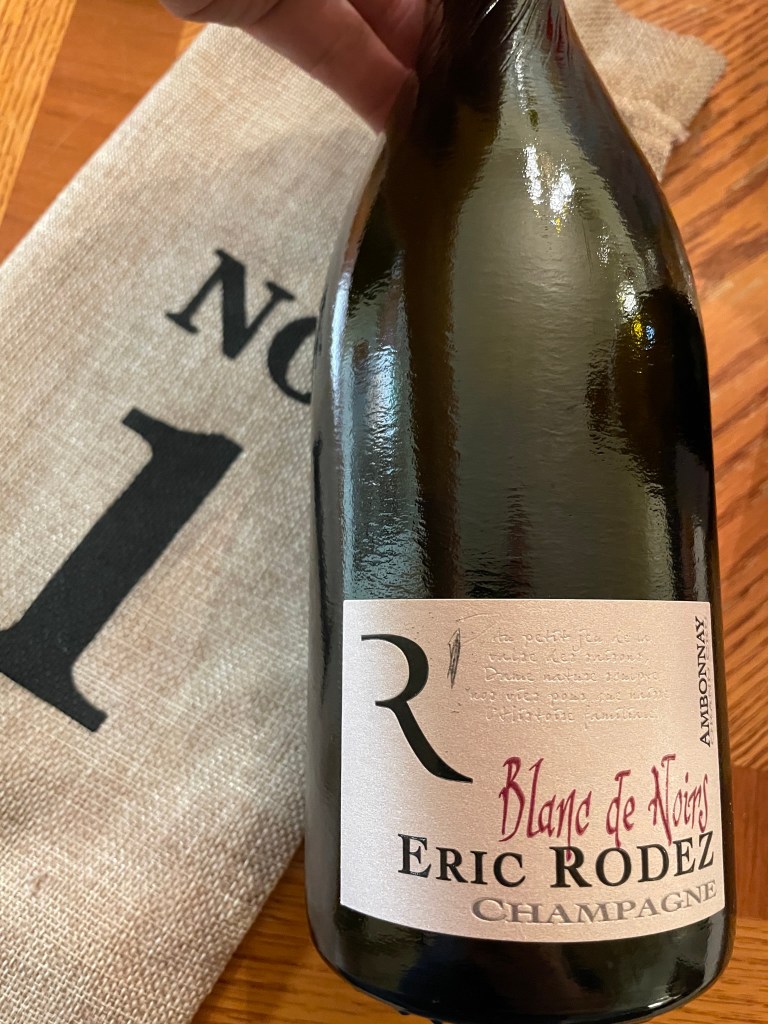
Eric Rodez Blanc de Noirs Grand Cru (Ambonnay, Champagne; $63 on wine searcher)
2019 Crosskeys Blanc de Noir (Shenandoah Valley; ~$40 when it was in stock)
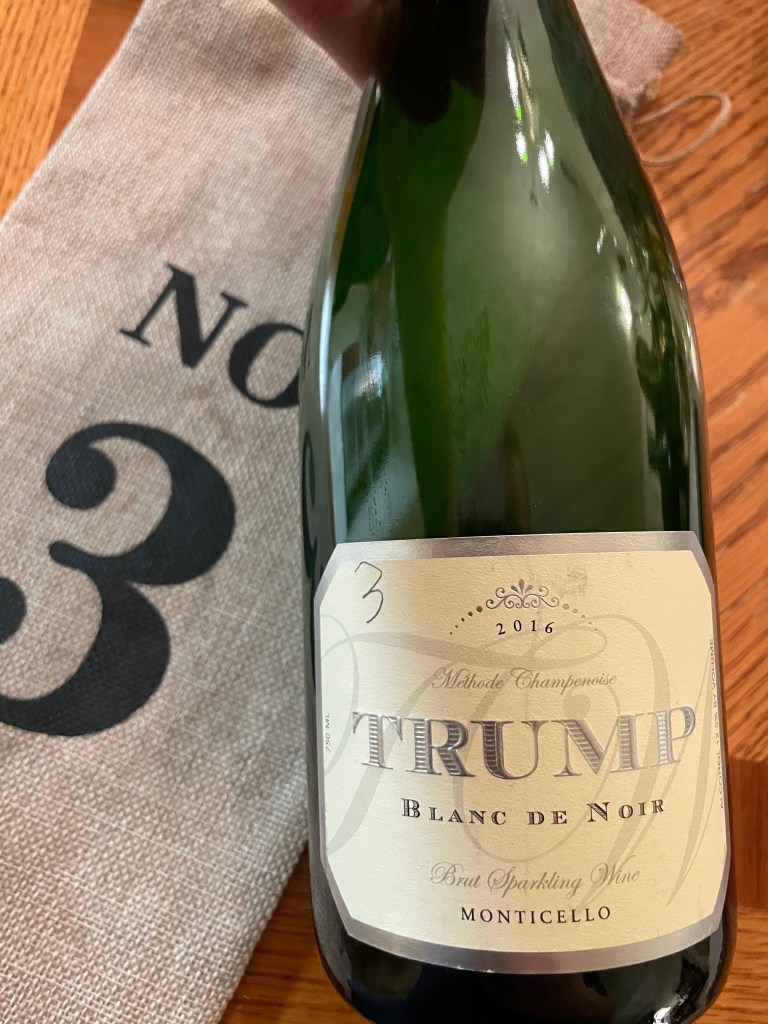
2016 Trump Blanc de Noir (Charlottesville; $55 at the winery)
Mailly Grand Cru Blanc de Noir (Champagne; $60 at Total Wine)
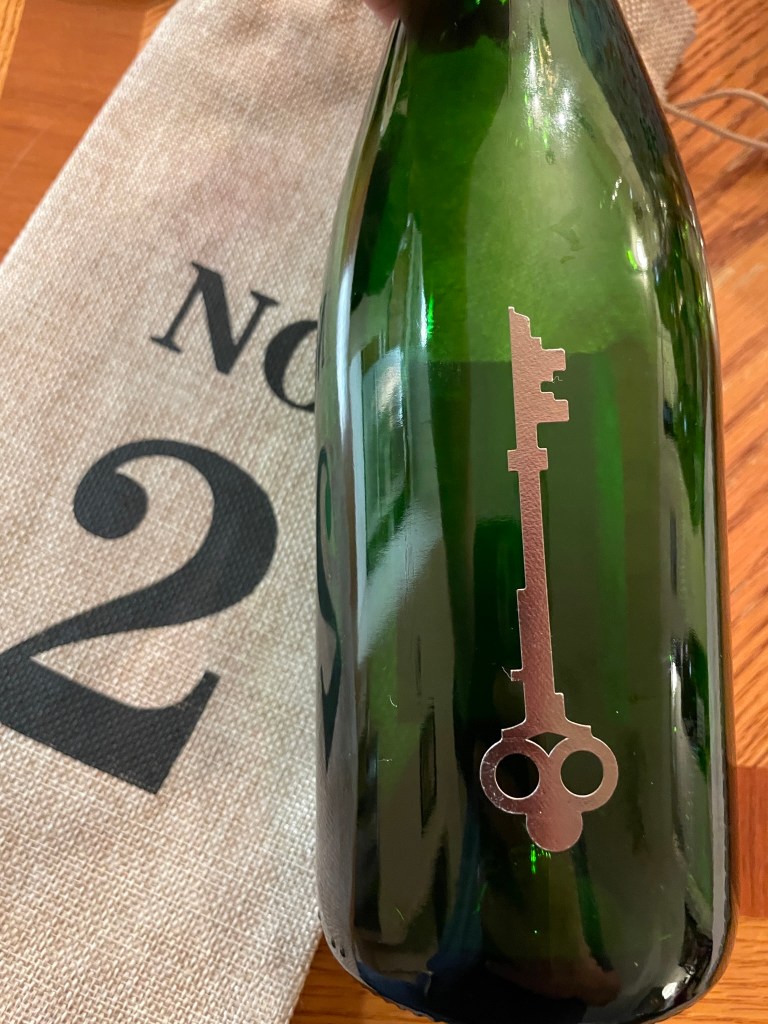
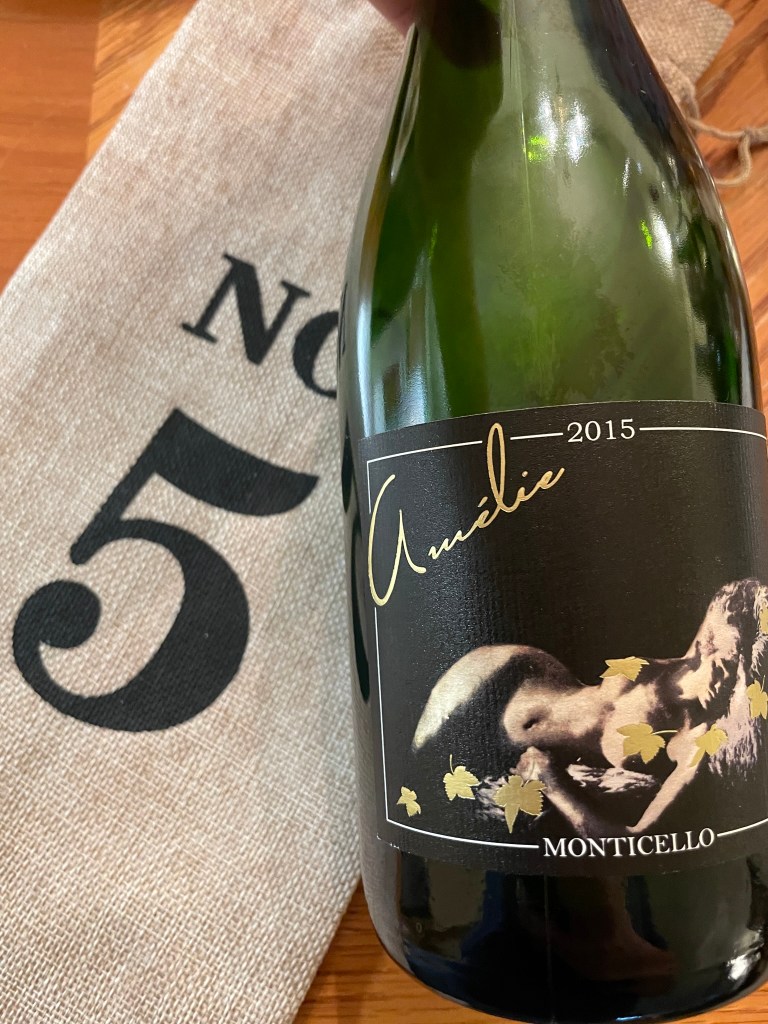
Keswick Vineyards Amélie (Charlottesville; $39 at the winery)
Albert Lebrun Blanc de Noirs Extra Brut (Marne Valley, Champagne; $38 on wine searcher)
We randomly paired the Virginia and French wines and bagged them in pairs. Bottles that won their flight advanced to the next round.
As always; this event was the product of THIS night with THIS group. On another day, we may have had different favorites.
Round 1 / Flight #1:
Wine 1: Eric Rodez Blanc De Noirs Grand Cru: 5 votes (winner)
Wine 2: 2019 CrossKeys Blanc de Noir: 1 vote
Eric Rodez comes from Ambonnay, one of 17 villages in Champagne authorized to label their sparkling as ‘Grand Cru’. I don’t know much more about them, other than any wine from champagne automatically has a serious rep to uphold.
CrossKeys is located in the ‘upper’ (southern) Shenandoah Valley. It’s made with pinot, which is grown specifically for sparkling production. This particular wine won “Best in Show” at the 2022 Atlantic Seaboard Wine competition.
PS – if you haven’t tried Shenandoah sparklings you should; the region’s cool climate makes it a good place for higher-acid wines, so sparkling are a good match.
Comparing the color and aromas of the two, the Grand Cru had more of a yellow hue with a funkier nose, while the CrossKeys was lighter with some light brioche.
On the palate the Eric Rodez had more complexity and we found it to be especially well balanced. The CrossKeys was easier drinking; lots of lemon notes. Someone mentioned a tad of vanilla, although it wasn’t from any barrel aging.
Votes:
Alex: #1; liked the depth
Lieven: #1; well balanced and overall drinkability
Lindsay: #2; felt it was easier drinking
Matt: #1, based on the greater complexity
Sarah: #1 enjoyed the brioche notes and the yeastiness
Stephanie: #1; noted the flavor carried through from the beginning to the end
Round 1 / Flight #2:
Wine #3: 2016 Trump Blanc de Noir: 5 votes (winner)
Wine #4: Mailly Grand Cru Blanc de Noir: 1 vote
Trump Winery’s sparkling shouldn’t need any introduction, as it makes some of the most famous sparklings in the state. You might even argue that its predecessor Patricia Kluge paved the way for local sparkling production in Virginia as she brought in Claude Thibaut (now one of the state’s premiere sparkling producers) as her winemaker.
The Mailley is another of Champagne’s Grand Cru villages. I couldn’t say much about it but hey…champagne!
The coloration of both were extremely close, but the noses were different. The Trump wine had yellow apple on the nose and was a little bready. It also took time to open up, although it never displayed any strong fruit notes.
The Mailly was smoky, and oddly enough seemed to get even smokier as it opened up. It was the drier of the two, although that’s not to say the Trump didn’t seem dry. It initially had a very displeasing cardboard note to it but that dissipated after about 10 minutes. It also had some tartness on the back end.
We felt the bubbles on both dissipated faster than we would have liked.
Votes:
Alex: #3; felt it was more drinkable
Lindsay: #4; once the funk came off, thought it was more complex
Lieven: #3; based on the balance and drinkability.
Matt: #3; I had a tough time choosing between the two and I probably couldn’t give you an exact reason why, but I just liked #3 better
Sarah: #3; also felt it was more drinkable
Stephanie: #3
Round 1 / Flight #3:
Keswick Vineyards Amélie: 3 votes (tie)
Albert Lebrun Blanc de Noirs Extra Brut: 3 votes (tie)
Keswick’s sparkling is made with cabernet franc, which is arguably the most versatile red grape in Virginia (as well as its most planted). It’s also available for purchase now (and I think it would make a great Thanksgiving wine).
The Albert Lebrun was different from the other two champagnes in that it was made of pinot meunier, which is usually used in Champagne as a blending grape. While it wasn’t planned, I liked that a cabernet franc and a pinot meunier were paired against one another, as neither style of sparkling is easy to find.
Sadly I didn’t capture as many notes on this round as I wished. I can say that while they both had strong starts, both changed in the glass in even more enjoyable ways as we enjoyed them. The Keswick had a vanilla nose and a palate that changed from vanilla to maybe orange notes. Some also detected a sense of petrol.
The funniest tasting note was someone mentioned that ‘it tasted like a donut’ in that the front and end palates were very enjoyable, but there wasn’t so much in the middle. Those who follow Keswick’s winemaker might laugh at this, since ‘donut’ is one of his favorite tasting phrases.
No notes for the Albert Lebrun, which is sad because this was one of the favorite wines of the night.
I took the votes and…it was a tie! I thought about using my place as host to cast a tie-breaker, but truth was I loved both equally. So I gave Keswick a wildcard and both went to the final round.
Votes:
Alex: #6; thought it was approachable, although he noted the shorter finish
Lieven: #5. Thought #6 was a little rough, while #5 was better balanced.
Lindsay: #5; no particular reason other than she just gravitated towards it. Thought #6 had lots of interesting things going on, though.
Matt: Split vote; ½ point for each; loved both
Sarah: #6. Thought the way #5 presented was ‘circular’ while also weightier, with lots of yellow apple and vanilla. #6 had more brioche-y notes.
Stephanie: Split vote; ½ point for each
Round 2 / Finalist Round
Normally we would have the single ‘best in flight’ wines go to the finalist round, but we enjoyed the third flight so much that we added both to the finalist round.
We tasted them side-by-side and rated them most-to-least favorite.
Alex: Keswick (4 points), Albert Lebrun (3 points), Trump (2 points), Eric Rodez (1 point)
Lieven: Eric Rodez (4 points), Trump (3 points), Keswick (2 points), Albert Lebrun (1 point)
Lindsay: Keswick (4 points), Albert Lebrun (3 points), Eric Rodez (2 points), Trump (1 point)
Matt: Eric Rodez (4 points), Albert Lebrun (3 points), Keswick (2 points), Trump (1 point)
Sarah: Albert Lebrun (4 points), Eric Rodez (3 points), Trump (2 points), Keswick (1 point)
Stephanie: Albert Lebrun (4 points), Eric Rodez (3 points), Keswick (2 points), Trump (1 point)
Wine #1: Eric Rodez: (17 points)
Wine #3: Trump Blanc de Noir (10 points)
Wine #5: Keswick Vineyards Amélie (15 points)
Wine #6: Albert Lebrun Blanc de Noirs Extra Brut (18 points; finalist)
So a caveat; we liked ALL of these wines (admittedly I personally wasn’t a fan of #4, but that’s a personal preference). One thing I did find interesting is the favorite ones tended to be some of the less-costly ones. None of them were especially fruity, which is something that often separates Blanc de Noirs from Blanc de Blancs.
In retrospect I might have opened them sooner so these wines had time to open up (I felt the CrossKeys definitely improved the following day). Sadly, my tasting events have a time limit.
So were we surprised that Champagne won? Not at all. That said, it wasn’t a blowout either.
The price point of these Virginia wines were on the whole comparable to these mid-priced Champagnes, and 2 made it to the final round. Two of my group selected the Keswick sparkling as the overall favorite of the night.
As far as I’m concerned, that Virginia was able to hang tough with a comparison to Champagne is a win in itself.


















































 Wine Trails and Wanderlust