Every December I make a pilgrimage for one of my favorite annual events – Linden’s library tastings.
Linden Vineyards opened in 1987, and owner Jim Law has been careful to hold back a portion of his vintages so he can see how they evolve over time. That’s allowed him to build an extensive wine library, some dating to nearly the founding of Linden. Jim opens up that library every December.
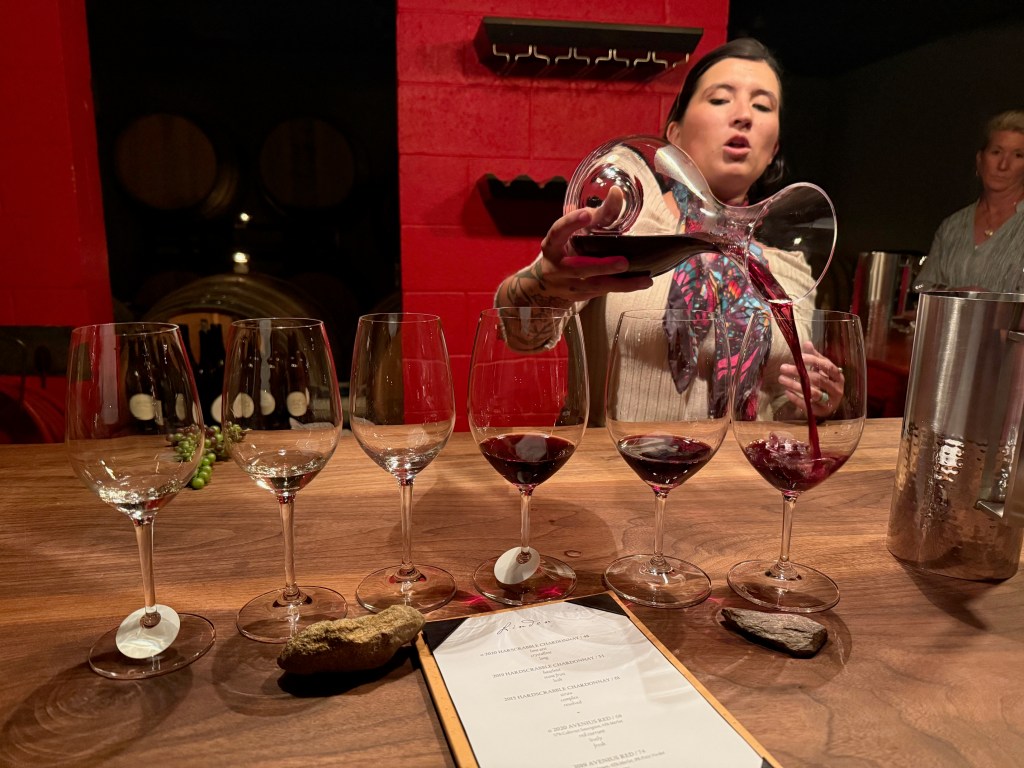
During the Friday I visited, Linden was doing side-by-side tastings of their Boisseau Chardonnay (2014 and 2019), Petit Verdot (2014 and 2016), and Avenius red (2015 and 2019).
Those were great, but the highlight of the day were the ‘bonus pours’ of their 1996 Chardonnay and 2004 Avenius red. Since library wines were for sale, I purchased a 2017 Avenius Chardonnay to share with my group.
Boisseau Chardonnay: Named after Linden’s warmest vineyard, just outside Front Royal. Both vintages were surprisingly fresh and high acid. I typically find Boisseau wines are more hedonistic compared to their higher-acidity cousins at Hardscrabble and Avenius, but the acidity was spot on here. Both wines were really outstanding.
2014 Boisseau. Ripe; lots of green apple, maybe pear? I was told the nose was reminiscent of chamomile tea nose, although I’ll have to take that on trust as I’m not a tea drinker.
2019 Boisseau. More tropical than outright ripe, maybe mango or even a hint of banana.
Petit Verdot. Petit Verdot is the only red wine Linden consistently labels as a full varietal (on rare occasions they’ll also make a Cabernet Franc). But technically, both of these PVs were blends, even if the vast majority of the juice was Petit Verdot.
These wines were also unique in that both had dashes of Carmenere, a variety that Jim experimented with but tore out because it was under-performing.
2014 Petit Verdot (88% Petit Verdot, 8% Cabernet Sauvignon, and 4% Carmenere). Fruit forward. The 12% blending soften it up a bit, so this isn’t a ‘slap you in the face with a blueberry’ PV. I had some sediment at the end.
2016 Petit Verdot (94% Petit Verdot, 3% Merlot and 3% Carmenere). Another soft expression of PV, but for a different reason. While the 2014 was made in neutral oak barrels, this was made in steel to deemphasize the tannin. Jammy, with raspberry notes.
Avenius red. This is Linden’s highest and coolest site. Lately, Avenius wines have been my favorites in side-by-side comparisons, partially because they are more ‘serious’ than wines made from Boisseau (although that 2014 Boisseau was excellent) but can be enjoyed younger than Hardscrabble.
2015 Avenius. Lots of earth with very faint fruit. I have a bottle I should try soon-ish if I’m to find those fruit notes.
2019 Avenius. The primary was there, although it was starting to explore those tertiary notes. I had a bottle in March and my notes then mentioned black fruit and high acidity. I didn’t get as much fruit this time though.
“Bonus pours”
1996 Chardonnay. This was all Hardscrabble fruit, although this was before the time when Linden had separate vineyards. The nose was nutty, and reminded me of a petit manseng. Nutty, caramel palate; layered. I’m in awe that a white wine could last nearly 30 years; I love ‘old’ chardonnays, and would absolutely try this again.
2004 Avenius red. Tart cherry. I wouldn’t call it ‘fresh’ but it wasn’t nearly as faded as you’d expect from a wine that’s over 20 years old. One member of my group mentioned it had an almost balsamic quality to it.
2017 Avenius Chardonnay. I hadn’t had this wine in a long time! Very full, even a little bit tropical.
Last weekend a group of friends and I went on what amounts to a pilgrimage to one of our favorite wineries in the state – Linden Vineyards.
I say ‘pilgrimage’ only half-jokingly. While I’ve seen owner/winegrower Jim Law described as the ‘high priest of Virginia terroir winemaking’, he actually dislikes lavish praise. Jim’s favorite title by far is ‘winegrower’, and he’s modest enough to still bus tables at his own winery.
Moreover, this wasn’t my standard visit. This event marked the return of Linden’s cellar tastings, an event that disappeared when COVID hit.
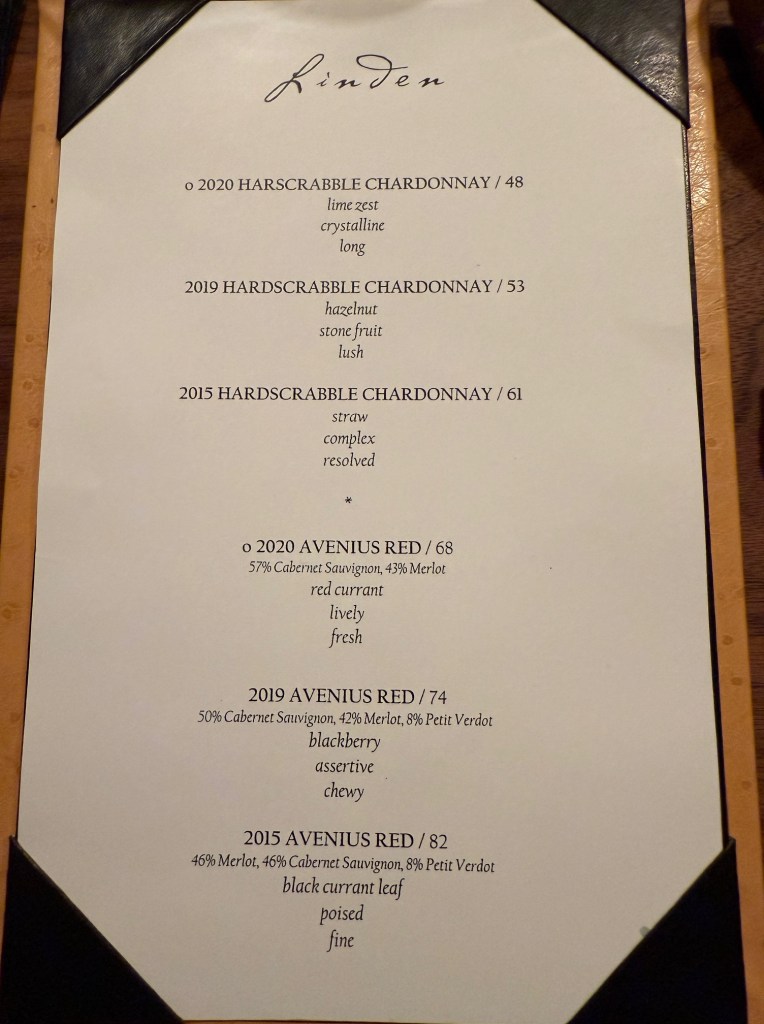
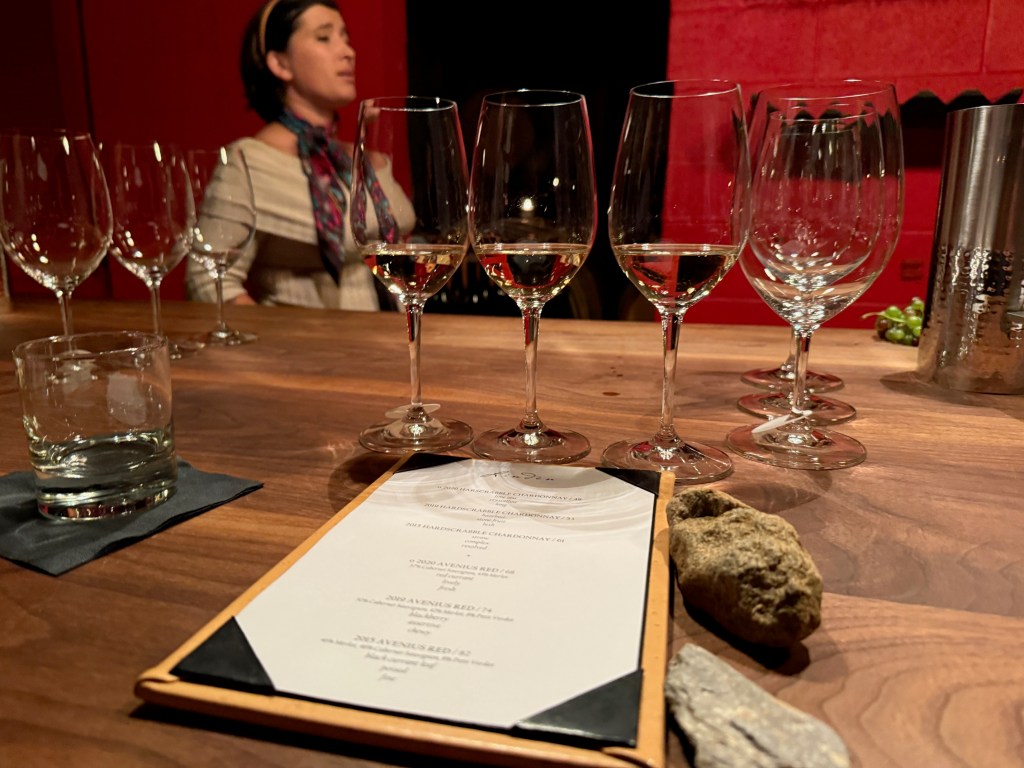
Linden’s cellar tastings include either a vertical (same vineyard different years) or horizontal (same vintage year but different vineyards). This particular event included verticals of Hardscrabble chardonnay (2015, 2019, 2020), and Avenius red (2015, 2019, 2020), plus a barrel sample of their 2024 Petit Verdot.
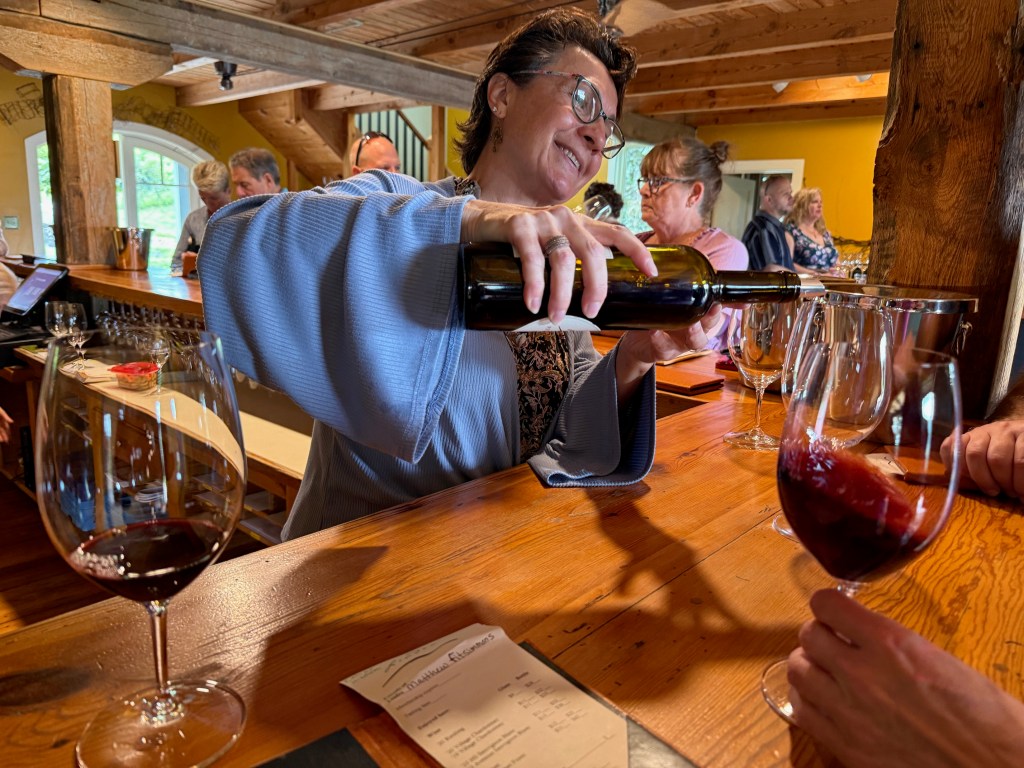
Weather-wise, we lucked out with a warm but not overly hot afternoon. I didn’t get a chance to chat with Jim, but I did catch up with his daughter Samantha, who was running tastings at the bar.
I did learn that despite the rain, things were looking OK in the vineyard. It also looks like this will be their last vintage of their Wabi Sabi white blend, which I’m not entirely sad about. Jim did spray earlier than usual to address the Spotted Lanternfly issue, which is unavoidable now given their prevalence in the state.
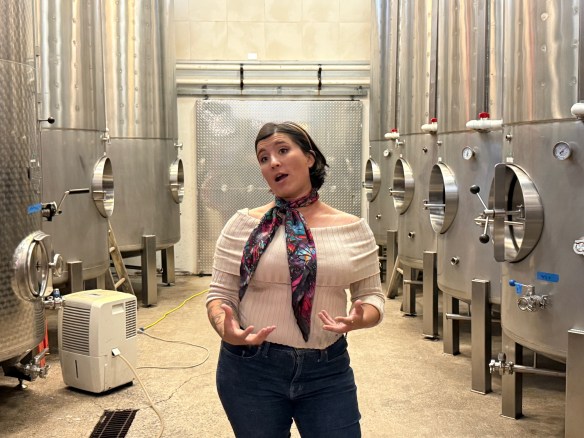
Once the last person arrived, we headed down to the cellar with McKenzie, a new addition to Team Linden. I didn’t get her full background, but she did have experience working the DC restaurant scene prior to moving to Culpepper. Hopefully we’ll see more of her.
I believe nearly everyone who attended this event was familiar with Linden’s wines, so we didn’t need to spend too much time on Jim’s low-intervention winemaking philosophy. That said, McKenzie was very extroverted host who loved telling us about the 6 wines before us.
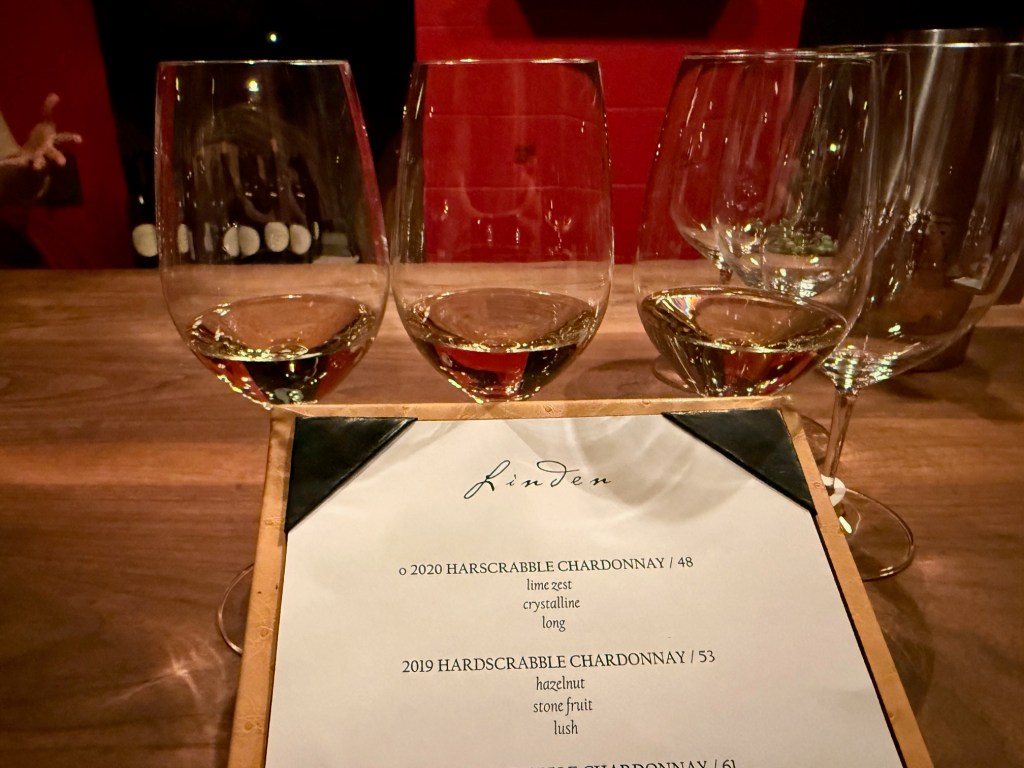
We kicked off with our Hardscrabble Chardonnay flight (made from the estate vineyard). I’ve had all of these before, but except for the 2019s not recently. I was especially excited by the 2015 Chardonnay, which Jim once said was one of the favorite wines he’s ever made.
2015 Hardscrabble Chardonnay: Very ‘full’ as white wines go. While it was starting to turn nutty, it still doesn’t present itself as a decade-old wine. Except for ‘age’ on the nose, it was still pretty vibrant and a tribute to the ageability of Jim’s wines. That said, Jim once told me this wine was probably at its peak, so it wouldn’t get any better than it was now.
2019 Hardscrabble Chardonnay: Very different from the other two. Much more stone fruit, plus very ‘bright’ due to being the product of a very warm year. I did detect a tad bit of newer oak on it. I think this wine will only get better.
2020 Hardscrabble Chardonnay: Stylistically similar to 2015, but riper. Good acidity; Kenny Bumbaco said it was ‘Chablis-y’. It was better than I remembered, although not quite in the same league as the other two. Still, it was a good wine from a vintage that isn’t well regarded in Virginia wine.
Next up was the Avenius red blend flight, grown just down the road at Shari Avenius’ vineyard. Shari has retired from the tasting room so I haven’t seen her in a long time, but it seems she is still tending her vineyard.
2015 Avenius (46% Cab Sauv, 46% Merlot, 8% Petit Verdot): Earthy nose. Not a lot of fruit but doesn’t need any, as it was an overall amazing wine. I have ‘persistent and chewy’ in my notes. I’m very glad I have a bottle of this in my cellar, although I probably should drink it sooner than later.
2019 Avenius (50% Cab Sauv, 42% Merlot, 8% Petit Verdot): Mix of fruit and earth on the nose. Good fruit on palate. You could likewise tell this was the product of a hot year, due to its ripeness.
2020 Avenius (57% Cab Sauv, 47% Merlot): OK; admittedly not my favorite. Brett on the nose and some on the palate, which gave it that barnyard/funk quality. I think you have to appreciate a little bit of brett to enjoy this, although it did give this wine an extra oomph of complexity and earthiness.
With the cellar tasting complete we adjourned upstairs for their regular tasting. Linden only recently switched over to a ‘summer’ tasting, now comprised of the 2023 Avenius Sauv Blanc, the 2023 Hardscrabble Sauv Blanc, the new 2022 Claret, and a full-varietal Cabernet Franc. And oh yeah – that 2024 Petit Verdot sample!
2024 Petit Verdot: Fruitier and lower in tannin than I expected. While different from what I usually expect, I definitely liked it. I believe it was made in steel, which is likewise unusual for PVs.
2023 Hardscrabble Sauvignon Blanc: Something a return to form, as this wine had a dash of Sémillon. Layered. In a way, it was like a riper version of a white Bordeaux.
2023 Avenius Sauvignon Blanc: Notes of boxwood…which is sometimes referred to as ‘cat pee’ (I hate that term, BTW). It was higher in alcohol, which meant the acidity wasn’t as prominent as it usually is.
2022 Cabernet Franc: This was the first full Cab Franc I’ve ever seen from Linden; certainly the first since 2010. All Hardscrabble vineyard fruit. It had a slight hint of the pyrazine notes that Cab Franc is known for, but they didn’t lean into that direction at all.
2022 Claret: I don’t have any notes for this one!
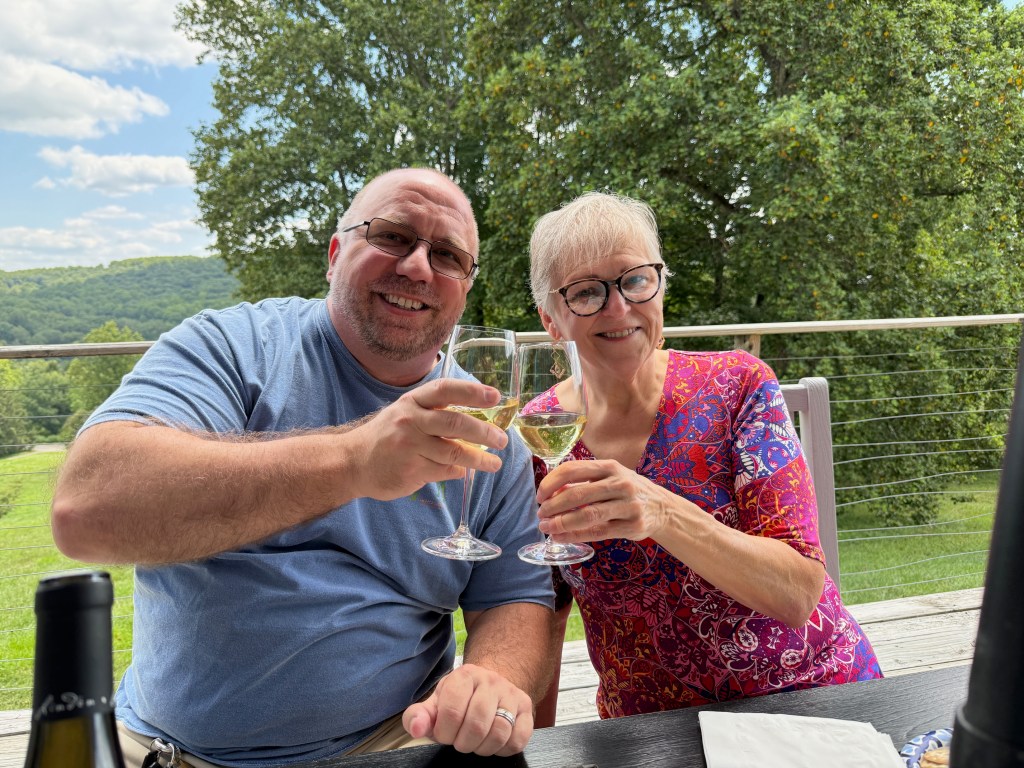
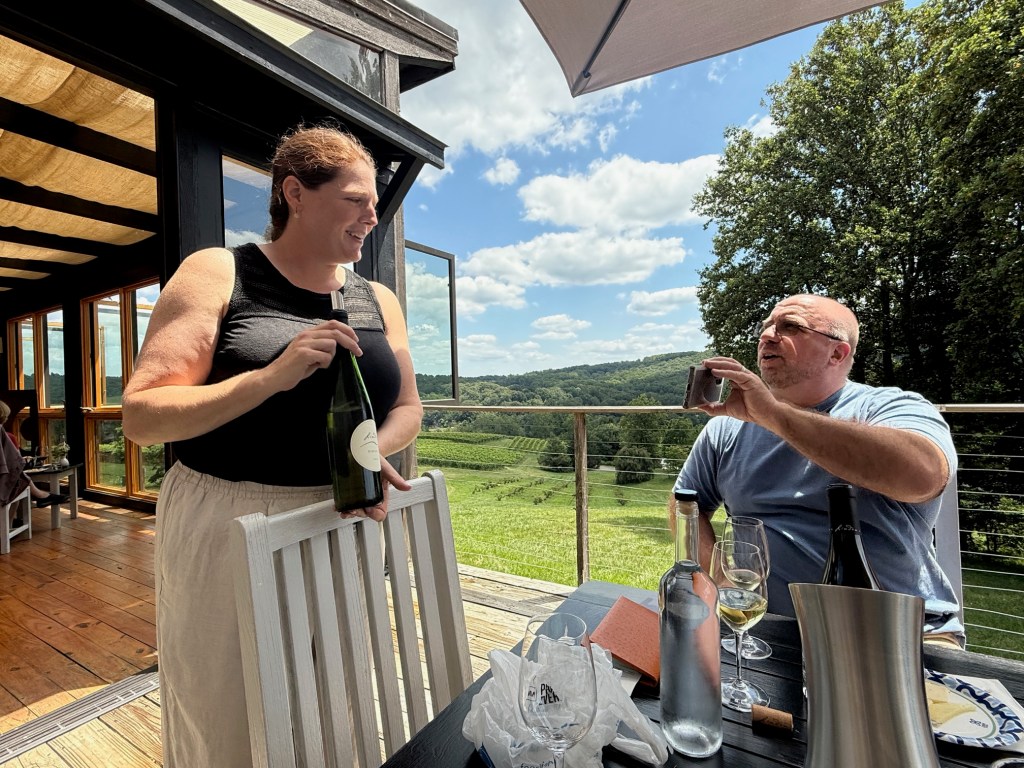
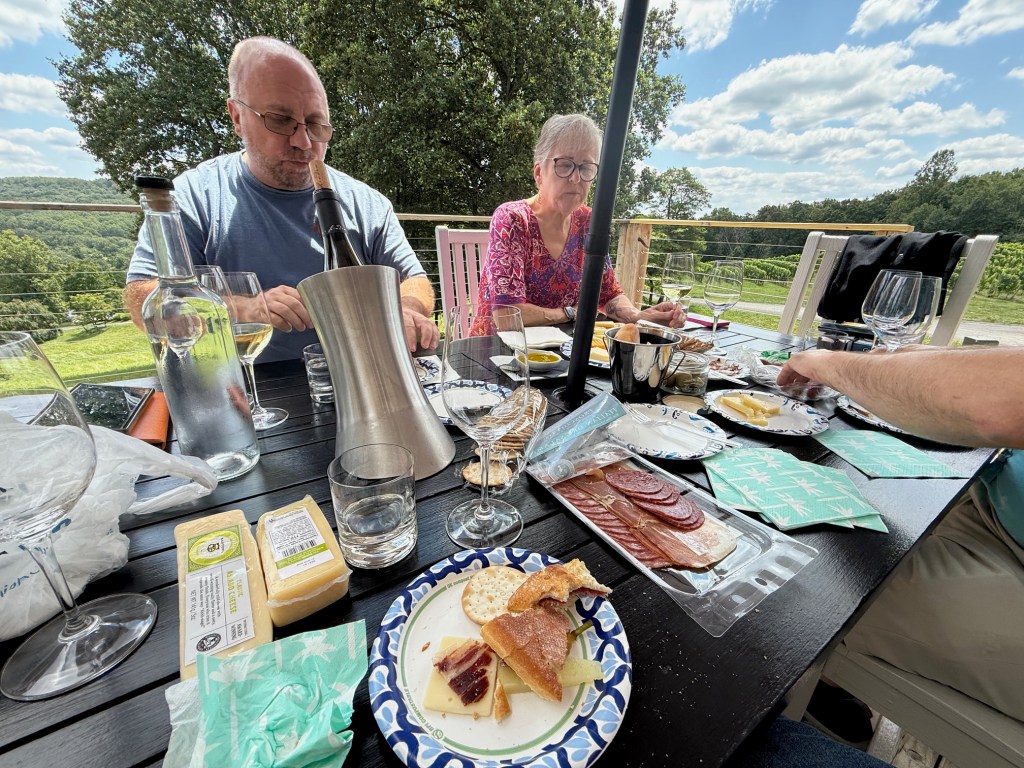
Afterwards we adjourned for snacks on their patio on a perfect summer day, ordering a 2015 Hardscrabble Chardonnay for the table and eating charcuterie. Then it was off to Barrel Oak, which has been upping its game of late (click this link for Dan’s blog on Barrel Oak; he loves more hits!).
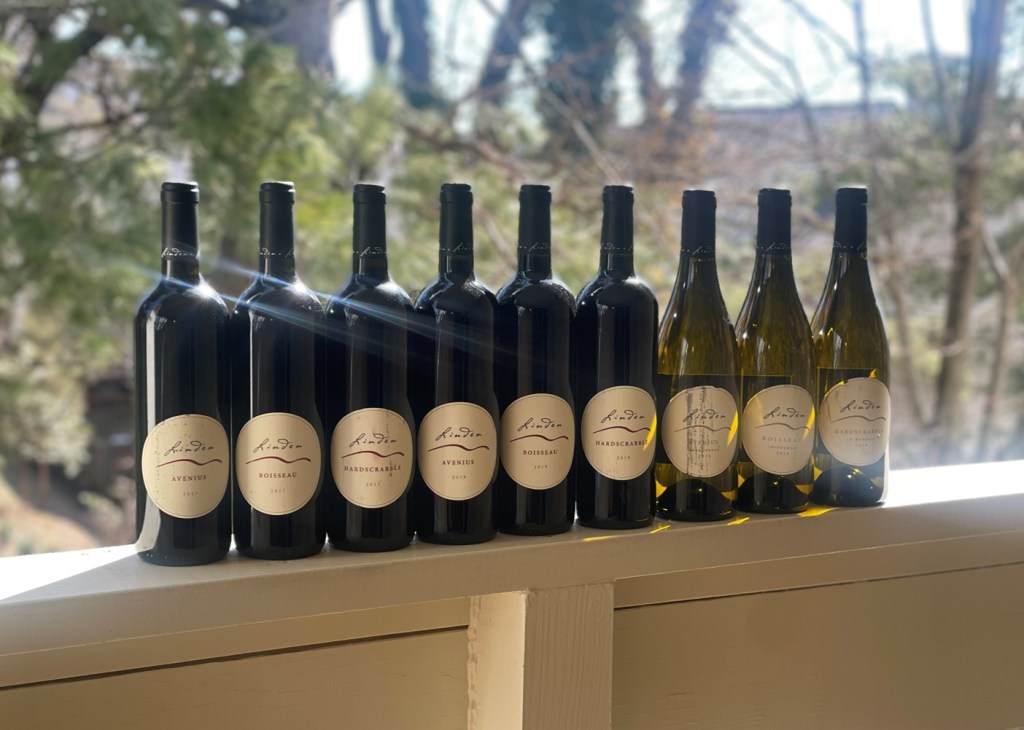
Few Virginia wineries are as terroir-driven as Linden Vineyards. Probably the best proof behind this statement is how many of Linden’s wines are named after the vineyards they come from; namely Avenius, Boisseau, and Hardscrabble.
These vineyards are the only places Linden uses for fruit, and their varying soil types and elevation means each provide a different tasting profile. While not every wine Linden produces is vineyard-specific (they also make a multi-vineyard Chardonnay called “Village” and red-blend named “Claret”), owner/winegrower Jim Law prefers to let the vineyards speak for themselves.
Avenius Vineyard (5 acres, 1,300-1,400 feet elevation). Linden’s highest and coolest site. Named for and farmed by Shari Avenius. Located less than a mile from the winery, but on a very different soil profile.
Boisseau Vineyard (4 acres, 600 feet). This is Linden’s lowest and warmest site. Named for and farmed by Richard Boisseau. As the smallest vineyard, it’s not uncommon for a vintage to lack a vineyard-specific Boisseau wine as the fruit was blended into Claret or Village.
Hardscrabble Vineyard (~20 acres, 1,100-1,400 feet elevation). This is Linden’s largest, oldest, and most diverse vineyard, located at the winery. The best blocks go into Hardscrabble (red or white), while the younger ones go into Claret & Village. Some vines date back to 1985.
Picking a favorite Linden vineyard is something of a parlor game for Virginia wine nerds. Hardscrabble arguably produces Linden’s most famous wines, but don’t discount the other two. “Acid-heads” love Avenius’ higher-elevation fruit, while Boisseau produces some of Linden’s easiest-drinking, more fruit-forward wines.
Nevertheless, I wanted to try all three side-by-side, and it wasn’t difficult to find helpers for this task. Most had tried Linden wine before, although only a few of them had been exposed to this kind of multi-vineyard, multi-vintage experience.
My tasting was both a vertical in that the reds came from two different years (2017 and 2019), and a horizontal in we had all three vineyards represented. 2017 and 2019 were also two of the better growing years in recent Virginia history.
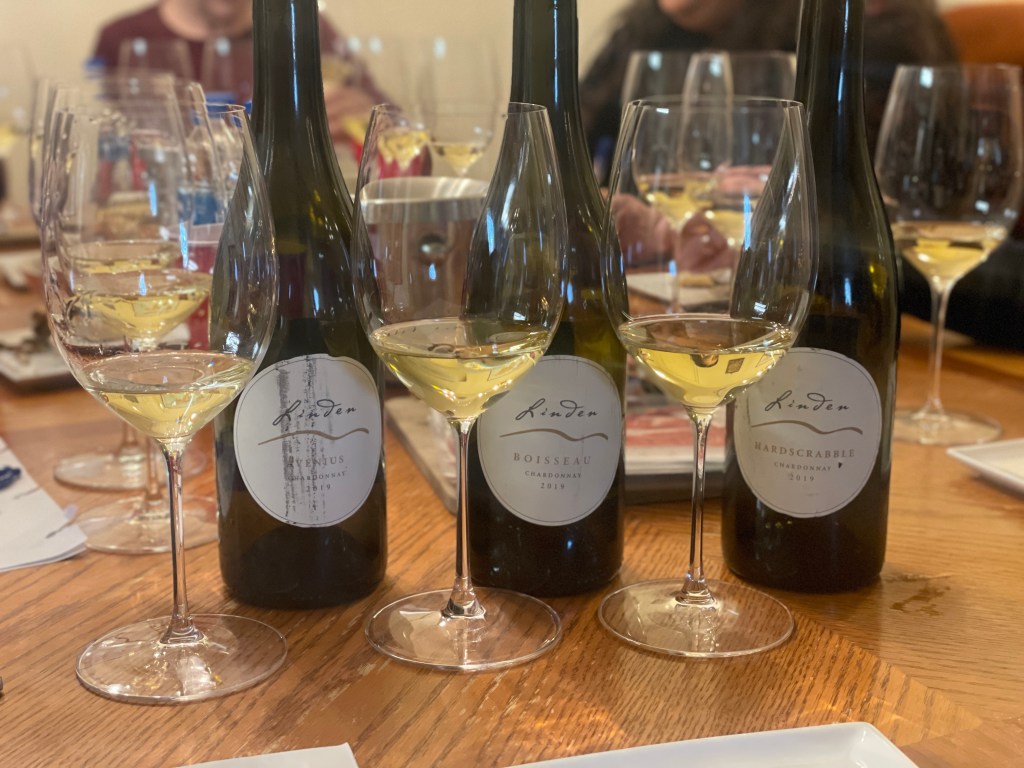
Our Chardonnay flight (only 2019 vintage)
2019 Avenius
2019 Boisseau
2019 Hardscrabble
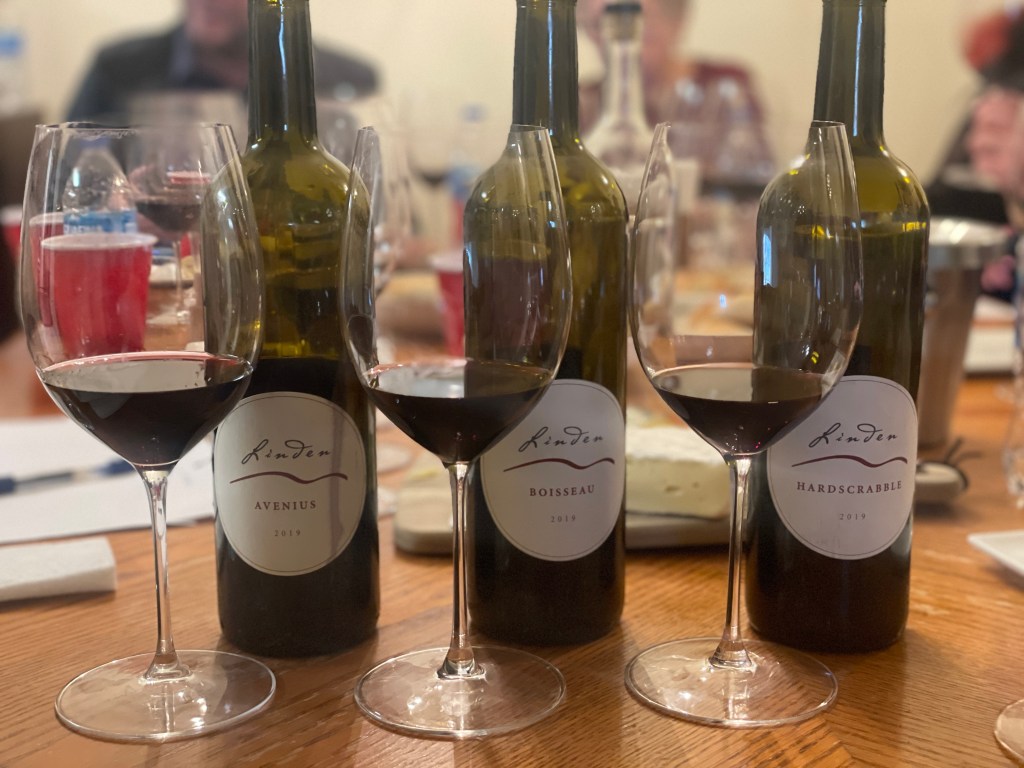
Our Bordeaux blend flights (2017 and 2019 vintages)
2017 Avenius (54% Merlot, 46% Cabernet Sauvignon)
2017 Boisseau (40% Cabernet Sauvignon, 34% Petit Verdot, 20% Merlot and 6% Cabernet Franc)
At the end of every round, I did a poll to determine our favorite from the flight. But in reality, “Best” was entirely subjective. Even the wine that was the ‘least’ favorite was something we’d have happily enjoyed.
All reds were decanted for 1.5-2 hours prior to the event. Jim has exceptionally detailed notes describing the vintage years and individual wines, so follow the embedded links more information on the Linden website.
2019 Chardonnay Round
Linden vineyards exist in no small part because Jim Law was inspired by Chablis. While most winemakers tend to advertise red blends as their ‘flagship’ wines, Chardonnay is of such importance that I’d argue Linden’s ‘flagship’ is its Hardscrabble Chardonnay.
These three Chardonnays had distinct personalities, but we usually saw more similarities than differences. Avenius and Hardscrabble are definitely ‘cousins’, while Boisseau was more of an outlier. Yet there was still a common thread of fruit and minerality to all three.
Linden 2019 Avenius Chardonnay. You could tell this was ‘mountain’ fruit because its acidity was more pronounced, plus it showcased minerality and structure. Very *bright*. Several of us detected notes of citrus, specifically lemon. Kathy mentioned chalk. Daniel mentioned ‘apple tart’.
Linden 2019 Boisseau Chardonnay. Lots of fruit notes. Tropical nose, notes of banana. Daniel mentioned maybe an herbal note. I heard someone mention tarragon and kiwi. Another guest mentioned a bitter note.
Linden 2019 Hardcrabble Chardonnay: This wine just felt ‘big’ on the palate. Apple and butterscotch notes. Also notes of orange peel, citrus, specifically a sweeter orange. The acidity is there, but you sometimes had to wait a moment for it to hit you. One person mentioned it had almost a certain waxiness to it.
When I did my poll, 7 out of 8 of us preferred Avenius. We almost universally felt the 2019 Avenius was very clean and ready to drink.
Hardscrabble was the runner up. It also had acidity, just not to the degree of Avenius. That said, we felt HS would only get better and better. Boisseau was definitely well enjoyed, but it was just a different animal than the other two.
Favorites:
Alex: 2/1/3. The outlier of my group!
Daniel: 1/3/2. By technical standards, he felt #3/Hardscrabble was the ‘best’ wine of the lineup, but felt Avenius was drinking great now. While both still had years to go, the Hardscrabble hadn’t yet peaked.
Kathy: 1/3/2.
Lieven: 1/3/2. Felt the Avenius was ‘ready to drink’ right now.
Matt: 1/3/2
Mark: 1/2/3
Todd: 1/3/2
Vanessa: 1/3/2. Felt the Avenius had the most lift and was clean, even waxy.
2017 Red blend round
2017 was one of Linden’s best vintages in years, for both reds and whites. These wines are likely to last for many, many years to come.
I was surprised that a vintage 8 years old tasted so fresh. As Virginia’s weather becomes increasingly erratic we are seeing more instances of ‘hot years’ that causes local fruit to become disjointed, or ‘rainy years’ which results in underripe fruit. But 2017 was a goldilocks year where the pieces fit almost perfectly.
Linden 2017 Avenius red: 54% Merlot, 46% Cabernet Sauvignon. Refined tannin but a shorter finish. We detected newer oak but it’s so integrated you don’t mind at all. It also leaned heavily on the fruit, with notes of blackberry and boysenberry. Someone mentioned notes of pine, eucalyptus, and it was ‘forest-y’. This wine also evolved the most in the glass.
Linden 2017 Boisseau red: 40% Cabernet Sauvignon, 34% Petit Verdot, 20% Merlot and 6% Cabernet Franc. Fruit notes, especially dark cherry. Some felt it was almost too fruity, and they struggled to find notes beyond it. Others noted a root beer quality to it, plus notes of pyrazines and pepper. While the general consensus was while this wine had more fruit than we preferred, it was “nice” fruit; not jammy at all. It also had a good structure to it.
Linden 2017 Hardscrabble red: 57% Cabernet Sauvignon, 43% Merlot. Balanced; medium/medium plus acidity. Ripe fruit, especially plumb. But there were also notes of minerality, including graphite. Notes of cassis were mentioned, while another guest said it was “meaty” and had a cigar box quality to it. This was also the most food-centric wine of the trio.
By a unanimous vote, the 2017 Hardscrabble red was our favorite. Avenius came in 2nd and Boisseau 3rd, also with unanimous votes by all eight attendees.
I’m absolutely not surprised that the 2017 Hardscrabble red was the favorite wine here. I’ve blind tasted it numerous times, and it’s nearly always my favorite in a contest of other championship-level wines.
Note to self; I should decant it more the next time I pop a bottle, since I felt the 2017 HS initially presented more earthy notes than I personally prefer, but the complexity popped out once swirled in the glass.
Favorites:
Alex: 3/1/2. Thought of steak when drinking the Hardscrabble, but felt the Avenius could be enjoyed on its own
Daniel: 3/1/2. The Hardscrabble was “balanced and complex”. The Avenius shared many of its qualities, just less so.
Kathy: 3/1/2
Lieven: 3/1/2. Felt the Hardscrabble was “elegant and elevated”
Matt: 3/1/2
Mark: 3/1/2
Todd: 3/1/2
Vanessa: 3/1/2. Said “The Avenius has structure, but the Hardscrabble has everything”
2019 Red blend round
While this vintage was two years younger than the 2017 round, the 2019 reds actually presented as being older and smoother than the 2017s. I attribute that to 2017 being such a great year that balance was easy to achieve, while 2019 was a hotter, riper year.
Linden 2019 Avenius red: 50% Cab Sauv, 42% Merlot, 8% Petit Verdot. The barrel notes were well integrated. Notes of black cherry and raspberry were mentioned. Tart. Higher acidity than the other wines in this flight.
Linden 2019 Boisseau red: 61% Cab Franc, 19% Petit Verdot, 17% Merlot, 3% Cab Sauv. Our notes were all over, but my favorite descriptor was “Hedonistic”. Long list of fruit and/or earthy notes, with some tasters leaning one way or the other. Many mentioned notes of black cherry, perhaps with a compote/sweet fruit note to it. A few mentioned liquorish. Others said it was ‘grippy’ and chewy. Still others felt it had more earthy characteristics, maybe a little mushroom, even ‘spice box’.
Linden 2019 Hardscrabble red: 65% Cab Sauv, 19% Cab Franc, 16% Merlot. Balanced. Notes of bramble fruit, baking spices, maybe a little brett. Cigar box and leather was mentioned. The tannin was chewy bur refined. Not a lot of fruit notes, though.
By another 8-person unanimous vote, the 2019 Boisseau red was decreed the favorite of our 3rd round. When he first tried it, I believe Daniel said something to the effect of, “That’s what I’m talking about!”. Avenius was almost universally the runner-up, and Hardscrabble was 3rd.
My best guess was the warmer year accentuated the fruit qualities of the Boisseau. It was also an outlier in this was our only red that was Cabernet Franc heavy, and people seemed to gravitate towards some of the spice notes that better Cab Francs have.
Favorites:
Alex: 2/3/1. Felt the #3/Hardscrabble needed more time
Daniel: 2/1/3. Likewise felt the Hardscrabble needed more time
Kathy: 2/1/3
Lieven: 2/1/3
Matt: 2/1/3
Mark: 2/1/3
Todd: 2/1/3. Felt #2 was the most open and balanced
Vanessa: 2/1/3. Said that #2/ was “great right now”
The results
In summary, here were the favorites per round:
2019 Avenius Chardonnay (7 out 8 votes)
2017 Hardscrabble red (8 out of 8 votes)
2019 Boisseau red (8 out of 8 votes)
I love that every round picked a different vineyard as their favorite. The qualities of each vineyard definitely shined through, influenced by the year the wine was made.
That said, I’m positive that had we tried this event either a year earlier or later, we easily could have come up with different results. Certain wines we tried this day were just ‘in their prime’, while others (especially Hardscrabble) arguably needed another year to reach their peak.
I admit I was somewhat surprised how unanimous we tended to be, given my group was rather diverse. 3 of us had been visiting Linden for years. Another 3 were DC-based wine experts who had experienced Linden, although not necessarily older vintages. The last 2 guests had until recently been living in Sonoma and were just starting their Virginia wine journey. Yet this group was extremely consistent in how we rated all 3 flights.
I did one last poll regarding favorite vineyard…and the overall favorite vineyard was Avenius. Guests seemed split whether they preferred the Avenius red or white. Again; ask us on another day, or with a different variety, we may have selected otherwise.
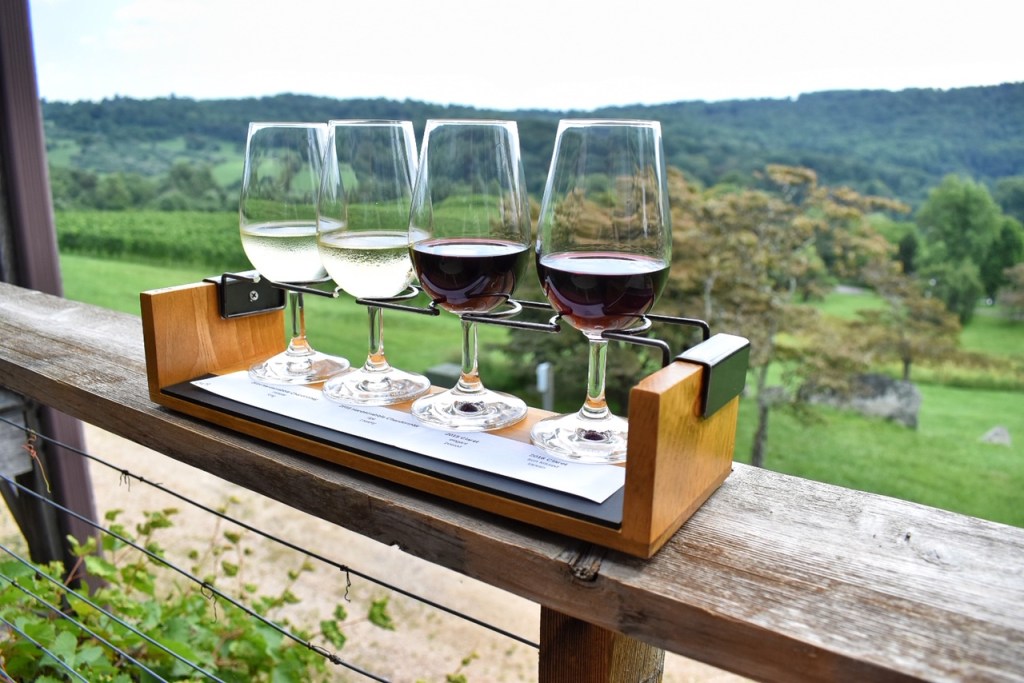
Linden recently hosted what might be my favorite event of the year – a pair of Friday-only library tastings. Being an overachiever, I went to both.
Jim Law produced his first vintage in 1987, so it’s fair to say that Linden has a considerable number of older bottles to choose from. He’s often spoken about the need to hold on to bottles for the future, be it comparative tastings or just for his own education. Even now, Jim’s older bottles often portend the direction his current releases are going.
Linden used to do Library tastings every December until COVID hit, so this is something of a return to norm. I was really impressed that Linden charged the same price for this library tasting that they do for their regular tastings. I attribute that to Jim being a ‘wine educator’ at heart, and he wants to make the study material available to everyone.
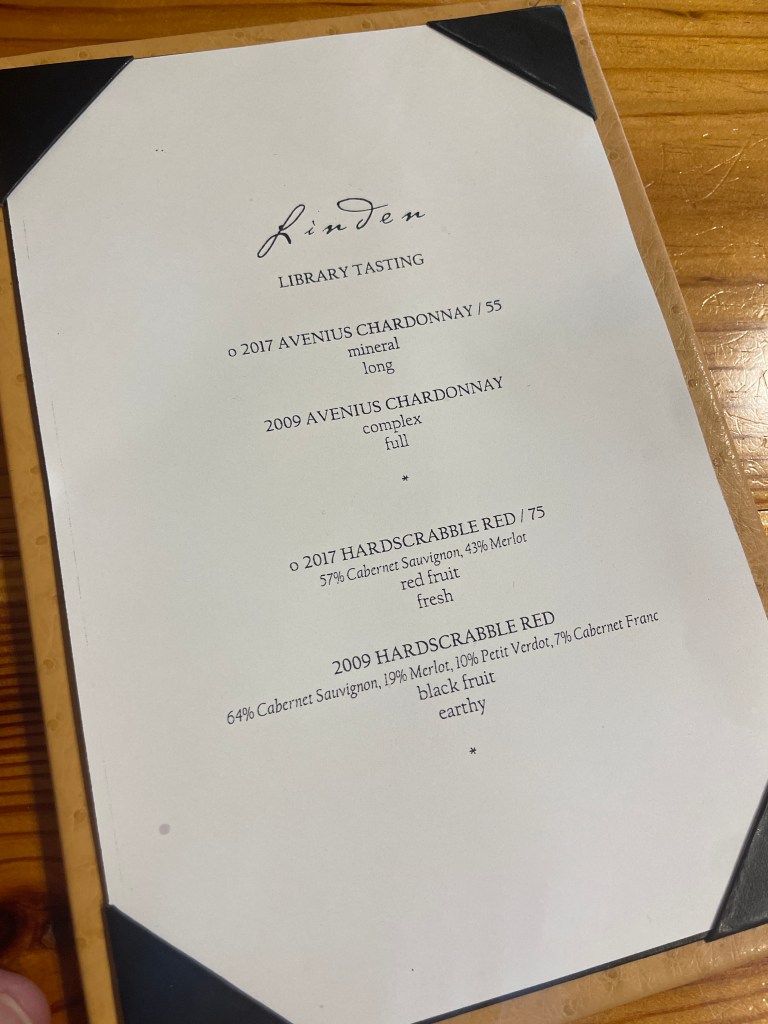
Both days included a pair of comparison flights of a 2009 and a 2017, which Jim selected because stylistically these are similar vintages. He also threw in a few extra bottles during both days.
The first flight included a 2009 and 2017 Avenius Chardonnays. Both were especially warm and dry years; arguably 2 of the best in the past 15 years. The 2009 was considerably darker compared to the 2017.
I bought a number of bottles from the 2017 vintage, so I know it’s great. Yet compared to the 2009, the 2017 just paled in comparison. It really didn’t seem fair to put 2009 compared to anything else, since 14 years of age just gave it so many extra layers.
By comparison, the 2017 was still tight, even if it was excellent. If in 8 years it turns into the 2009, then I’d be very happy.
On top of these bottles, Jim brought over a sample of the 2007 Avenius Chardonnay to make this flight a trio.
The 2007 was considerably softer but still provided plenty to savor. My friends who joined me for my 1st visited debated which was better. Some preferred the 2007 for its complexity, while the 2009 ‘was more delicious’.
I ended up getting a glass of the 2009 Avenius to enjoy in the members room.
Comparative flight #2: 2009 Hardscrabble red and 2017 Hardscrabble red
To be fair, the 2017 Hardscrabble red is one of my all-time favorite Virginia wines ever. I’ve used it in blind tastings and wine professionals (including one born and raised in Bordeaux) insisted this was a Bordeaux wine. This bottle had maybe a tiny bit of brett in it, but only in a way that added to its complexity in a good way.
The 2009 was more leathery, no fruit but plenty of power. The rim was a little watery but it didn’t present as an ‘old’ wine.
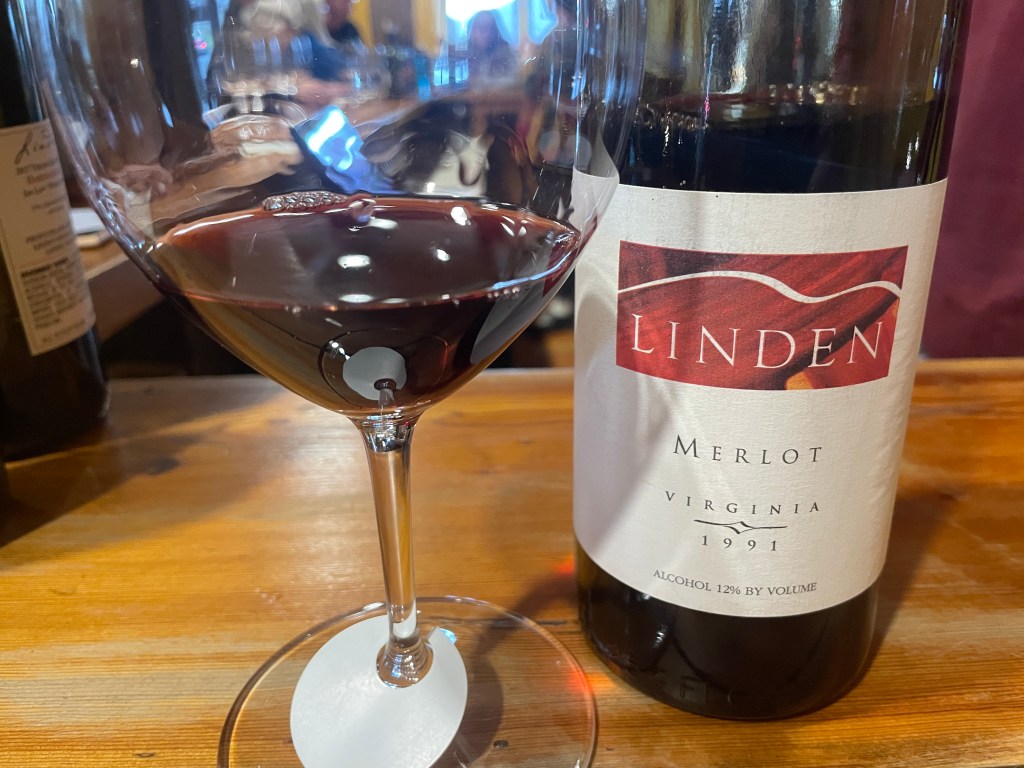
“Bonus flight” #1: 1991 Merlot and 2001 Reserve
Neither of these bottles were on the original tasting. But when Jim opens a ‘bonus’ tasting, you just sit back and enjoy.
While drinking the 1991 Merlot I learned a new wine descriptor; ‘sanguine’. It directly translates as ‘bloody’, and is a reference to not just the color but the iron notes it exudes.
To me, if a red wine could be minerally, this is it. It also had some history to it, since the red label came from a finger painting of Jim’s daughter Sam (who now works at Linden full time).
Jim explained the 2001 Reserve was an example of him chasing the current trends of the time. He designed it to be all power, no finesse. It also seemed to predate his focus on vineyard-specific wines. Shockingly, it still had some fruit notes to it.
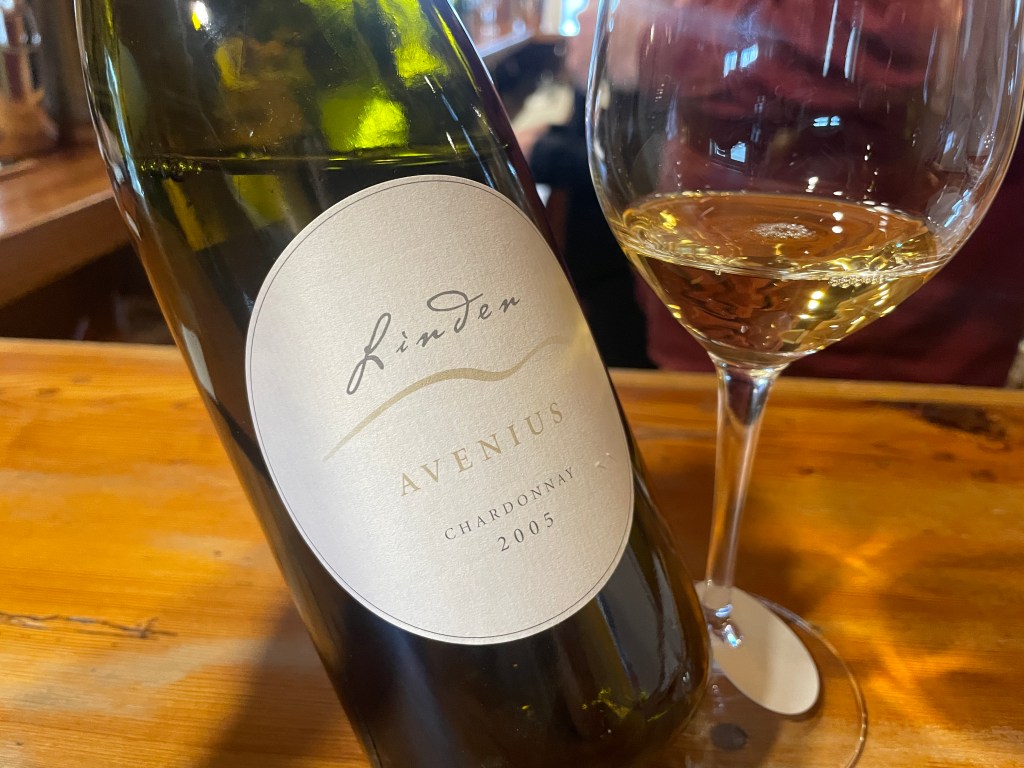
During my 2nd visit I was able to get a new trio of wines; flight of 2005 and 2006 Avenius Chardonnays, and a 1997 Reserve.
The 2005 had very little fruit left; it was like biting into an old lemon that was becoming a husk. The 2006 was livelier. Of course, neither held a candle to the 2009 Avenius.
The 1997 Reserve was perhaps the best ‘old Virginia wine’ I’d ever had. There was still some fruit there, despite being 27 years old. Earthy but still drinkable.
Turns out Jim only made 2 ‘Reserves’; one in 1997 and one in 2001. Both were precursors to today’s Hardscrabble reds.
I enjoyed one last glass of the 2009 Chardonnay, then off to Walsh Family Wine.
A few months ago, I did a blind “Judgement of Virginia” tasting, modeled off the famous Judgment of Paris where California triumphed over France. 7 French wines were compared to 7 similar Virginia wines, all made between 2017 and 2021.
I knew our Virginia wines would do well, but to my surprise all 7 Virginia bottles beat their French counterparts. Granted I picked high-quality Virginia wineries, but even I was shocked at the blowout.
After examining the contest I realized something; Virginia went into this comparison with an advantage since its wines can be enjoyed young, while wines from Bordeaux require time to age. So, I came up with a new idea – to compare older Virginia Bordeaux-style vintages against similar French wines in order to keep the matchup even.
I invited a panel of experts (OK – they were wino friends of mine…who happened to have a great deal of industry experience and/or above average palates) and we sampled 3 Virginia Bordeaux-style wines vs 3 actual Bordeaux wines, all made between 2012-2015. Everything was done blind.
While I call this a “Bordeaux blend comparison”, that term isn’t entirely fair despite the Virginia wines using 100% Bordeaux grapes.
Cabernet Franc and Petit Verdot often play prominent roles in Virginia, but very secondary ones in France. Also, Bordeaux wines tend to favor either Cabernet Sauvignon or Merlot (often around 75% Merlot for right bank Bordeaux, but far more variable blends for left bank Bordeaux), while Virginia red blends tend to be more evenly distributed between multiple grapes. This means while the grapes may be the same, the composition of the blends could be very different.
The tasting was simple; compare two wines side by side and we’d select a favorite. While several attendees were wine judges, I elected to keep things simple and have everyone simply pick a single favorite of every flight. In the case of a tie, the host (me) decided between the two.
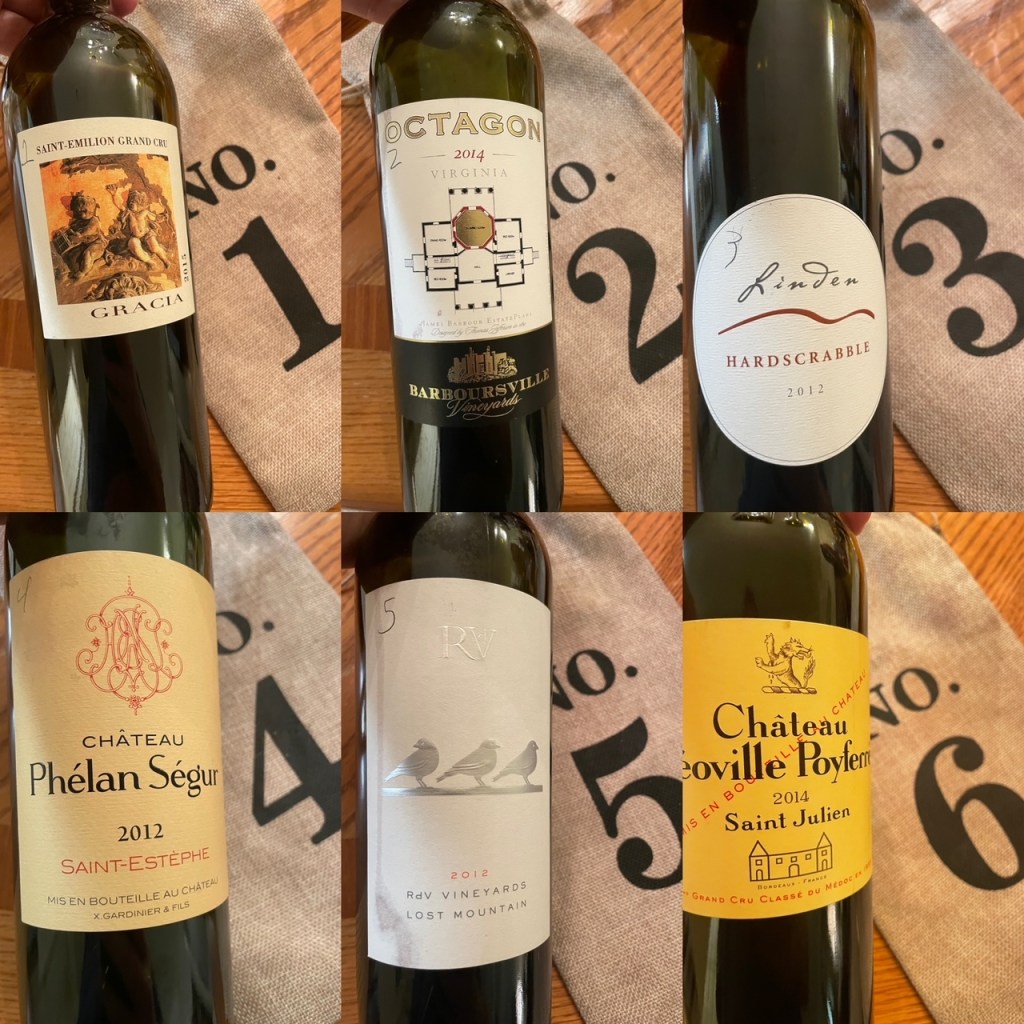
I bagged everything in pairs, so nobody (including myself) knew which pairs we were trying. All we knew is one wine was Virginia, and the other was Bordeaux. The specific pairings were selected in advance, based on the wine’s age and blend.
The wines:
France:
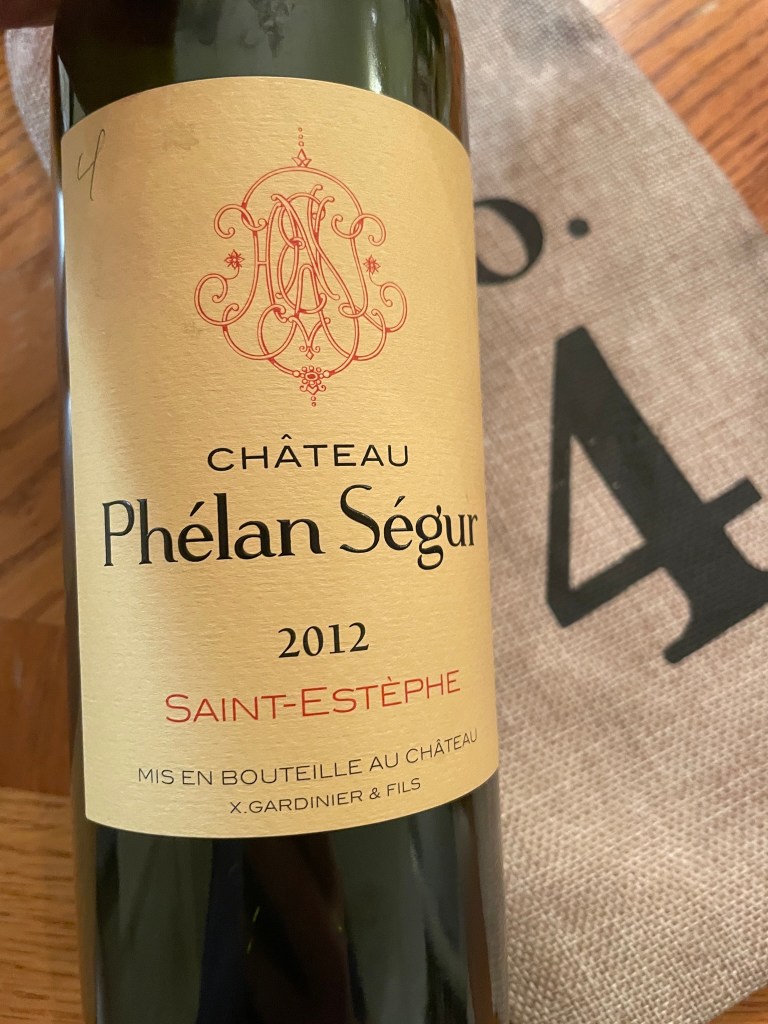
2012 Château Phélan Ségur: 50% Cabernet Sauvignon/ 50% Merlot (Left Bank, Saint-Estèphe) (wine searcher retail $62, with significant regional variation)
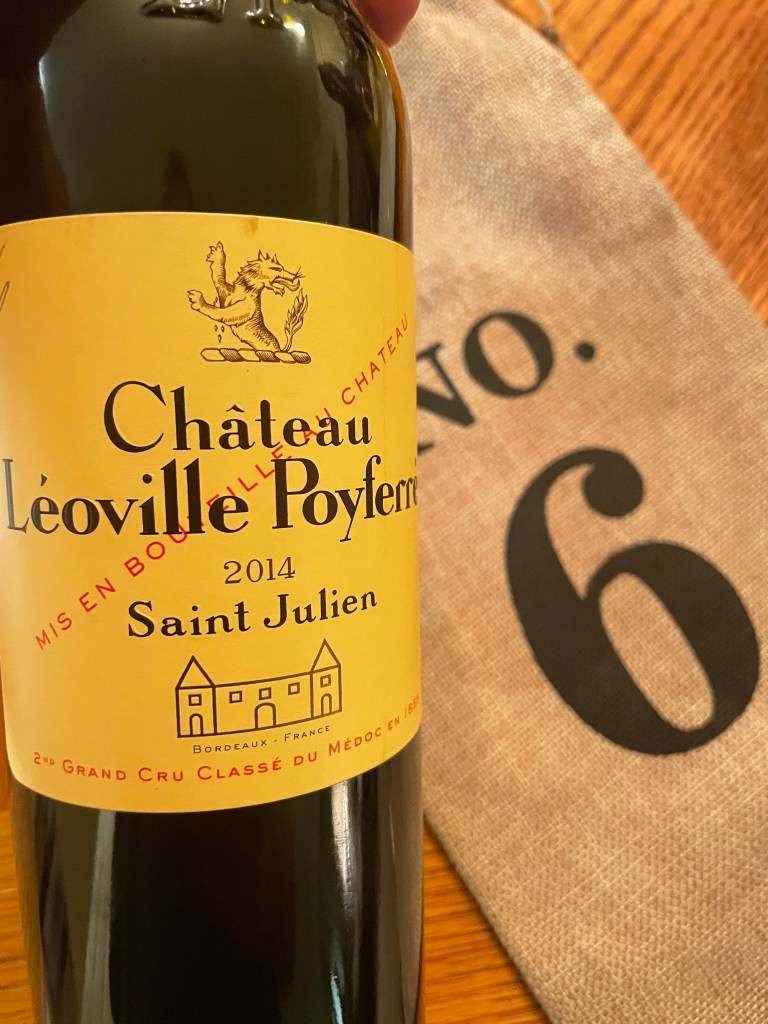
2014 Château Léoville-Poyferré: 60% Cabernet Sauvignon / 35% Merlot / 3% Cabernet Franc (Left bank Second Growth, Saint-Julien) (wine searcher retail $118, locally priced at $80)
2015 Château Gracia: 70% Merlot / 25% Cabernet Franc / 5% Cabernet Sauvignon (Right bank Grand Cru, Saint-Émilion) (wine searcher retail $111)
Virginia:
2012 Linden Hardscrabble: 56% Cabernet Sauvignon / 34% Merlot/ 9% Cabernet Franc / 1% Petit Verdot (selling at $75 in the winery)
2012 RdV Lost Mountain: 46% Cabernet Sauvignon / 40% Cabernet Franc / 14% Merlot (impossible to price due to scarcity; originally around $120 but recent vintages price at $220)
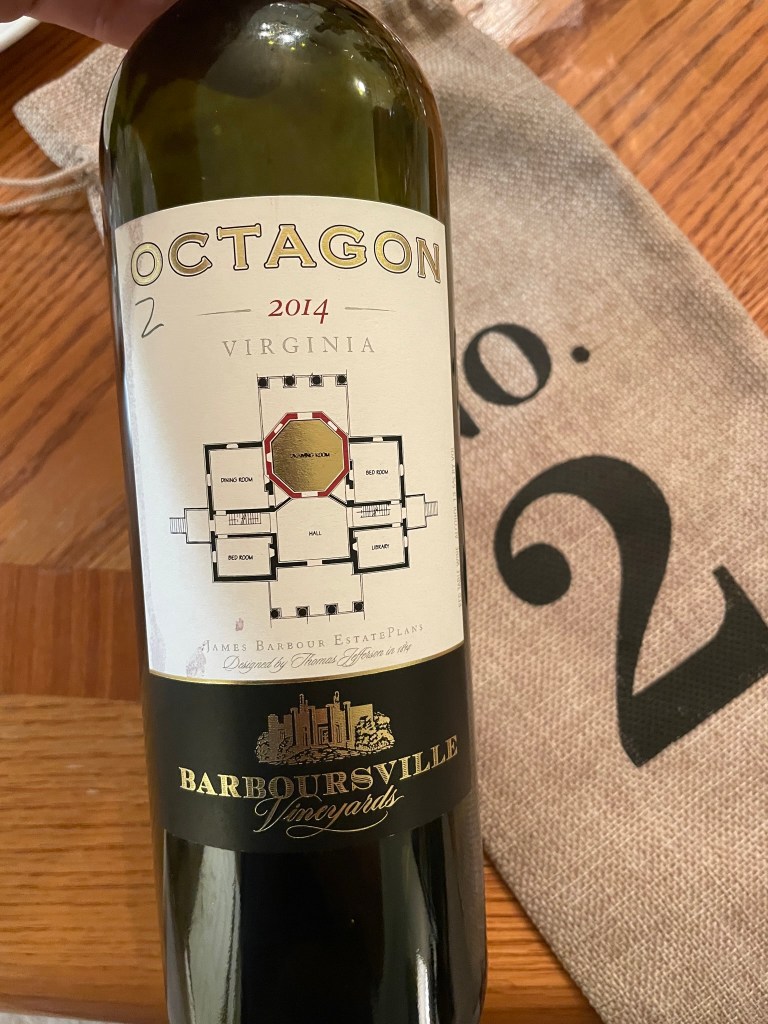
2014 Barboursville Octagon: 56% Merlot/ 23% Petit Verdot / 15% Cabernet Franc / 6% Cabernet Sauvignon (impossible to price to do scarcity; originally around $50 at the winery several years ago but likely retailing over $100 now).
Each of these came from well-regarded producers on both sides of the Atlantic. Even the experienced group tasting with me sometimes had difficulty identifying which was Bordeaux and which was Virginia. Of the 6 of us tasting 6 wines, I think we were accurate under 70% of the time.
As always, a caveat: this competition was the result of this day, with this group of people. It by no means indicates the wines that were selected as round favorites were superior to the other, or the wines that didn’t win their round weren’t loved. For this particular event, I’m convinced that at least 5 of the 6 wines we tried could have been selected as the ‘winner’ with a different food pairing; they were that good.
Pairing #1:
Wine #1 (2015 Château Gracia): 70% Merlot / 25% Cabernet Franc / 5% Cabernet Sauvignon (Saint-Émilion): 3 Votes
This round was evenly matched. I asked Dave McIntyre to pick a favorite and he didn’t want to give an answer; both of these were so equally well loved.
That feeling was shared amongst the group. To nobody’s surprise we were tied 3/3 (note to self – I need to have an odd number of tasters in the future). Not only that, but I think half of us (including me) got the Virginia wine wrong.
Ultimately I picked #2 to go to the next round, although it could have gone either way.
Alex: #2. Thought #1 was Bordeaux, also mentioned it was approachable. Notes of black current, red cherry, and tobacco backed by a long finish. Yet #2 was even more approachable with lots of red fruit, cola and a nice brightness to it.
Dave: #2. Loved both; didn’t want to pick between the two. #1 had a more ‘candied’ fruitiness he thought was associated with Virginia, but had less oak integration and was less harmonious because it didn’t have a lot of tannin. #2 loved it, and made a note about the color.
Matt: #1. #1 had some primary fruit on the nose but it was fading. #2 had some funk; earthy nose.
Katie: #2. She thought #1 was Virginia; liked the wine although she didn’t think the tannins were well integrated.
Kathy: #1. #1 had grippy tannins and more prominent fruit. #2 she found the fruit harder to find, and maybe a little reductive.
Vanessa: #1. Good maturity; tannins were chalky. Lots of fullness on the finish. #2 was brighter, velvety tannins, good acidity.
This was another even round. I favored #4 but not by a huge degree. Again, I was wrong on which was Virginia vs France since I thought I felt a lot more Cab Franc on #4, but was proven wrong (it had none).
With another 3/3 vote I was the tie-breaker here since I favored #4, so it went to the next round. Coincidentally it was my favorite of the night.
Alex: #3: Notes of smoke, tobacco, black cherry, vanilla, blackberry, and strawberries, with a long finish.
Dave: #4. Thought #3 was dense, dark fruit note, needed more time to develop. #4 had notes of clove, and maybe a cigar box note to it. Of the two, this was the one that was presenting better ‘now’.
Matt: #4. I found #3 to be lighter on the nose; some fruit but with an earthy palate. #4 had more pepper but very smooth tannins. I admittedly thought this was Virginia.
Katie: #3. Though #3 was elegant, and ‘couldn’t stop going back to it’. Also very floral. #4 had a herbatiousness to it, and thought it needed food.
Kathy: #3. Very “pretty” wine. Stewed strawberries but not overly jammy. #4 was had a meaty and spicy note.
Vanessa: #4. Thought #3 was lighter, good fruit quality, and less extraction. Overall it was ‘elegant’. #4 had more extraction and richness. She thought it had a brett note which gave it more complexity.
Pairing #3
Wine #5 (2012 RdV Lost Mountain): 46% Cab Sauv / 40% Cab Franc / 14% Merlot (5 Votes, round winner)
Wine #6 (2014 Château Léoville-Poyferré): 60% Cab Sauv / 35% Merlot / 3% Cab Franc (Saint-Julien) (1 Vote)
This round had a clear winner. #6 came off as too tannic; my mouth was positively dry after tasting it. But #5 was enjoyed all-around.
Alex: Split his votes between the two. #5 was more approachable, with lots of black pepper baking spice, cloves, and plumb on the palate. #6 had notes of dark chocolate, cherry and red fruit, but had a harsh nose.
Dave: #5. Dave said #5 had a pretty nose, was floral, and tasted notes of black currant and soft tannin. #6 had an off-putting nose and a very tannic finish.
Matt: #5. I found #5 to have some fruit on the nose but not the palate. Of the two, this was definitely the more drinkable right now. #6 was more of a food wine. Tannic finish, very dark and brooding overall.
Katie: #5.
Kathy: #5 had notes of blackberry, plumb, maybe menthol. Wished the finish lasted longer. #6 had an interesting notes, burnt toffee character to it on the palate.
Vanessa: #5. Thought #5 was well put together, while #6 was disjointed.
Finalist Round:
Wine #2 (2014 Barboursville Octagon): 56% Merlot/ 23% Petit Verdot / 15% Cabernet Franc / 6% Cabernet Sauvignon
Wine #5 (2012 RdV Lost Mountain): 46% Cabernet Sauvignon / 40% Cabernet Franc / 14% Merlot
From most favorite to least favorite, the results were:
Alex: Wines 2/5/4
Dave: Wines 4/5/2
Matt: Wines 4/2/5
Katie: Wines 5/4/2
Kathy: Wines 5/4/2
Vanessa: Wines 4/2/5
The lowest vote earned 1 point. The runner-up had 2 points, and the favorite wine got 3 points.
2014 Octagon from Barboursville had 7 points
2012 Lost Mountain from RdV had 11 points:
2012 Château Phélan Ségur had 12 points (Finalist)
Results:
I’d say there were a few take-aways.
The biggest is I felt this event demonstrated Virginia has the ability to go toe-to-toe with Bordeaux. Of 3 pairings, Virginia tied its Bordeaux counterpart twice and once easily surpassed it. 2 Virginia wines made it to the FInalist round, and the 2012 RdV Lost Mountain was also the 2nd favorite wine of the evening.
I was pleased to see how incredibly close these parings were at multiple levels. Every wine deserved high scores, and I truly believe that on another day, most of them could have been picked as our finalist. Even identifying the Bordeaux of the mix was sometimes difficult.
Second would be that while price and quality often go hand-in-hand, that’s not 100% true. The favorite of the day was the least expensive wine of all (still not cheap at $60-ish, but still). Not surprisingly RdV came in second, but the ‘brown bag’ method definitely evens the playing field.
Lastly, if there’s a downside to this event is while this tasting showed to me Virginia’s potential, the reality is it’s nearly impossible for our average wine lover to enjoy this kind of comparison. Virginia wines are often sold young, and limited inventory means most ‘older’ vintages are almost impossible to find. Even long-time Virginia wine collectors might only have a few special bottles from the 2012 vintage (or earlier).
Also keep in mind that the Virginia wines I selected represent the ‘elite’ of what the state has to offer. Few Virginia wines can age for 10 years like these did, or are made with the exquisite craftmanship we found.
Next up – a comparison of mid-priced Virginia red blends, a Cabernet Franc day, another sparkling round, and Petit Manseng.

















 Wine Trails and Wanderlust