Bordeaux vs Virginia Blind Merlot

“Fcking” Merlot is arguably the least-appreciated wine in Virginia. Petit Verdot and Petit Manseng are the rising stars people like to talk about, while Cabernet Franc and Chardonnay are vineyard workhorses. Yet for some reason, Merlot doesn’t get the same level of attention.

A look at Virginia’s recent wine competitions doesn’t help its case. Merlot has earned a grand total of 8 Gold medals in the past three Governor’s Cup competitions. Not bad…but that pales compared to 49 Golds for Petit Verdots and 24 for Petit Mansengs in the same space of time. Heck, even Albariño has earned 10 VA Governor’s Cup Golds recently, and that’s with a fraction of the plantings Merlot has.
So on the face of it, maybe it’s fair to say Merlot doesn’t have the same level of luster as other well-known varieties. Yet that statement defies logic, for two reasons.

First, Merlot is the 2nd most planted grape in the entire state, according to the most recent survey of Virginia grape growers. Petit Verdot and Chardonnay are close, but Merlot is still ahead by a handful of acres. This isn’t what you’d expect from a variety that’s unappreciated. It helps you can find a lot of clay (Merlot’s preferred soil) in Virginia, so Merlot is well suited to this state.

Second, Merlot is a key component of a number of Virginia’s most iconic Bordeaux-style wines (looking at you, King Family, Barboursville, and Michael Shaps, to name a few). In many of them, Merlot is often their largest contributor.

Merlot’s most famous expression is probably found on Bordeaux’s Right Bank, although arguably that’s somewhat an unfair statement. Bordeaux wines are nearly all blends, so tasting a Right Bank Bordeaux is more like a “Merlot & friends”. That’s a big difference to Virginia Merlots, where 100% expressions are the norm.

So when I decided to do a Merlot comparison, it wasn’t a straight-up comparison. All four bottles from Virginia were 100% Merlot, while only one of the French bottles was 100%. The remaining three Bordeaux were anywhere from 80%-88% Merlot, and finding bottles with that high a percentage was difficult.

Tasting & Scoring Methodology

I picked the Bordeaux bottles in advance, selecting ones that were anywhere from $35-$45 and composed of least 80% Merlot. I paired the French and Virginia bottles according to vintage age as best as I could.

I felt ~$40 was a sweet spot price-wise since the French bottles would largely be at the same price point as their Virginia counterparts. I assume I was getting more export-oriented bottles (France tends to keep its best stuff, or put it outside my price point), but such is Bordeaux’s esteem that even ‘budget-friendly’ Bordeaux wines punch above their weight.

I also took the unusual step of decanting all of my wines. Young Bordeaux are notorious for taking time to open up, so I made sure they all received a good 2 hours in my decanters. The Virginia wines usually got an hour.

A group of friends & I blind tasted 4 comparison flights, each consisting of one French and one Virginia wine. All the flights were bagged blind. It wasn’t planned that way, but it turned out the odd numbers were always Virginia and even numbers were France.

Every round my guests picked a favorite, and also told me what region they felt it came from. After we sampled all of them, we did a vote to decide the top 3 wines of the day, then revisited the top wines for a 2nd tasting.

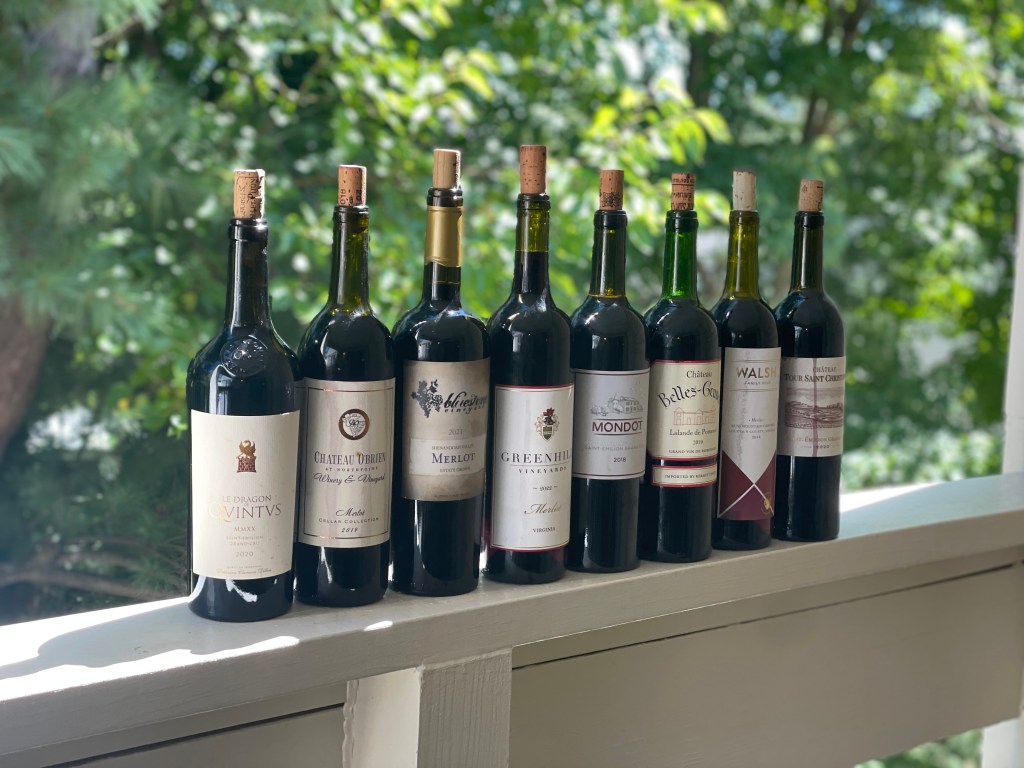
The contenders:

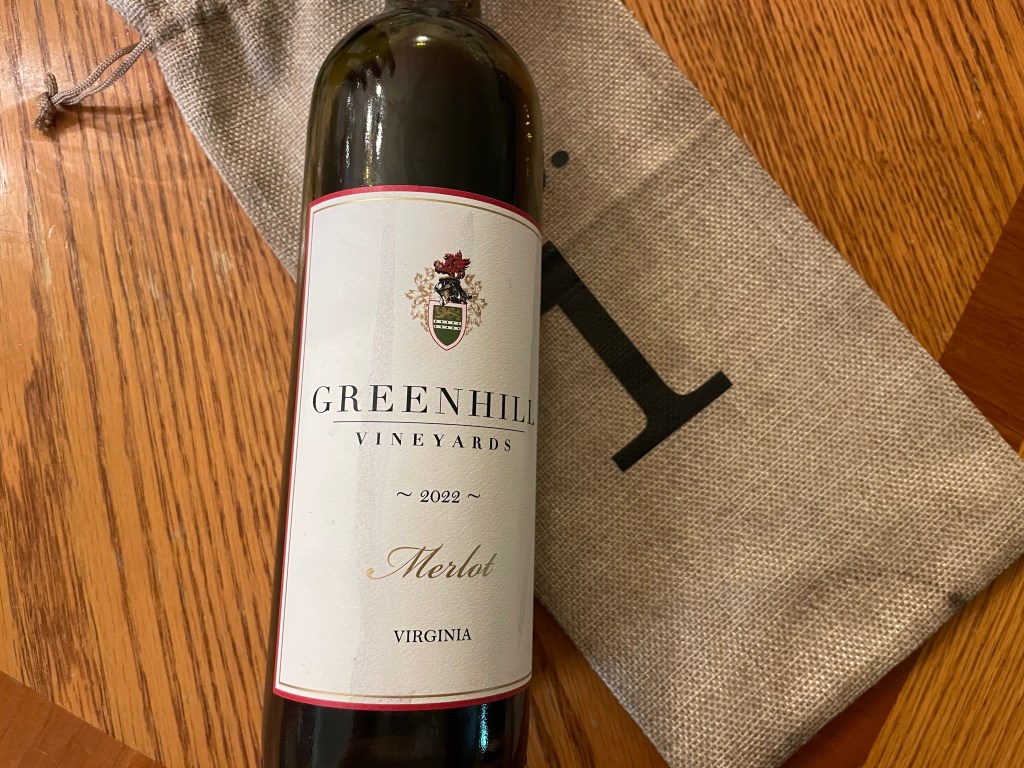
1. 2022 Greenhill Vineyards Merlot

2. 2020 Chateau Dragon de Quintus – St. Emilion (84.7% Merlot, 15.3% Cabernet Franc; roughly $40)

3. 2019 “Russ Mountain” Walsh Family Wine Merlot ($42)

4. 2019 Chateau Belles Graves – Lalande de Pomerol (88% Merlot, 12% Cabernet Franc; $46)

5. 2019 Chateau O’Brien Merlot ($69)

6. 2020 Troplong Mondot – St. Emilion (100% Merlot, roughly $40)

7. 2021 Bluestone Vineyard Merlot ($27.50)

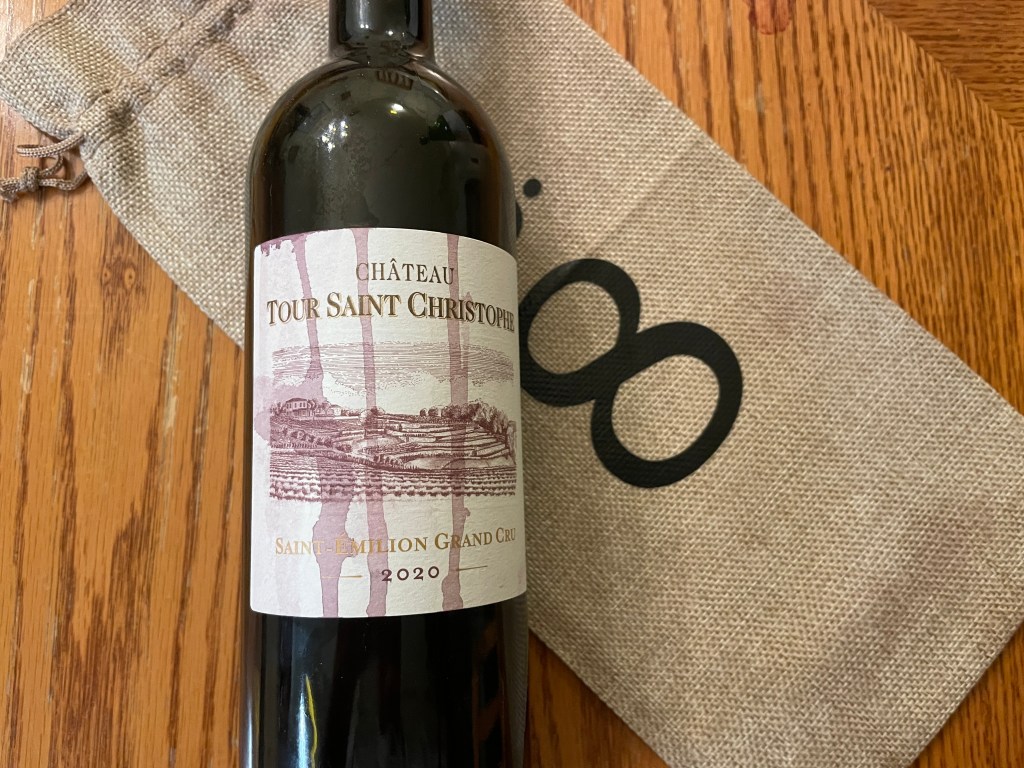
8. 2020 Chateau Tour St Christophe – St. Emilion (80% Merlot, 20% Cabernet Franc; $35)

Flight #1

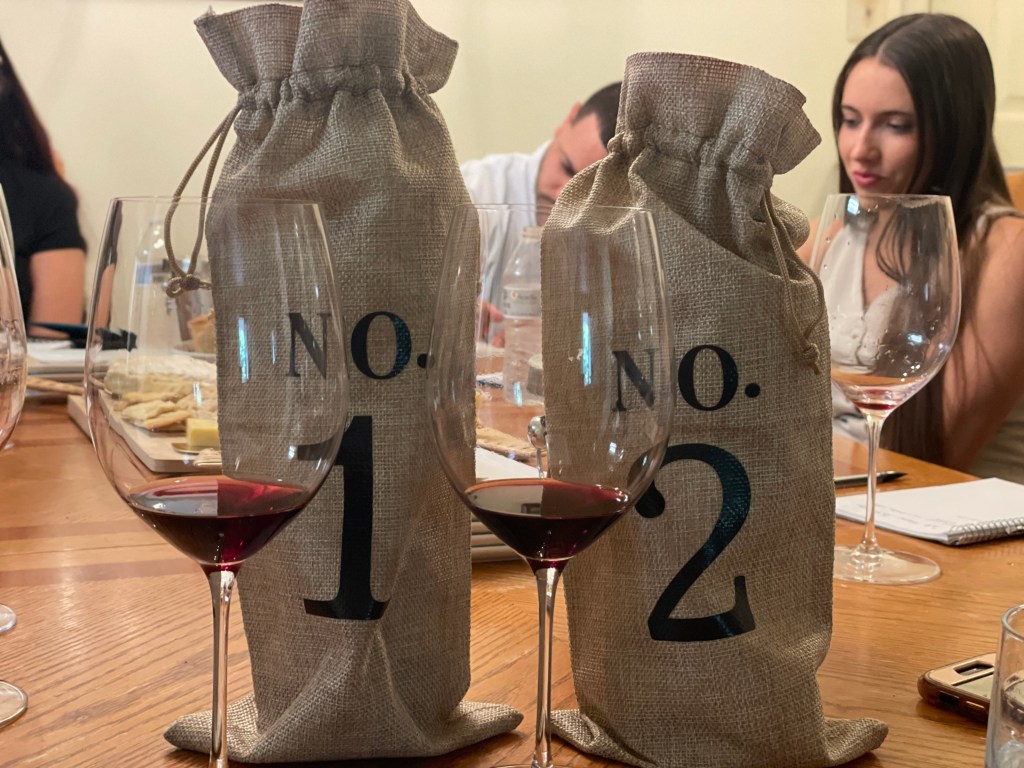
  • Bottle #1: 2022 Greenhill Vineyards (4 votes)
  • Bottle #2: 2020 Chateau Dragon de Quintus (4 votes)
This was a tough round to judge. The results were evenly split, with #1/Greenhill generally being described as more smokey/spicy while #2/Dragon de Quintus was more tannic/punchy, with notes of dark fruit and forest floor. We didn’t do a great job identifying the correct region, as Greenhill really came off as ‘old world’.

Bottle #1 / 2022 Greenhill Vineyards (Virginia). The first wine (Greenhill) was a shade lighter, had some earth notes, but didn’t present as ‘New World’ to me. Our tasting notes generally focused on how it was more smokey/spicy, smooth, with reminders of autumn. 

Bottle #2 / 2020 Chateau Dragon de Quintus (France). This wine was definitely the earthier and bolder of the two. I felt #2 was France, but I wasn’t completely certain of that call.

Most of the tasting descriptors listed #2 as more tannic/punchy, with notes of dark fruit; blackberry specifically. The higher level of alcohol (15.5%) was a turn-off for some people.
Votes:

  1. Matt: Voted #1, felt it was Virginia.
  2. Dominick: Voted #1, felt it was VA. Detected a woodsy, barrel-y char to it. Felt #2 had darker fruit, a more cranberry nose, and was tannic.
  3. Hailey: Voted #2, felt it was VA. Described #1 was smoky and peppery, while #2 had more cloves and forest floor.
  4. Ann: Voted #2 and thought it was Virginia. Felt #1 was ‘woodsy’. Felt #2 was bolder, with a blackberry note.
  5. Emily: Voted #1, felt it was from VA. Thought #1 had a cherry nose, ‘autumnal spice’ notes on the palate. Thought it was nicely balanced. Thought #2 was ‘punchy’ (it did have 15.5% alcohol), was more fruit forward, and notes to blackberry and cherry.
  6. Brandon: Voted #1, thought #1 was VA. Thought #2 was higher in tannin.
  7. Ashley: Voted #2, thought #2 was France. Thought #1 had notes of coco and detected smooth tannin, maybe cherry coco on the notes and some pumpkin spice, nutmeg on the palate. Thought #2 was more caramelized, maybe a bit of brett and notes of liquorish.
  8. Mica: Voted #2, thought #2 was France. Thought #1 was ‘mustardy’ (maybe spicy?), peppery.

Flight #2

  • Bottle #3: 2019 “Russ Mountain” Walsh Family Wine Merlot (6 votes)
  • Bottle #4: 2019 Chateau Belles Graves – Lalande de Pomerol (2 votes)

I immediately liked this round much more than the previous one, even if both came off as somewhat barnyard-y. Again, the Virginia wine was lighter in color. I wasn’t a fan of #4 (Lalande de Pomerol) although by and large it was enjoyed by the table. #3/Walsh was almost universally pinned as our Virginia wine, if only because #4 was so unmistakenly France.

Bottle #3 / 2019 “Russ Mountain” Walsh Family Wine Merlot. I was surprised how many notes of ‘barnyard’ came out; having tried this in the past I don’t remember that at all. There were fruit notes here, but you had to look for them. Some noted notes of jamminess with that fruit.

Bottle #4 / 2019 Chateau Belles Graves. 13.5% alcohol but some felt it was higher. If #3 was barnyard-y, this was VERY barnyard-y with a side of funk. More than a few guests said they detected notes of green pepper and overall ‘earth’ notes.

Votes:

  1. Matt: Voted #3, thought #3 was Virginia. I felt it was the far more balanced of the two, while #4 was rather monolithic to me (ironic because #3 was 100% Merlot while #4 had some Cab Franc).
  2. Dominick: Voted #4, thought #4 was Virginia. Detected notes of thick jam, specifically strawberry in #3. Detected more green pepper on the nose and some on the palate of #4.
  3. Hailey: Voted #3, thought #3 was Virginia. Felt #3 had a longer finish, more tart cherry, black pepper, with some barnyard characteristics. Felt #4 was more vegetal.
  4. Ann: Voted #3, thought #3 was Virginia. #3 had a petrol nose, more fruit forward, floral, grippy and jammy.
  5. Emily: Voted #3, thought #3 was Virginia. Thought #3 was very funky and barnyard-y on the nose. Thought #4 had higher alcohol and more green pepper notes.
  6. Brandon: Voted #3, thought #3 was Virginia. Thought both were funky, but #4 was more so. #4 also had more alcohol.
  7. Ashley: Voted #4, thought #4 was France. Thought #3 had notes of barnyard on the palate. Was tannic, notes of green pepper, ‘pesto sauce’. #4 was earthier.
  8. Mica: Voted #3, thought #3 was Virginia. Thought #3 was ‘mildly memorable’, had a pepper tang, was earthy. #4 was more acidic.

Flight #3

  • Bottle #5: 2019 Chateau O’Brien Merlot (6 votes)
  • Bottle #6: Troplong Mondot – St. Emilion (2 votes)
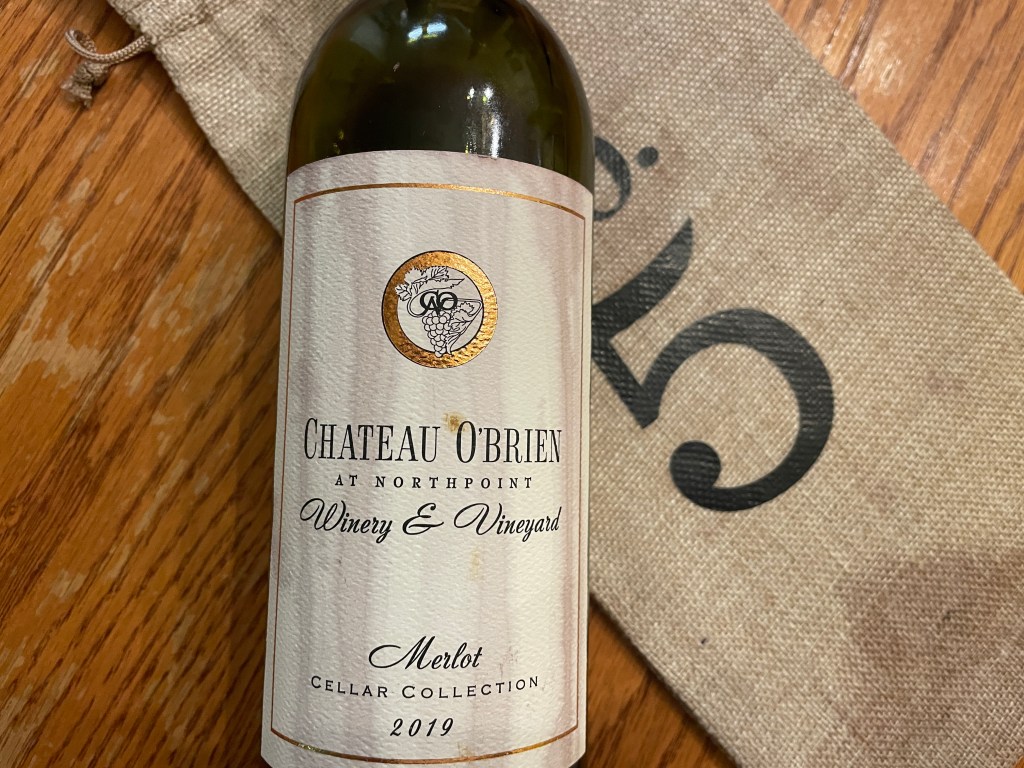
This was perhaps my favorite round of the day, and the group agreed these wines had two of the nicest finishes of the entire lineup.

Bottle #5 / 2019 Chateau O’Brien. Lots of great descriptors, with fruit notes of black or tart cherry, blackberry, blueberry, clove. “Fun” and “Vibrant” were my two favorite tasting descriptors. I suspect many of us knew this would be in the finalist round.

Bottle #6 / 2020 Troplong Mondot – St. Emilion. A rare 100% Merlot from Bordeaux. I liked it when I first sampled it at a wine store and my palate remembered it, since I was one of two people to vote for this wine as the round favorite. I thought this would go into the finalist round too, but I got outvoted.

This wine was almost universally praised for its balance, body, and black cherry/blackberry notes. Someone mentioned this was a ‘sit by the fire’ wine, and I think there was a lot of agreement on that.

Votes:

  1. Matt: Voted #6, thought #6 was France. Thought #6 had wonderful black cherry notes.
  2. Dominick: Voted #5, thought #5 was Virginia. Thought #5 had notes of dark fruit, noted a nice finish.
  3. Hailey: Voted #6, thought #6 was Virginia. Thought #5 had notes of cloves, cherry, blackberry, and was tart. #6 had black cherry, blackberry, and was velvety.
  4. Ann: Voted #5, thought #5 was Virginia. Thought #5 was ‘vibrant and fun’, fruit forward, with notes of boysenberry. #6 was more savory and had a good body.
  5. Emily: Voted #5, thought #5 was Virginia. #5 was tart cherry, a little musty, liked the fruity aroma. #6 changed a lot in the glass (no tasting notes though).
  6. Brandon: Voted #5, thought #5 was Virginia. #5 had notes of tart cherry, while #6 had an almost Pillsbury note to it, maybe brioche.
  7. Ashley: Voted #5, thought #5 was Virginia. (I think this was #6); thought the nose and palate had different flavors.
  8. Mica: Voted #5, thought #5 was France. Thought #5 had notes of blackberry and chocolate, with some mild pepper. #6 was tangier on the finish but was balanced.

Flight #4

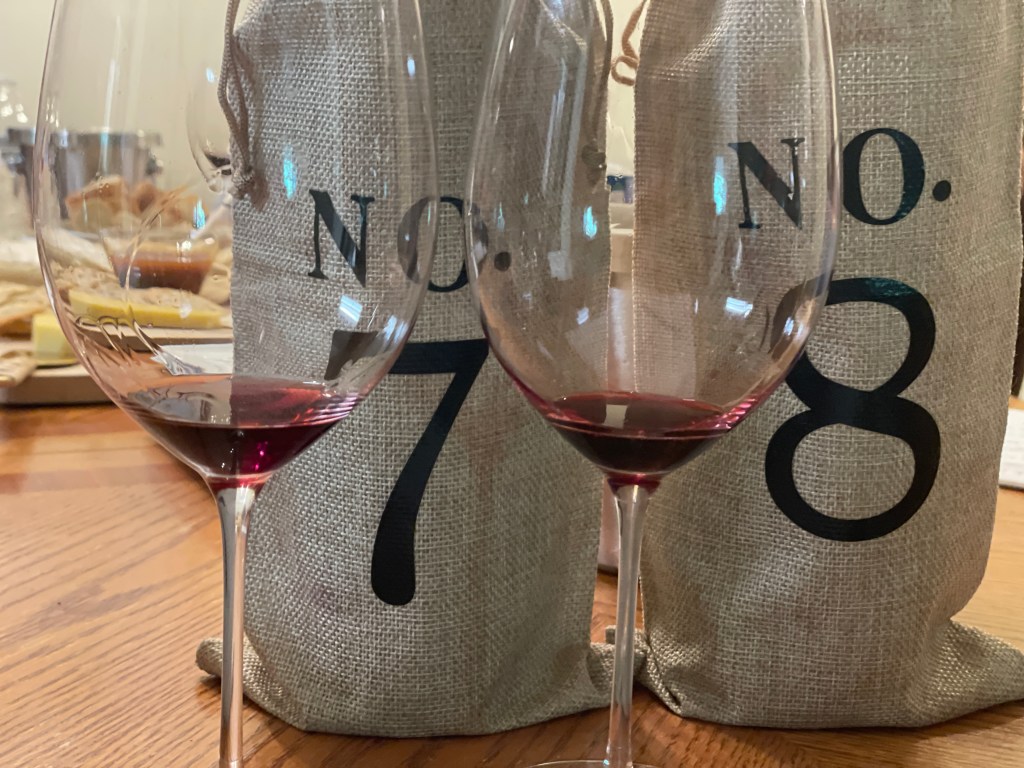
  • Bottle #7: 2021 Bluestone Vineyard Merlot (8 votes)
  • Bottle #8: 2020 Chateau Tour Saint Christophe – St. Emilion (0 votes)

This was my 2nd favorite round. Both wines were well balanced and complex, although we overwhelmingly thought the Bluestone simply had more going for it. 

Bottle #7 / 2021 Bluestone Vineyard Merlot. People LOVED the nose on this one. Very well balanced (I thought the best balance of the day), and this is the first time I ever heard someone describe ‘tomato leaf’ as a descriptor. Notes of tart cherry were also mentioned.

I do want to give a special shout out – at $27.50 this was possibly the best buy of the day. Try that Shenandoah Valley fruit!

Bottle #8 / 2020 Chateau Tour St Christophe. I looked online and this had some amazing ratings to it. This wine was almost universally praised for its balance, body, and black cherry/blackberry notes. Several noted its higher level of acidity, notes of mocha or chocolate, and many agreed with comments of its richness.

Votes:

  1. Matt: Voted for #7 and I leaned towards France but couldn’t really decide. I thought #7 was complex and balance.
  2. Dominick: Voted for #7 and thought it was Virginia. Thought #7 had a tomato leave nose, while the palate was more tomato and bell pepper. #8 was more dark chocolate.
  3. Hailey: Voted for #7 and thought it was Virginia. Thought #7 was more tart cherry, red cherry, basil, and baking spice. #8 was more blackberry, clove, was more fruit-forward.
  4. Ann: Voted for #7 and thought it was Virginia. Thought #7 had an almost sweet nose to it, and found notes of plumb. #8 had more brioche to it.
  5. Emily: Voted for #7 and thought it was Virginia. Loved the nose on #7. Thought #8 was more of a cherry pie nose, and noted the great color.
  6. Brandon: Voted for #7 and thought it was Virginia. #7 was more vegetal, well balanced, #8 was more jammy and rich.
  7. Ashley: Voted for #7 and thought it was Virginia. #7 had an almost butter popcorn nose to it, toasty oak, coco. #8 had higher acidity and a chocolate pop to it.
  8. Mica: Voted for #7 and thought it was Virginia. #7 reminded her of blackberry jam, while #8 was more acidity, maybe a lime and blackberry note to it.
Finalist Flight

  • Bottle #3: 2019 ‘Russ Mountain’ Walsh Family Wine (2nd place)
  • Bottle #5: 2019 Chateau O’Brien (#1st place)
  • Bottle #7: 2021 Bluestone Vineyard (#3rd place)

I did a poll of our favorite wines, and #3/Walsh Family, #5/Chateau O’Brien, and #7/Bluestone Vineyard were picked. As it so happened, all were from Virginia!

I wasn’t surprised that #5 (Chateau O’Brien) or #7 (Bluestone) made the list; there seemed to be a consensus to include those two. The hard part was choosing a 3rd option.

While I wasn’t a big fan of our 2nd round, we had more than a few guests who LOVED that round the most. There was just something about the ‘Old World’ quality that spoke to some people.

In the end, complexity of the #5/Chateau O’Brien earned the most #1st place votes, as well as many 2nd place votes. Walsh and Bluestone were almost tied.

  1. Matt: Voted #5 / #7 / #3.
  2. Dominick: Voted #7 / #5 / #3.
  3. Hailey: Voted #3 / #7 / #5.
  4. Ann: Voted #5 / #3 / #7.
  5. Emily: #5 / #3 / #7.
  6. Brandon: #5 / #7 / #3.
  7. Ashley: #5 / #3 / #7.
  8. Mica: #3 / #5 / #7.

Lessons Learned

I hadn’t done a straight-up Bordeaux comparison before, so it was interesting to see the results. I have to say though; I was genuinely surprised to see that in 1-vs-1, Virginia won 3 out of 4 and tied with the 4th. On top of that, the top 3 were all Virginia.

I have to wonder if maybe my guests having a ‘Virginia palate’ may have influenced the results (we picked the Virginia wine around 75% of the time). That’s not entirely true though; we often liked the Bordeaux wine, and several chose Bordeaux over Virginia…but the purity of the fruit of the Virginia wines often carried them to the ‘win’.

That in itself was surprising. Normally you think that blends are an improvement, since the combination is supposed to give them an edge over single-varietal wines. Yet here, the most popular French wine was probably the 100% Merlot. The other three (with 12-20% Cab Franc) were at times too tannic, or too acidic, or too alcohol-y.

I do think I need to up my game in finding equivalent French bottles. You’d think wines in the $40-range would be equivalent to what Virginia can produce, but here that wasn’t so.

I also have to give credit to Howard O’Brien of Chateau O’Brien, who introduced this wine to me on a visit earlier this year. O’Brien is known for smooth but big reds, especially his Tannat. This was the first time he’d had a 100% Merlot, and he knocked it out of the park. I probably should have put this against a higher-priced Bordeaux to make it a more equitable challenge.

Most importantly, everyone in attendance loved these 100% Merlots. So screw that Sideways movie and try one yourself.

France vs Virginia Part Deux (2024)

If you’re reading this, you probably know all about the “Judgement of Paris”. It’s a huge inspiration to my own wine comparisons, although mine tend to include a broader selection of varieties than the original event (and Virginia wine is always in the mix).

I often hear that both in style and geography, Virginia wine is a half-way point between California and France. But having tried a great deal of both, I’d only somewhat agree with that statement.

My observation is stylistically speaking, Virginia wine trends more towards France than it does California. That said, truly successful Virginia winemakers focus on being ‘Virginia’ rather than try to emulate one region or the other.

I’d already done one “Judgement of Virginia” comparison, but after a few years it was time to apply the lessons-learned from the first time and try again.

Tasting & Scoring Methodology

A group of friends & I blind tasted 5 comparison flights. All the flights were bagged blind. It wasn’t planned that way, but many of the same wineries I selected for my 2022 event were again represented.

The goal was to pick a ‘favorite’ every round, as opposed to rating them and determining which one we thought was the ‘best’. In many cases, ‘best’ was entirely subjective.

This particular event included an abundance of industry professionals. Of the six of us, two had side-gigs at wine stores, two were working on their WSET Diplomas (and one was a wine judge), and one was born in Bordeaux and had experience working at both California and Virginia wineries.

While all were familiar with Virginia wine, I didn’t need to worry about having a bias in favor of either France or Virginia. At least one (gasp!) may have even expressed doubts what Virginia could bring to the table, so I was on a bit of a mission to show the best of what Virginia had to offer.

Because of that, it’s fair to say that my Virginia wines represented a good cross-section of the ‘elite’ of the local industry. But that didn’t mean we slouched on our French pairings; I did my best to compare a wine from each area that was roughly equal in terms of blends and price points.

I specifically told my attendees to not share their guess on which wine came from which region until the end of the event. It was about the best wine of each round, not ‘guess the Virginia bottle’. All the bottles were unveiled at the end.

The contenders:

  1. Charles Heidsieck blanc de blancs (France) ($95 Wine Searcher)
  2. 2016 Trump “Brut Reserve” (Virginia) ($95 for the 2017 vintage)
  3. 2022 Chateau Picque-Caillou Blanc (France) ($43 Wine.com)
  4. 2023 Walsh “Bethany Ridge” (Virginia) (~$34)
  5. 2015 Linden “Hardscrabble” (Chardonnay) (Virginia) (~$42 for current 2021 vintage)
  6. 2015 Louis Jadot Beaune (France) ($55 Wine Searcher)
  7. 2016 Chateau Tour des Termes (France) ($35 Wine Searcher)
  8. 2019 Fifty-Third Winery “Romulus” (Virginia) (~$35-$40 when released)
  9. 2018 Chateau de la Brede Rouge (France) ($62 Wine Searcher)
  10. 2017 Linden “Hardscrabble” (red) (Virginia) (~$75 – $85 library wine)

Flight #1: Sparkling

  • Bottle #1: Charles Heidsieck blanc de blancs (France; I believe it was bottled in 2017)
  • Bottle #2: 2016 Trump “Brut Reserve” (Virginia) (Round winner; 6 votes as favorite; all incorrectly guessed Champagne)

Of course, we start with sparkling.

This was arguably the biggest surprises of the day. All of us voted for Bottle #2 (Trump) as our favorite. During a last-minute pre-unveiling tally to guess its area of origin, all of us guessed it was Champagne. Nope; this was Albemarle County’s very own Trump Winery.

This is where I wish I took a video of the reactions. We were SURE this was Champagne; nobody even floated the idea it was Virginia (even those who’ve had it). The tasting notes also seemed to back that assessment up, with #2/Trump seeming a bit more ‘aged’ and having finer bubbles.

But I shouldn’t be surprised. This was the 2nd time a 2016 Trump Brut Reserve won one of my blind tastings (the other being an 100% sparkling event). Additionally, a 2017 Trump Blanc de Blanc won the previous Judgement of Virginia against a Taittinger champagne.

I’ve said in the past that “Trump sparkling can go toe-to-toe with anything”. But now, I need to edit that statement. It would likely take a +$100 Champagne to surpass a Trump Winery Brut Reserve.

Bottle #1 / Charles Heidsieck blanc de blancs (France). More brioche on the nose than #2. “Bigger” on the palate. Creamy and fresh. One of us mentioned it was more reminiscent of “American” butter while #2 (Trump) was reminiscent of French butter, and several backed that assessment up. It had thicker bubbles with more citrus notes.

Bottle #2 / 2016 Trump “Brut Reserve” (Virginia). The brioche was there on the nose but I personally thought there was a mineral note to it. Lemony, creamy and fresh. More ‘aged’ notes, including nuttiness. More ‘European butter’ notes, which (I’m told) is fattier and more delicious than its American counterpart.

  • Kathy: Voted #2 (Trump). Guessed Champagne (it was Virginia). Thought #1 had more aggressive bubbles, maybe more reductive. #2 was more oxidative and citrusy.
  • Lieven: Voted #2 (Trump). Guessed Champagne (it was Virginia). Lots of similarities between the two, although thought #1 was ‘narrower’. Thought #2 had probably a few more grams of sugar than #1, although both were Brut. He also came up with the idea that #1 (Champagne’s Heidsieck) was more ‘American’ butter while #2 was ‘European’ butter
  • Marine: Voted #2 (Trump). Guessed Champagne (it was Virginia). Concurred with Lieven’s comment about “American butter” vs “European butter”.
  • Matt C: Voted #2 (Trump). Guessed Champagne (it was Virginia). Thought #2 had more dosage. #1 was more kumquat notes while #2 was more mandarin orange.
  • Matt F: Voted #2 (Trump). Guessed Champagne (it was Virginia). No tasting notes (too busy writing).
  • Robrette: Voted #2 (Trump). Guessed Champagne (it was Virginia). Thought #1 was more acidic while #2 was ‘rounder’. Also liked the texture of #2.

Flight #2: Sauvignon Blanc

  • Bottle #3: 2022 Chateau Picque-Caillou Blanc (Bordeaux Blanc, a rare 100% SB)
  • Bottle #4: 2023 Walsh Family Bethany Ridge (Round winner; 6 votes for favorite; 3 guessed were Virginia)

This round was surprising because the Bordeaux Blanc came off as “New World”, while the Walsh was much more Sancerre-like.

At first I was upset I didn’t ask for a more ‘classic’ expression of French Sauv Blanc, but in retrospect I’m happy how it came out. It just goes to show you that not only can Virginia wine present as “Old World”, there are times when “Old World” wine comes off as “New World”.

The Bordeaux Blanc was so overpowering floral that I could have guessed it was a Torrontés in a blind tasting. A very off-brand Sauv Blanc, especially for France. But still very quaffable.

Bottle #3 / 2022 Chateau Picque-Caillou Blanc. The nose was aggressive, nearly overpowering. It was so off-brand it threw us for a loop, and I suspect those who weren’t familiar with Walsh Family assumed this had to be the “New World” wine.

Grassy, almost New Zealand-style perfume-y nose. Lighter in color, and maybe a dab of oak. Lots of texture. Notes of citrus, jasmine, tarragon, and gooseberry were mentioned.

Bottle #4 / 2023 Walsh Family Bethany Ridge. “Shy” was the key descriptor, which I assume was due to it being recently bottled. The nose took a while to make an appearance but was lovely when it finally arrived.

Notes of dry grass (as opposed to freshly cut grass). Delicate and elegant. Citrus and lingering stone fruit notes. I completely understand why people thought this was France; maybe my next pairing will be Sancerre instead of a Bordeaux Blanc.

  • Kathy: Voted for #4 and guessed #4 was Virginia. Thought #3 had nice acidity and was perfume-y. #4 had notes of quince, mineral, and dried herbs.
  • Lieven: Voted for #4 and guessed #4 was France. #3 had notes of stone fruit, papaya, tarragon, and was floral and bright. #4 had a sharper nose.
  • Marine: Voted for #4 and guessed #4 was Virginia. #3 was ‘flamboyant’. Notes of cat pee, passion fruit, and was smooth. #4 was more subtle, notes of fresh herbs and had a lovely finish.
  • Matt C: Voted for #4 and guessed #4 was France. Thought #3 had notes of honeysuckle and grapefruit.
  • Matt F: Voted for #4 and guessed #4 was Virginia (mostly because I know and love Walsh’s SB) but never could have guessed #3 was French.
  • Robrette: Voted for #4 and guessed #4 was France. Thought #3 was grassy, fleshy, notes of dragon fruit. #4 was lmon-lime, grape fruit, hint of herbs.

Flight #3: Chardonnay

  • Bottle #5: 2015  Linden “Hardscrabble” (Chardonnay) (Virginia) (3 votes, tie; all guessed it was Virginia)
  • Bottle #6: 2015 Louis Jadot Beaune (France) (3 votes, tie)

This round was special because I LOVE aged Chardonnay. The 2015 Linden is one of owner/winegrower Jim Law’s favorite (and highest rated) Chardonnay vintages ever, and bottles of Hardscrabble Chardonnay are basically his ‘flagship wine’. I’m not familiar with the Louis Jadot but dang, that one aged beautifully as well.

I didn’t take great notes on why we all thought #5 was Virginia, but we all must have found something about it that stood out since we were all accurate.

Bottle #5 / 2015 Linden “Hardscrabble” (white) (Virginia). It had a ‘hot note’ of higher alcohol. Lemon notes, nutty nose. This seemed more ‘fruit’ driven.

Bottle #6 / 2016 Chateau Tour des Termes (France). “Big”, nutty qualities as well. Lots of complexity on the nose. Complex palate. This seemed a tad bit more ‘winemaker’ driven, at least on the nose.

  • Kathy: Voted for #5 and thought #5 was Virginia. Thought #5 was fresher, more fruit vs #6 showcased ‘the winemaker’, and #5 had a note of salinity.
  • Lieven: Voted for #6 and thought #5 was Virginia. Thought #5 was more bruised fruit, lemony but also cooked, with notes of marmalade. #6 was more lemon drop, with a sour note. Both had notes of baking spice.
  • Marine: Voted for #6 and thought #5 was Virginia. #5 was more pronounced bruised apple, lighter and more acidic than #6. #6 was shy, smooth, balanced and toasty.
  • Matt C: Voted for #5 and thought #5 was Virginia. #6 was ripe pair, fresh butter on the nose. Saw a hot note to it. #6 had a reductive nose, notes of melted butter, cooked apple, and baking spice
  • Matt F: Voted for #6, and thought #5 was Virginia.
  • Robrette: Voted for #5 and thought #5 was Virginia. Thought #5 as rounder and had more mouth feel. #6 was sharper.

Flight #4: Red Flight #1

  • Bottle #7: 2016 Chateau Tour des Termes (France) (Round winner, 6 votes)
  • Bottle #8: 2019 Fifty-Third Winery “Romulus” (Virginia; all guessed it was Virginia)

This round was our mid-price ranged red comparison. The differences between them were more pounced than the other rounds (at least in my opinion). It was relatively easy to guess the Virginia wine since it was brighter and more fruit-driven than the Bordeaux.

This was a fight between ‘easy drinking vs serious & complex’. They were slightly further apart in vintage than I would have preferred – but you take what you can get.

Bottle #7 / 2016 Chateau Tour des Termes (France). I wrote most of the notes below for this round.

Bottle #8 / 2019 Fifty-Third Winery “Romulus” (Virginia).

  • Kathy: Voted for #7 and thought #8 was Virginia. Thought #7 had black plumb, notes of peppercorn, was rustic, and had more complexity. #8 was more black cherry vanilla (like the ice cream), notes of cherry cola.
  • Lieven: Voted for #7 and thought #7 was Virginia. Thought #7 was red and black fruit, notes of cassis and char, with a savory note. #8 was more blue and black fruit, note of violet, and had a lighter palate.
  • Marine: Voted for #7 and thought #8 was Virginia. #7 had notes of fresh herbs, black cherry, rustic, more ‘serious’. #8 was fresher, more crushed berry, and liked the brightness.
  • Matt C: Voted for #7 and thought #8 was Virginia. Thought #7 had a “Virginia nose”, notes of cassis, maybe a little new oak. #8 was softer, leaned into the fresh fruit, was softer and had a lingering berry note.
  • Matt F: Voted for #7 and thought #8 was Virginia. I thought #8 had a sour note on the palate, and wasn’t as well integrated when compared to #7.
  • Robrette: Voted for #7 and thought #7 was Virginia. #7 was more complex while #8 was brighter and was less complex, with cola notes.
  • Flight #5: Red Flight #2
  • Bottle #9: 2018 Chateau de la Brede Rouge  (France) (3 votes; tie)
  • Bottle #10: 2017 Linden “Hardscrabble” (red) (Virginia) (3 votes; tie, 2 out of 6 guessed it was Virginia)

While Jim Law’s flagship wine is his Hardscrabble white (Chardonnay), he makes some damn good reds. His wines are always well balanced, and that was evident here.

But the Brede Rouge wasn’t a slouch either, everyone loved it just as much. Votes were tied between them.

Surprisingly (or not, depending on how high your estimation of Linden is), 4 out of 6 of us thought the Virginia wine was Bordeaux (even my guest from Bordeaux thought so). I’ll take that as a huge vote of confidence for Linden Vineyards.

It wasn’t until the next day that I got the ‘musty’ notes that are indicative of Bordeaux on the nose, although both bottles were well aerated before this event.

Bottle #9 / 2018 Chateau de la Brede Rouge (France). It was late so most of my tasting notes are below. Several thought they detected an ‘olive oil’ note to #9, which threw people off.

Bottle #10 / 2017 Linden “Hardscrabble” (red) (Virginia). Guests generally identified this as smooth, balanced, and fruit-driven.

  • Kathy: Voted for #9, thought #10 was Virginia. Thought #9 was brine-y and had a note of olive oil which was unusual for Bordeaux. #10 was fresher, more raspberry and herbs and fewer barnyard notes.
  • Lieven: Voted for #10, thought #9 was Virginia. Thought #9 was more red cherry, plumb, pomegranate, and potting soil. #10 was more red cherry, plumb, earth and forest floor. Thought this wine was more about the mid-palate.
  • Marine: Voted for #10, thought #9 was Virginia. Thought #9 had notes of cinnamon, pepper, nutmeg, prune-y and tobacco. I think she mentioned notes of nutmeg and spice. #10 had notes of black current, cherry, and ‘juicy’
  • Matt C: Voted for #9, thought #9 was Virginia. #9 was black cherry, liquorish, brine, notes of baked fruit and had a cooked quality to it. #10 was black current, cigar box, red and black fruit and cedar.
  • Matt F: Voted for #10, thought #10 was Virginia.
  • Robrette: Voted for #9, thought #9 was Virginia. Thought #9 was more red fruit, black cherry, but balanced and smooth. #10 was more red fruit, and lighter, smoother, softer.

Lessons Learned:

Normally I talk about how similar a well-made Virginia wine can be to a classic expression of the same variety from France. What surprised me was how French wine can, on occasion, showcase “New World” notes.

The Chardonnay and the 1st red flight were easy; 100% of guests correctly identified each country of origin. The Sauvignon Blanc flight was harder to guess, with only 4 out of 6 guessing correctly. Even more difficult was the 2nd flight (with Linden) where only 2 out of 6 guessed correctly.

The sparkling round was the real stumper. Was it conceit to assume Virginia couldn’t match a $80-$100 bottle from Champagne? Maybe! I stand by my assessment that Trump Winery’s sparklings hit above their price point.

I also loved how wrong people were about the Linden Hardscrabble red vs Bordeaux flight, which stumped most of us.

So was it that Virginia wines are expressive of “Old World”? Or a few of these French wines were New World-ish? A bit of both, at least in this case.

In the end of our 5 comparisons, Virginia won 2 rounds, Bordeaux 1 round, and we had 2 ties.

France vs Virginia: The Bordeaux (blend) Heavyweights

A few months ago, I did a blind “Judgement of Virginia” tasting, modeled off the famous Judgment of Paris where California triumphed over France. 7 French wines were compared to 7 similar Virginia wines, all made between 2017 and 2021.

I knew our Virginia wines would do well, but to my surprise all 7 Virginia bottles beat their French counterparts. Granted I picked high-quality Virginia wineries, but even I was shocked at the blowout.

After examining the contest I realized something; Virginia went into this comparison with an advantage since its wines can be enjoyed young, while wines from Bordeaux require time to age. So, I came up with a new idea – to compare older Virginia Bordeaux-style vintages against similar French wines in order to keep the matchup even.

I invited a panel of experts (OK – they were wino friends of mine…who happened to have a great deal of industry experience and/or above average palates) and we sampled 3 Virginia Bordeaux-style wines vs 3 actual Bordeaux wines, all made between 2012-2015. Everything was done blind.

While I call this a “Bordeaux blend comparison”, that term isn’t entirely fair despite the Virginia wines using 100% Bordeaux grapes.

Cabernet Franc and Petit Verdot often play prominent roles in Virginia, but very secondary ones in France. Also, Bordeaux wines tend to favor either Cabernet Sauvignon or Merlot (often around 75% Merlot for right bank Bordeaux, but far more variable blends for left bank Bordeaux), while Virginia red blends tend to be more evenly distributed between multiple grapes. This means while the grapes may be the same, the composition of the blends could be very different.

The tasting was simple; compare two wines side by side and we’d select a favorite. While several attendees were wine judges, I elected to keep things simple and have everyone simply pick a single favorite of every flight. In the case of a tie, the host (me) decided between the two.

I bagged everything in pairs, so nobody (including myself) knew which pairs we were trying. All we knew is one wine was Virginia, and the other was Bordeaux. The specific pairings were selected in advance, based on the wine’s age and blend.

The wines:

France:

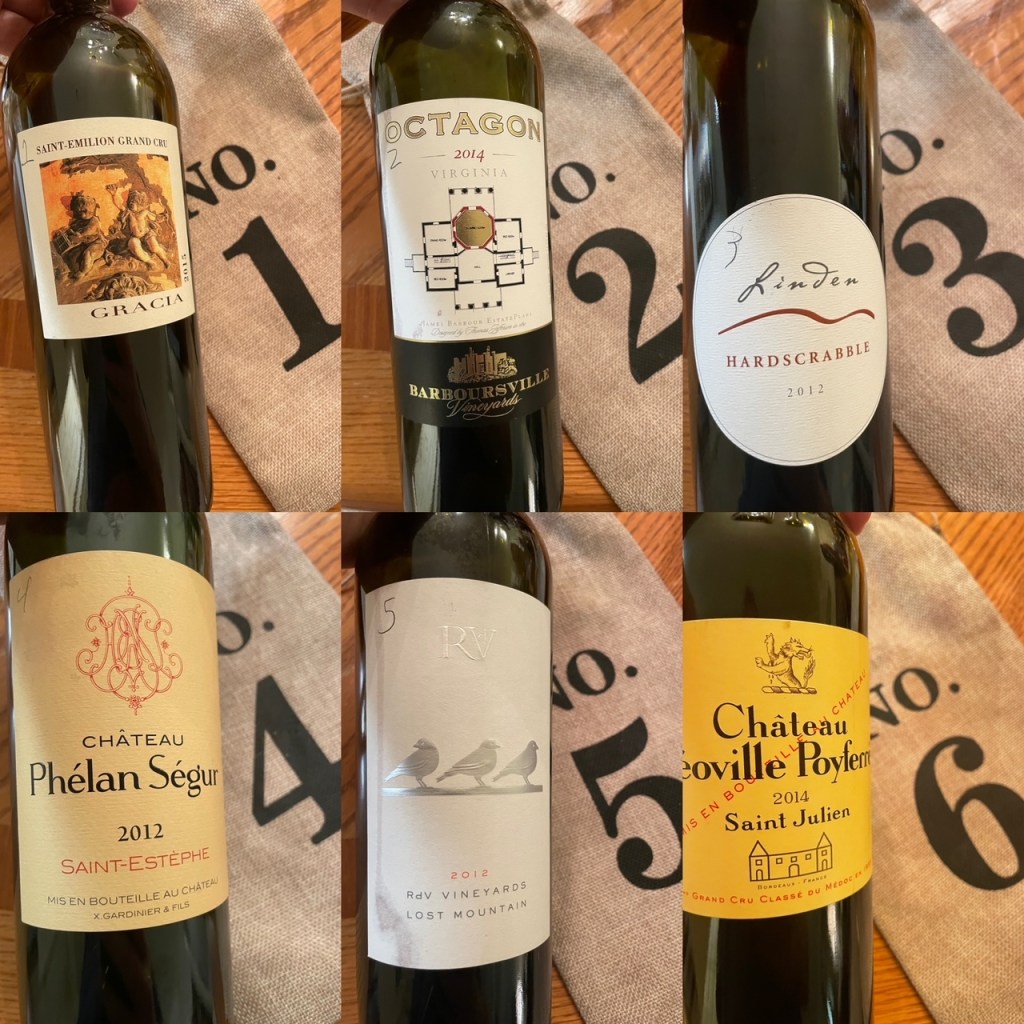
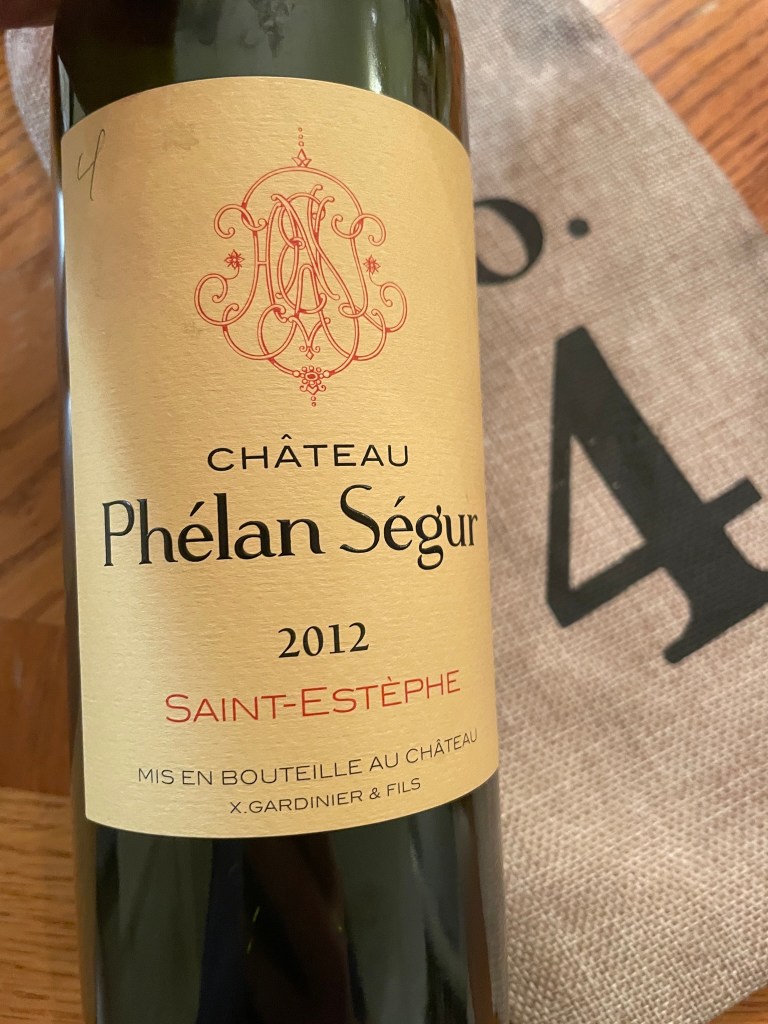
  1. 2012 Château Phélan Ségur: 50% Cabernet Sauvignon/ 50% Merlot (Left Bank, Saint-Estèphe) (wine searcher retail $62, with significant regional variation)
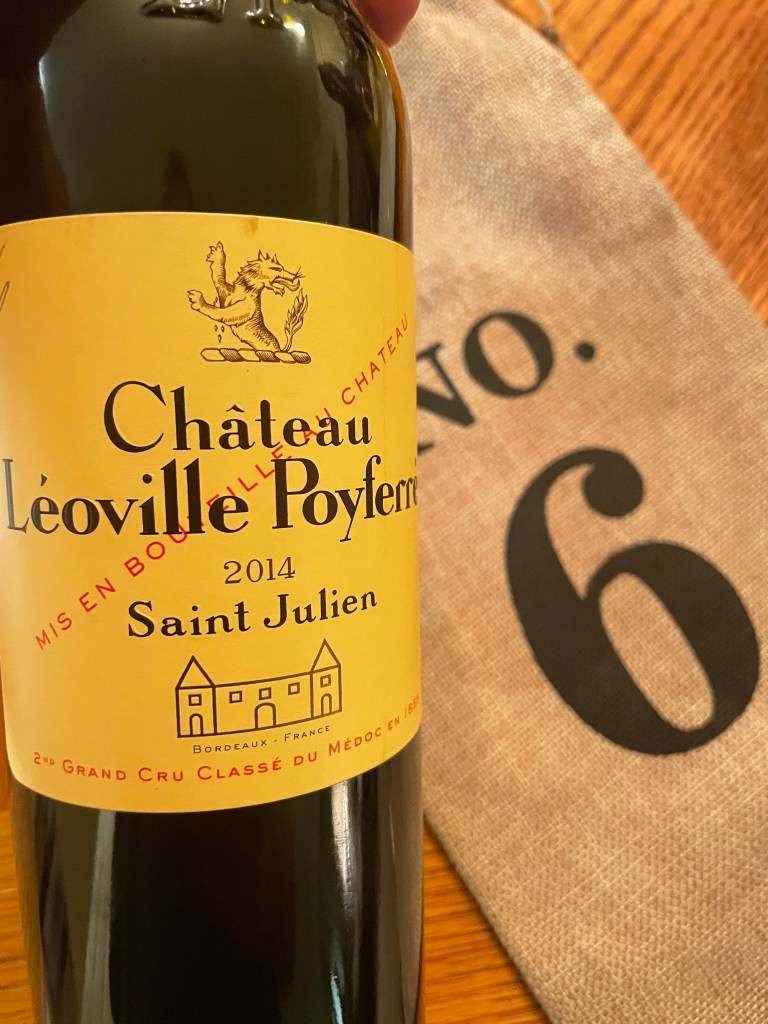
  2. 2014 Château Léoville-Poyferré: 60% Cabernet Sauvignon / 35% Merlot / 3% Cabernet Franc (Left bank Second Growth, Saint-Julien) (wine searcher retail $118, locally priced at $80)
  3. 2015 Château Gracia: 70% Merlot / 25% Cabernet Franc / 5% Cabernet Sauvignon (Right bank Grand Cru, Saint-Émilion) (wine searcher retail $111)

Virginia:

  1. 2012 Linden Hardscrabble: 56% Cabernet Sauvignon / 34% Merlot/ 9% Cabernet Franc / 1% Petit Verdot (selling at $75 in the winery)
  2. 2012 RdV Lost Mountain: 46% Cabernet Sauvignon / 40% Cabernet Franc / 14% Merlot (impossible to price due to scarcity; originally around $120 but recent vintages price at $220)
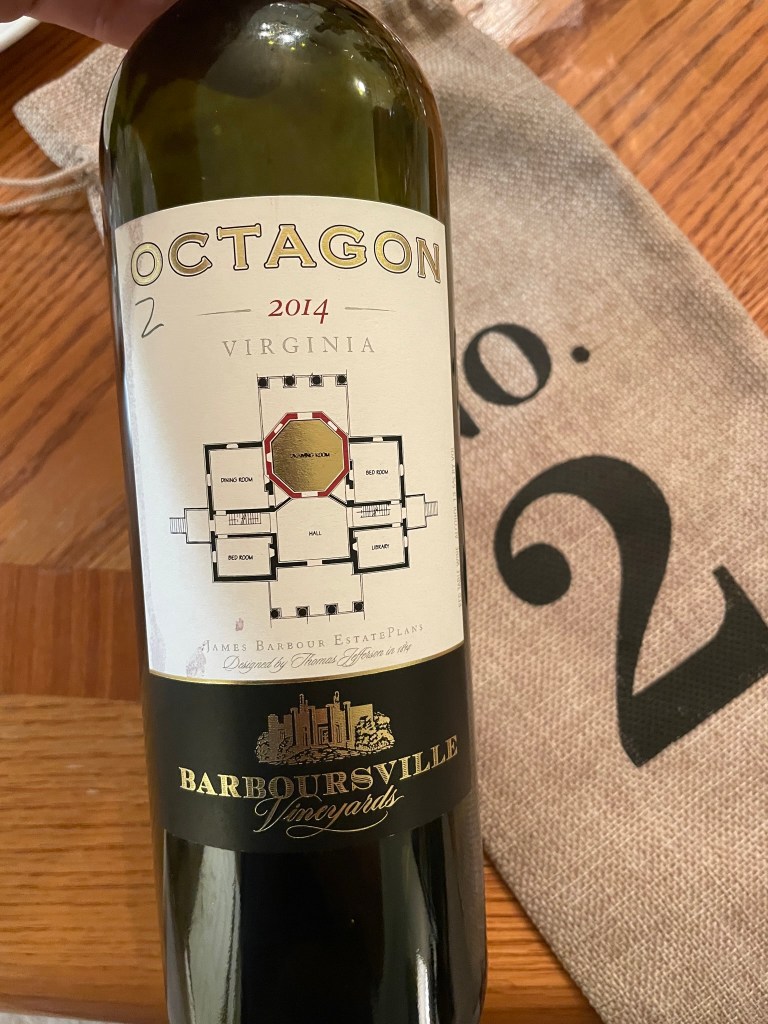
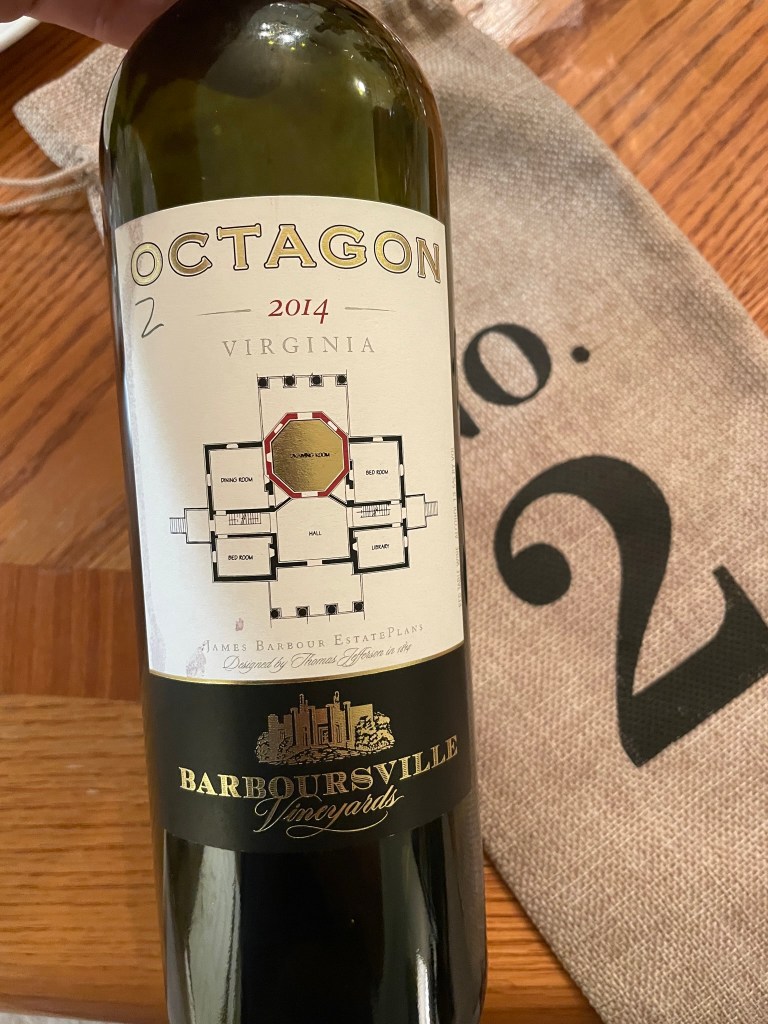
  3. 2014 Barboursville Octagon: 56% Merlot/ 23% Petit Verdot / 15% Cabernet Franc / 6% Cabernet Sauvignon (impossible to price to do scarcity; originally around $50 at the winery several years ago but likely retailing over $100 now).

Each of these came from well-regarded producers on both sides of the Atlantic. Even the experienced group tasting with me sometimes had difficulty identifying which was Bordeaux and which was Virginia. Of the 6 of us tasting 6 wines, I think we were accurate under 70% of the time.

As always, a caveat: this competition was the result of this day, with this group of people. It by no means indicates the wines that were selected as round favorites were superior to the other, or the wines that didn’t win their round weren’t loved. For this particular event, I’m convinced that at least 5 of the 6 wines we tried could have been selected as the ‘winner’ with a different food pairing; they were that good.

Pairing #1:

Wine #1 (2015 Château Gracia): 70% Merlot / 25% Cabernet Franc / 5% Cabernet Sauvignon (Saint-Émilion): 3 Votes

Wine #2 (2014 Barboursville Octagon): 56% Merlot/ 23% Petit Verdot / 15% Cabernet Franc / 6% Cabernet Sauvignon: 3 Votes (3 votes, round winner)

This round was evenly matched. I asked Dave McIntyre to pick a favorite and he didn’t want to give an answer; both of these were so equally well loved.

That feeling was shared amongst the group. To nobody’s surprise we were tied 3/3 (note to self – I need to have an odd number of tasters in the future). Not only that, but I think half of us (including me) got the Virginia wine wrong.

Ultimately I picked #2 to go to the next round, although it could have gone either way.

Alex: #2. Thought #1 was Bordeaux, also mentioned it was approachable. Notes of black current, red cherry, and tobacco backed by a long finish. Yet #2 was even more approachable with lots of red fruit, cola and a nice brightness to it.

Dave: #2. Loved both; didn’t want to pick between the two. #1 had a more ‘candied’ fruitiness he thought was associated with Virginia, but had less oak integration and was less harmonious because it didn’t have a lot of tannin. #2 loved it, and made a note about the color.

Matt: #1. #1 had some primary fruit on the nose but it was fading. #2 had some funk; earthy nose.

Katie: #2. She thought #1 was Virginia; liked the wine although she didn’t think the tannins were well integrated.

Kathy: #1. #1 had grippy tannins and more prominent fruit. #2 she found the fruit harder to find, and maybe a little reductive.

Vanessa: #1. Good maturity; tannins were chalky. Lots of fullness on the finish. #2 was brighter, velvety tannins, good acidity.

Pairing #2:

Wine #3 (2012 Linden Hardscrabble): 56% Cab Sauv / 34% Merlot/ 9% Cab Franc / 1% PV ( 3 votes)

Wine #4 (2012 Château Phélan Ségur): 50% Cab Sauv/ 50% Merlot (Saint-Estèphe) (3 votes, round winner)

This was another even round. I favored #4 but not by a huge degree. Again, I was wrong on which was Virginia vs France since I thought I felt a lot more Cab Franc on #4, but was proven wrong (it had none).

With another 3/3 vote I was the tie-breaker here since I favored #4, so it went to the next round. Coincidentally it was my favorite of the night.

Alex: #3: Notes of smoke, tobacco, black cherry, vanilla, blackberry, and strawberries, with a long finish.

Dave: #4. Thought #3 was dense, dark fruit note, needed more time to develop. #4 had notes of clove, and maybe a cigar box note to it. Of the two, this was the one that was presenting better ‘now’.

Matt: #4. I found #3 to be lighter on the nose; some fruit but with an earthy palate. #4 had more pepper but very smooth tannins. I admittedly thought this was Virginia.

Katie: #3. Though #3 was elegant, and ‘couldn’t stop going back to it’. Also very floral. #4 had a herbatiousness to it, and thought it needed food.

Kathy: #3. Very “pretty” wine. Stewed strawberries but not overly jammy. #4 was had a meaty and spicy note.

Vanessa: #4. Thought #3 was lighter, good fruit quality, and less extraction. Overall it was ‘elegant’. #4 had more extraction and richness. She thought it had a brett note which gave it more complexity.

Pairing #3

Wine #5 (2012 RdV Lost Mountain): 46% Cab Sauv / 40% Cab Franc / 14% Merlot (5 Votes, round winner)

Wine #6 (2014 Château Léoville-Poyferré): 60% Cab Sauv / 35% Merlot / 3% Cab Franc (Saint-Julien) (1 Vote)

This round had a clear winner. #6 came off as too tannic; my mouth was positively dry after tasting it. But #5 was enjoyed all-around.

Alex: Split his votes between the two. #5 was more approachable, with lots of black pepper baking spice, cloves, and plumb on the palate. #6 had notes of dark chocolate, cherry and red fruit, but had a harsh nose.

Dave: #5. Dave said #5 had a pretty nose, was floral, and tasted notes of black currant and soft tannin. #6 had an off-putting nose and a very tannic finish.

Matt: #5. I found #5 to have some fruit on the nose but not the palate. Of the two, this was definitely the more drinkable right now. #6 was more of a food wine. Tannic finish, very dark and brooding overall. 

Katie: #5.

Kathy: #5 had notes of blackberry, plumb, maybe menthol. Wished the finish lasted longer. #6 had an interesting notes, burnt toffee character to it on the palate.

Vanessa: #5. Thought #5 was well put together, while #6 was disjointed.

Finalist Round:

Wine #2 (2014 Barboursville Octagon): 56% Merlot/ 23% Petit Verdot / 15% Cabernet Franc / 6% Cabernet Sauvignon

Wine #4 (2012 Château Phélan Ségur): 50% Cabernet Sauvignon/ 50% Merlot (Saint-Estèphe)

Wine #5 (2012 RdV Lost Mountain): 46% Cabernet Sauvignon / 40% Cabernet Franc / 14% Merlot

From most favorite to least favorite, the results were:

Alex: Wines 2/5/4

Dave: Wines 4/5/2

Matt: Wines 4/2/5

Katie: Wines 5/4/2

Kathy: Wines 5/4/2

Vanessa: Wines 4/2/5

The lowest vote earned 1 point. The runner-up had 2 points, and the favorite wine got 3 points.

2014 Octagon from Barboursville had 7 points

2012 Lost Mountain from RdV had 11 points:

2012 Château Phélan Ségur had 12 points (Finalist)

Results:

I’d say there were a few take-aways.

The biggest is I felt this event demonstrated Virginia has the ability to go toe-to-toe with Bordeaux. Of 3 pairings, Virginia tied its Bordeaux counterpart twice and once easily surpassed it. 2 Virginia wines made it to the FInalist round, and the 2012 RdV Lost Mountain was also the 2nd favorite wine of the evening.

I was pleased to see how incredibly close these parings were at multiple levels. Every wine deserved high scores, and I truly believe that on another day, most of them could have been picked as our finalist. Even identifying the Bordeaux of the mix was sometimes difficult.

Second would be that while price and quality often go hand-in-hand, that’s not 100% true. The favorite of the day was the least expensive wine of all (still not cheap at $60-ish, but still). Not surprisingly RdV came in second, but the ‘brown bag’ method definitely evens the playing field.

Lastly, if there’s a downside to this event is while this tasting showed to me Virginia’s potential, the reality is it’s nearly impossible for our average wine lover to enjoy this kind of comparison. Virginia wines are often sold young, and limited inventory means most ‘older’ vintages are almost impossible to find. Even long-time Virginia wine collectors might only have a few special bottles from the 2012 vintage (or earlier).

Also keep in mind that the Virginia wines I selected represent the ‘elite’ of what the state has to offer. Few Virginia wines can age for 10 years like these did, or are made with the exquisite craftmanship we found.

Next up – a comparison of mid-priced Virginia red blends, a Cabernet Franc day, another sparkling round, and Petit Manseng.