Arterra Wines Winter Dinner and 2023 Vintage Release

Last week I attended a wine dinner hosted by Arterra Wines. Not only has Arterra consistently been one of my favorite wineries, but this event also featured many of their newest releases. Since I’ve been anticipating tasting their 2023 vintage reds for years, my attendance was practically mandatory.

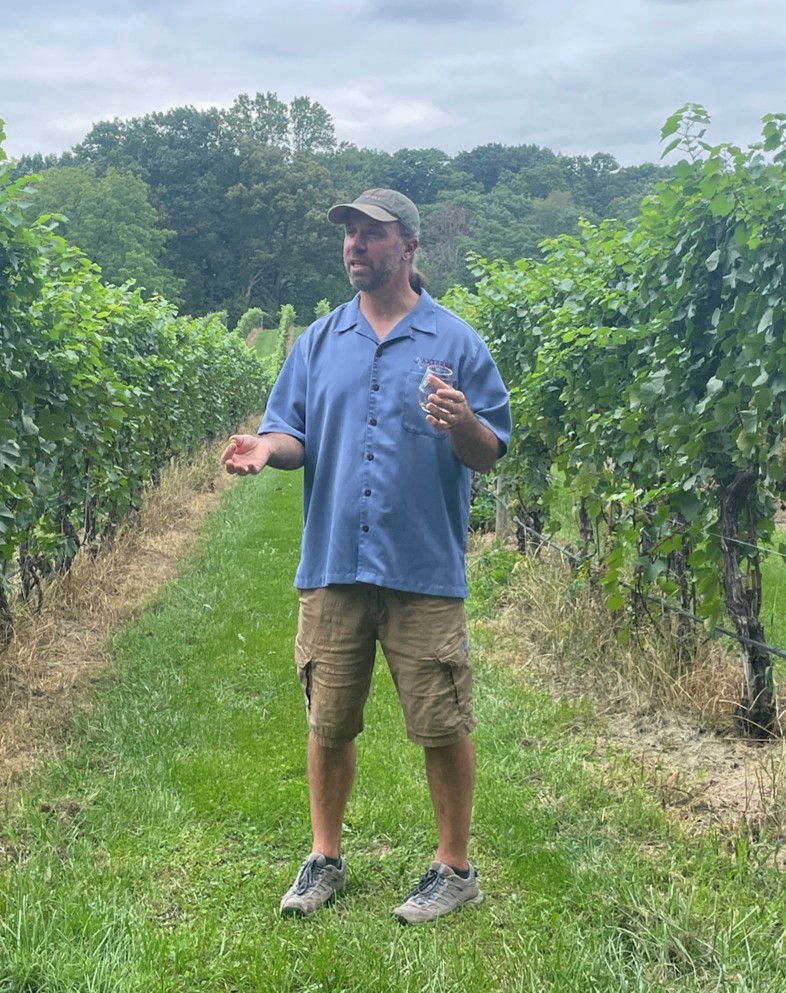
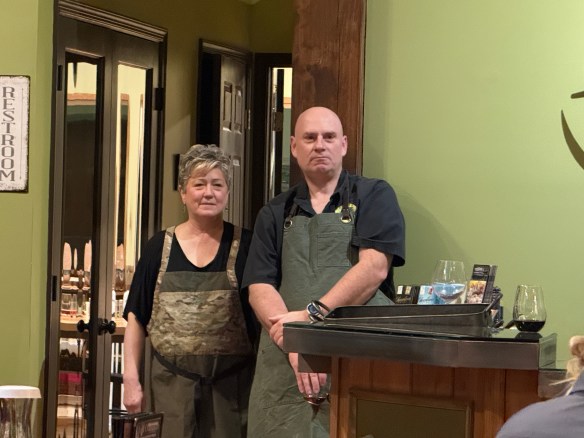
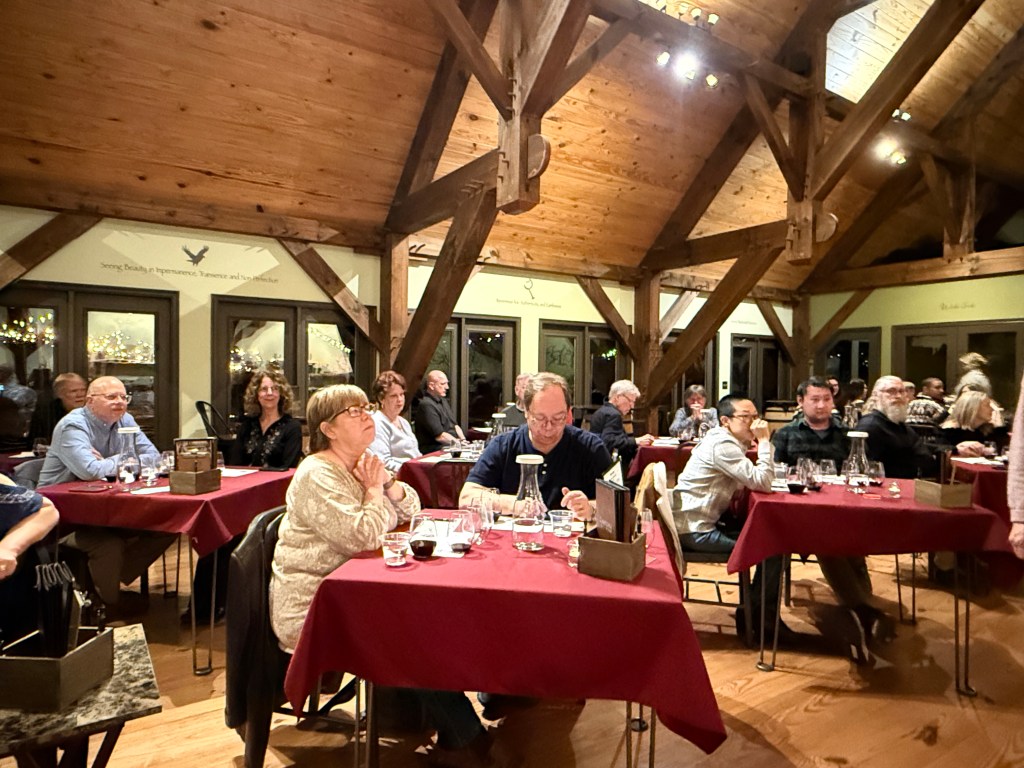
Wine dinners are often a combination of food pairings and education, and this event didn’t disappoint. Owner/winemaker Jason Murray discussed the overall ethos behind his winemaking, as well as the wines being served.
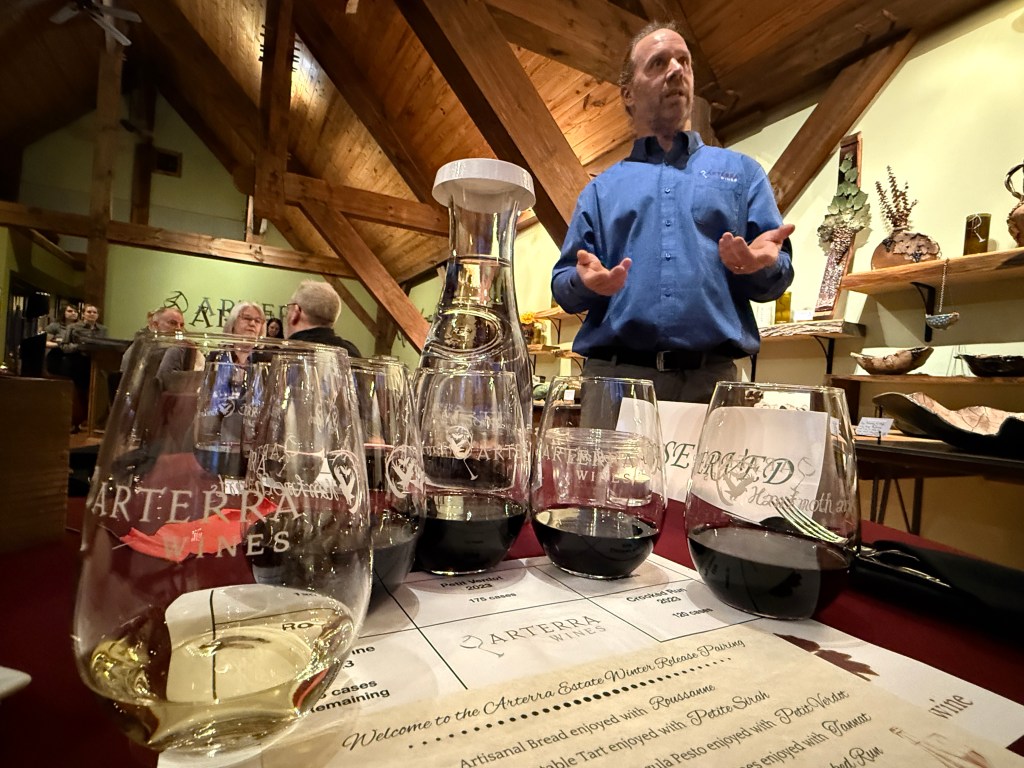
For those who aren’t familiar with Arterra, Jason is one of Virginia’s foremost proponents of minimal intervention winemaking. He’s so hyper ‘minimal’ he frowns on using techniques even other self-described ‘minimalists winemakers’ utilize, and calls his winemaking style ‘clean winemaking’ (which is stylistically similar to ‘natural wine’, although he prefers his wines filtered as opposed to cloudy).

Jason could write essays on what constitutes clean winemaking, but the short version boils down to two things: limited (and more recently, 100% organic) sprays in the vineyard, and the use of natural yeast in the cellar. He also doesn’t use new oak in his wines, as that would insert an external flavor profile.

Limited chemical spraying has always been one of Jason’s hallmarks; the main reason he previously tolerated any non-organic spraying was because for years he didn’t have an effective method to control black rot (a destructive grape disease that afflicts vineyards in warm, humid areas).

Jason started his move to 100% organic farming 2023, after newer organic materials came on the market. When his 1/2-acre trial run proved successful, he expanded his organic program to his entire estate vineyard. As of 2025, his estate vineyard is now fully organic and should receive its organic vineyard certification by 2028.
The other element of Jason’s winemaking is his usage of native yeast. During the event, Jason explained “Yeast is the starting point to either express your site or override that expression to produce wine the way you want to produce it”.

He further explained how his ‘clean winemaking’ style had three main outcomes; 1) wines that produce wine a rounder, broader profile, which is more outwardly expansive on the palate, 2) wines with a richer ‘chewer’ texture, which is especially unusual in dry wines, and 3) his wines have wonderfully fresh, clean finish. These factors were present in the samples we had that night.

The wines he served were from the 2023 vintage, widely regarded as one of Virginia’s best in decades.
Wine and Food Pairing

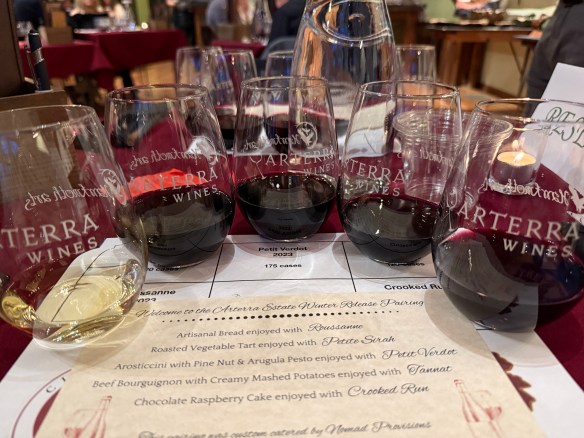
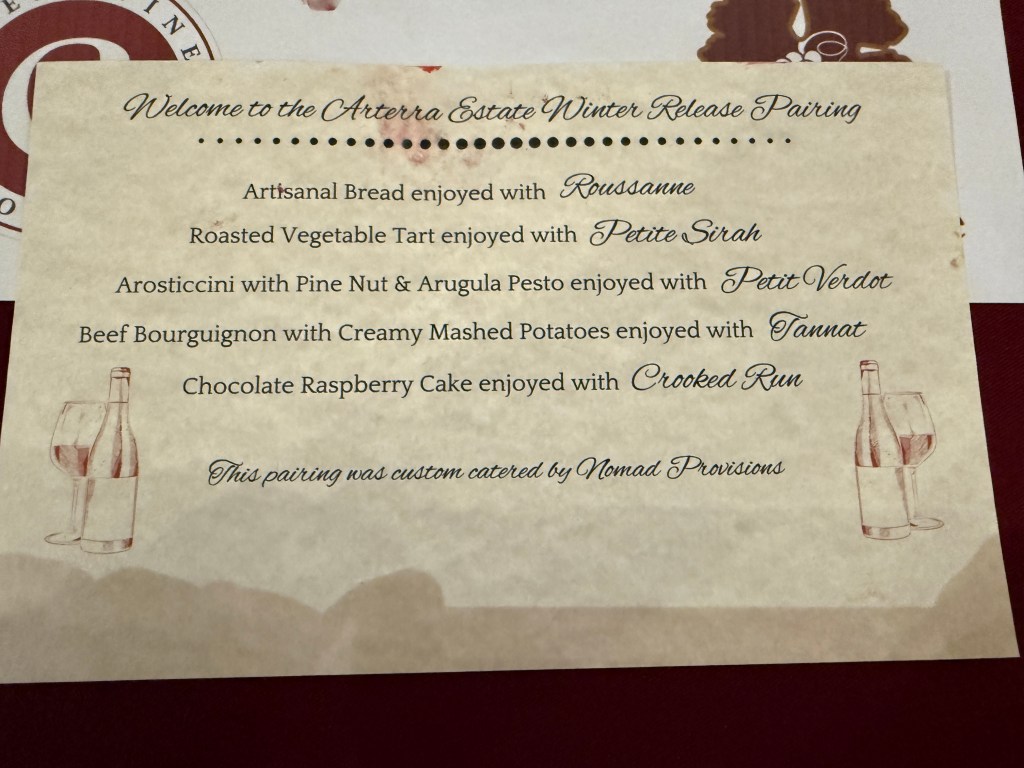
Nomad Provisions were our chefs for the evening. They served a series of small plates and chose the wine pairings for them (Jason was happy to let the food experts select the pairings).

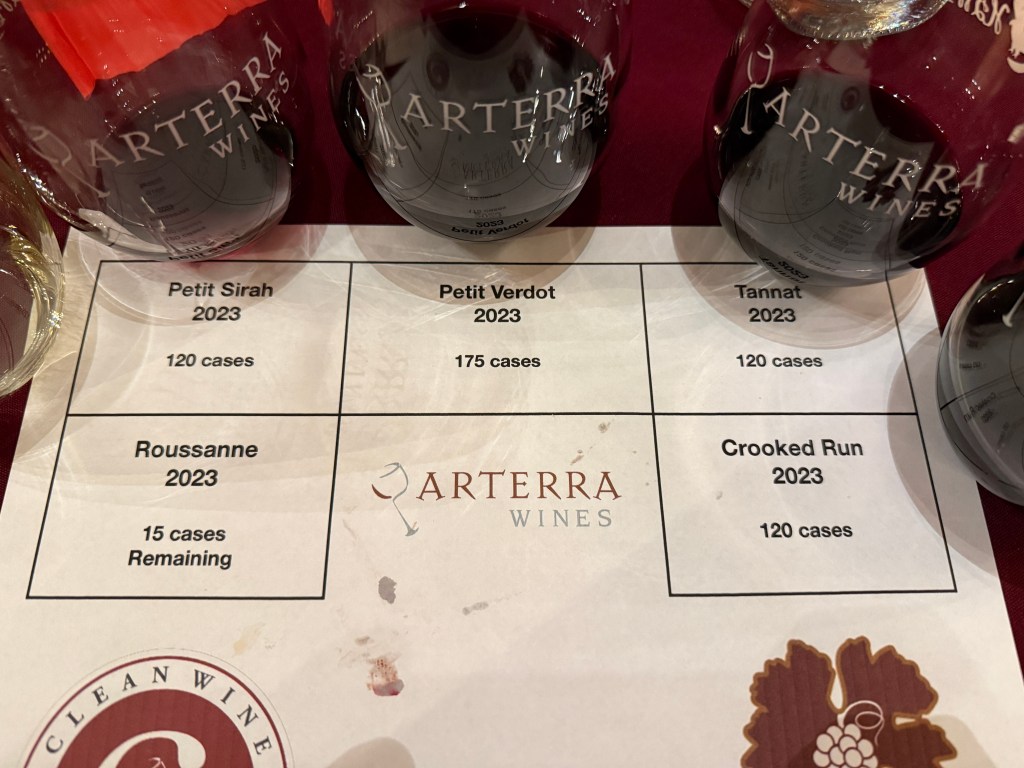
2023 Roussanne (with focaccia bread): Very full bodied for a white wine, with maybe a touch of lemon peel on the palate. Those lemon notes became more expressive the longer the wine sat in my glass. I thought it was a great starter wine, and I assume the high texture was a direct result of Jason’s ‘clean winemaking’ practices.

Arterra is one of the few roussanne growers in Virginia. Ironically, a friend of mine texted me a day earlier praising this particular wine during his visit a day earlier, not knowing I was going to this event.
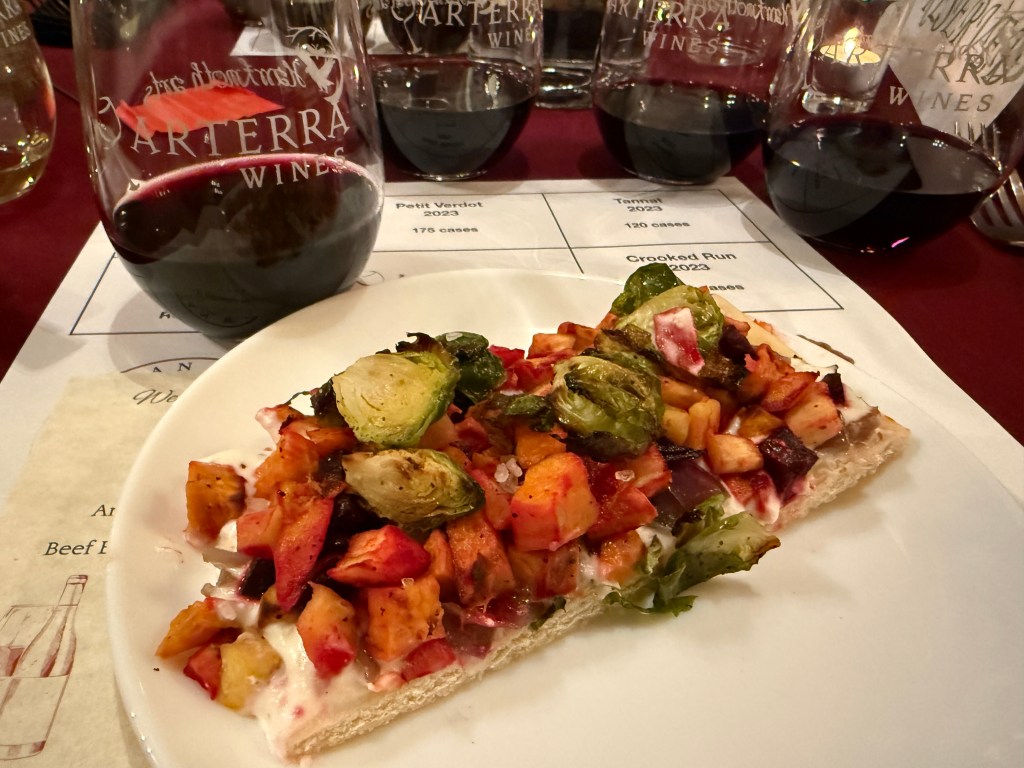
2023 Petit Sirah (with roasted vegetable tart). Juicy and bright, but the tannins were there. I found notes of leather, or perhaps tobacco at the end. This is what Arterra provides to guests who are looking for wine with structure and backbone, like Cab Sauv.

Jason explained Petit Sirah is something of an outlier in Virginia. Apparently, Petit Sirah tends to suck up water so its flavor profile can be very vintage dependent. That said, in the vineyard it’s also become a lot easier to work with once the vines matured. Oddly enough, Jason’s initial Petit Sirah harvests produced huge clusters (the opposite you’d expect from a grape with the name ‘petit’ in the name) but those clusters shrank as the vines matured.
2023 Petit Verdot (paired with arosticcini, and a pine nut & arugula pesto). Hearty and earthy. This is a great grape for Jason’s minimalist winemaking, as it’s one of the most weather hardy vinifera grapes in the state. If Jason could pick out a state grape for Virginia, this would be his #1 choice (note: Jason is not a big fan of cabernet franc, so he admits he’s slightly biased here).
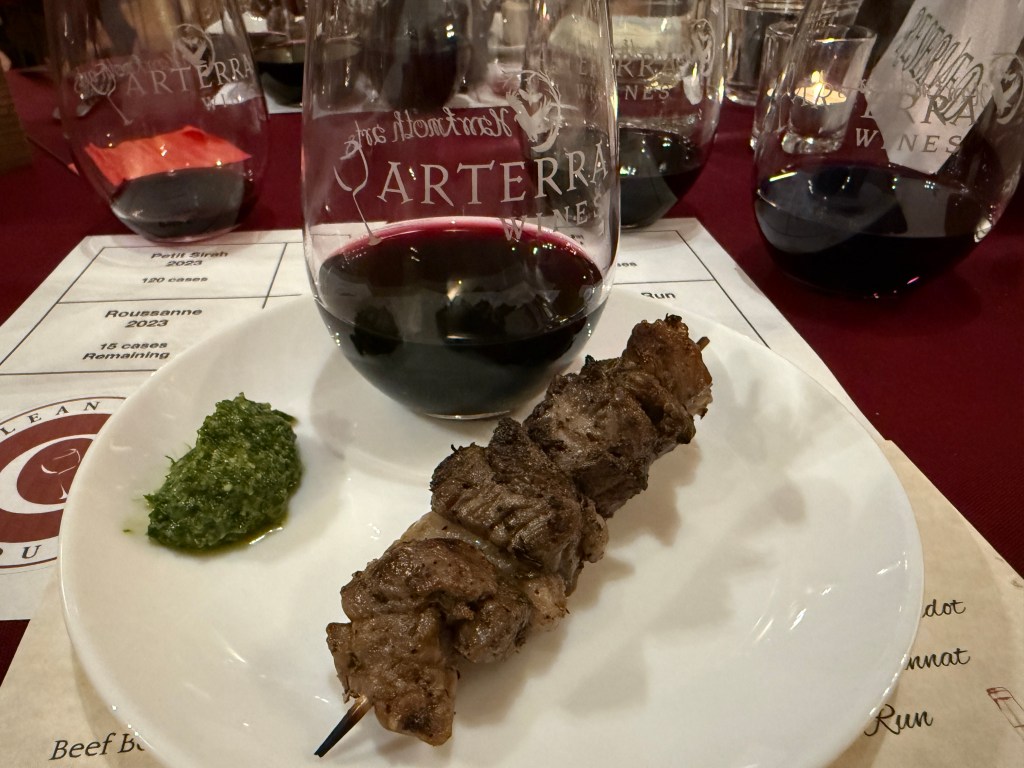
PS – Jason and I both learned that ‘arosticcini’ is just a fancy word for a lamb kabob!

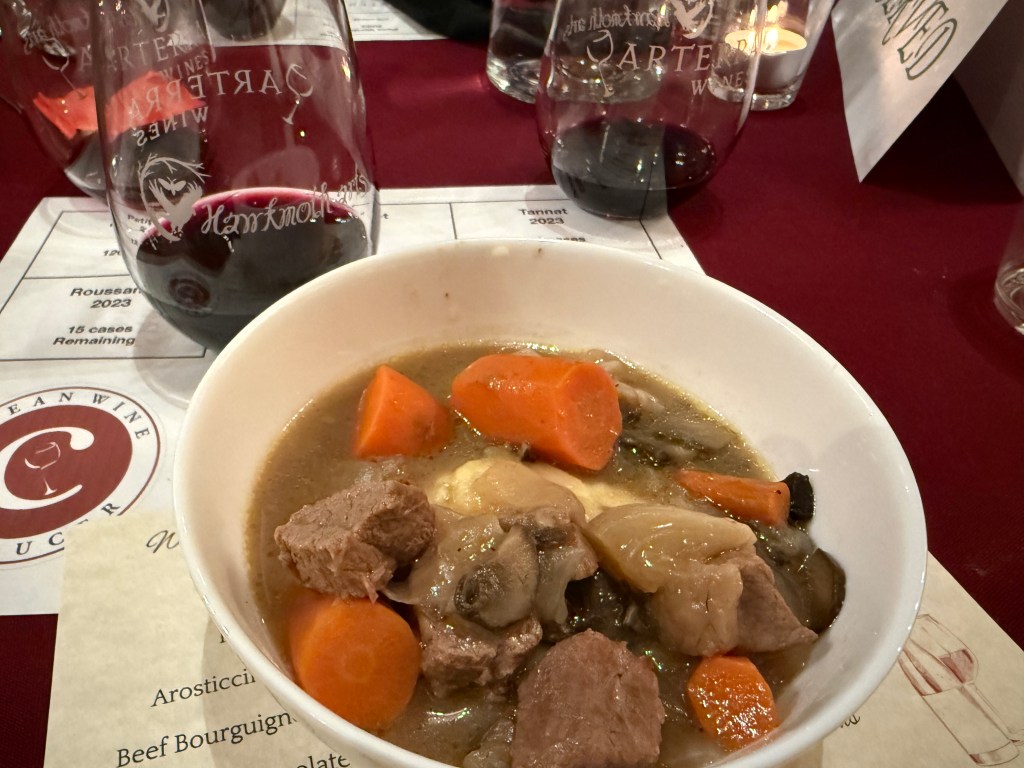
2023 Tannat (with beef bourguignon). If a wine could be described as ‘brooding’, this is it. As it opened, I found notes of black cherry, plus maybe some cola qualities as well. Most notably, there were lots, lots, and lots of tannin.
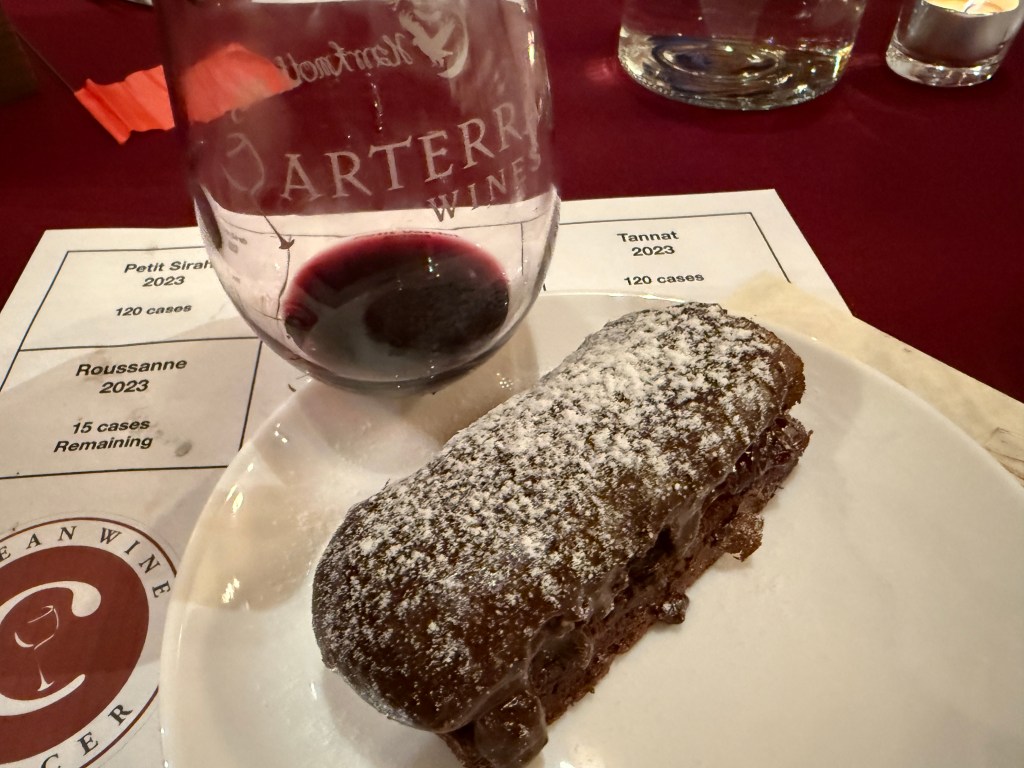
2023 Crooked Run red blend (with chocolate raspberry cake). Also heavy on tannins, but not quite to the degree of the tannat. I kind of wish it had more fruit qualities, but I appreciated how it evolved the most in the glass (in fact, I would say the sampled I tried all evolved quite a bit).

I finished up with a Chardonnay, which like the roussanne had a lot of intensity for a white wine.
I was supposed to be joined by Dan Redding of MyNovaWineBlog, but he bailed on me because this event was rescheduled! We actually tasted the 2023 release earlier in the year, but I get bragging rights for being at the dinner (na-na-nana-na, Dan).

Exploring The Peak Shenandoah Wine Region

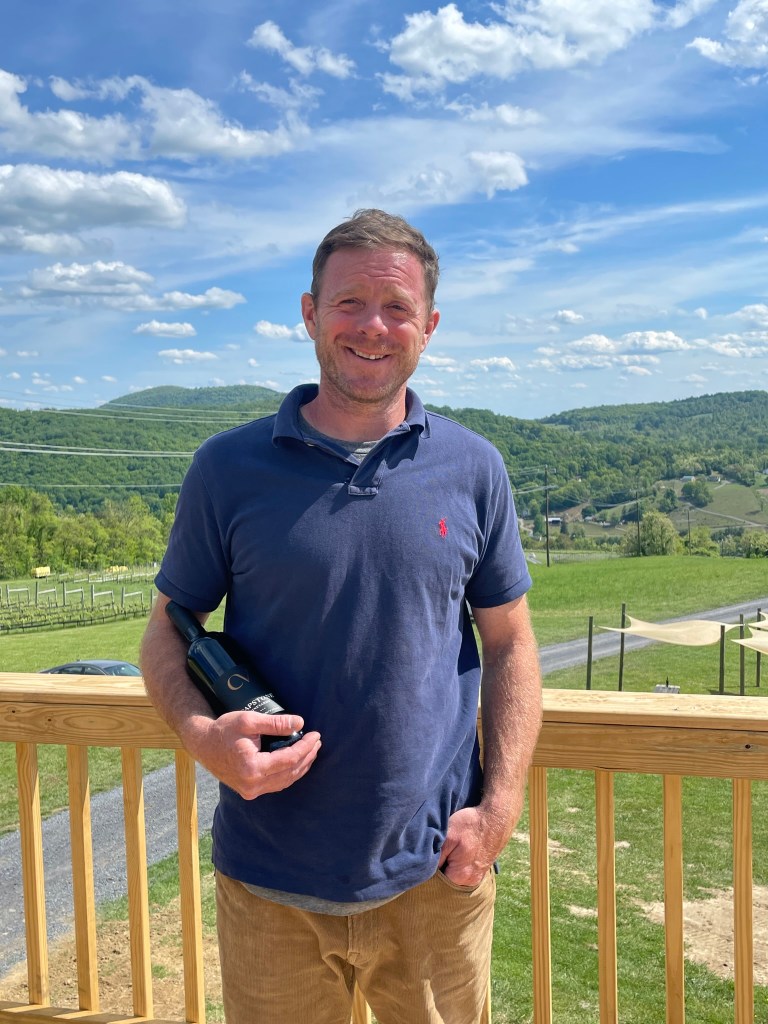
Peak Shenandoah is Virginia’s newest wine region. Named after Shenandoah National Park, it brings together six wineries located within 30 minutes of the park’s northern entrance at Front Royal. Region members include Arterra Wines, Capstone Vineyards, Chester Gap Cellars, Fox Meadow Vineyards, Rappahannock Cellars, and Star in the Valley Winery.

These venues are heavily influenced by the mountainous terrain around them. But according to Star in the Valley owner Shane Waller, they are bound by more than geography.

“Our wineries straddle both county lines and American Viticultural Areas (AVAs), yet we are still connected by a common character.

When I look at these other wineries, I see reflections of us. Folks that tend to the vines themselves, make the wine themselves, and have small, family-run-tasting rooms they’re selling wine from.

We’re all in the mountains and are just around the corner from fantastic outdoor recreation spots. That’s why I like to say it’s a wine region, because it’s an area where the wineries have similar characteristics.

We named it Peak Shenandoah as a homage to the park, as there are a lot of people that come here for hiking. We want to let these visitors know there are other fantastic places to visit as well. Or if you’re here for wine, come have a great day, stay overnight, and you can have a great hike the next day.”

Six Wineries Connected By A Common Thread

Peak Shenandoah isn’t a federally designated wine growing area like the nearby Shenandoah Valley AVA or Middleburg AVA. At the same time, it’s more than a wine trail, where participants sometimes share little in common beyond being neighbors.

“What sets our area apart from Loudoun or Charlottesville is elevation is the common thread for our participating wineries,” said Amanda Darvill of Fox Meadow. “Fox Meadow is at 1,800 feet. Capstone is at 1,500’. Star in the Valley is 1,300’. The other wineries are somewhere around 1,000’.

This elevation is important because cool air preserves acidity. Being near Chester Gap also means we have a constant breeze coming through, which helps alleviate disease pressure.”

Peak Shenandoah had its kick-off event on May 18th at Fox Meadow. The event showcased how their wines share similarities as well as unique personalities.

Photos of the Peak Shenandoah kick-off event taken by Mandy Giehll/Giehll Photography

While these wineries share many of the same grape varieties found elsewhere in Virginia, they don’t limit themselves to Chardonnay, Cabernet Franc, or Petit Verdot. Every participant has options that are seldom found elsewhere in the state.

Arterra Winery: Owner Jason Murray uses native yeast and minimal intervention winemaking to bring out the natural varietal characteristics of his grapes, a style he calls ‘clean wine’. Jason also recently announced he is pursuing an organic certification for his estate vineyard, which includes Petit Sirah and Tannat.

Arterra’s tasting room doubles as the studio for Hawkmoth Arts, showcasing his wife Sandy’s nature-themed multi-media artwork.

Capstone Vineyards: When describing the weathered, well-drained soils that make up his vineyard, owner Theo Smith explained, “With dirt like this, making wine is easy. All I have to do is not screw it up.”

Capstone grows traditional Bordeaux red varieties, as well as several grapes less common to Virginia such as Chenin Blanc and Muscat Ottonell. That said, Theo’s 2024 Sauvignon Blanc was a standout at the Peak Shenandoah kick-off event.

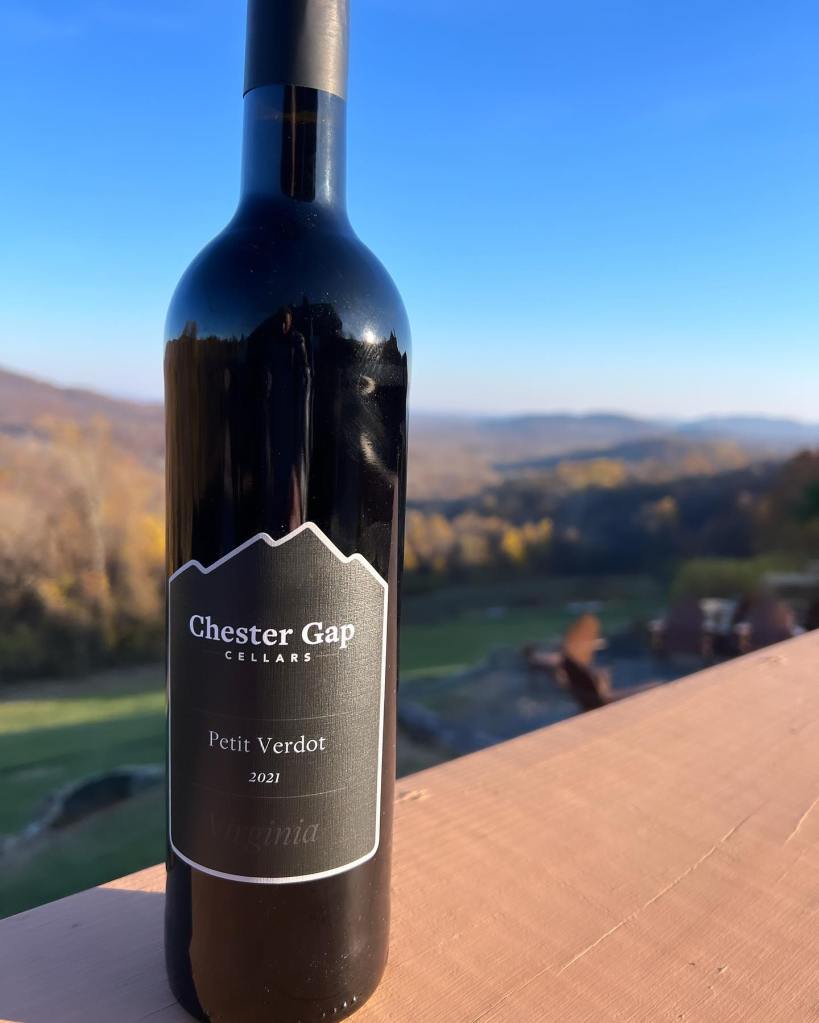
Chester Gap Cellars: With a tasting room set at 1,300 feet at the top of a steep slope, great views are guaranteed here. Visitors can also stay overnight at their on-site AirBnb.

Chester Gap is one of the handful of Roussanne growers in Virginia, although visitors should also try their stainless steel 2021 Viognier for its combination of minerally, crispness, and notes of salinity.

Fox Meadow Vineyards: Owners Amanda and Whiticar Darvill have a very personal connection with Virginia wine; their first date was at the 2011 Virginia wine festival.

Their tasting room is one of the highest elevation sites in the state (and boasts one of the best views). This elevation also affords them the opportunity to grow Pinot Noir, the vineyard’s newest addition.

Rappahannock Cellars: Rappahannock is known for its diversity of options. These include a variety of reds and whites, an in-house distillery, and its sparkling wine program.

Rappahannock’s sparklings include everything from its “Fizzy” rosé for daily sipping to its traditional method “Prestige”. While the variety may seem intimidating, tasting manager Kelly Knight explained, “Most customers don’t seem to worry about how the sparkling is made, as long as it’s good.”

Star in the Valley Winery: Star is the only Peak Shenandoah winery actually located in the Shenandoah Valley. In addition to its vinifera, they produce several wines made with hybrid grapes (make sure to try their Chardonel).

Star in the Valley’s lack of light pollution and higher elevation also makes it a great place for stargazing. Shane is partnering with the Shenandoah Astronomical Society for special ‘full moon’ events on 6/14, 7/12, 8/9, and 9/6, with live DJs to accompany these evenings.

Visitors to Peak Shenandoah need not confine themselves to wine, as the region is adjacent to Shenandoah National Park, George Washington National Forest, and Sky Meadows State Park. The Appalachian Trail’s Trumbo Hollow trailhead is just around the corner from Capstone and Fox Meadow, while the Tuscarora Trail is minutes from Star in the Valley.