It’s easy to find light fare at a Virginia winery. It’s far more difficult to find places that elevate the food to be on par with the wine. Victoria Cosner, Executive Chef of Pippin Hill Farm & Vineyard’s Executive Chef said it best – “If they don’t have food, it’s hard for me to justify going there on my one day off. I want to expect good food.”
Any visitor to 12 Ridges Vineyard is guaranteed to be blown away by the mountain views and wine that demonstrate a ‘sense of place’. Located on an old Christmas tree farm, it has the vibe of a get-away retreat.
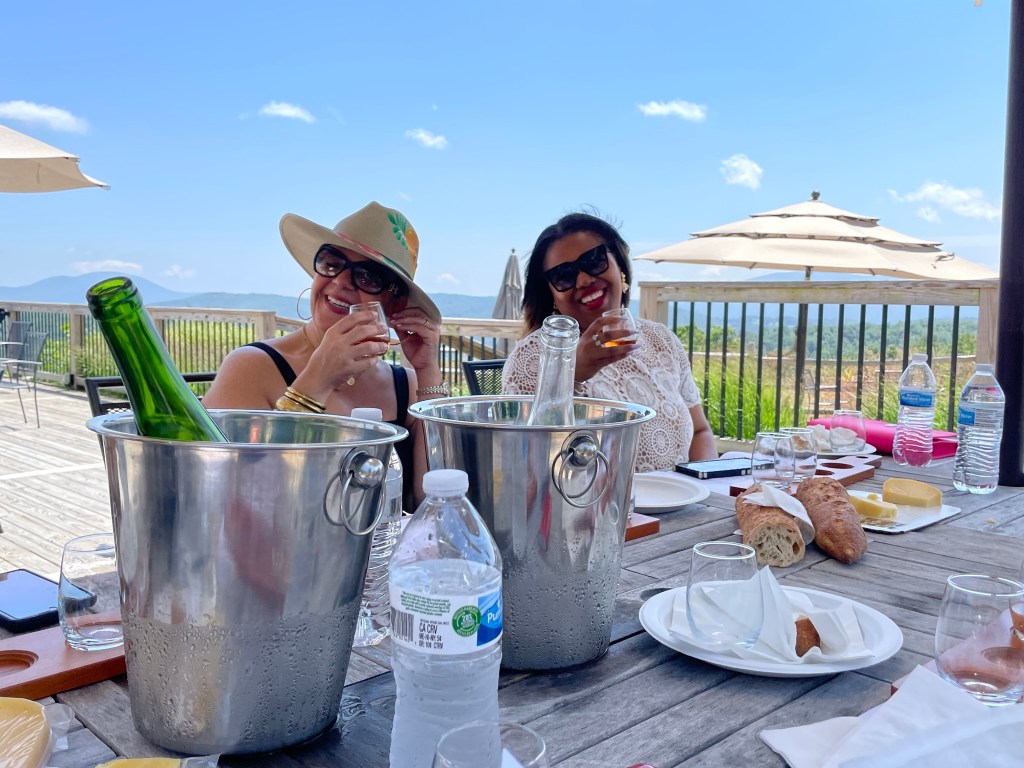
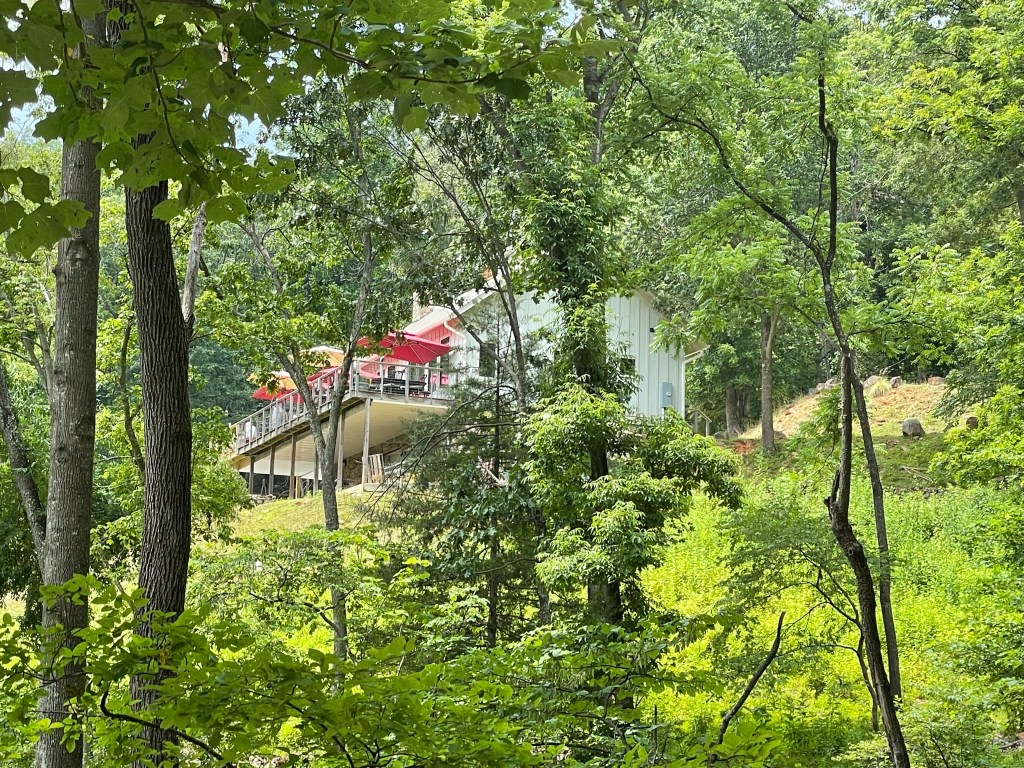
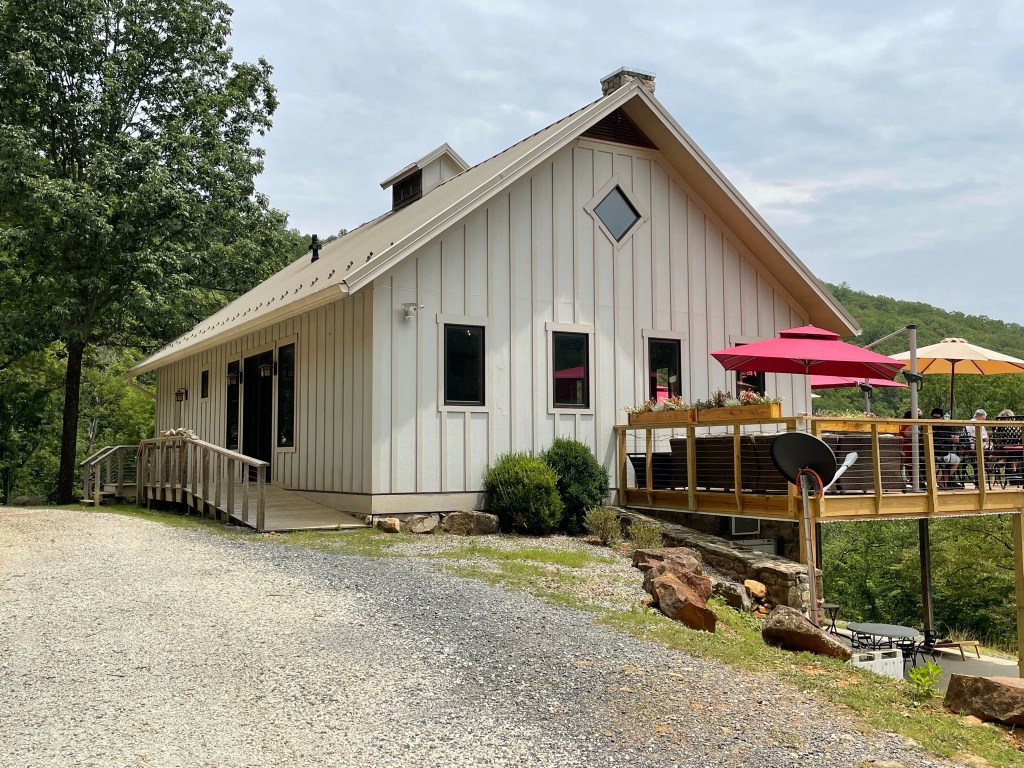
The tasting room adroitly maximizes their huge deck so guests can take in their surroundings. You can even hang out on the swing set at the top of the hill, overlooking the vineyard and Blue Ridge Mountains.
I’ll get to the wine in a moment, but before talking about that it’s important to explain *why* wine grown here is so special.
In telling the story of ‘how I started my winery’, owner Craig Colberg said when he bought the property in 2010, he didn’t have a specific long-term plan. Fortunately, Craig’s friends gave him the idea of planting a vineyard precisely to take advantage of its unique potential.
That’s because this place is all about location location location. Vineyard consultant Jake Busching planted the vineyard in 2018 fully knowing its terroir had the potential to make fantastic white wines, especially suitable to make sparkling.
12 Ridges opened in 2019, initially selling wine from other high-mountain sites while their vines matured. Their 20 acres are roughly equally divided between chardonnay, pinot gris, pinot noir, and riesling, with the first vintage coming out in 2022.
What You Need To Know About High Elevation Wine
Situated off northern end of the Blue Ridge Parkway, at 3,300 feet it’s the highest elevation vineyard in Virginia (and 2nd highest in all the east coast). It also has rocky, well drained soils, important for producing high-quality grapes.
But 12 Ridge’s greatest advantage comes down to one word: acidity. Grapes grown at cooler sites retain higher levels of acid, making them crisp, food friendly and ageable. Acid is also one of the key components for sparkling wine. Not coincidentally, they planted slightly heavier on the chardonnay and pinot noir, as these are Champagne’s most famous grapes.
Higher elevation sites are by default cooler, an important advantage as global warming takes hold. That said, sites with high relative elevation (higher than the surrounding area) have a special additional advantage, referred to as a ‘thermal belt’.
Cold air is heavy and drops to lower elevations. As the cold comes in, it displaces lighter warm air which create a zone of warmer temperature above it.
It’s not uncommon for mornings at 12 Ridges to be a full 10 degrees warmer than the valley below, helping guard the vines from morning frost. Craig explained the diurnal temperature shift could take them from the upper 50s in the morning to highs in the 70s in the daytime.
High elevation sites have other advantages. Grapes grown in such locations are subjected to stronger UV rays, resulting in thicker skins that provide more intense color and bolder tannins. Stronger winds also reduce disease pressure, as good airflow removes moisture from the vines.
But as with nearly everything, there’s a tradeoff.
Winegrower Josh Seaman explained how 12 Ridges doesn’t have bud break until late April. While this puts them past much of the ‘danger zone’ of a spring frost, being 3-4 weeks behind the rest of the state elevates their risk to hurricane season.
Cool weather sites also must juggle the tradeoff between ripeness and acidity. Heat ripens grapes on the vine, but also causes their acidity to drop. The cool weather means 12 Ridge’s fruit struggles to ripen even into September. Windy conditions also make fruit set more difficult.
A Taste of Terroir
As of late 2023, 12 Ridges has only produced two vintages. Fortunately, Craig was very generous and let us try what he had.
While production should ramp up in the future, this is unlikely to ever be a high-producing site. The vineyard typically only produces 1 ton of fruit per acre, which is a lower yield than they’d prefer. Sadly, quantity is often the enemy of quality.
We also talked about their plans for a sparkling program. With acidity like this, the grapes here almost cry out to be made into sparkling wine. Their first release using chardonnay and pinot gris will come out in 2025, so I’ll have to be patient until then.
While the prospect of high-acid whites is enticing, I was just as excited at the prospect of more pinot noir. While there almost 50 acres planted in Virginia, I’d argue less than half of that is planted in cooler sites where it can reach its full potential. This is one of them.
I was also happy to learn their wine is made at newly-formed Common Wealth Crush, with Ben and Tim Jordan as their winemakers. Their low-intervention philosophy is a great fit for 12 Ridges, and Common Wealth Crush (which I visited later that day) has a great setup for both sparkling and still wine.
Over an extended tasting Craig and Josh discussed the lineup, and we found a lot to love. That said, if I *had* to pick a favorite, it would be the chardonnay.
This chardonnay was, not to exaggerate, my favorite Virginia chardonnay of the past year; and I’ve had a LOT of great chardonnay. To say I held back a tear when I learned there was none for purchase would be only a slight exaggeration.
What we tried:
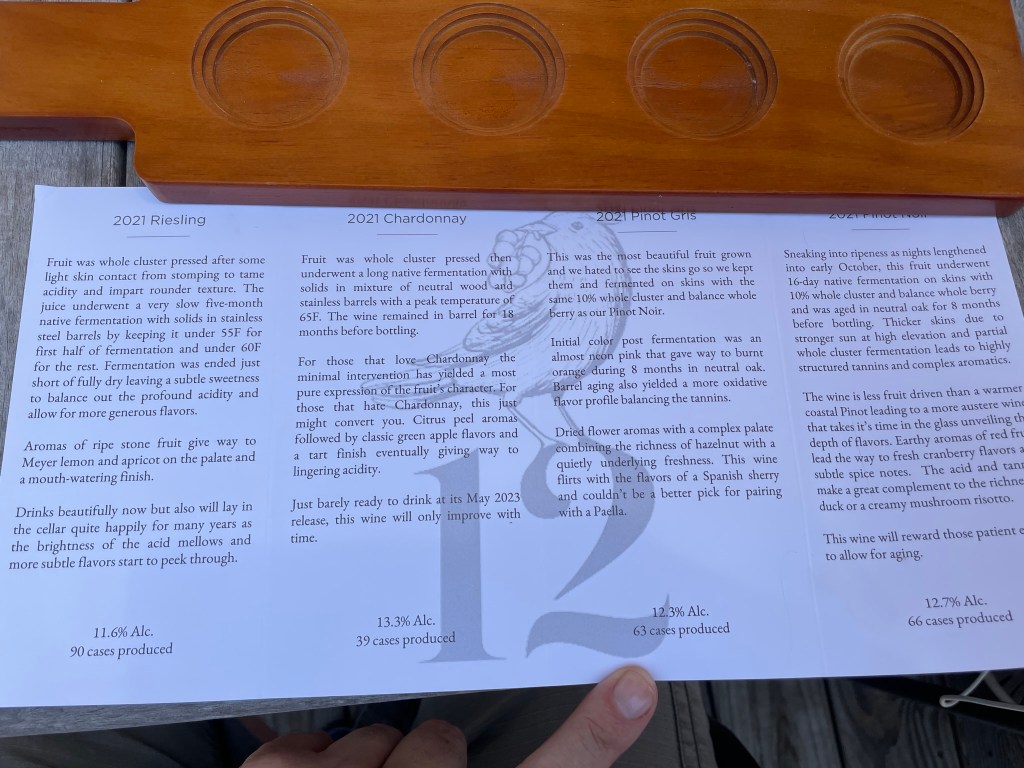
2021 Chardonnay; fresh, high acidity. It also had surprising weight, with light apple notes which reminded me of a golden delicious. More Chablis than Burgundy in style, which in itself is very different from what you find elsewhere in Virginia.
2021 Riesling: Bright, green apple. Mostly dry with a sweet note at the end. Well balanced.
2021 Pinot Gris: Made in an orange wine style, which means they used white wine but didn’t remove the skin during fermentation. Tangy, weighty, and overall really nice and interesting.
2021 Pinot Noir: A bit heavier than a west coast pinot, but that’s not a negative; we all enjoyed it. Made using native yeast and a bit of whole cluster fermentation.
For those who are curious, here is a brief list of Virginia’s high-elevation vineyards.
This list could be even longer if I included vineyards in the Upper Shenandoah Valley / Roanoke / Wytheville areas. I omitted these locations because while they have raw elevation, the lack of ‘relative’ elevation (meaning the vineyards are closer to the valley floor) means those vineyards lack the ‘thermal belt’ and airflow needed to excel in the same way vineyard like 12 Ridges or Ankida can.
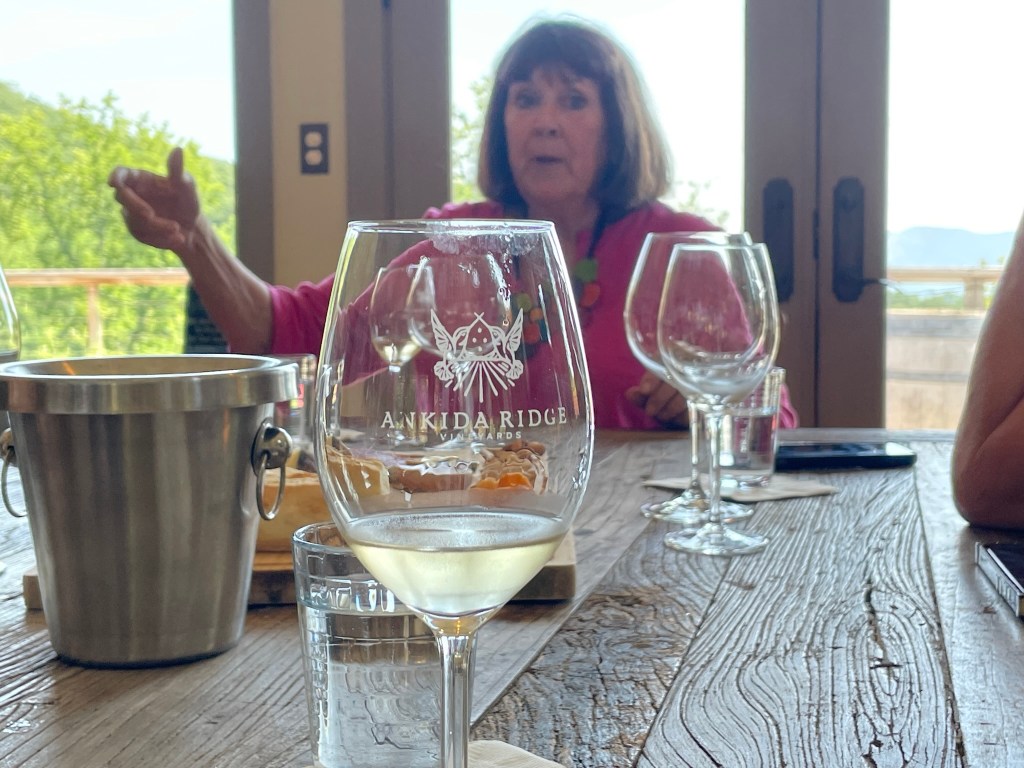
It’s tough to find a Virginia wine lover who’s unfamiliar with Ankida Ridge. While Ankida is one of the state’s more remote vineyards, being one of Virginia’s very few pinot noir growers make them one of the more famous.
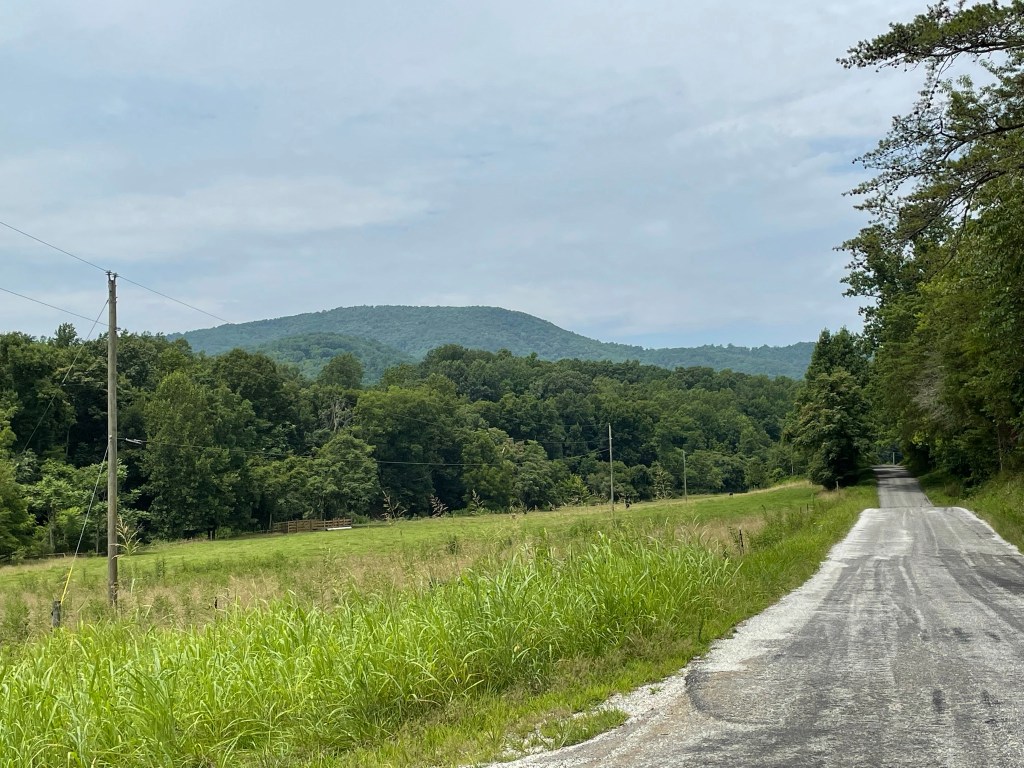
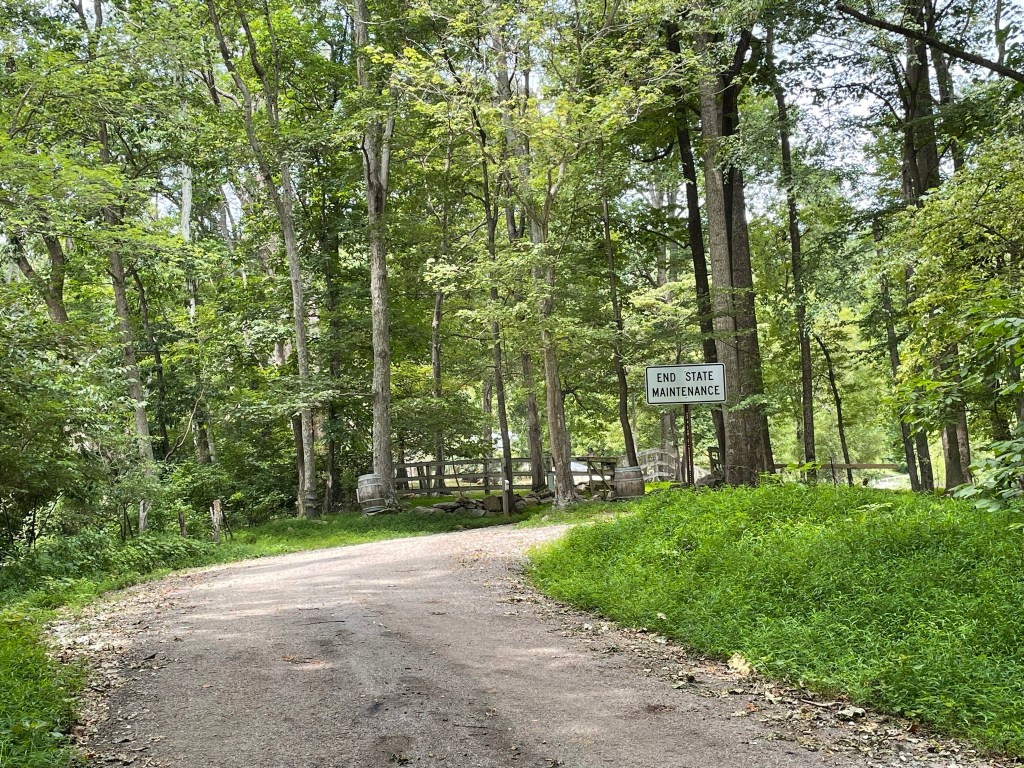
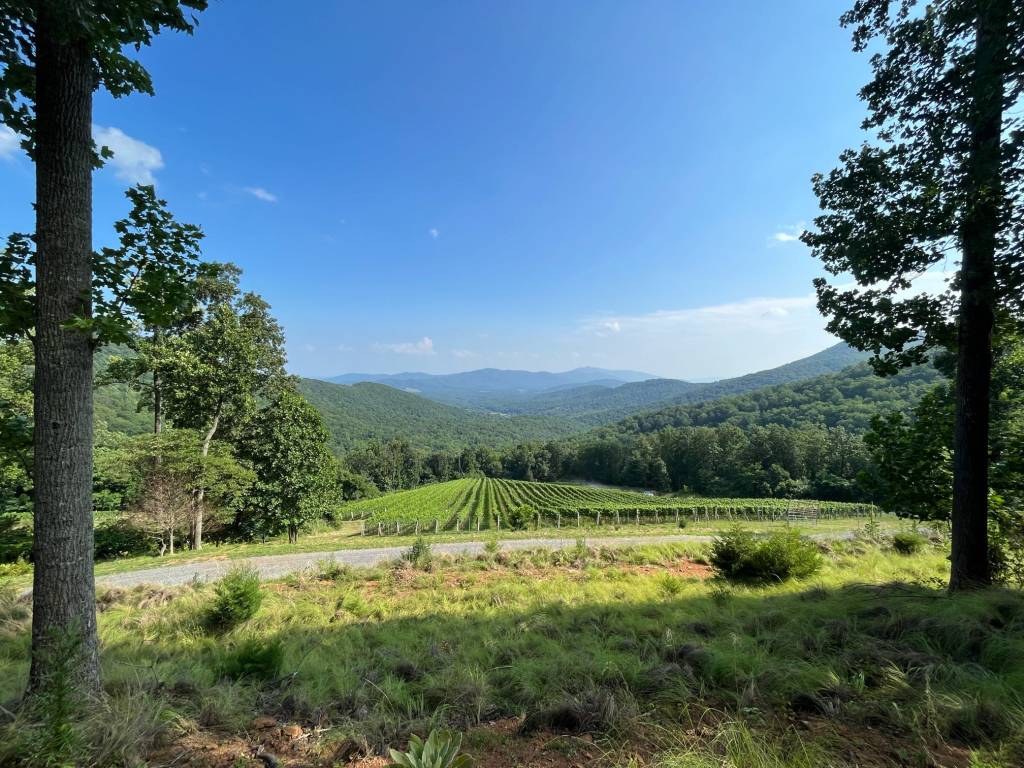
Ankida is only 75 minutes from downtown Charlottesville, but the last leg of the journey is all uphill. You know things will get interesting when you pass signs that say “end of state maintenance” and your signal gets weak, but at least the views are beautiful.
I’d been trying to meet up with owners Christine and Dennis Vrooman for a long time but always seemed to miss them. But this time I was in luck; Christine was happy to host a small group, and it was easy to find ‘volunteers’ to come with me.
With an elevation that tops out at 1,800 feet, Ankida is one of Virginia’s higher-elevation vineyards. While one wouldn’t blame the Vroomans for choosing the location for the view alone (which is technically true – the land was originally going to be a weekend getaway), its elevation actually serves a more practical purpose.
Standing on the deck of her tasting room overlooking the valley, Christine gestured at the scenery before us. “We have a little valley here and a little valley there, and cold air moves down them to the bottom of the mountain. We’ve never been touched by spring frost, and our disease pressure is low since we never get morning dew. I could have called it Utopia Ridge.”
The phenomenon Christine was referring to is called a ‘thermal belt’, and its why winegrowers prize mountaintop sites. Cold air is dense, and like water flows to the lowest point available. This in turn displaces lighter warm air which rises above it. This results in a narrow zone where the temperature is warmer than what is above and below it.
As Ankida is 1,000 feet higher than the bottom of the valley, the morning cold air passes through the vineyard but like an unwanted guest is shown the way out. This lets the vines stay within a consistent temperature range, one that is conducive for growing grapes. Christine explained their mornings start off warmer than the town below, but in the afternoon, the vineyard is typically 5-15 degrees cooler than the surrounding lower regions. Even in the hot 2023 summer the temperature never hit 90 degrees.
This climate (plus the ancient granite the vines are planted on) makes it a great place for pinot, gamay, and chardonnay; 6 acres in total. The first two grapes are nearly unheard of in Virginia, while the later retains a degree of acidity that’s rarely found.
This unique microclimate is the inspiration for an initiative that Ankida and nearby 12 Ridges Vineyard are working on; a new American Viticultural Area (AVA) dedicated to high-elevation vineyards.
Details are scarce since it’s mostly conceptual, but the idea is to have a non-contiguous AVA which only includes vineyards situated above a certain elevation. 1,000 feet has been bandied around as the measuring stick to join the club, but fine details such as the vineyard’s elevation in relation to its surrounding area are just as important as the site’s true elevation above sea level.
Fortunately for my group, Christine didn’t let my geeky wine questions stop her from pouring. Out came several cheese plates and a number of bottles, starting with their newest wine, the Blanc de Noir champenoise-style sparkling.
As much as I missed their Blanc de Blanc, this Blanc de Noir was equally good. Even in a lineup full of stars, it was special.
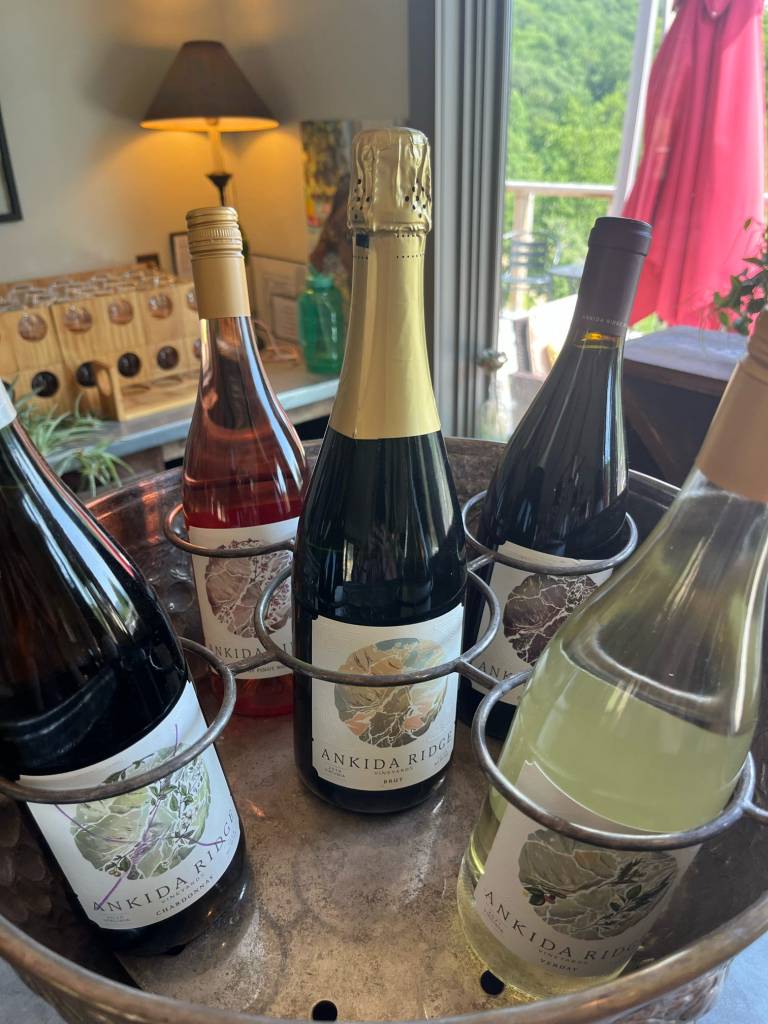
Next up were a pair of pinot-based wines; Ankida’s rosé and “Verday”, plus a chardonnay.
The rosé was nice, but I’ve had lots of great rosés and it was almost unfair to it put it next to a wine that truly surprised me; the Verday. Named after the light, refreshing wine that Portugal is known for, Verday had the same zestiest as any Vino Verde I’ve had.
Next up was their chardonnay. While the pinot noir gets the majority of the press, I think their bright & creamy 2021 Chardonnay should get equal billing. Not sure if I should give credit to the terroir or winemaker Nathan Vrooman, but dang I liked that one.
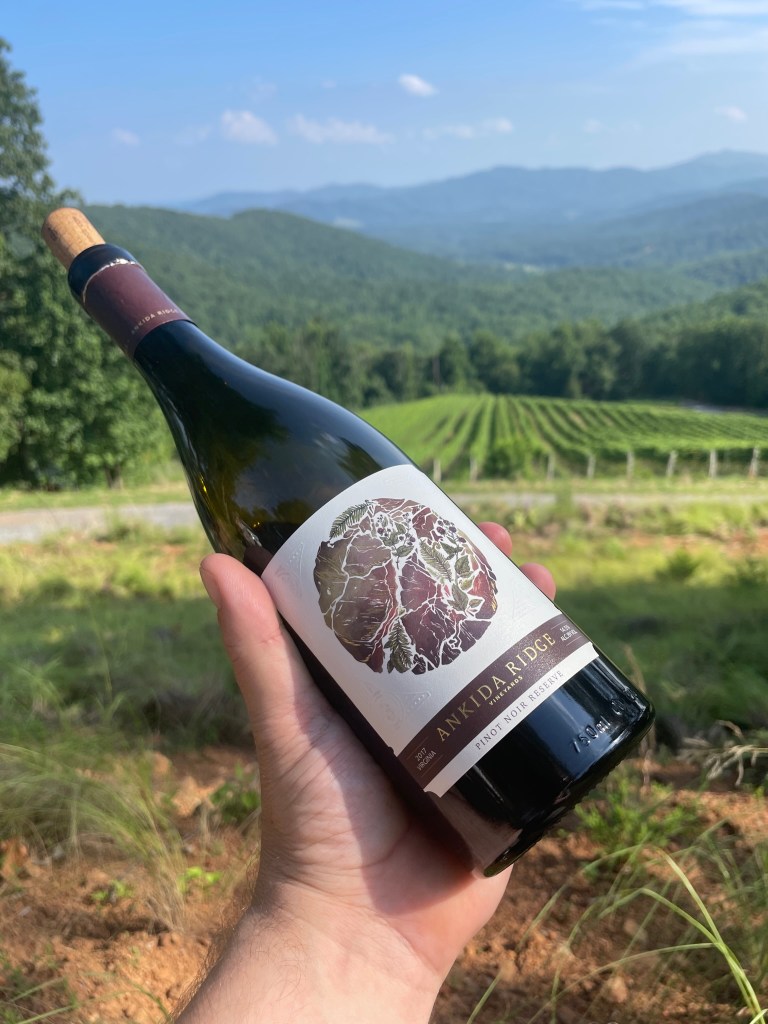
Then came a pair of pinot noirs; 2017 Reserve and 2019. The former was a special treat and made me kick myself for not ordering it while I could (granted it was $85…but still). 2021 wasn’t quite as complex but was still very quaffable. I was excited to learn that a 2021 Reserve was also in the works.
We ended the day sitting at the top of the vineyard finishing off the open bottles and admiring the view before heading home – but not before we were treated with a ride through the vineyard.
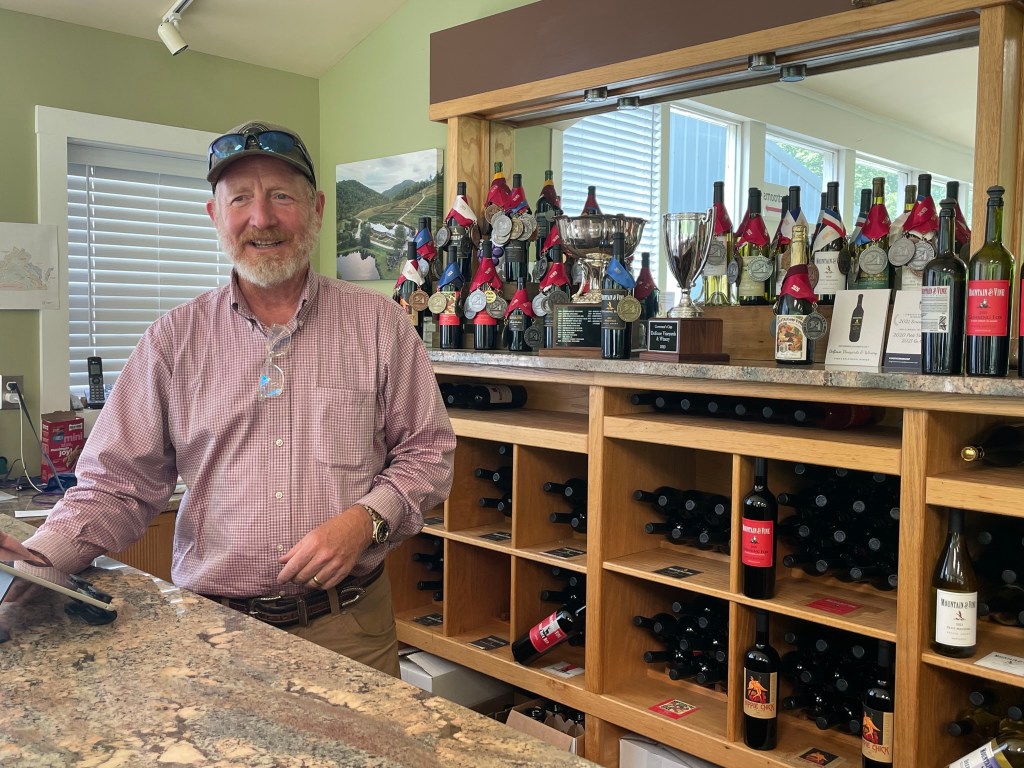
During a 4-winery visit weekend last month, a group of friends and I kicked things off with a visit to Mountain & Vine (which for now still goes by its old name, DelFosse).
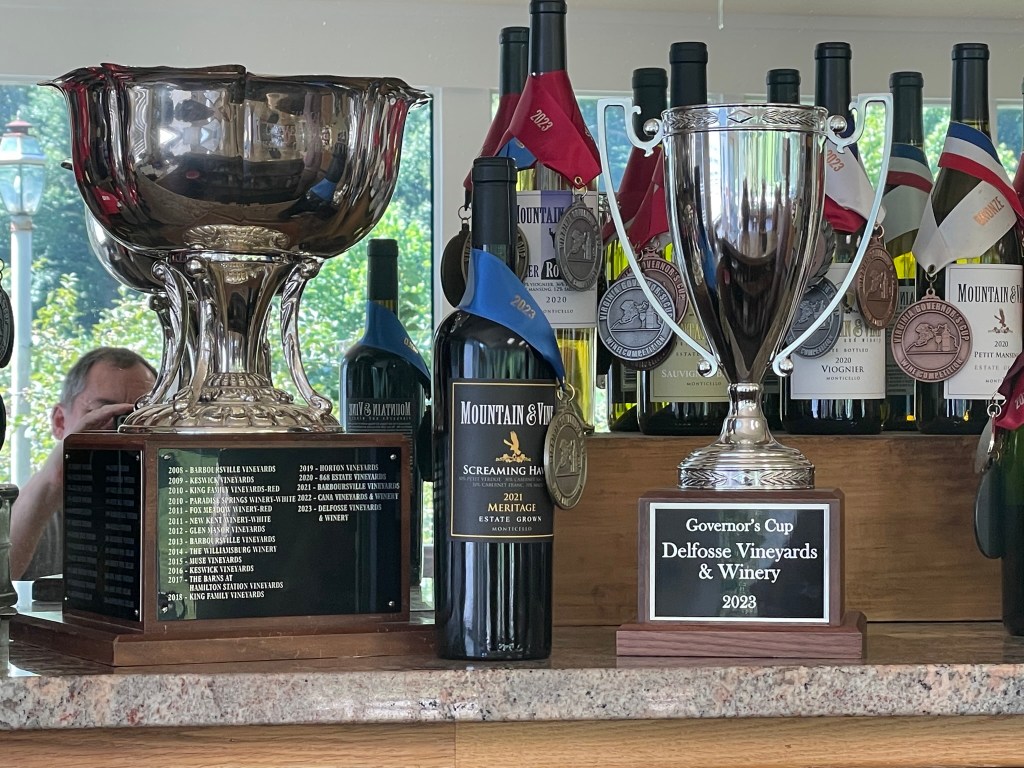
I’d been to Mountain & Vine a few years earlier, but this was my first stop since they won the 2023 Virginia’s Governor’s Cup for their 2021 Screaming Hawk Meritage. If the chance to taste this wine wasn’t enough, getting to catch up with their new winemaker Stephen Barnard (formerly at Keswick) sealed the deal.
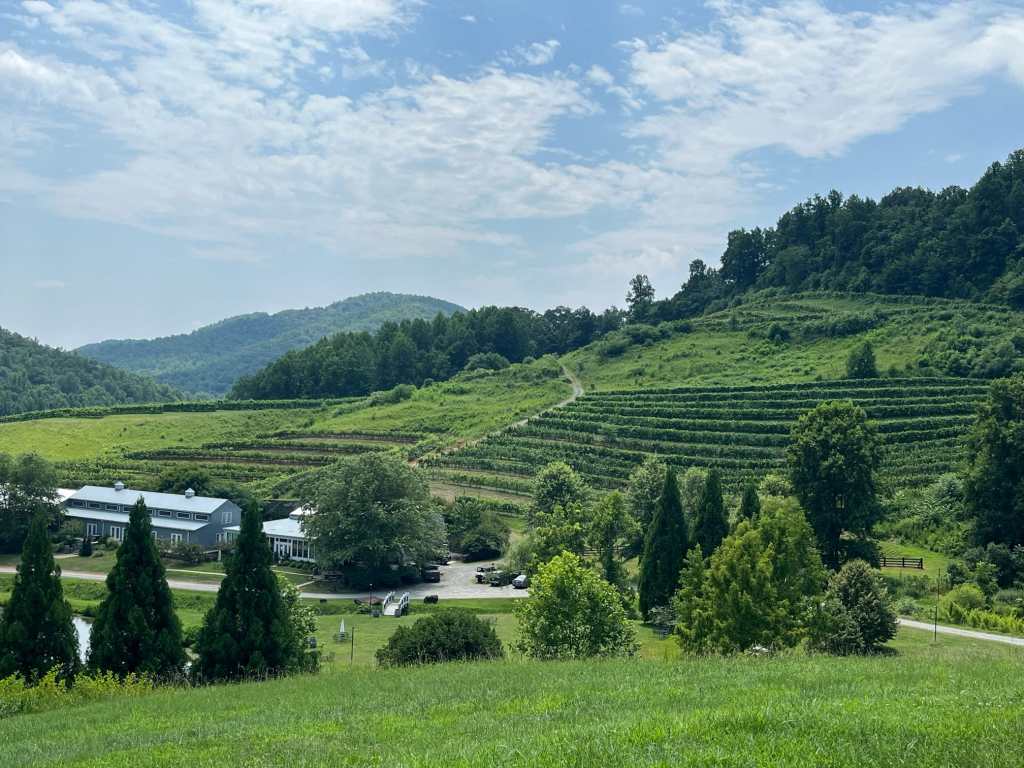
Mountain & Vine is located about 30 minutes SW of Charlottesville in the lower hills of the Blue Ridge Mountains. It feels like an exceptionally rural area, but the tasting room is pretty and the view from the top of the hill is absolutely killer. They even have a B&B on the property.
Stephen was gracious enough to host my group, but we lucked out we also got to meet with owner Mike Albers.
He and his wife Adrienne purchased the property from Claude DelFosse in 2017. It didn’t make sense to keep the name of the old owner forever, but the Albers weren’t in a rush to change it either. They slowly shifted the name to Mountain & Vine, focusing on rebranding the name on the bottles as opposed to the name of website.
This new labeling proved fortuitous as their Cup win brought a ton of publicity. While the sign at the entrance still says DelFosse, they’ve almost completely pivoted to Mountain & Vine.
As for the vineyard, based on the slopes I saw it was easy to tell this is a great place for winegrowing. The have 17 acres vines using 11 varietals; all vinifera with the sole exception of some chambourcin. At an elevation of 850-1,100 feet, those vines are (for the most part) safely above the frost line.
Mike fully admitted that when he submitted the Screaming Hawk he thought it was a bit too young, but figured he’s submit it anyway just to get their opinion. Well – surprise! The judges obviously disagreed and he came away with the Cup.
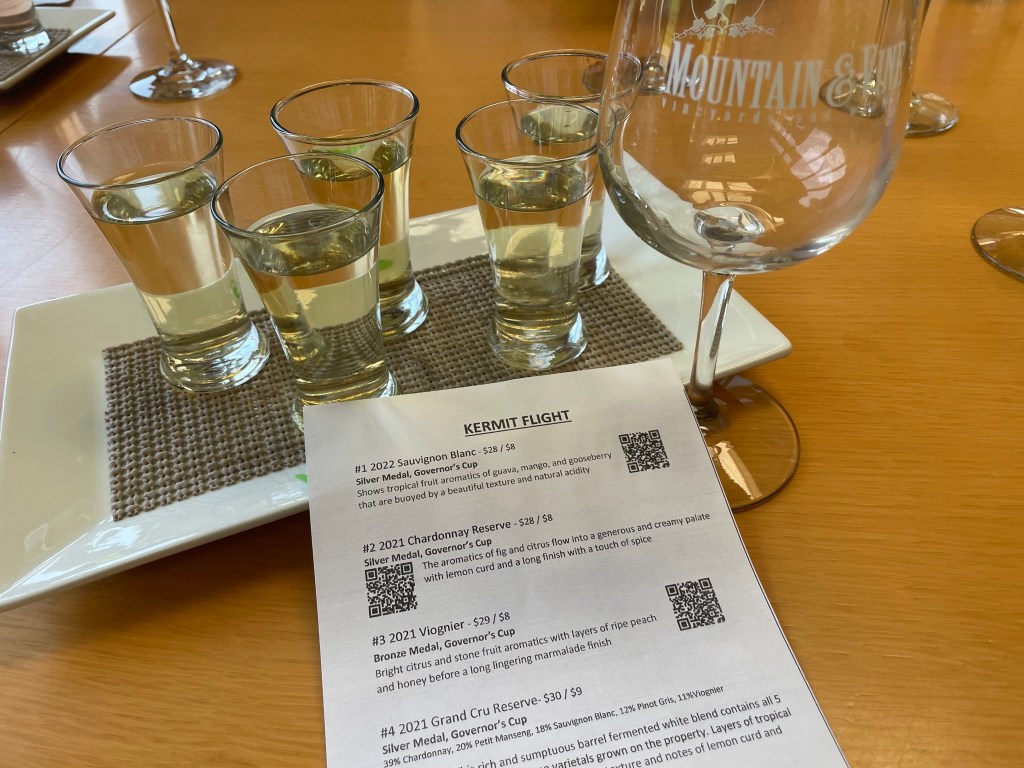
Once Stephen came in from the vineyard we sat down for an extended tasting. As he’d only been here for a matter of weeks none of these wines were his, but that didn’t stop him from chatting them up. All in all we easily tried at least a dozen wines, all estate grown.
We kicked things off with the whites, and I found a lot to love. The Grand Cru Reserve is a rich white blend and one of my favorite wines of the weekend. I also loved the sauv blanc and chardonnay. I left with two bottles of the Cru.
For reds, obviously my favorite was the bigger, drier wines, but they had several options that were designed to be served chilled or could satisfy a sweeter audience.
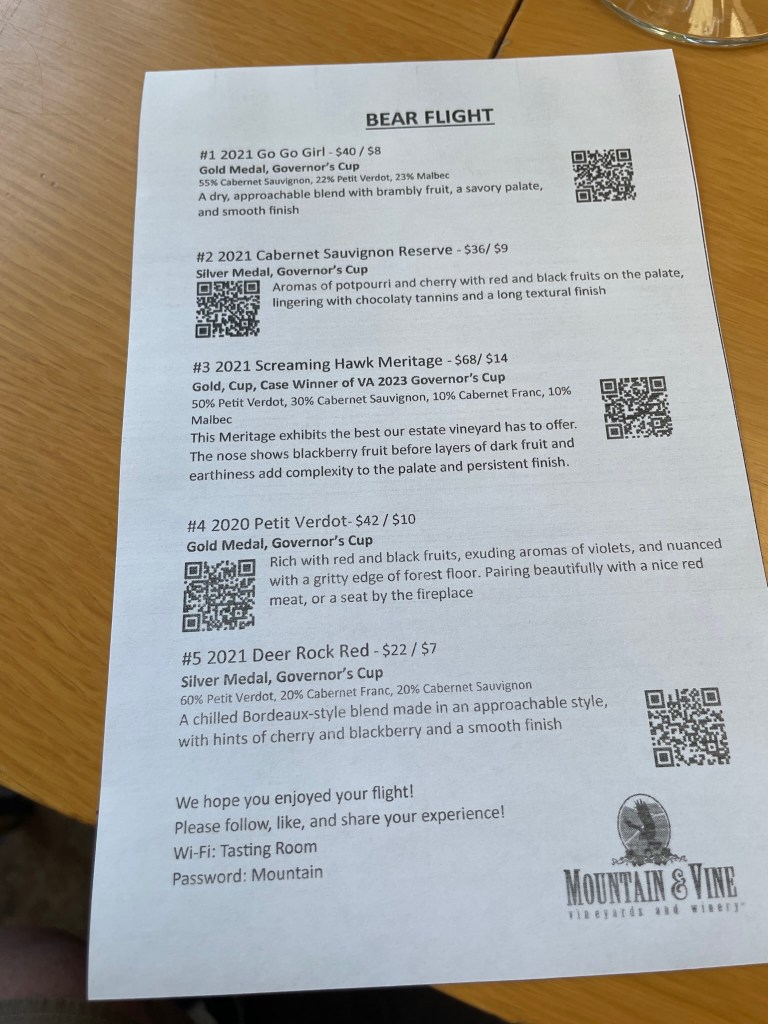
The 50% Petit Verdot, 30% Cabernet Sauvignon, 10% Cabernet Franc and 10% Malbec Screaming Hawk was the favorite of the lineup. For a PV-heavy wine it didn’t taste overly ‘big’, and neither did I feel it was overly youthful. It was totally drinkable now and had Mike poured me more I would have finished it right there.
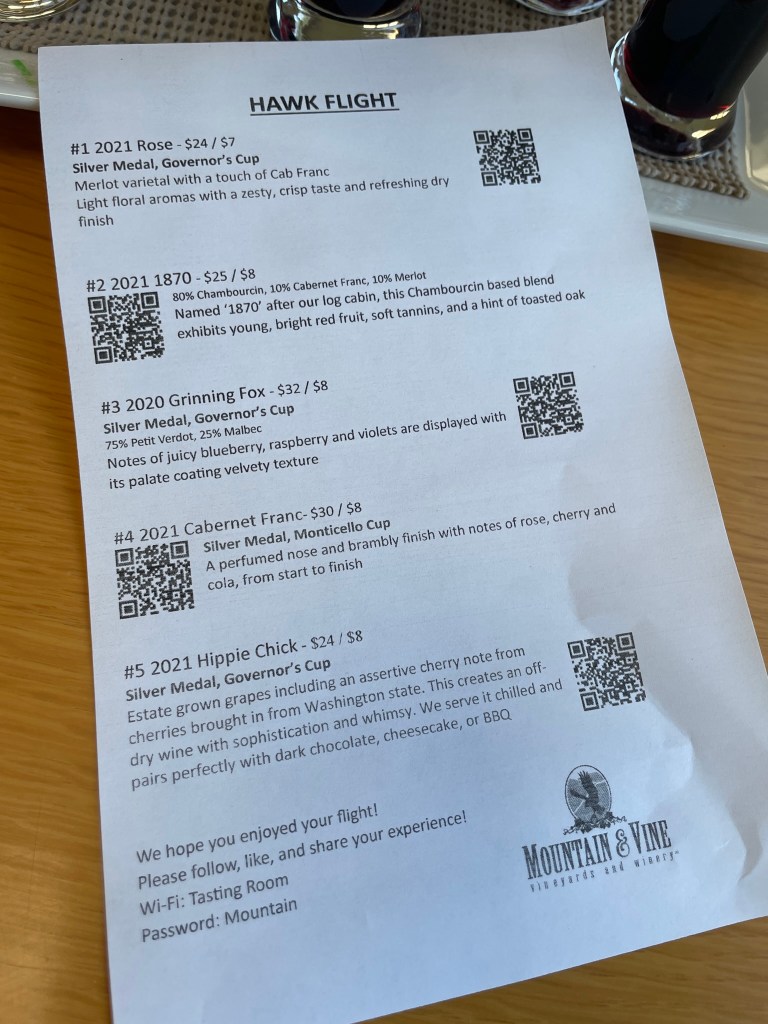
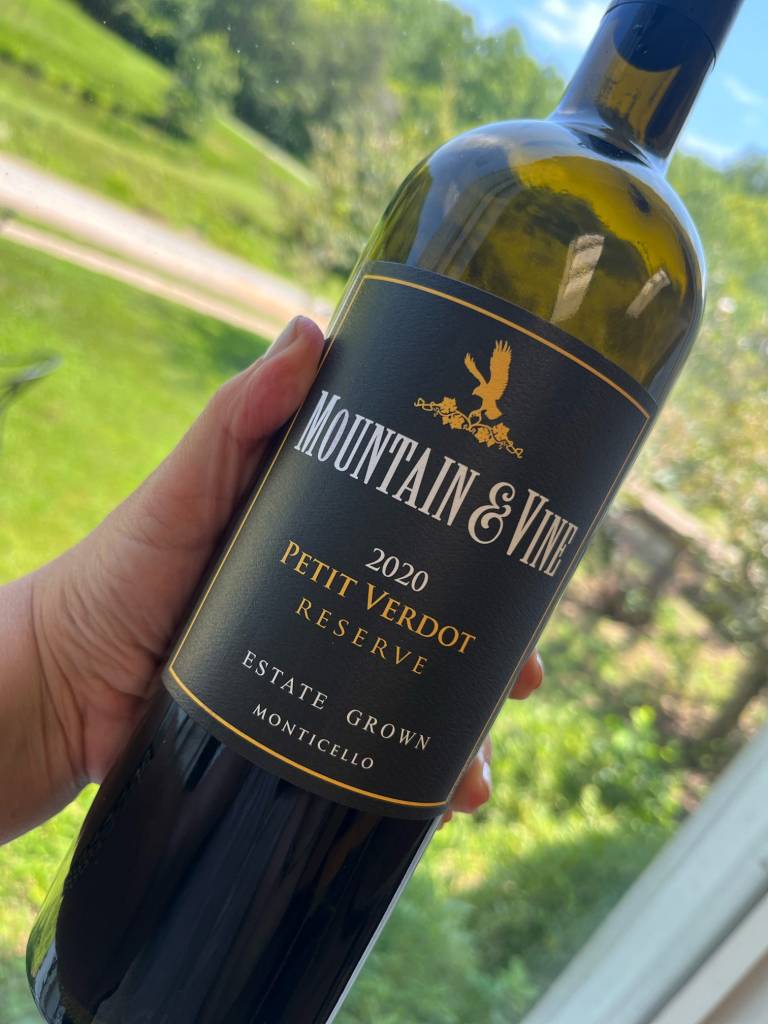
The runners up were their “Grinning Fox” (75/25 PV and Malbec), 2020 PV, and “1970” chambourcin. It’s not often that I’m impressed with chambourcin but I really liked the fruity-strawberry notes.
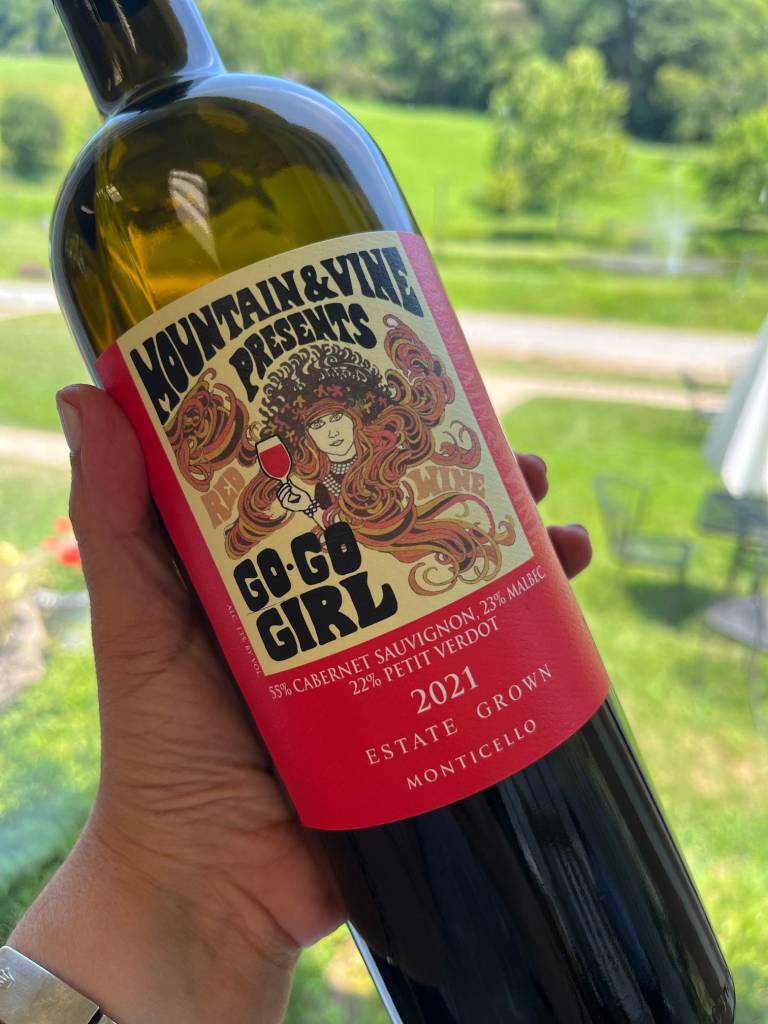
Rounding it out we tried a soft cabernet franc, the “Deer Rock” and the “Hippie Chick” that was more for a sweeter palate. Sadly no 100% Malbec (theirs is one of the few in Virginia); that was already sold out.
All the wines were good-to-great (even ones that normally don’t fit my palate). But if the quality wasn’t enough, I really appreciated how the prices were easily a good 10-20%-ish cheaper than elsewhere in the Charlottesville area. Being remote has other advantages.
To anyone who visits – TAKE PICTURES FROM THE HILL. The view alone is worth the trip.
My latest article from Wine and Country Life is now live!
There were a lot of great new places in the past two years, but here I discuss Crimson Lane Vineyards, Everleigh Vineyards & Brewery, Kalero Vineyard, Nicewonder Farm, Oakencroft Vineyards, and Seven Lady Vineyard/Dover Hall.
Common Wealth Crush Co. (CWCC) is tough to describe at a glance because it has a lot going on. Its core business is to make wine for other customers, a process often called ‘custom crush’ but technically should be referred to as contract winemaking. 7 Lady Vineyards is one of their main customers, but they make wine for others as well.
On top of that CWCC provides a venue for vintners to make wine under their private labels. Jake Busching does his winemaking here, and CWCC rents tank space for other winemakers like Stinson Vineyards who have outgrown their own facilities.
As if that’s not enough, winemakers Ben and Tim Jordan craft wine under their own labels. This includes wine made under the Common Wealth’s logo, plus their personal and family brands.
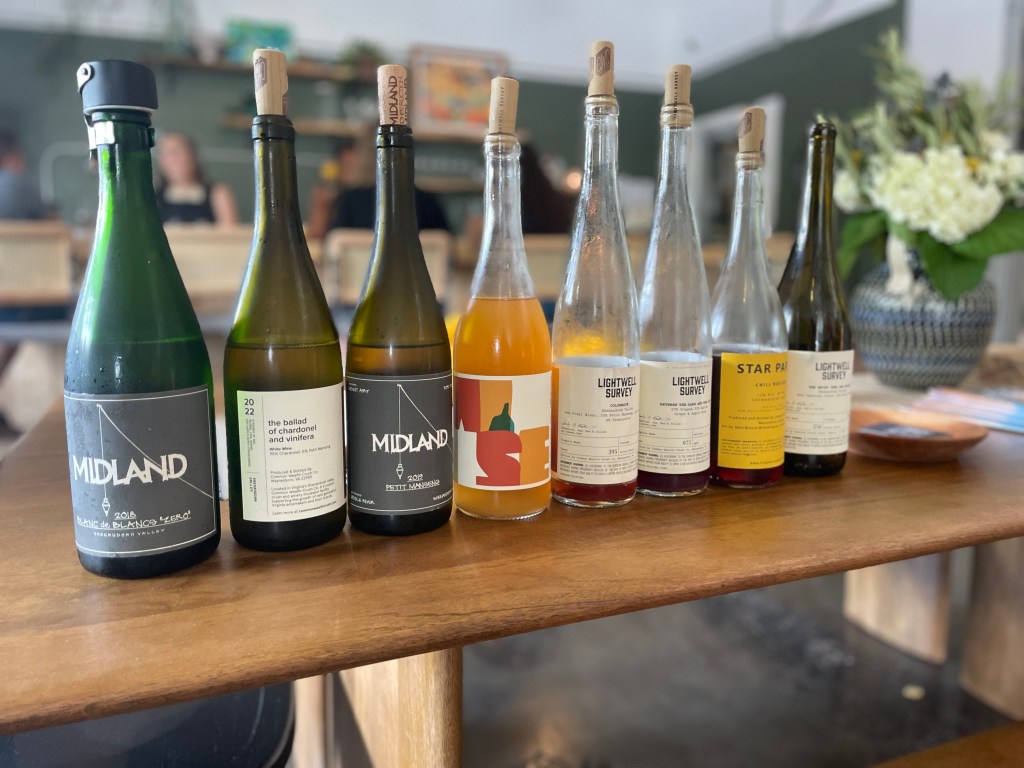
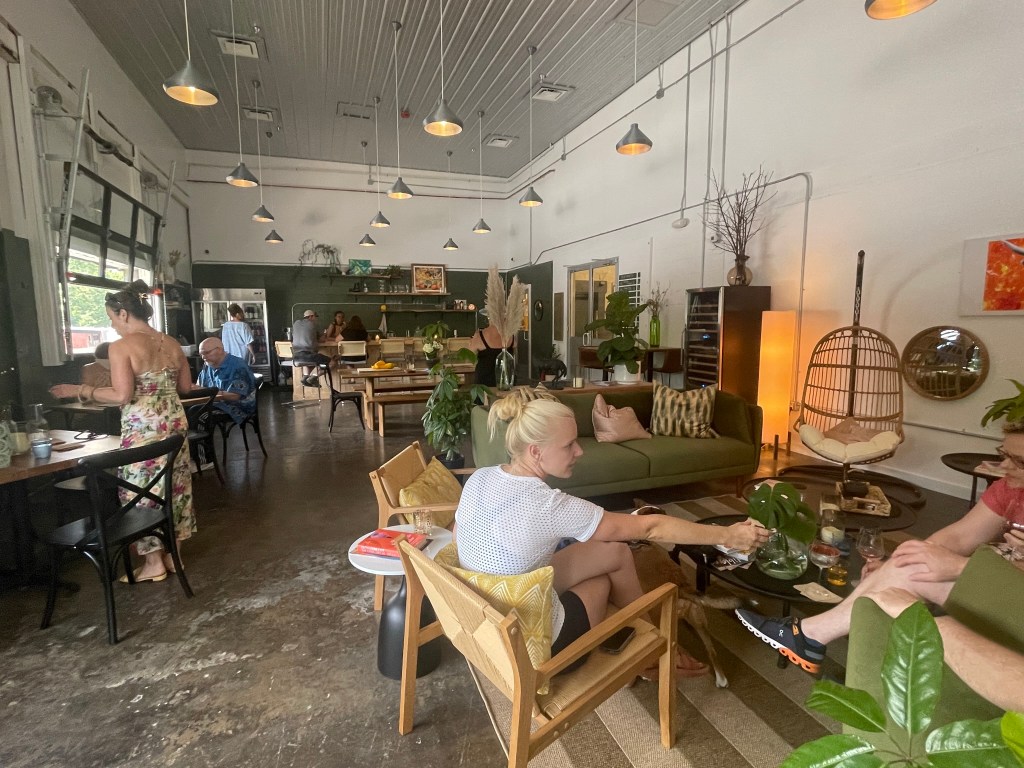
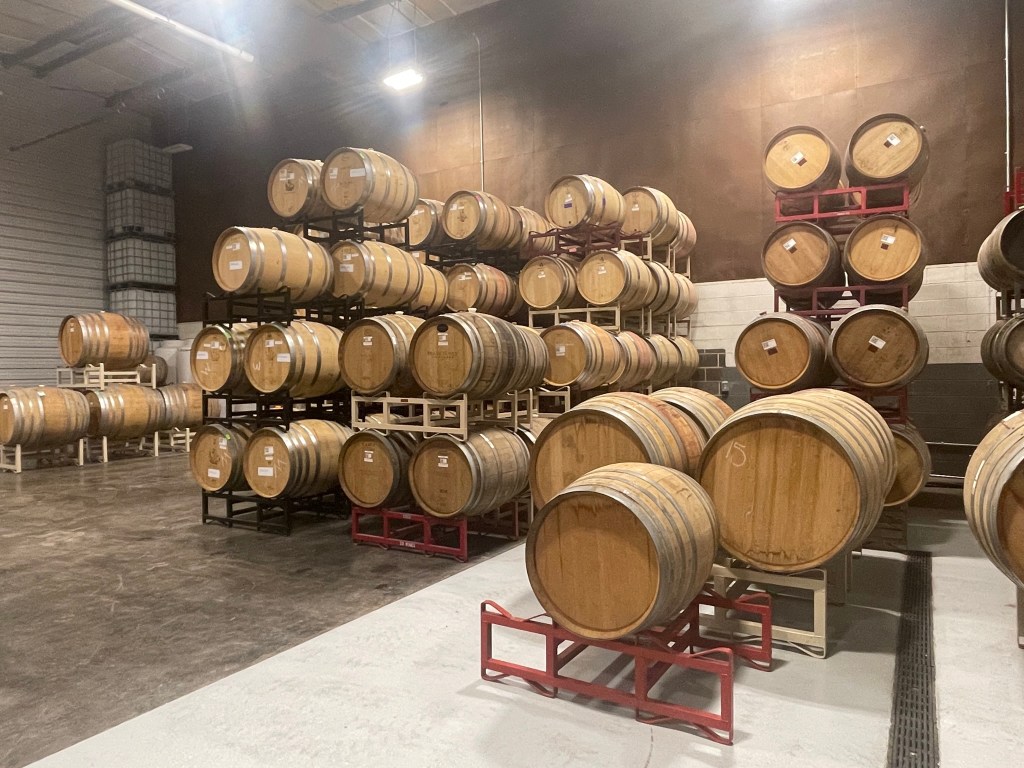
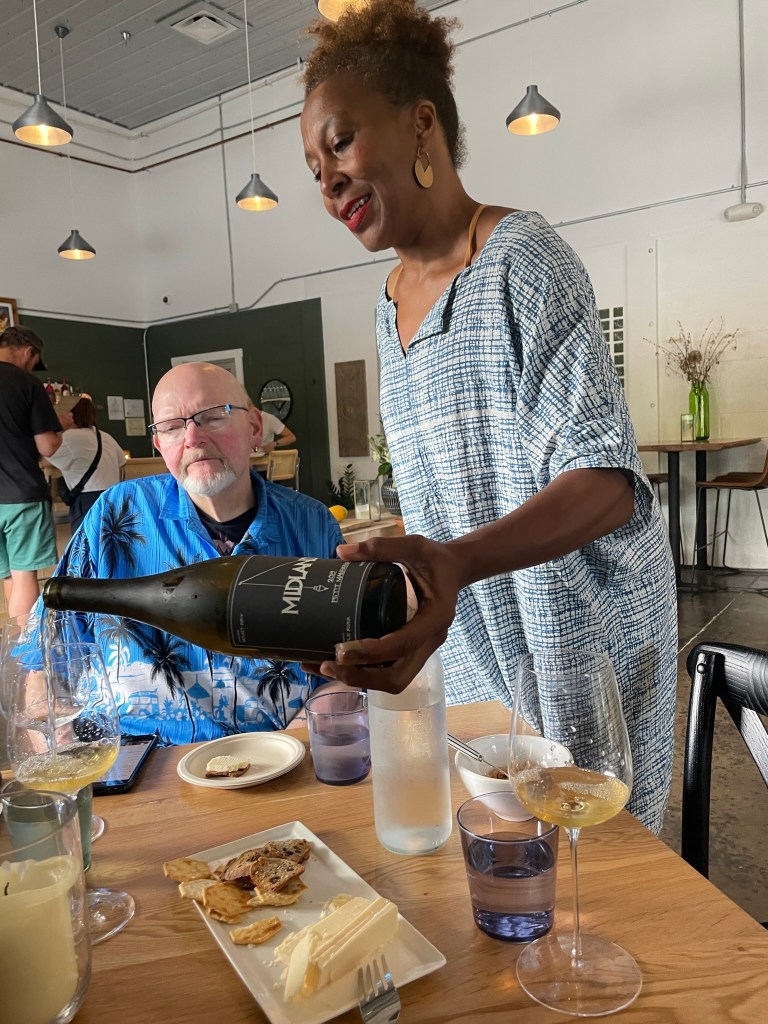
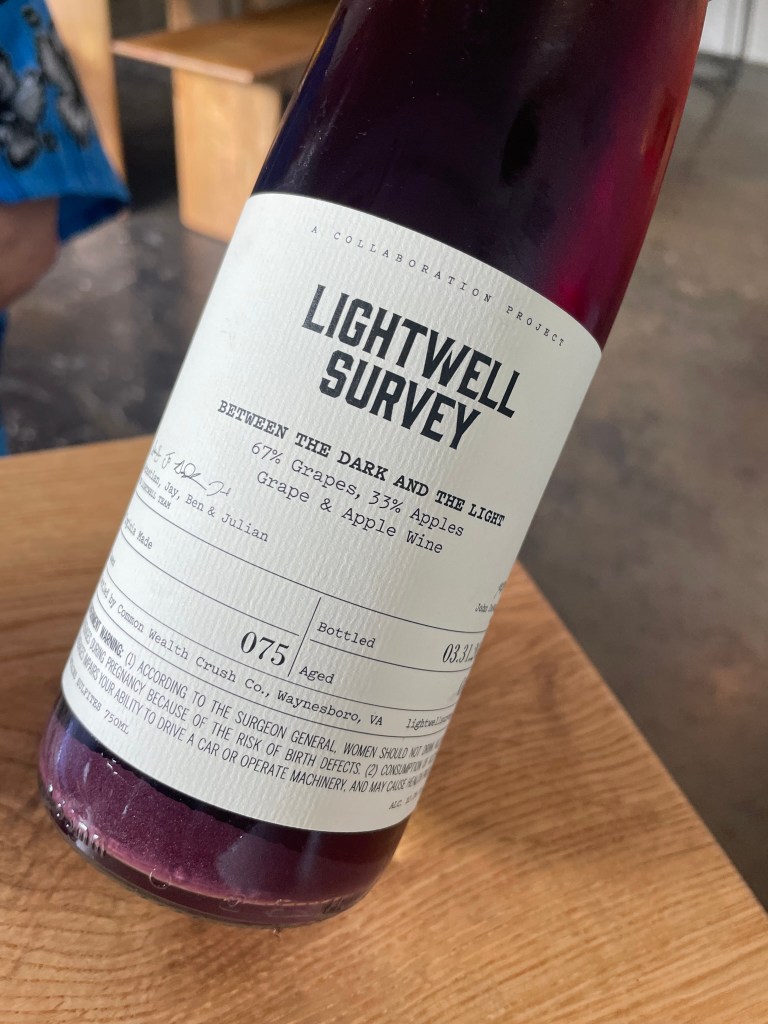
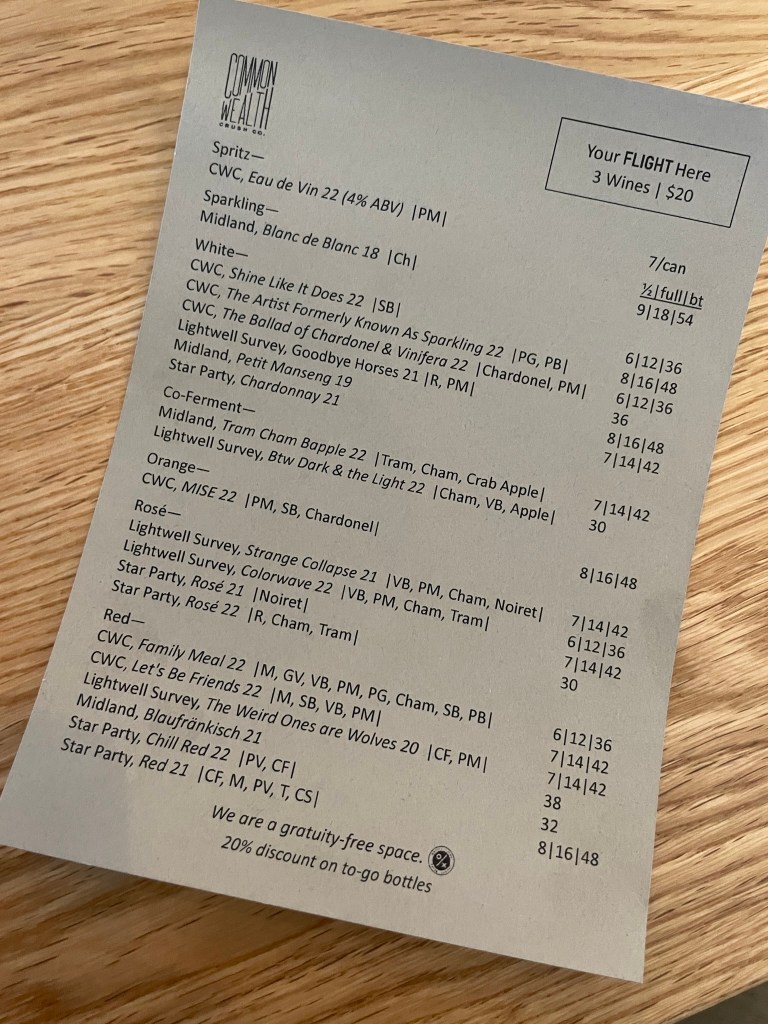
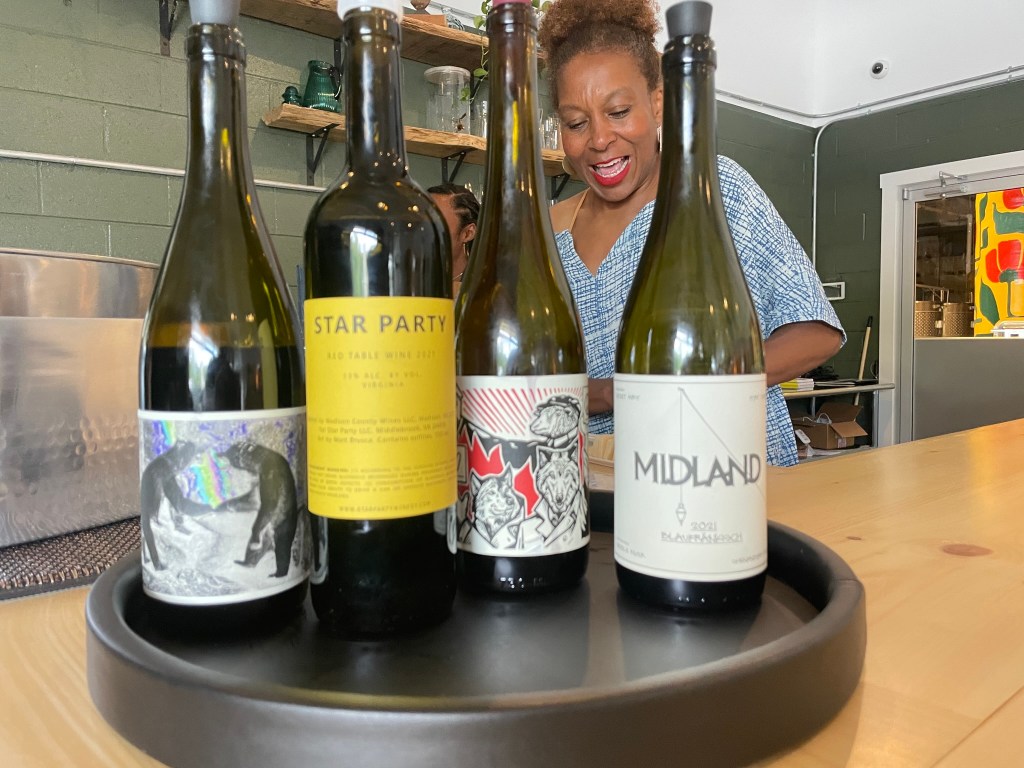
CWCC is located in an old metal crafting facility in Waynesboro. While most of the space is dedicated to winemaking they also have a small tasting room which serves bottles from CWCC, Midland Wine (using fruit from the Jordan family farm in the Shenandoah Valley), Lightwell Survey (Ben Jordan’s side project), and Star Party (Tim Jordan’s side project).
The backstory to Commonwealth is the founders (Ben and Tim, plus partner Patt Eagan) recognized the Virginia wine scene needed a contract winemaking facility that is scalable to different customer needs. Members of the local wine industry often associate ‘custom crush’ with Michael Shaps Wineworks, who famously makes wine on behalf of at least a dozen major customers. But others have gotten in on the action, recognizing a number of vineyards lack the space, funding, or expertise to support winemaking on their own property.
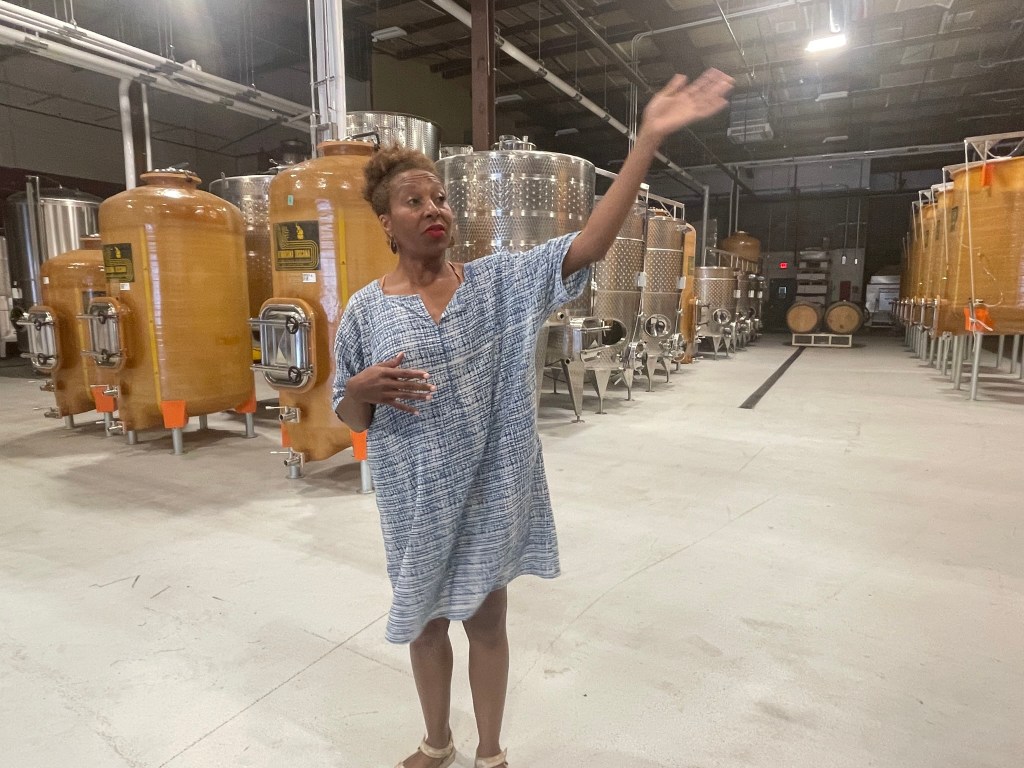
In most cases contract winemaking facilities do all the work from start to finish. While CWCC offers this same beginning-to-end service, what makes them different is they allow winemakers the option of renting space and equipment so they can do their own winemaking.
This is important as many small producers, including winemakers working on their own side projects, are at risk of being displaced from their existing facility should the owner require the extra space. This makes CWCC a great incubator for micro brands that need a place to call home for an extended period of time.
The Jordan brothers also make a ‘family of wines’ that are branded separately but share broad stylistic similarities. For one, all or nearly all the fruit used for CWCC, Midland (the Jordan family farm), Lightwell (Tim’s brand), and Star Party (Ben’s brand) wines are from the Shenandoah Valley, so they tend to be higher in acidity. Ben and Tim also share a love of fanciful labels, minimal intervention winemaking, and a flair for blending, often using varieties that are otherwise rarely seen in the same bottle.
My group met up with partner Lee Campbell, a somm with extensive restaurant experience who previously acted as Early Mountain Vineyard’s New York state rep. Saying she’s a wine rock star is an understatement; we jumped at the chance of a tour.
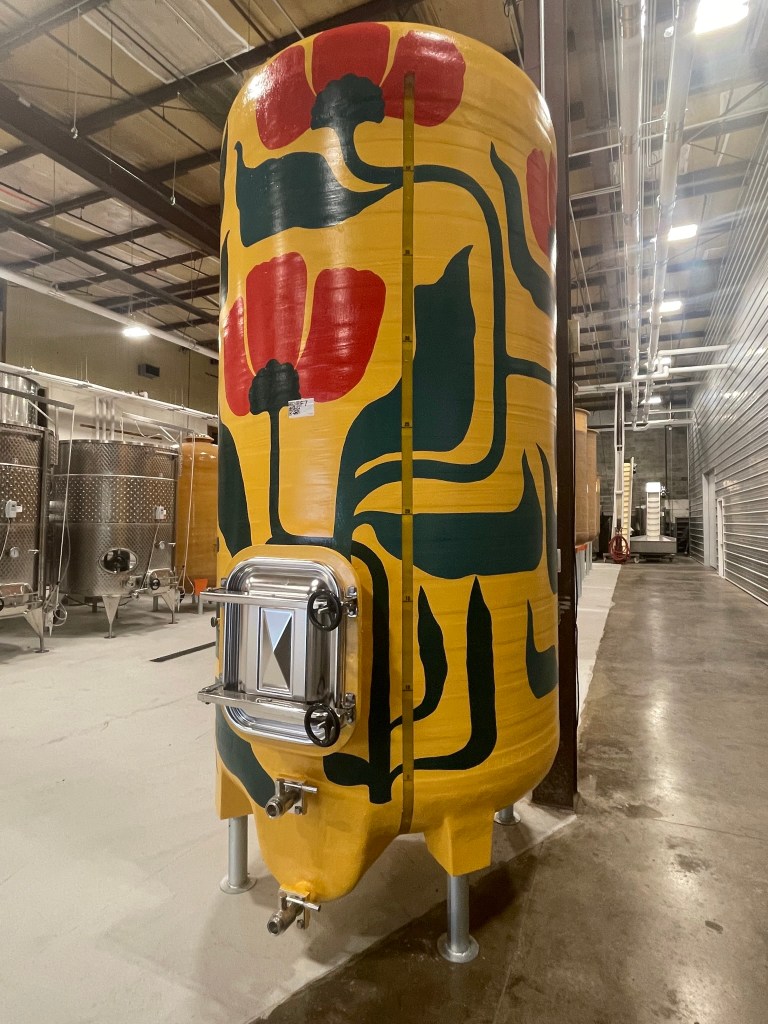
Lee explained how their broad customer base requires multiple sizes and styles of fermentation vessels to meet different needs. Wandering down the aisles we saw a number of fiberglass tanks as well as more traditional steel ones. CWCC currently has 6 start-to-finish customers, 5 ‘winemaker’ customers, and several others who fell somewhere in-between.
After our tour we sat down for an extended tasting of CWCC, Midland, Star Party, and Lightwell wine in their cozy tasting area. Lee stayed with us to walk us through all the options.
Nearly all of these labels include ‘non-traditional’ blends or styles, which made for an exciting tasting. I soon realized with around 20 wine options at my disposal it was unnecessary to visit another winery afterwards.
There are far too many to list individually, so here are a few of the more interesting wines:
Star Party 2021 Rosé, made with the hybrid noriet (their 2022 was a blend of chambourcin and traminette)
Lightwell 2021 Colorwave Rosé, made with vidal, petit manseng, chambourcin and noriet.
Lightwell “Btw Dark & the Light”, a co-ferment with 2/3rds grapes and 1/3rd apples
CWCC 2022 MISE, an orange wine with PM, sauv blanc, and chardonel
CWCC The Artist Formerly Known as Sparkling, a white wine originally planned to be a sparkling but ultimately became a still wine
Midland 2019 Petit Manseng, I can’t find my tasting notes but remembering having several stars next to it
Midland 2018 Blanc de Blancs “Zero”, sparkling wine (also my favorite here)
20 potential tastings are too much for a single visit, but I did my best to sample the menu (being able to share with my group helped). Needless to say, we found a lot we liked and left with many bottles.
I asked about Lightwell Survey’s old space and was told they will continue to use it for big events. But otherwise, this is basically the new Lightwell tasting room.
I loved the entire idea of CWCC; you’ll have to make multiple trips before you try everything. I also love how Lee (and presumably others) are partners or otherwise paid staff since this is a gratuity-free space. With exciting wine and fair labor, so what’s not to love?
There are certain phrases used in the wine world that grate me, and “Anything but chardonnay” is one of the top contenders. Given chardonnay is one of the most planted varieties in the world – and 2nd most planted in Virginia – if you hate chardonnay, it can only be because you haven’t tried enough of them.
I say this because chardonnay is the chameleon of white wine. You can find austere, higher-acid chards from cool weather vintages, or full, ripe wines from warm-weather climates. It can be heavily manipulated with oak or made in steel. From Australia’s Adelaide Hills to Washington State’s Walla Walla, chardonnay is (literally) everywhere.
Burgundy is often thought of as the world’s premiere chardonnay producing region, but I’ve had a number of Virginia wines that could give good Burgundies a run for their money. The biggest problem I had for this event is narrowing down the list of contenders.
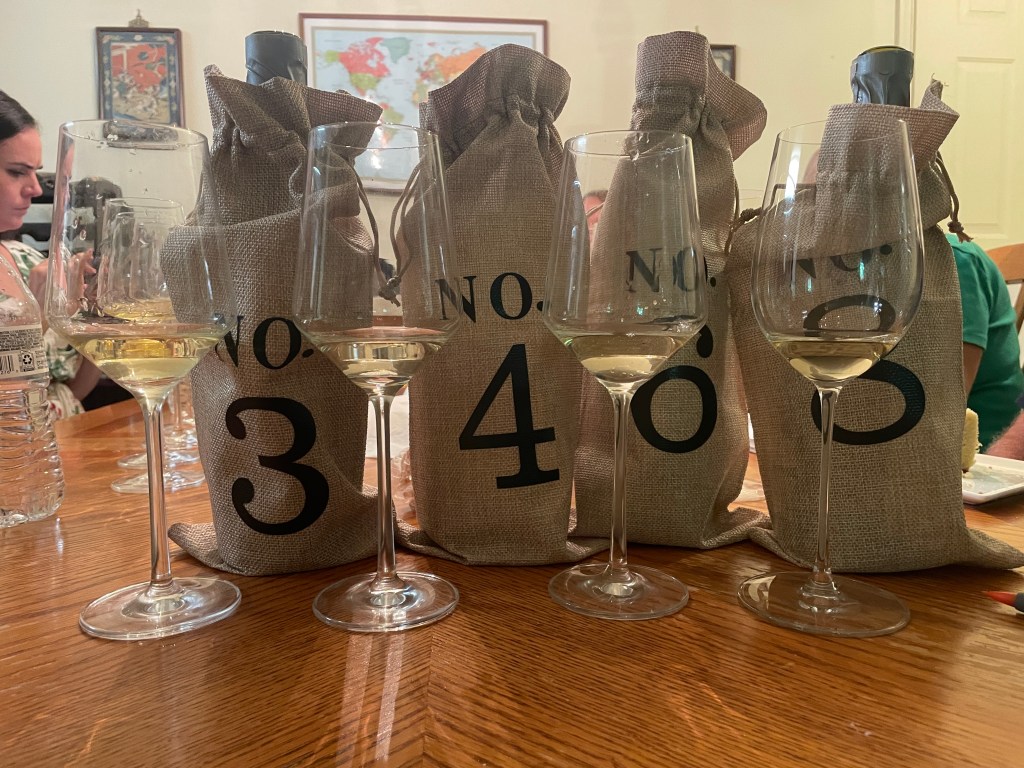
Ultimately my guests were able to bring a variety of chardonnays from around the state. The only rules I gave them is I couldn’t have any wines that were in my last chardonnay challenge, and I needed at least one Shenandoah Valley wine.
The goal was to do 2 flights of Virginia wines and a flight of Burgundy, all blind. We had a last-minute issue with getting our last French wine, so we substituted a Russian River Valley (California) chardonnay for it.
The top wines of every flight went to a finalist round. Since we loved the wines in the 2nd flight so much, I gave the runner up in that flight a wildcard advance to the final round.
As always, this event was the product of this day with this group. Many of these wines had the potential of being a winner.
The contenders:
2019 Brix and Columns (winery in the Shenandoah Valley, not sure where the fruit is from)
2019 Linden Boisseau (Front Royal)
2021 Vint Hill (Story Vineyard, Fauquier County)
2021 DuCard TANA (TANA Vineyard)
2022 12 Pearls of Wisdom (Effingham/Pearmund)
2021 Stone Tower (Leesburg)
2020 Famille Vincent (Burgundy)
2019 Patrick Javiller (Burgundy)
2016 Hertelendy (Russian River Valley, CA)
Flight #1
Wine 1: 2019 Brix and Columns
Wine 2: 2019 Linden Boisseau
Wine 3: 2021 Vint Hill (round winner)
Bottle #1: 2019 Brix and Columns: Light gold. Muted nose. Clean, crisp. Notes of hazelnut and lemon. Some people mentioned it was a little musty. The biggest problem some had was the finish just fell off at the end.
This wine was a bit divisive because it was very easy drinking, almost at the expense of complexity. I liked it a lot, but others found it wanting.
Bottle #2: 2021 Linden Boisseau: High acidity, floral nose. Notes of tart apple and lemon/lime. Someone noted it had an almost riesling quality to it. It was a wine that seemed to cry out for food, and the lack of a pairing dish probably brought it down a notch.
Bottle #3: 2021 Vint Hill: I found notes of slate; someone else said honeysuckle and lemon. Others noted notes of lemon and peach; almost a creamsicle quality to it. Several people noted it had lots of honey. Almost all of us mentioned its long finish and good complexity.
We were all over the place in terms of favorites. Everyone liked #2 but nobody put it as a favorite. I was torn between “easy drinking” vs “complexity” but went with the former. Most of the guests chose the latter category, so the Vint Hill wine won out.
Alex: 3/2/1
Frank: 3/1/2
Jen: 3/2/1
Kathy: 3/2/1
Matt: 1/3/2
Ryan: 1/3/2
Stephanie: 3/2/1
Flight #2
Bottle #4: 2021 DuCard TANA (wildcard advance)
Bottle #5: 2022 Effingham 12 Pearls of Wisdom
Bottle #6: 2021 Stone Tower (round winner)
Wine 4: 2021 DuCard TANA: Noticeably floral, with notes of marzipan, sweet almond, flowers. Solid acidity, with a bit of minerality. We guessed made in stainless. We were partially correct; I later learned it started in steel but also had 4 months in neutral oak and aged on lees.
Grown in the TANA vineyard around 6 miles from DuCard on a SW-facing slope. Made in “Mȃcon” style, as benefiting from having a French winemaker.
Wine 5: 2022 12 Pearls of Wisdom: Very perfume-y. Long, very grapy finish. Racy acidity. Notes of lemon, apricot, or peach. Overall delicious.
There was a LOT going on in this wine. We enjoyed it thoroughly but felt it was almost ‘too much’. We probably would have enjoyed it more on its own as opposed to a lineup of other chardonnays, as it wasn’t a very chardonnay-like wine.
Wine 6: 2021 Stone Tower: Notes of apricot, peach on the nose. Personally, I thought it was lighter than the other two, but others note it was on the fuller side.
More elegant and mineral driven than anything we’d had so far. We thought it had a little bit of oak. Smooth. Someone mentioned a ‘smoky minerality’ to it, with notes of grapefruit.
This was a tough round to choose a favorite! For the seven of us, it was easy the favorite round of the day.
The biggest problem I found was wine #5 was so different from the others it seemed out of place, to the point it was an almost unfair comparison.
Wines #4 and #6 were more evenly matched, to the point it was a near toss-up. But since we liked #4 so much, I gave it a wild card advance to the final round. Many felt #4 (DuCard) was more likely to please multiple people, while #6 (Stone Tower) was a ‘serious’ wine.
Alex: 6/5/4. Felt #6 was what he would open on his own.
Frank: 4/6/5
Jen: 6/4/5
Kathy: 6/4/5
Matt: 4/5/6
Ryan: 4/6/5
Stephanie: 6/4/5. Liked the complexity of #6. #4 was more likely to please a crowd.
Flight #3
Wine 7: 2020 Famille Vincent
Wine 8: 2019 Patrick Javiller (round winner)
Wine 9: 2016 Hertelendy
Wine 7: 2020 Famille Vincent: Muted nose. Some oak. Crisp, notes of mandarin orange or clementine.
Wine 8: 2019 Patrick Javiller: I found notes of crisp green apple, some butter. Others mentioned lemon blossom on the nose and palate.
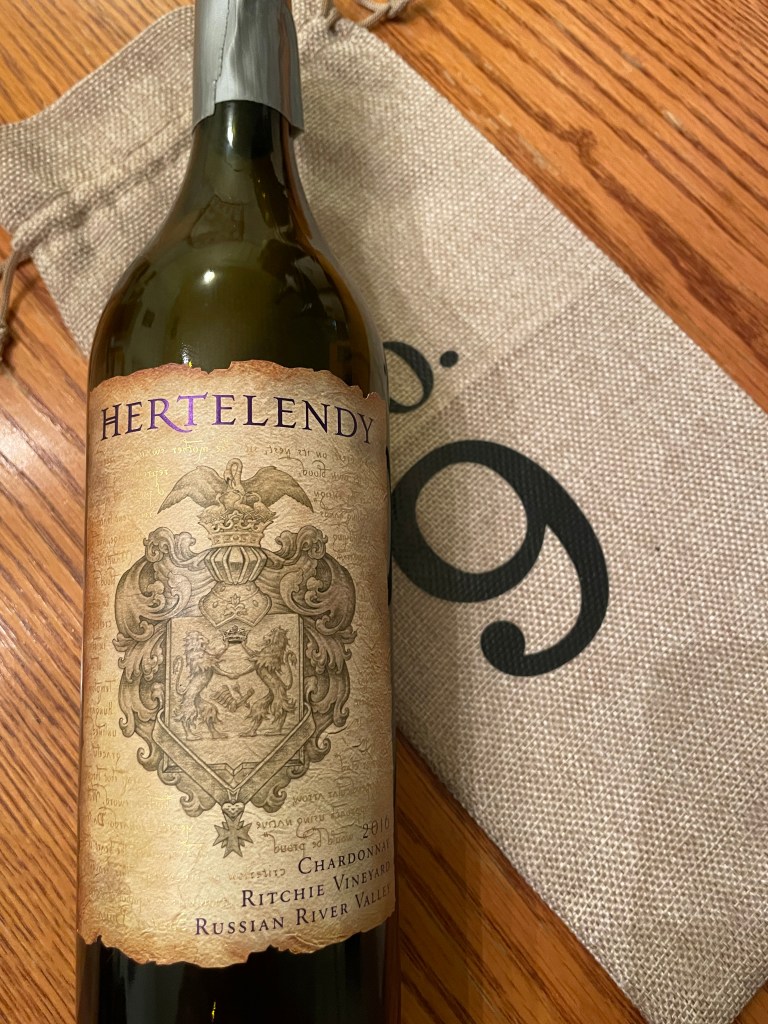
Wine 9: 2016 Hertelendy: “Funky and smoky” were the key adjectives. This wine was CLOUDY. Not sure what was going on here. On the nose, notes of drawn butter or maybe butterscotch. Nutty on the palate; maybe hazelnut, maybe a bit of lees or oak.
The cloudiness of the last wine was divisive for many of us, so it was really a contest between #7 and #8.
Alex: 9/8/7
Frank: 7/8/9
Jen: 8/7/9
Kathy: 8/7/9
Matt: 8/7/9
Ryan: 7/8/9
Stephanie: 7/8/9
Finalist Round:
Wine 3: 2021 Vint Hill (3rd favorite)
Wine 4: 2021 DuCard TANA (favorite of the day)
Wine 6: 2021 Stone Tower (runner up)
Wine 8: 2019 Patrick Javiller (4th favorite)
No major wine notes this time. We went almost straight to the judging.
I thought wine #3 (Vint Hill) improved a lot, although #6 had my favorite nose of the lineup. #8 was a bit spicy.
In a surprise twist, wild card wine #4 (DuCard) beat wine #6 (Stone Tower) even though in an earlier round Stone Tower was favored (by a narrow margin). Both were easily the top wines of the day, but 2021 DuCard Vineyard “TANA” was the overall favorite in the end.
Alex: 6/4/3/8
Frank: 4/6/3/8
Jen: 6/4/3/8
Kathy: 6/3/4/8
Matt: 4/3/6/8
Ryan: 4/3/8/6
Stephanie: 4/6/3/8
If there’s a lesson learned here, it was that chardonnay comes in all flavor profiles. Not one of these were butter-bombs (despite having a California chardonnay). The best Virginia ones definitely showcased elegance and would have done any Burgundy winemaker proud.
I also think food and time caused us to shift votes. Wine #3 had a noticeable improvement, becoming the runner up to several guests. The addition of food (we had an amazing cheese board and dessert) also may have accentuated #4.
This was the first time a ‘wild card’ wine won one of my events, which I also attribute to how it was the kind of wine that everyone can enjoy. Put in a large group, the DuCard TANA came out as the favorite. But huge kudos to the Stone Tower wine, which many of my guests would drink by themselves.
Lately, clean air has been something in short supply in northern Virginia. I spent much of the week inside, plotting where I would spend the weekend (and more importantly, someplace I could breathe easily). Fortunately, Shenandoah Park specializes in clean air…which also meant a side-trek to DuCard Vineyards was in order.
DuCard is located not far from the Sperryville entrance of Skyline Drive, and even closer to the White Oak Canyon and Old Rag trailheads. I’ve long thought of it as a hidden gem, although more of my friends including My NOVA Wine Blog have been discovering it.
DuCard exemplifies a theory of mine; wineries off the beaten path work extra hard to make your visit worthwhile. Not only has the wine consistently been above-par, their service is always top notch. It helps the local scenery serves as a great brand ambassador.
I’d last wrote about DuCard in 2019 (and been back a few times) but since they’d had a few changes in the lineup, a new blog seemed necessary.
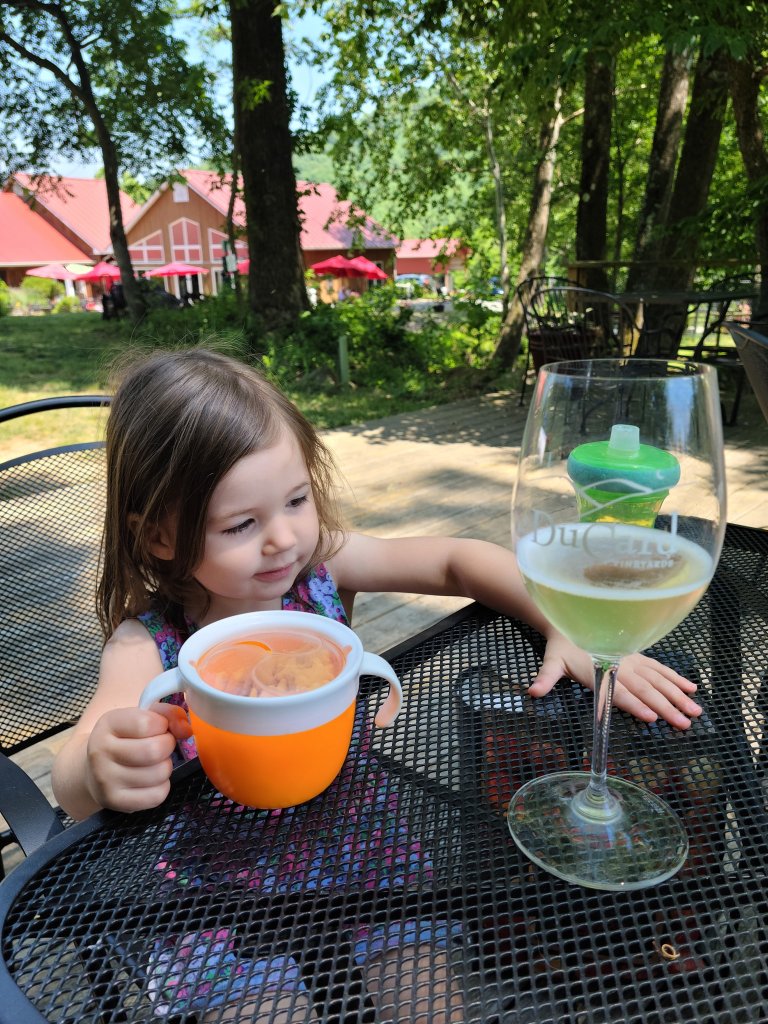
Owner Scott Elliff was making the rounds amongst guests when I walked in, showcasing his latest wine; “Pet-Nat”. He even made t-shirts with a gnat logo for the occasion! My group managed to grab a table near the brook and settled down with a glass. Even the 2 1/2-year-old seemed to appreciate the color.
Scott wasn’t the only friendly face there; Kathy Wiedemann was at the tasting bar when I came in for a fresh bottle. Asking her to join a mini vineyard tour with Scott was an easy sell.
While walking amongst the vines Scott told us about his three vineyards. The main one at the winery had 20-year old vines; not something you see everyday in Virginia.
He also talked about the trellising system for his Norton vines. I’m probably mis-remembering half of the details but there was something unique in how they designed it, allowing the fruit to hang in such a way to minimize its acidity. Norton is a HUGELY acidic grape, so taming that quality is important. But it must have done the trick, since DuCard’s was the favorite of a Virginia Norton comparison last year.
But it was his new additions that really excited me. Scott managed to convince his neighbor to sell him a few extra acres of land adjacent to his vineyard, which he’s using to plant two acres of Albariño. Not only that, but Tannat is being planted at another vineyard. I mean seriously; just when I thought I couldn’t love this place enough, they are planting two of my favorite grapes.
Since it was the weekend of National Rosé Day, we of course had to have the obligatory photo of a bottle, perched on the bridge across the brook.
After some snacks, we made our way inside of a seated tasting.
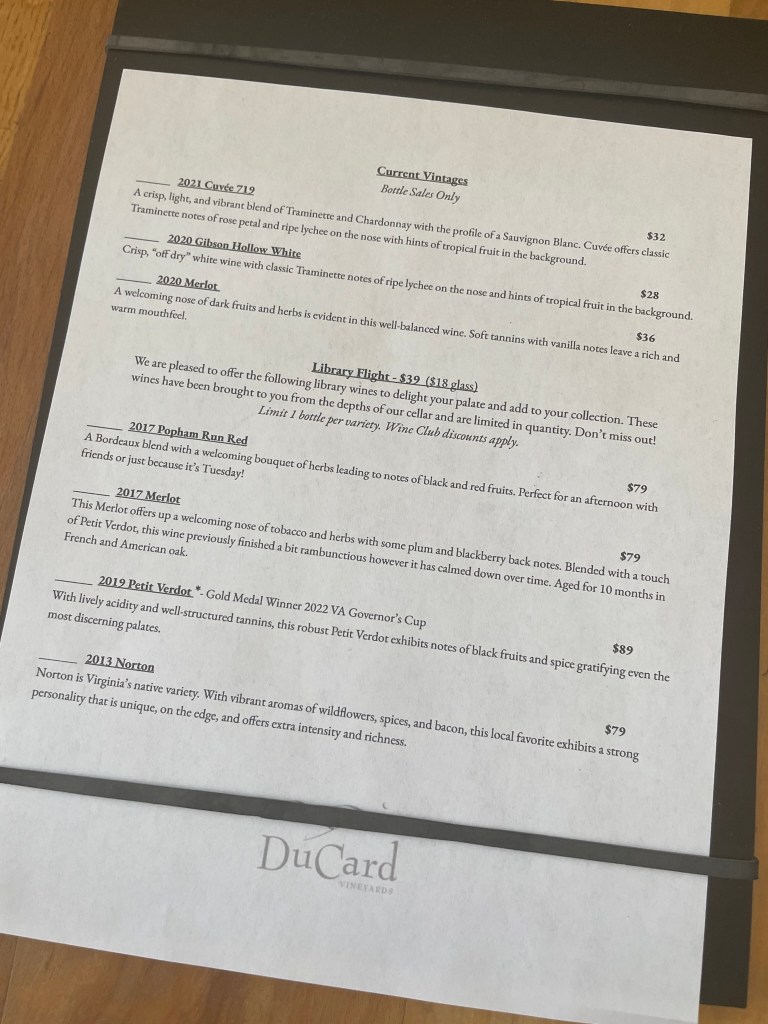
They had a red, white, and mixed flight available. Scott talked us through much of it before going off to check on other guests. They also had a library tasting, which made Kathy’s eyes light up.
The mixed flight had two Chardonnays (one made in steel, one oaked), the Popham Run red blend, and a fairly soft Cab Franc. I liked the two reds, but LOVED one the “TANA ” Macon-style Chard. Very full for a Chardonnay; I think it would be even better with food but great on its own.
But arguably the hit of the day was their 2019 Petit Verdot (which Kathy shared a sample of with me). I was tempted to open the TANA right there, but as time was running short I took it home with me. Kathy was so impressed she grabbed the TANA, a library 2019 Petit Verdot, and the very effervescant and quaffable pet-nat.
All in all, a really successful day. Extra kudos to the staff for giving the dog a water bowl, which he sampled while under my table.
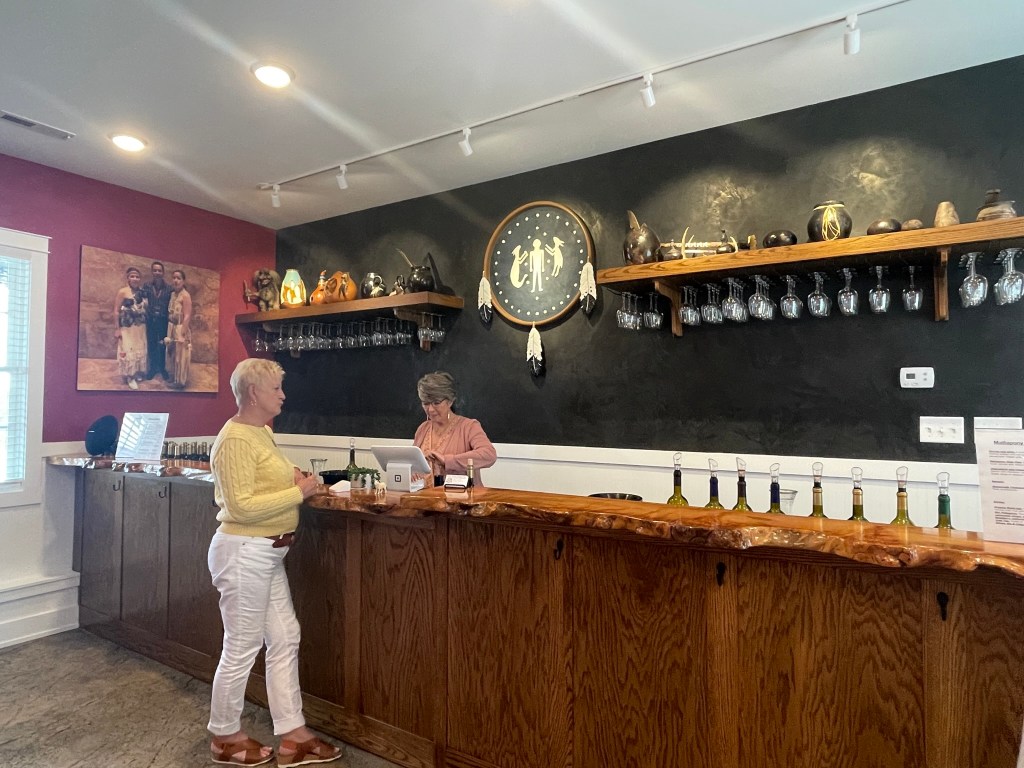
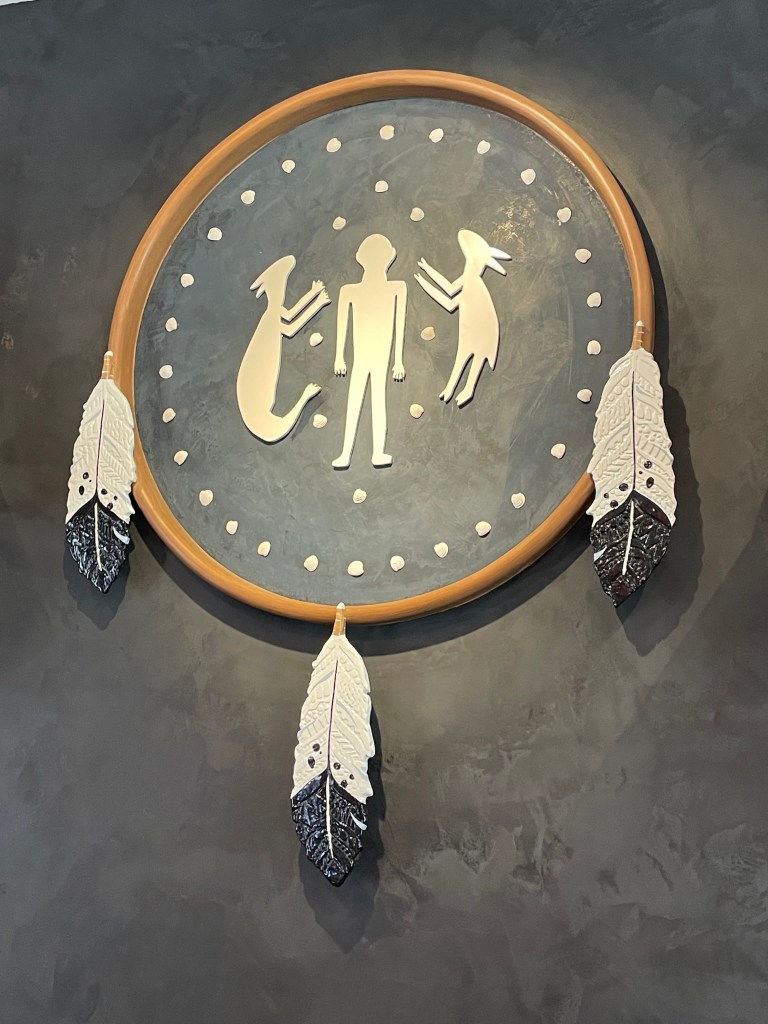
Mattapony Reserve is one of Virginia’s newest wineries, opening in late 2022 on the Mattaponi Indian Reservation on the banks of the Mattaponi River east of Richmond. This wasn’t on my original itinerary, but I had some free time so I scooted over to try it out.
Since there isn’t a vineyard, the tasting building isn’t obvious at a glance. The winery is located at the end of a long circular road (maybe I could have taken a right instead of a left and sped up my journey, but I didn’t know). I passed a number of family homes, a church, and the Mini Ha-Ha Educational Trading Post (I never thought I’d see a sign like that, but there it was!). But the GPS was right on, and as soon as a saw a big parking I figured that was the place.
The entire experience has a very mom-and-pop vibe to it. It helped that Ginger and Lonnie Custalow, the owners/winemakers were behind the counter. Ginger poured while telling me their backstory.
They were home winemakers for a while, finally making their first commercial vintage in 2020. They named the winery ‘Mattapony’, which is an older spelling of the local tribe. There’s a separate Mattaponi winery as well, although the two couldn’t be more different.
All of Mattapony’s fruit is from Virginia, and the wine is made via ‘natural winemaking’. This is a bit of an open-ended term, since there is no technical definition of ‘natural wine’. But generally speaking it means limited intervention, low chemical spraying, and (in their case) no added sulfites.
While there isn’t a lot of indoor seating it has something I think is even better; a covered patio next to the river. I was told that if you watch long enough you might even see some bald eagles swooping down. No eagles were seen when I was there, but the view was well worth the visit.
Nine wines were available during my visit; a pair of Nortons, a pair of Petit Verdots, a Pinot Grigio rose’, a 2021 Chardonel, a 2020 Chardonnay, DeChaunac, and a red blend called “Two Rivers”.
I got to try them all, with my favorites being the rose’, Chardonnay, and DeChaunac (if only because I see it so rarely). The prevalence of hybrids is very common in natural winemaking.
The Chardonnay was definitely my favorite. It was almost an orange wine; very dark hue to it. Notes of pineapple and coconut abound.
The Pinot Grigio rose’ was nicely done; lots of peach notes. I almost got a glass, but opted for the Chardonnay instead.
That DeChaunac was damn interesting. It’s a French-American hybrid that was one of the first created in the wake of phylloxera. I found it was very acidic and tart. I later found they got the fruit from Rockbridge.
If you like smoky reds; this is your place. The 2021 Norton and 2020 PV were both was lighter than I expected. Did it have something with the winemaking style? I forgot to ask.
It may be further out than many wineries, but there’s something to be said about kicking back on the porch and hoping to see eagles fly-by.
If you haven’t visited Cheesetique, you’re missing out. While a second location is in Shirlington the OG store is located in Del Ray, part of a row of cute of mom-and-pop restaurants and boutique stores.
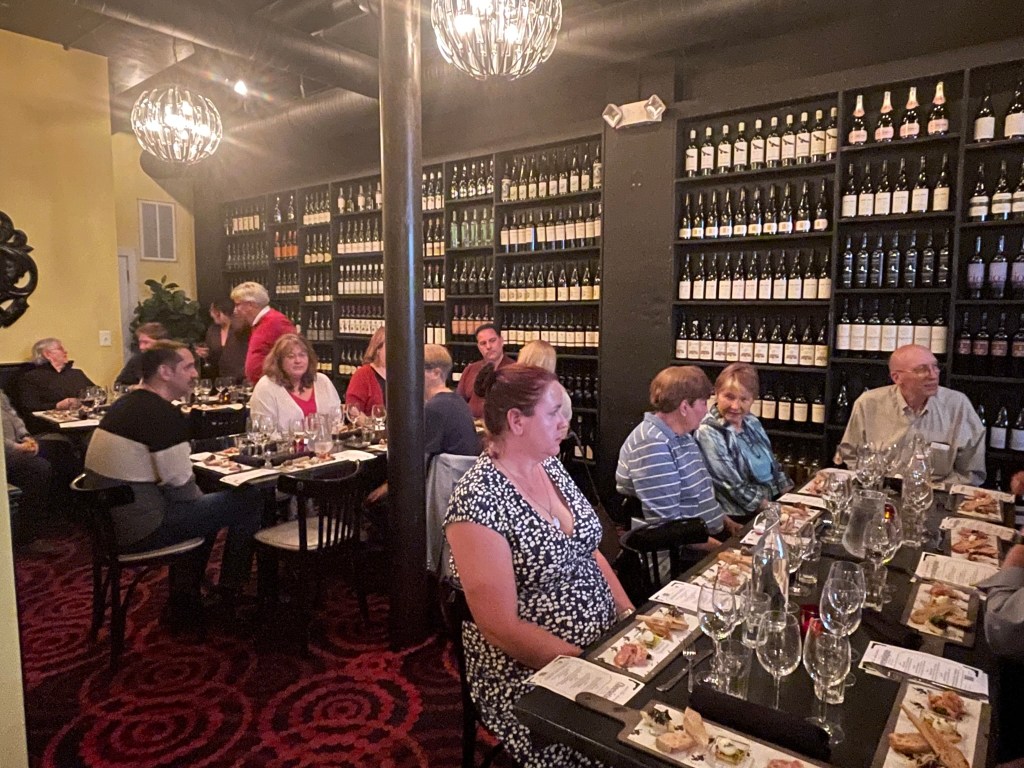
One of my favorite evening events are their in-person wine and cheese pairings, which have been on pause since COVID. But while avidly waiting for their return I saw Cheesetique post an event that might be even more fun – the chance to try a flight of Opus One wines.
If you like to drink fancy red wine but never heard of Opus One…you might be living under a rock. For many years an Opus One wine held the record as the most expensive California wine ever sold. Even new releases go for almost $400 a bottle.
So when owner Jill Erber kicked off the event by describing Opus One as “One of the world’s most iconic wines” she wasn’t joking.
While usually described as Cabernets Sauvignons (as they typically use between 76-86% Cab Sauv, depending on the vintage), bottles of Opus also fit the description of left-bank style Bordeaux blends, often using all five noble red grapes.
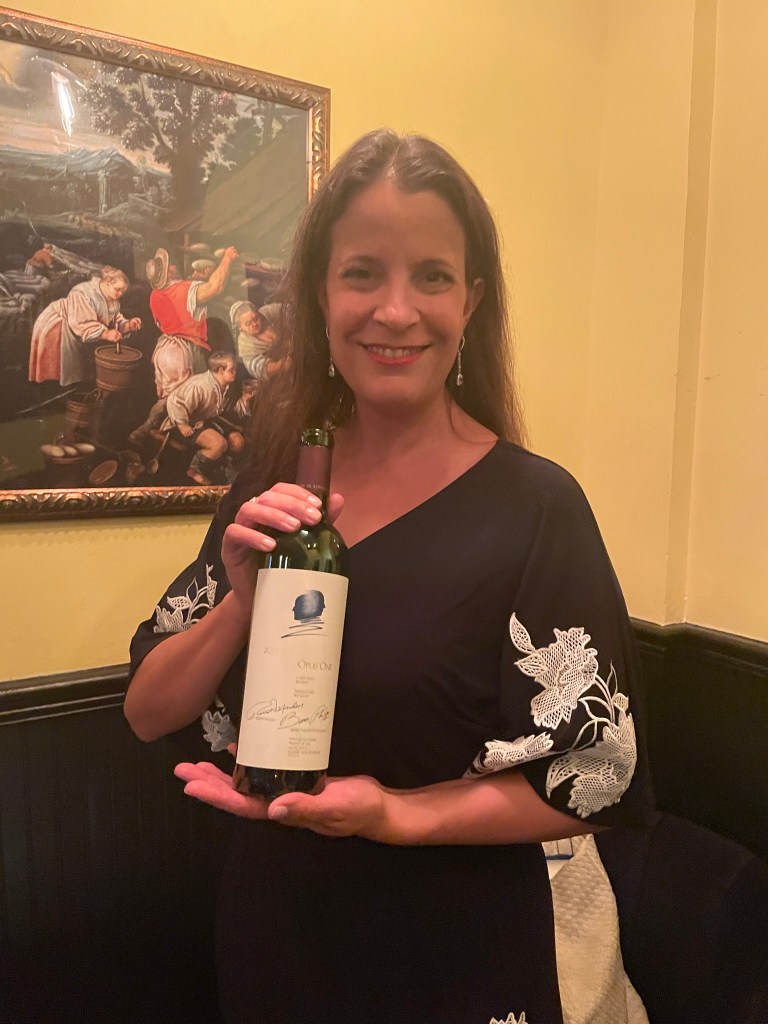
I went in expecting a wine tasting (and some bite-sized snacks). What I didn’t know is I was getting a full history lesson, as told by one of their brand ambassadors, Emmanuel Padilla.
A Brief History of Opus One
The story of Opus One is really the story of two of the wine industry’s greatest marketers and innovators; Robert Mondavi and Baron Philippe de Rothschild.
Both came from famous wine families. Robert was the first person to open a winery in California since prohibition and went on to become known as the ‘father of California wine’. Baron came from the family that owned Château Mouton Rothschild, the only estate to be accepted as a “First Growth” Bordeaux winery after the initial Bordeaux Wine Official Classification of 1855.
But their legacies were cemented by their ability to bring wine to the masses. In an era where it was customary for vineyards to sell to middlemen, both realized they could increase their profitability and control quality by bottling their own wine and selling directly to the public.
Both also pioneered the use of lower-cost wine brands in conjunction with their premium ones, so people could have a taste of Napa or Bordeaux without breaking the bank. “Luxury should not be unapproachable,” explained Emmanuel.
It was the 1976 “Judgment of Paris” that brought these men together. This event saw a pair of Napa wines take top honors in a blind tasting (beating one of Baron’s own wines), heralding Napa’s ‘arrival’ in the wine world. Baron realized California was a huge business opportunity, so in 1979 he partnered with Robert with the goal of creating an ultra-premium brand.
Opus One was the fruits of their labor, with the first vintage being produced in 1982.
The Difference Between Bordeaux and Napa
After our history lesson, Emmanuel discussed Opus One’s philosophy. This includes being able to drink your wine immediately, not wait years (sometimes decades) for the wine to settle down. “What are we known for in America?”, Robert asked the audience. “Impatience!”
Emmanuel spoke about the scores they’ve earned from the fancy wine magazines but he didn’t dwell on them, comparing wine critics with music critics. After all, Led Zeppelin is one of the greatest rock bands of all time. But were they appreciated when they were touring? No!
He also went into detail about wine growing at Opus One and climate change as a whole. Opus One’s vines point true north to minimize the sun exposure, as they want a longer, cooler ripening season than a fast one that will cause their grapes to bake. Listening to details like this put me in wine-geek heaven.
Fire (and smoke taint) is another growing problem. While Opus One already harvested their grapes before the 2020 Napa fires broke out, they knew the reputation of a ‘smoke vintage’ could damage the brand. While Emmanuel loves their 2020 vintage, he wasn’t optimistic an Opus One flagship wine would be released from it.
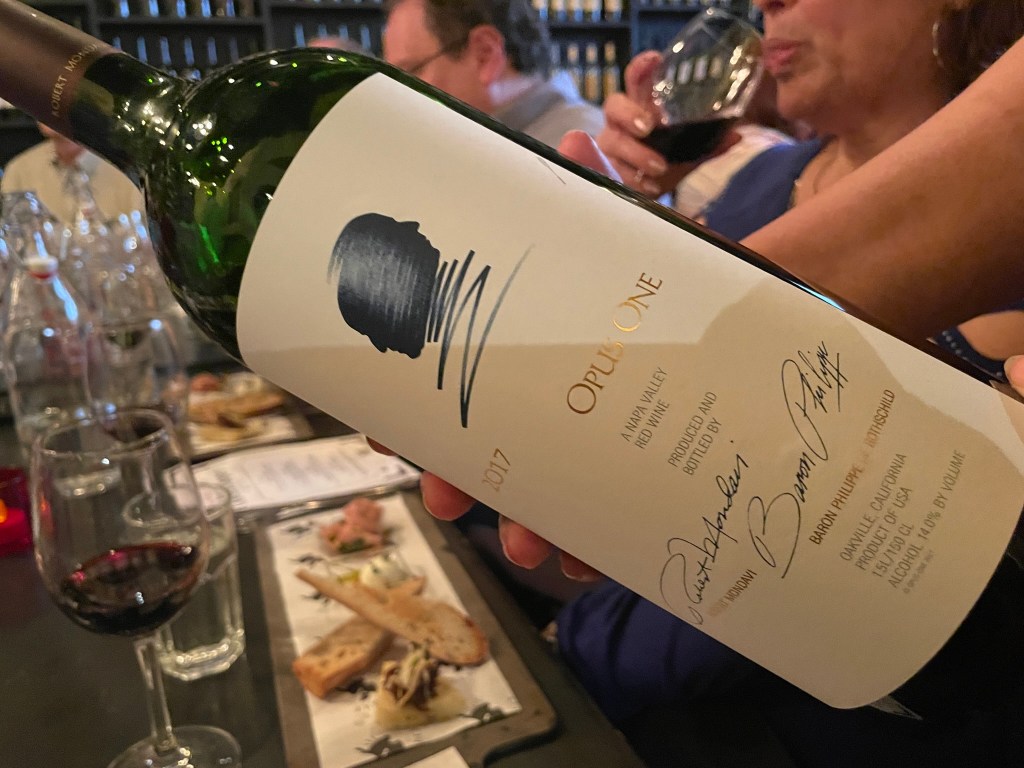
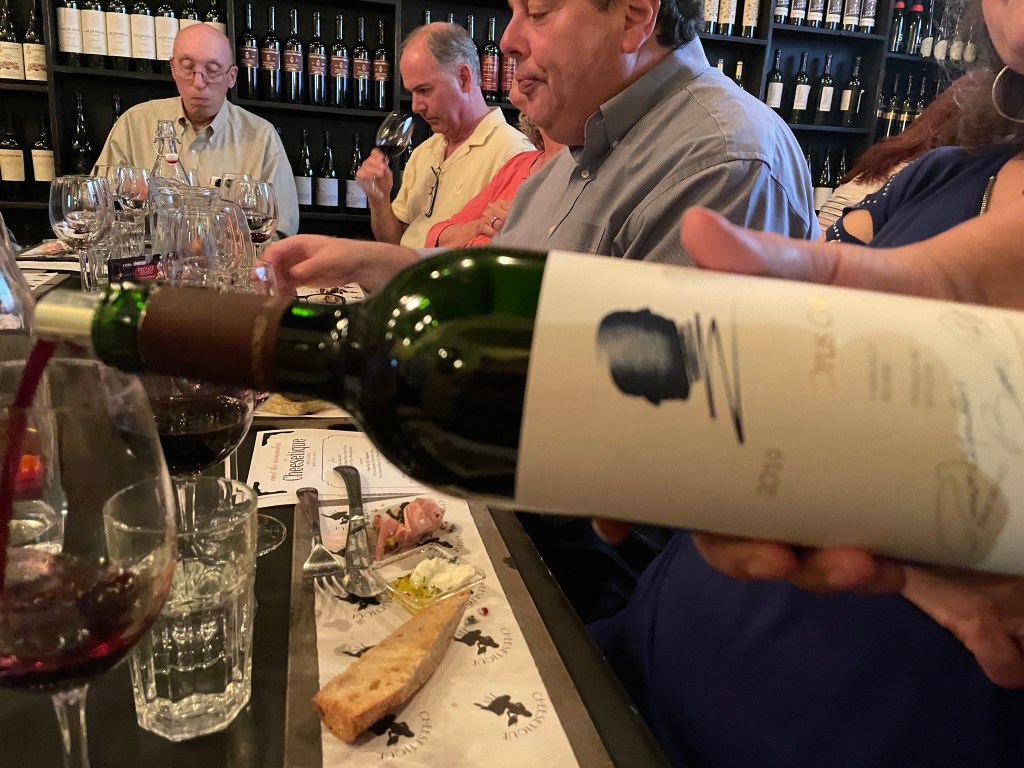
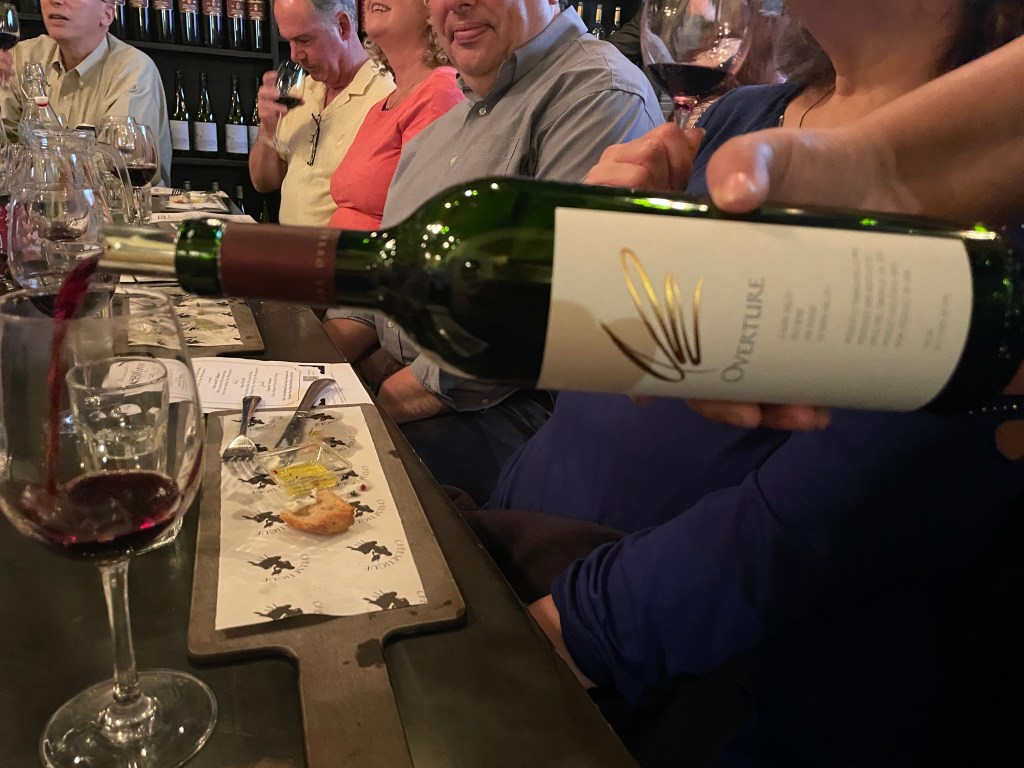
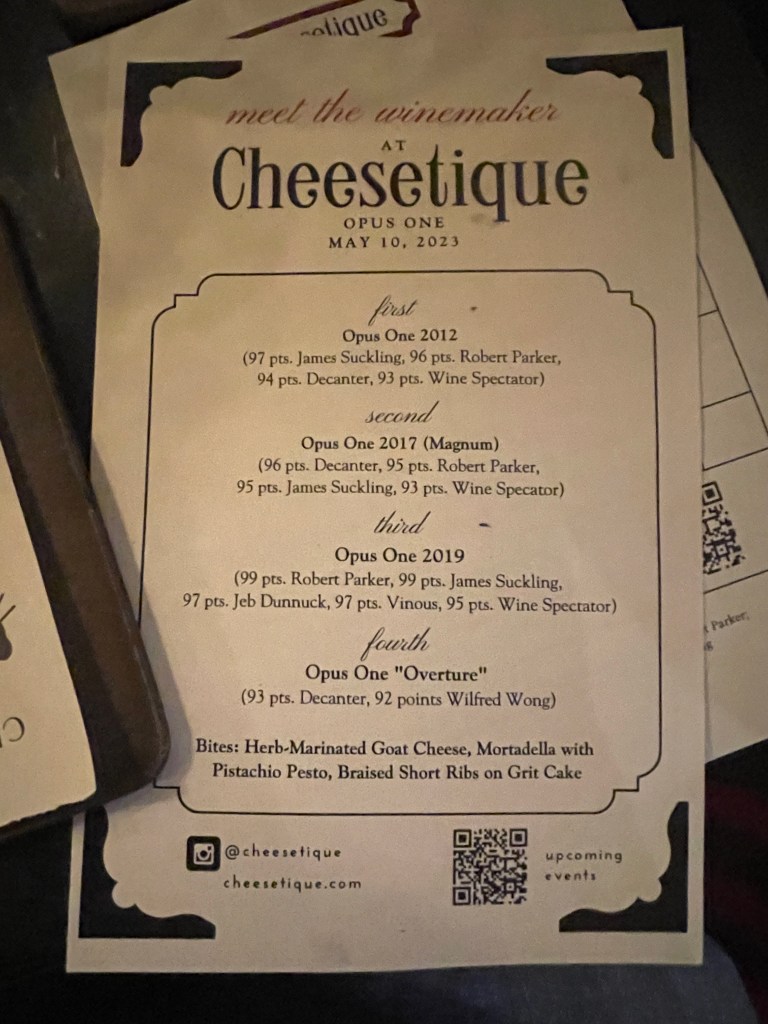
It may seem all we did was listen to Emmanuel talk, in truth we were tasting wine the entire time. Four wines were poured over the course of the evening; three of their flagship “Opus One” wines and a wine from their second label, Overture. This being Cheesetique, of course we had small snacks to go with everything.
The wines:
2012 Opus One. Expressive nose; rich but not overpowering. Lots of dark fruit with a touch of granite. Blend of 79% Cabernet Sauvignon, 7% Cabernet Franc, 6% Merlot, 6% Petit Verdot, and 2% Malbec.
2017 Opus One. Similar tasting notes but I thought with more complexity. Bottled sold at this particular event were in magnum, which (I didn’t know) increases their age-ability. 80% Cabernet Sauvignon, 16% Cabernet Franc, and 4% Merlot.
2019 Opus One. Initially I felt this was an obviously young wine but I quickly changed my mind. Complex but still with a nice fruit profile. Reminded me of what the 2012 would have tasted like in its youth. I later realized it had a similar blend; 78% Cabernet Sauvignon, 8% Merlot, 6% Cabernet Franc, 6% Petit Verdot, and 2% Malbec.
Opus One Overture (NV). More approachable. Rounder. More ripe fruit driven. This wine could be aged but is really meant to be enjoyed sooner.
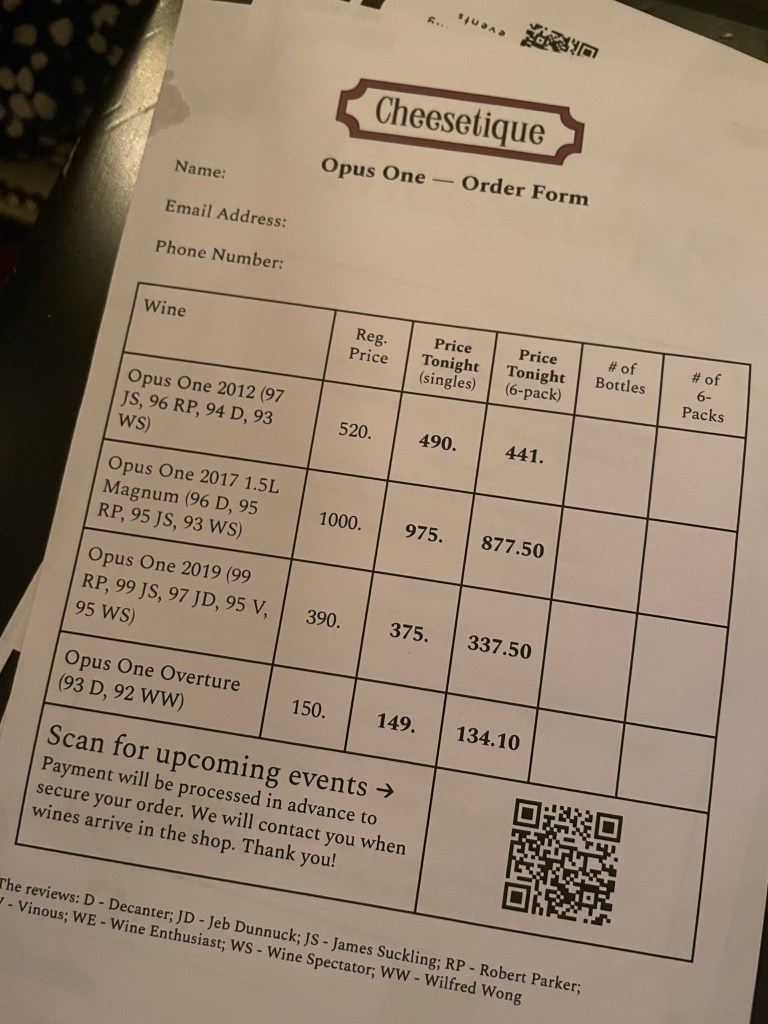
I was really lucky to make this event; it sold out in 2 hours but my name was called from the waiting list. For those who weren’t as lucky there will be another event this summer.
Not only will you have the chance to taste these wines, you’ll be able to buy bottles at a comparative discount (but of course still eye-watering high…because it’s Opus One).

























 Wine Trails and Wanderlust