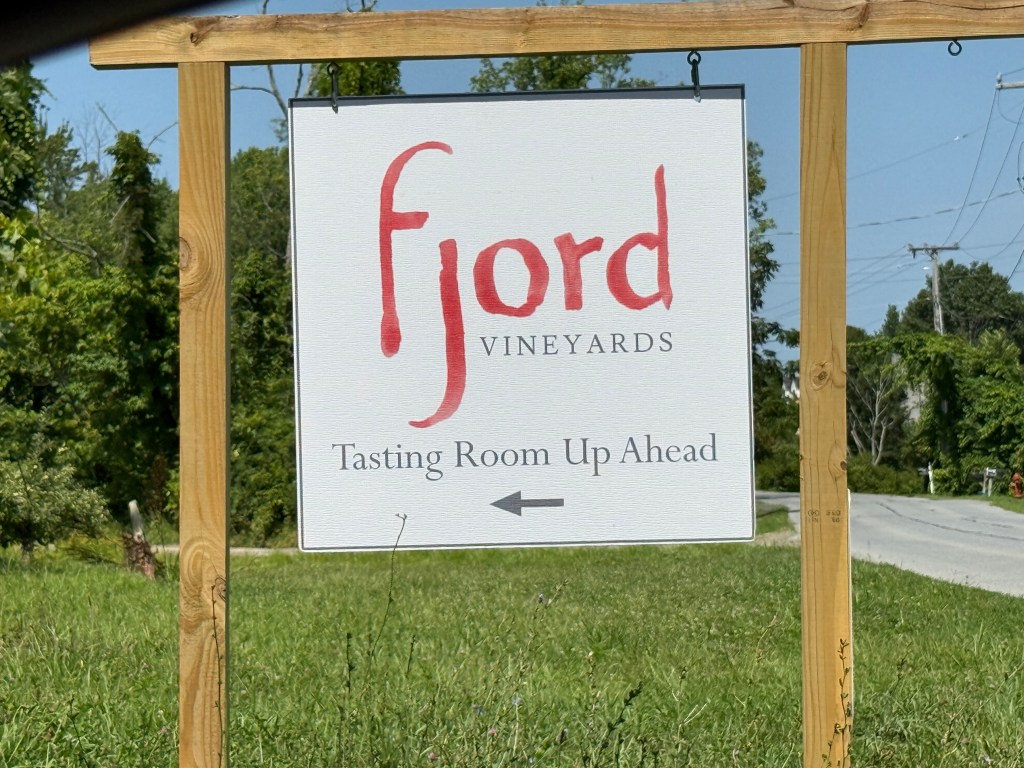
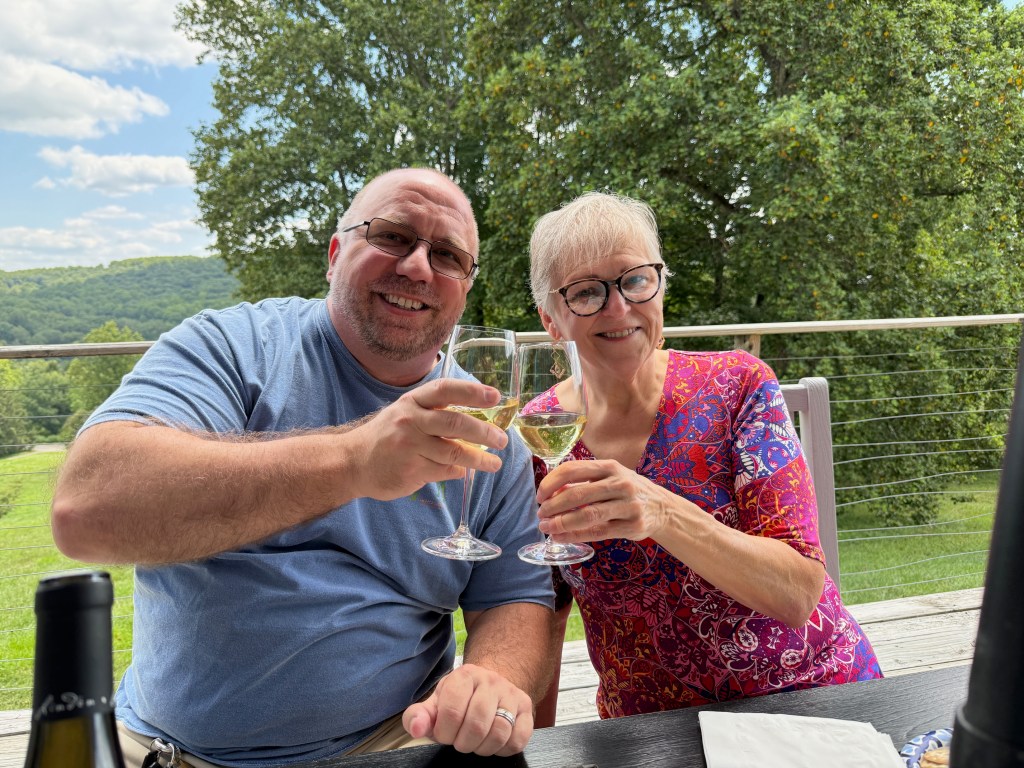
As a native of the Hudson Valley, you can imagine how pleased I am at the proliferation of vineyards in the area. When Fjord opened along Route 9 at a site not far from the Hudson River, I marked it as a must-visit, even if it took me a while.
Fjord Vineyards is owned by Matt Spaccarelli, part of the same family that owns nearby Benmarl Winery. Matt was already making Benmarl’s wines but wanted to branch out. He founded Fjord in 2013 as a 2nd label, giving him the flexibility to be a little more experimental.
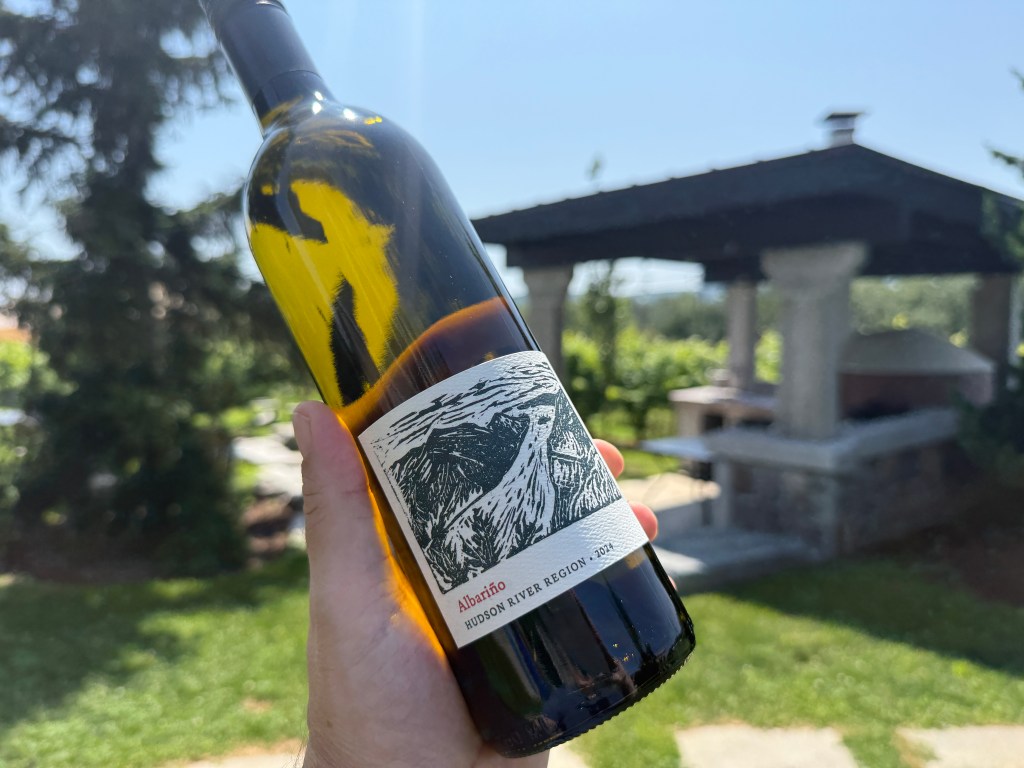
Now, Matt makes wine for both locations. Fjord’s wines are made with their 42 acres of estate grapes, which include 3 acres of Albariño (the largest planting of this variety in New York State).
At first, I thought the name was a homage to a cool piece of Norwegian topography, but it’s more than that.
It turns out a nearby section of the Hudson River might properly be called a fjord, defined by wiki as a “long, narrow sea inlet with steep sides or cliffs, created by a glacier”. This waterway helps remove cold air from the vineyard, allowing them to produce varieties that otherwise wouldn’t survive elsewhere.
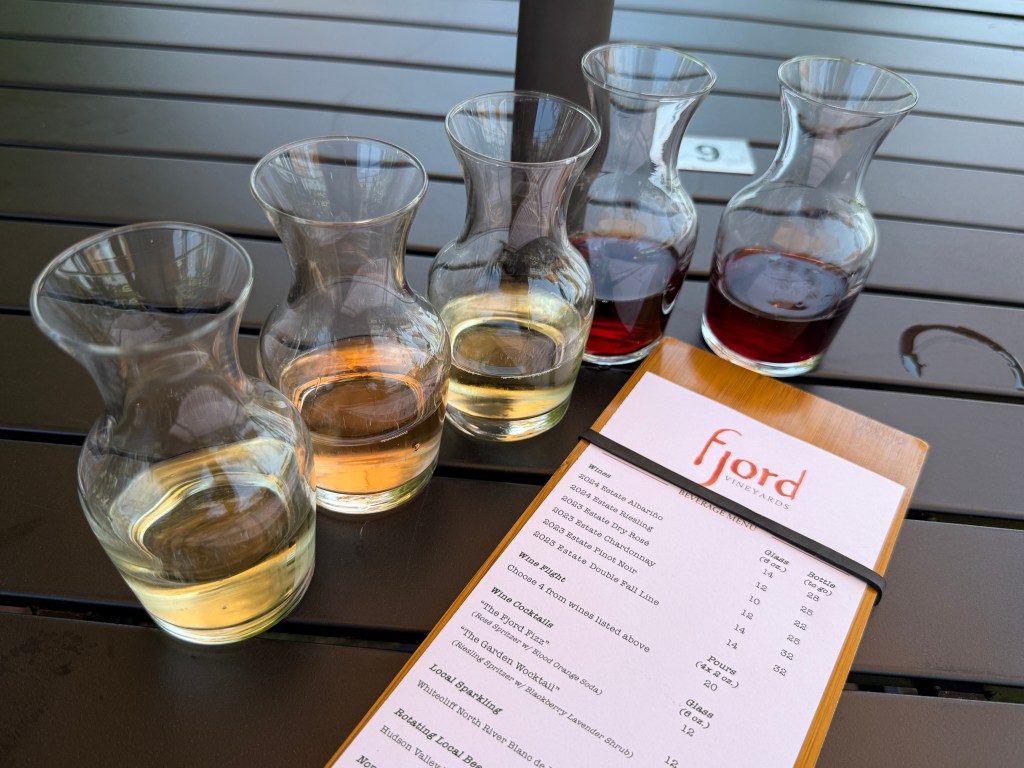
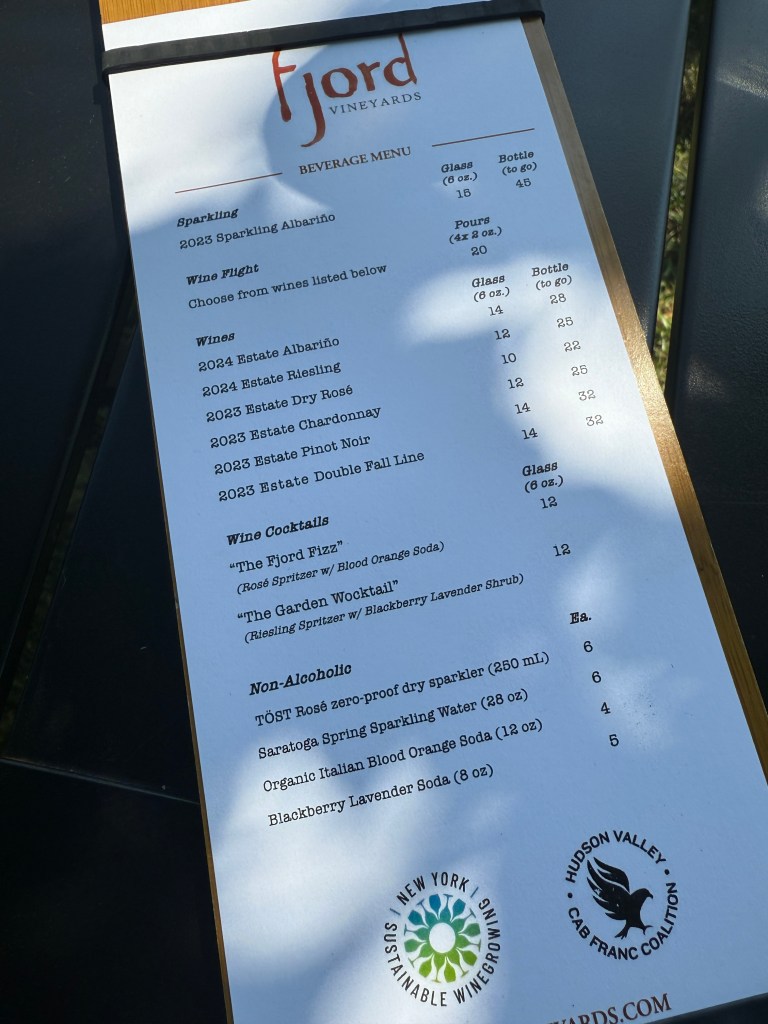
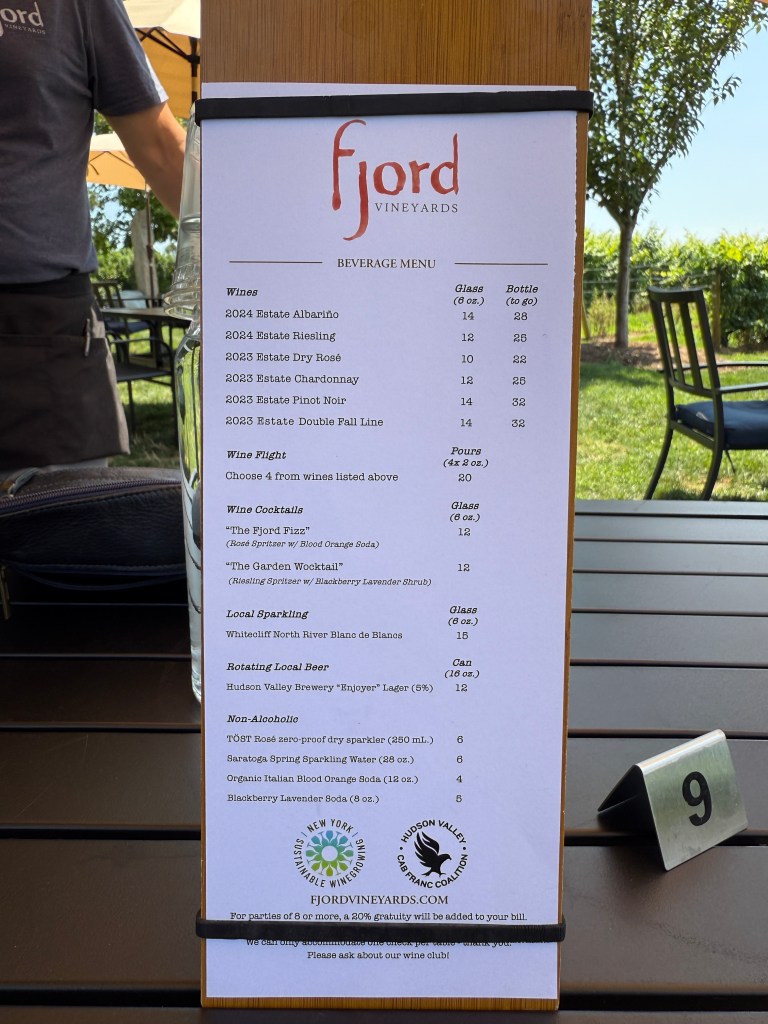
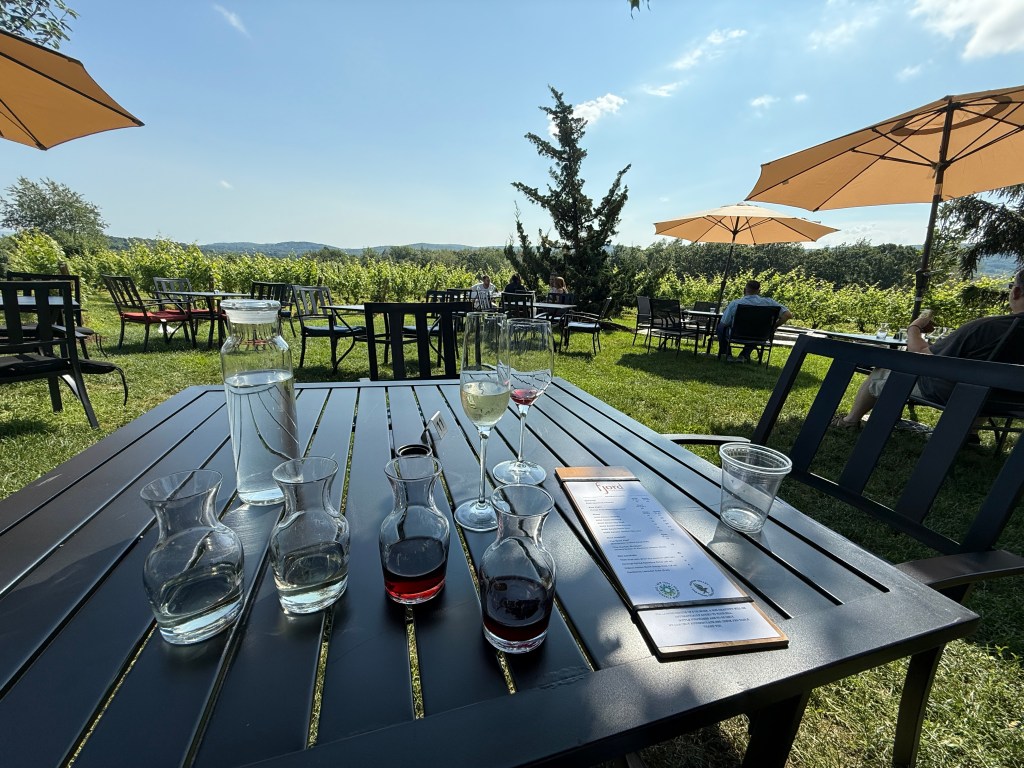
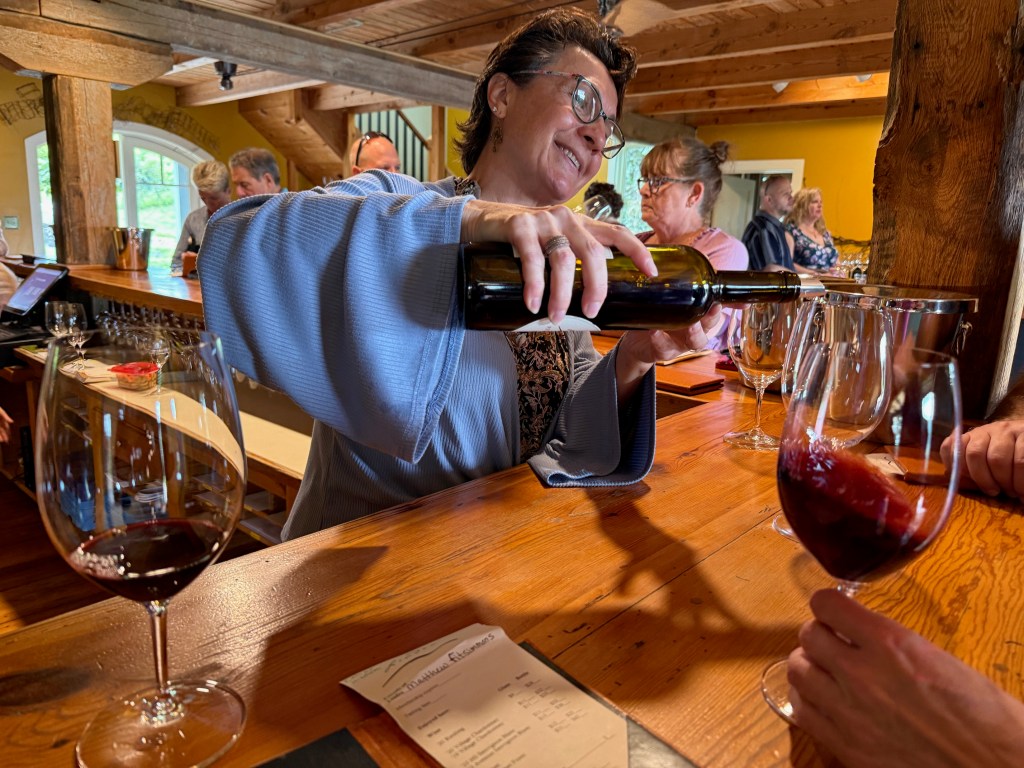
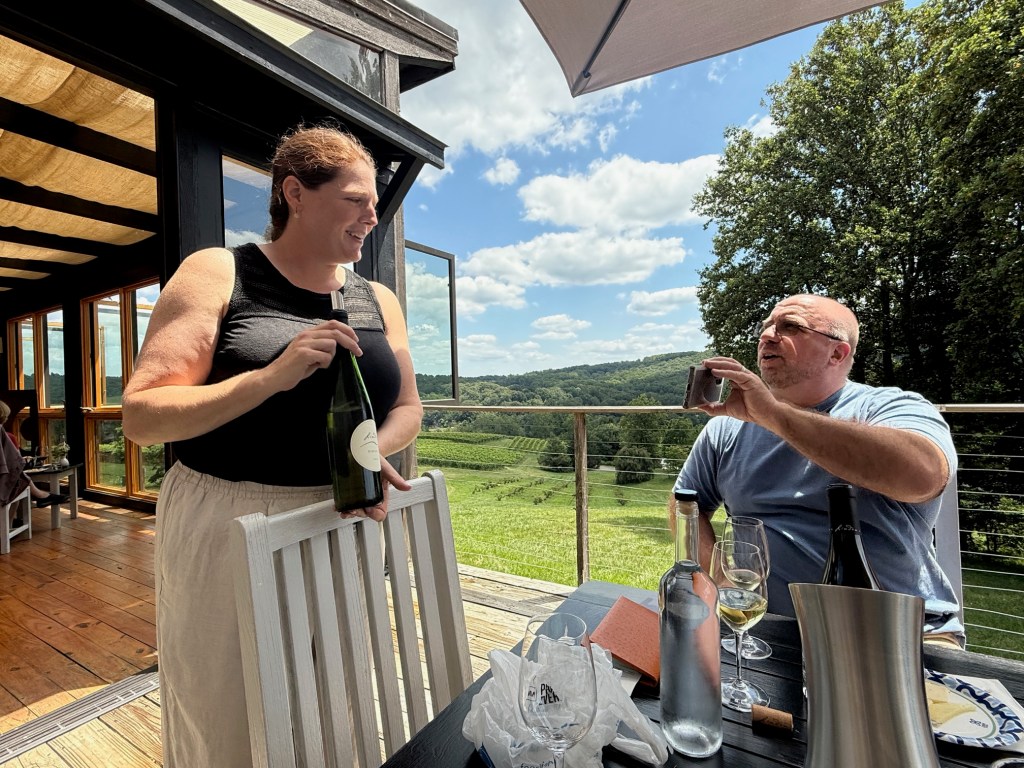
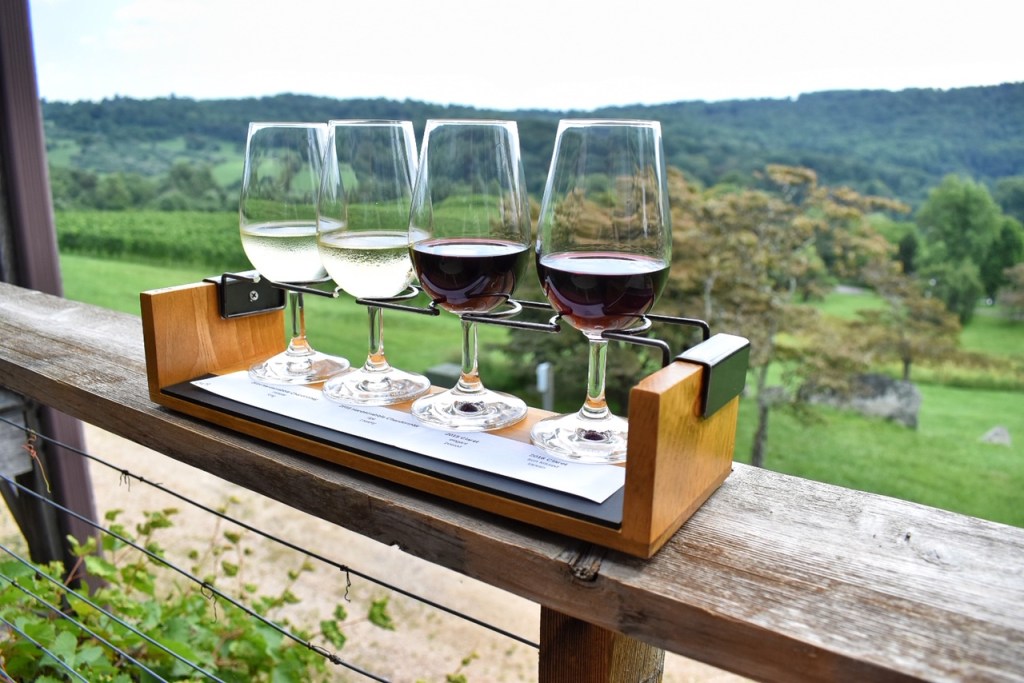
My server gave me the low-down on their wines; $20 for 4 samples, out of a total of 6 options including Riesling, Albariño, Chardonnay, Pinot Noir, a red blend, and a rosé. They also had other beverage options, including wine cocktails, beer (outsourced), and a Blanc de Blanc.
At this point I did a double take. Wait…what did you say? An Albariño? In New York?!?
It turns out this variety is one of those ‘experimental’ varies my server was referring to, and one they were especially proud of. Albariño is typically a warm weather grape found in Spain and Portugal, hence an unusual choice for cool-weather New York. But it was doing well enough to warrant keeping it.
It’s lucky they did. About a month after my visit, this Albariño won “Best white” at the Hudson Valley Wine Competition (and Fjord earned “Best Winery”). So I guess I’m not the only one who liked it.
Wines I tried:
Albariño: Heavy on the minerality, with stone fruit on the side. Not as much citrus as I would have expected. Very aromatic, with notes of lemon added in.
Chardonnay: Bright, lots of stone fruit, especially apricot. I also detected some vanilla notes, perhaps from the barrel. But it definitely wasn’t over oaked; just enough to be detectable.
Rosé: Red fruit; maybe notes of pepper or spice
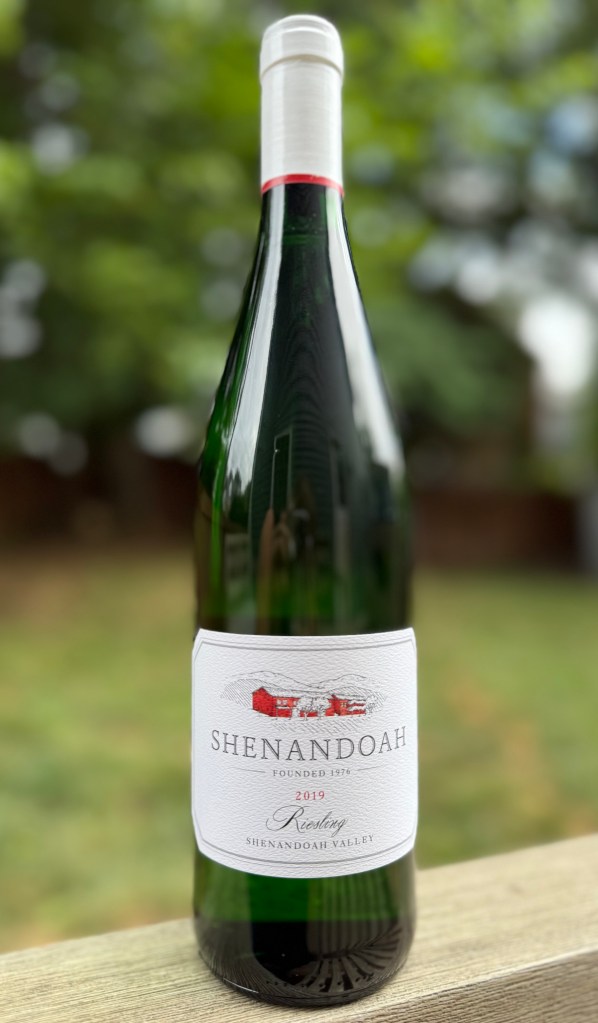
Riesling: Very bright, leaning off-dry
Pinot Noir: A winner! And tough to grow in this area. Some earth and cherry notes (more the later than the former); very traditional flavors for this variety.
“Double Fall Line” red blend: Notes of earth and red currant. Very smooth.
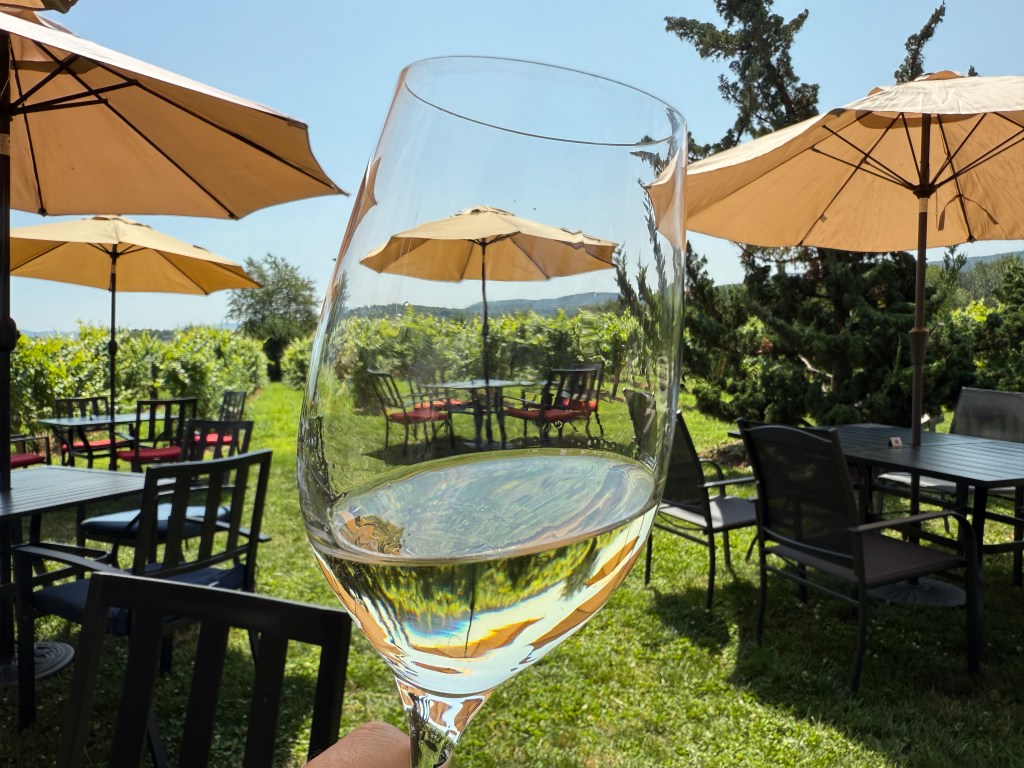
Definitely visit on a sunny day so you can enjoy the view!
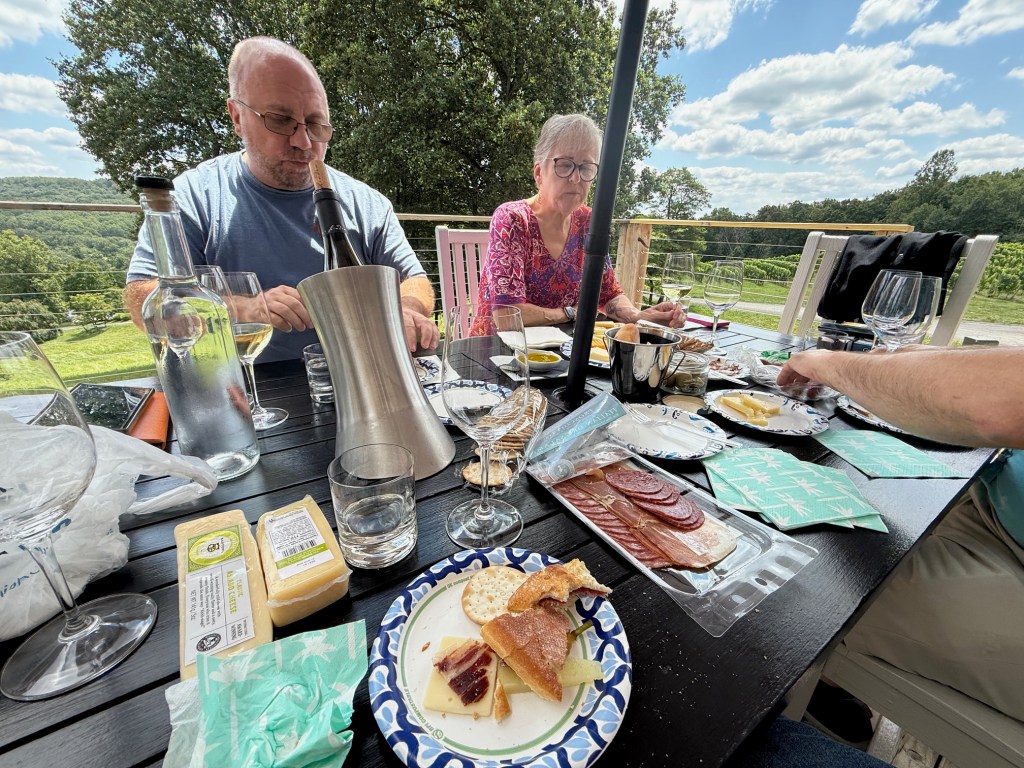
Between my guests and I were covered all six options (doubling up on the Albariño).
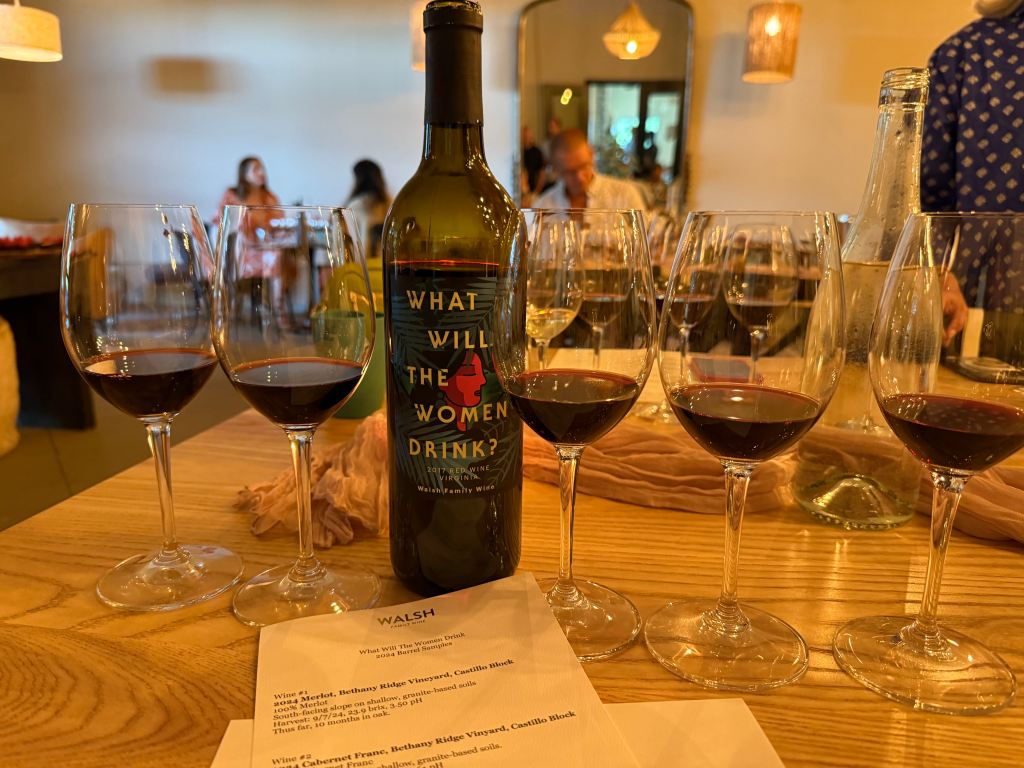
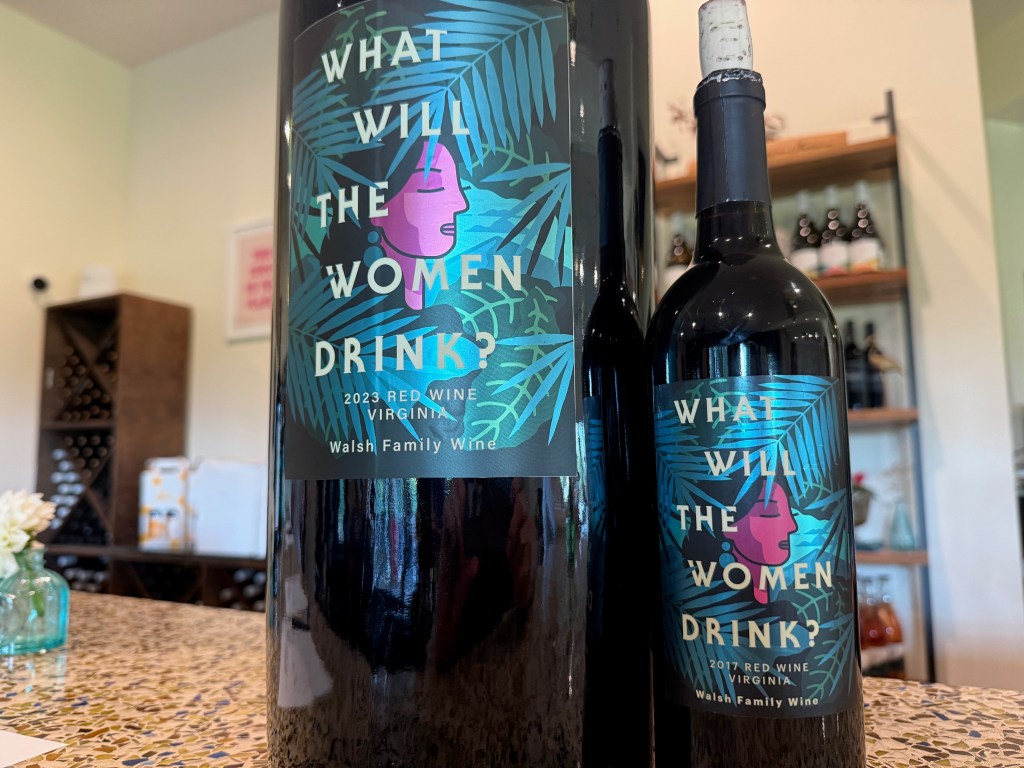
If wine competitions gave awards for witty comebacks, Walsh Family Wine’s “What Will The Women Drink?” would win hands-down.
During a 4-wine vertical of previous vintages of WWTWD, Walsh Family Wine co-owners Nate and Sarah Walsh shared the event that inspired this wine.
The story started not long after they got married; at the time, Sarah was working as a wine importer and Nate as the winemaker for Sunset Hills. Around 2013, they started discussing the possibility of a passion project, where she could learn his side of the business and he could learn hers.
Fast forward a number of years, this ‘passion project’ became a full-on winery – Walsh Family Wine, which opened in 2019.
During their opening day, Sarah was confronted by a patron who asked her, “Excuse me, but are you the owner? I have some advice I’d like to give you”… and he proceeded to explain to Sarah how she should run her business, not letting Sarah get in a word.
Eventually this guy looks around and asks, “Exactly where will you be putting your wine slushy machine?”. Sarah tried to laugh it off, insisting they would never get one. Then the man looked at her, and with zero irony asks, “But what will the women drink?”.
This comment would be bad enough if it was an isolated incident…but it’s not. Sarah has heard versions of this story for her entire professional career selling high-end wine. During many of her visits to places like Napa, winemakers almost always cater to a male demographic. Rarely are big, bold reds marketed to women.
Later recounting the story to her family, she told them, “I want to make this big, bold, dark red blend, and I’m going to call it “What Will The Women Drink?”.
Her family was like “Yeah! That’s a great idea!” (she doesn’t think they believed her).
Then Sarah followed up with, “And I’m going to charge men more!” and they’re like….”Well…maybe not this part, but we love the idea of a What Will The Women Drink? wine!”.
WWTWD is not only marketed towards women, but it also supports women in need. Part of the wage gap of every dollar spent on WWTWD goes to a women’s rights group. This year, Walsh is supporting Women Giving Back, a local non-profit.
5 Vintage WWTWD Vertical
Walsh shared 4 vintages of WWTWD. I made it a 5-vintage tasting, as I brought a 2017 of my own.
2017 WWTWD (40% Petit Verdot, 40% Tannat, 20% Cabernet Sauvignon): This wine needed time to open up. But once it did, oh boy! The 2017 was hitting that ‘old world’ phase, with notes of forest floor, mushroom, and or/earth the palate. Rich nose.
2019 WWTWD (55% Petit Verdot, 25% Cabernet Sauvignon, 20% Tannat): A bit higher in alcohol, with more red fruit on the plate.
2020 WWTWD (45% Petit Verdot, 35% Cabernet Sauvignon, 20% Tannat): The nose was more muted compared to the 2019. More black currant on the palate. It was very approachable, probably because of it was relatively lighter year for reds.
2021 WWTWD (45% Petit Verdot, 40% Tannat, 15% Cabernet Sauvignon): More bramble fruit on the nose, black fruit on the palate. Notes of graphite and purple flower. Very graceful; my favorite of the evening.
2022 WWTWD (67% Petit Verdot, 21% Tannat, 7% Merlot, 5% Cabernet Franc): This seemed a little young and still tight. This was my least favorite, although my neighbors absolutely loved it.
My rankings (from most to least favorite) were 2021 (because of its approachability), 2017 (because of its old world qualities), 2020, 2019, and 2022.
We also tried some younger wines; a 2024 Bethany Ridge Merlot, 2024 Cab Franc, and a 2024 Tannat. All are potential components of the 2024 WWTWD blend.
Women Giving Back
We also heard from a representative of “Women Giving Back”, a non-profit based in Sterling that provides clothing and other accessories to women in crisis, many of which are survivors of domestic abuse. It was a powerful speech.
Speaking right to the audience, co-chair Dave Baer rhetorically asked, “How do they get their lives restarted? What’s the basic thing to give yourself a little self-respect and dignity?
Where are they going to get their clothing when they are leaving their homes in the middle of the night, being escorted by a police officer?
Women Give Back started by doing clothing drives throughout the DMV, donating gently used clothing to women vetted by social service organizations. These women can come in and shop at no cost to them and pick up anywhere from 50-75 clothing items, ranging from children’s items to professional attire.”
Women Giving Back has recently expanded their footprint, not only servicing abused men but also partnering with Loudoun Hunger Relief and LAWS Domestic Violence & Sexual Assault Services. This allows this grouping to provide a comprehensive approach to which now includes clothing, emergency groceries, and counseling.
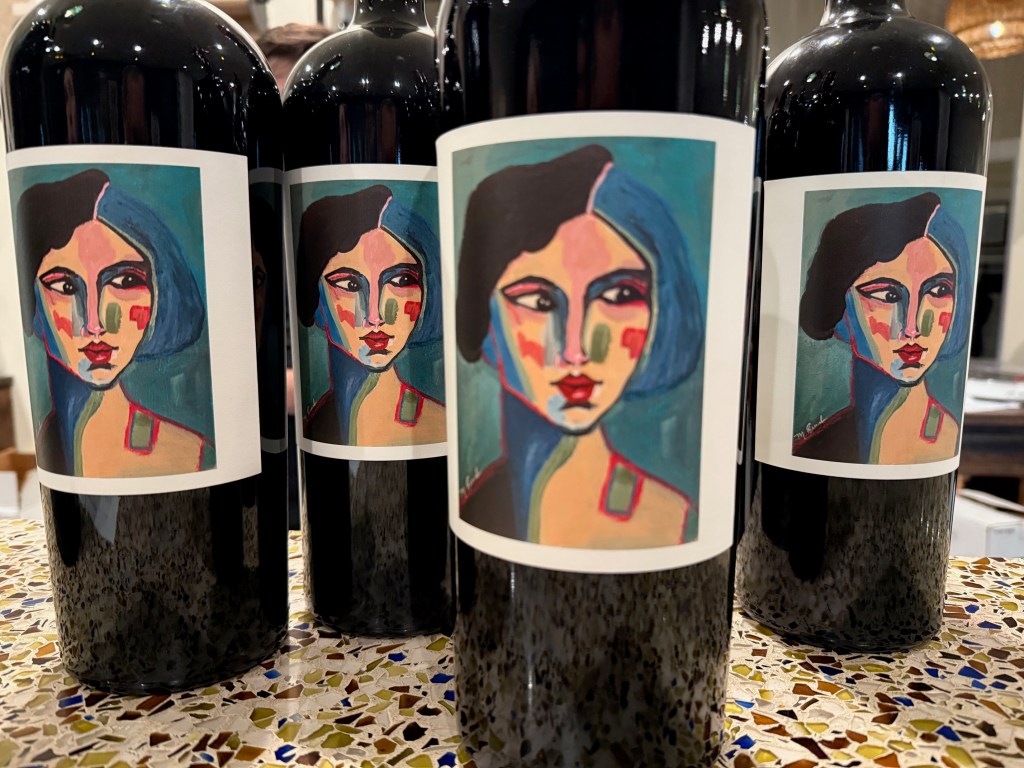
The event also included an auction, which included a Salmanazer of WWTWD (the equivalent of 12 bottles), a 4-wine WWTWD vertical, a magnum of donated from Early Mountain Vineyard, several WWTWD magnums with limited-edition labels, and other gifts provided for the auction.
To top it off, all WWTWD profits from this evening were donated to Women Give Back, including the proceeds from the auction. The event resulted in $4K in donations.
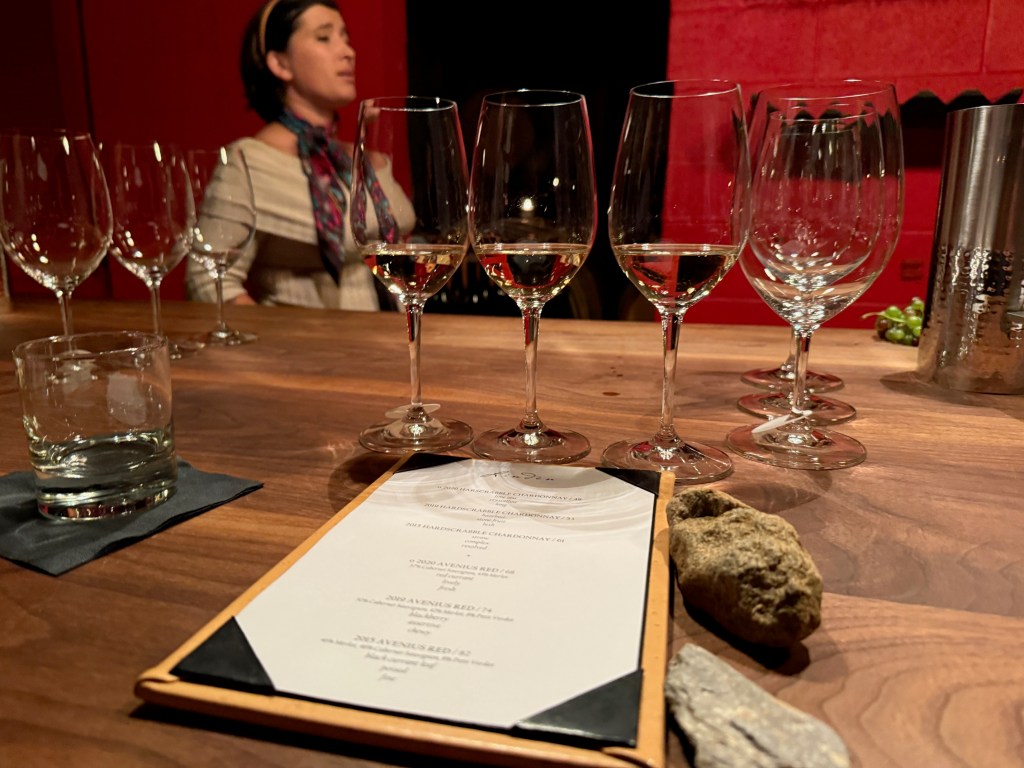
Last weekend a group of friends and I went on what amounts to a pilgrimage to one of our favorite wineries in the state – Linden Vineyards.
I say ‘pilgrimage’ only half-jokingly. While I’ve seen owner/winegrower Jim Law described as the ‘high priest of Virginia terroir winemaking’, he actually dislikes lavish praise. Jim’s favorite title by far is ‘winegrower’, and he’s modest enough to still bus tables at his own winery.
Moreover, this wasn’t my standard visit. This event marked the return of Linden’s cellar tastings, an event that disappeared when COVID hit.
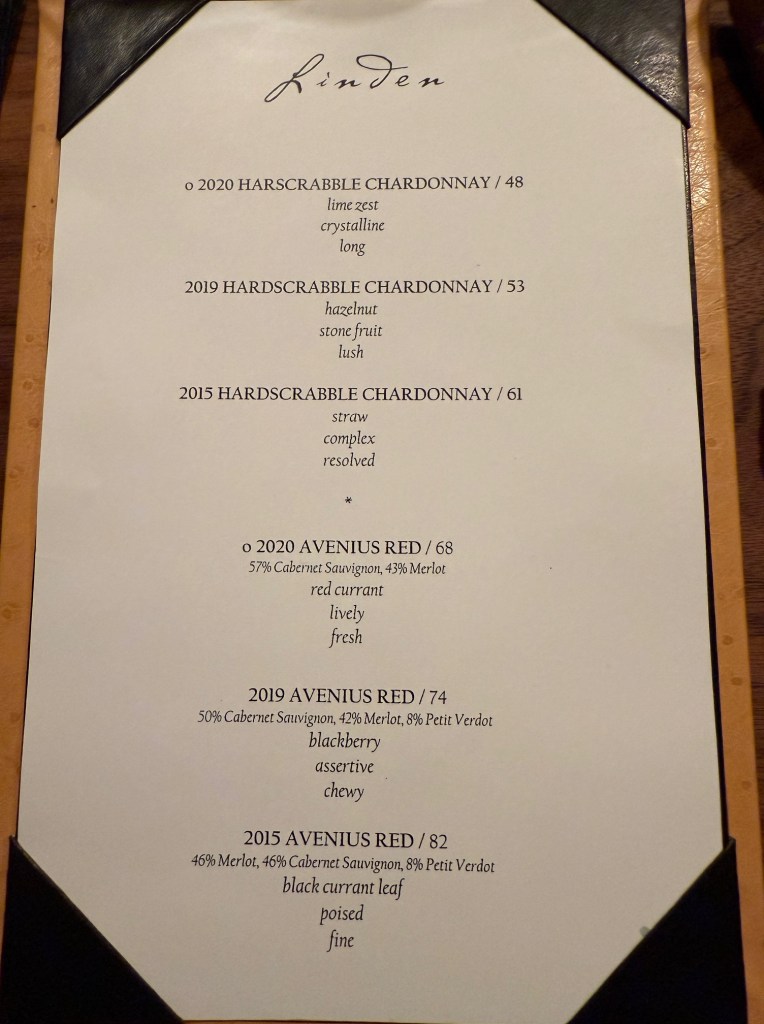
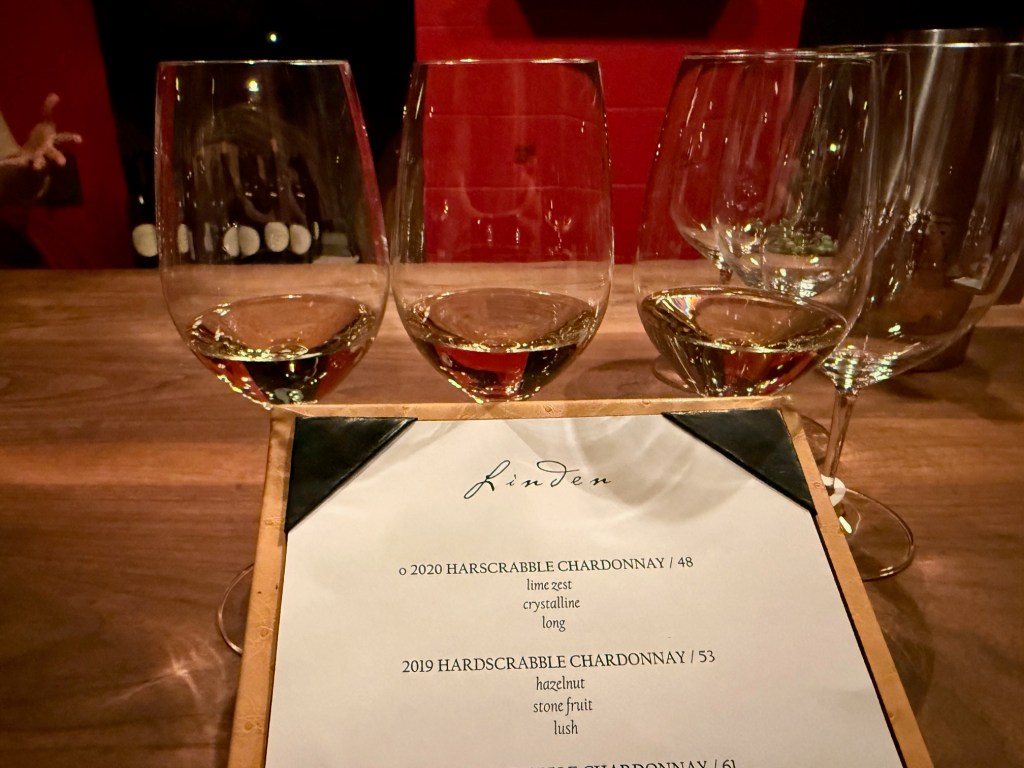
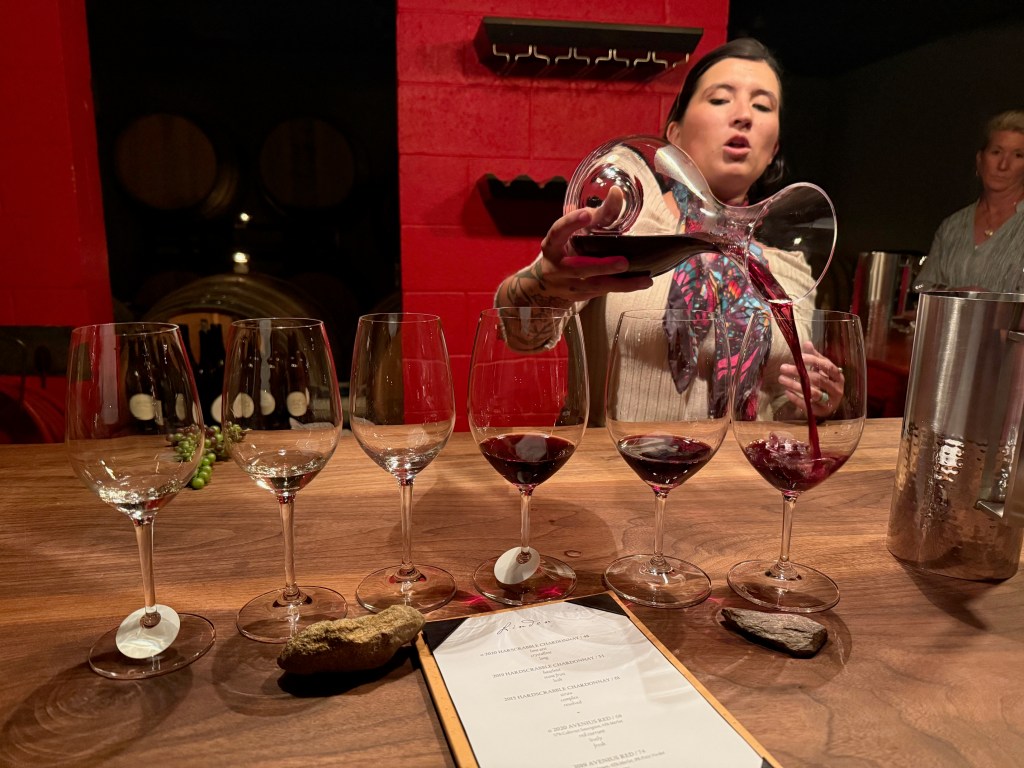
Linden’s cellar tastings include either a vertical (same vineyard different years) or horizontal (same vintage year but different vineyards). This particular event included verticals of Hardscrabble chardonnay (2015, 2019, 2020), and Avenius red (2015, 2019, 2020), plus a barrel sample of their 2024 Petit Verdot.
Weather-wise, we lucked out with a warm but not overly hot afternoon. I didn’t get a chance to chat with Jim, but I did catch up with his daughter Samantha, who was running tastings at the bar.
I did learn that despite the rain, things were looking OK in the vineyard. It also looks like this will be their last vintage of their Wabi Sabi white blend, which I’m not entirely sad about. Jim did spray earlier than usual to address the Spotted Lanternfly issue, which is unavoidable now given their prevalence in the state.
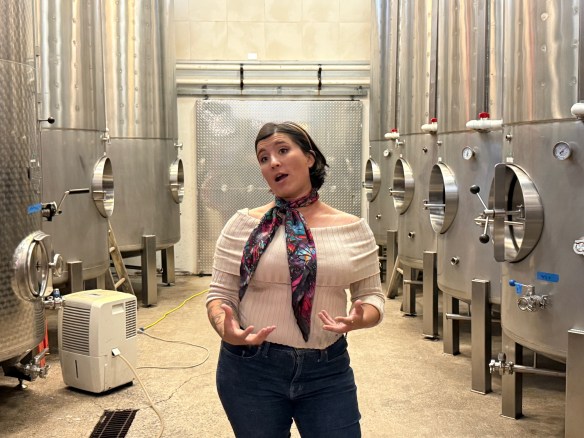
Once the last person arrived, we headed down to the cellar with McKenzie, a new addition to Team Linden. I didn’t get her full background, but she did have experience working the DC restaurant scene prior to moving to Culpepper. Hopefully we’ll see more of her.
I believe nearly everyone who attended this event was familiar with Linden’s wines, so we didn’t need to spend too much time on Jim’s low-intervention winemaking philosophy. That said, McKenzie was very extroverted host who loved telling us about the 6 wines before us.
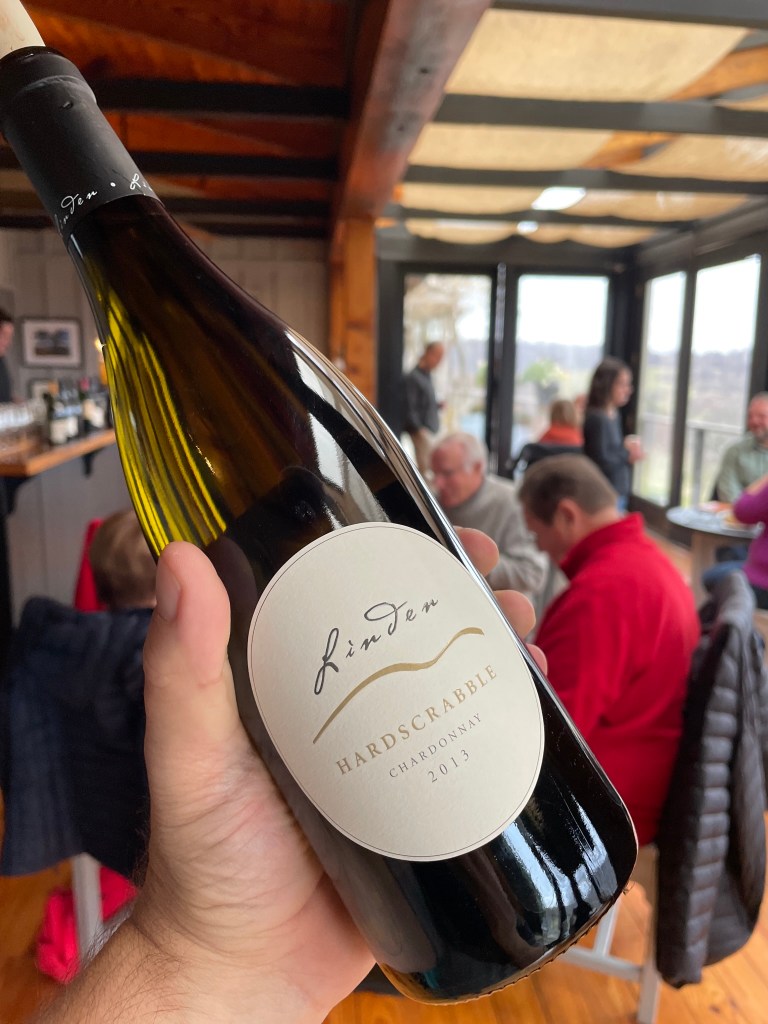
We kicked off with our Hardscrabble Chardonnay flight (made from the estate vineyard). I’ve had all of these before, but except for the 2019s not recently. I was especially excited by the 2015 Chardonnay, which Jim once said was one of the favorite wines he’s ever made.
2015 Hardscrabble Chardonnay: Very ‘full’ as white wines go. While it was starting to turn nutty, it still doesn’t present itself as a decade-old wine. Except for ‘age’ on the nose, it was still pretty vibrant and a tribute to the ageability of Jim’s wines. That said, Jim once told me this wine was probably at its peak, so it wouldn’t get any better than it was now.
2019 Hardscrabble Chardonnay: Very different from the other two. Much more stone fruit, plus very ‘bright’ due to being the product of a very warm year. I did detect a tad bit of newer oak on it. I think this wine will only get better.
2020 Hardscrabble Chardonnay: Stylistically similar to 2015, but riper. Good acidity; Kenny Bumbaco said it was ‘Chablis-y’. It was better than I remembered, although not quite in the same league as the other two. Still, it was a good wine from a vintage that isn’t well regarded in Virginia wine.
Next up was the Avenius red blend flight, grown just down the road at Shari Avenius’ vineyard. Shari has retired from the tasting room so I haven’t seen her in a long time, but it seems she is still tending her vineyard.
2015 Avenius (46% Cab Sauv, 46% Merlot, 8% Petit Verdot): Earthy nose. Not a lot of fruit but doesn’t need any, as it was an overall amazing wine. I have ‘persistent and chewy’ in my notes. I’m very glad I have a bottle of this in my cellar, although I probably should drink it sooner than later.
2019 Avenius (50% Cab Sauv, 42% Merlot, 8% Petit Verdot): Mix of fruit and earth on the nose. Good fruit on palate. You could likewise tell this was the product of a hot year, due to its ripeness.
2020 Avenius (57% Cab Sauv, 47% Merlot): OK; admittedly not my favorite. Brett on the nose and some on the palate, which gave it that barnyard/funk quality. I think you have to appreciate a little bit of brett to enjoy this, although it did give this wine an extra oomph of complexity and earthiness.
With the cellar tasting complete we adjourned upstairs for their regular tasting. Linden only recently switched over to a ‘summer’ tasting, now comprised of the 2023 Avenius Sauv Blanc, the 2023 Hardscrabble Sauv Blanc, the new 2022 Claret, and a full-varietal Cabernet Franc. And oh yeah – that 2024 Petit Verdot sample!
2024 Petit Verdot: Fruitier and lower in tannin than I expected. While different from what I usually expect, I definitely liked it. I believe it was made in steel, which is likewise unusual for PVs.
2023 Hardscrabble Sauvignon Blanc: Something a return to form, as this wine had a dash of Sémillon. Layered. In a way, it was like a riper version of a white Bordeaux.
2023 Avenius Sauvignon Blanc: Notes of boxwood…which is sometimes referred to as ‘cat pee’ (I hate that term, BTW). It was higher in alcohol, which meant the acidity wasn’t as prominent as it usually is.
2022 Cabernet Franc: This was the first full Cab Franc I’ve ever seen from Linden; certainly the first since 2010. All Hardscrabble vineyard fruit. It had a slight hint of the pyrazine notes that Cab Franc is known for, but they didn’t lean into that direction at all.
2022 Claret: I don’t have any notes for this one!
Afterwards we adjourned for snacks on their patio on a perfect summer day, ordering a 2015 Hardscrabble Chardonnay for the table and eating charcuterie. Then it was off to Barrel Oak, which has been upping its game of late (click this link for Dan’s blog on Barrel Oak; he loves more hits!).
Few Virginia wineries have what are sometimes called ‘old vines’. Those that do will most likely happily let you know about them, with the implication that “old vines = better wines”.
But what does the term ‘old vines’ actually mean, and why are they important?
There is no legal definition for what constitutes a wine made with ‘old vines,’ although private organizations have their own criteria.
In 2024, the International Organization of Vine and Wine defined an “old vine” as a plant that is documented to be 35 years or older. Plots where 85% of such vines meet this criterion may be considered ‘old vineyards.’ Several other organizations, including the South African Old Vine Project and the Old Vine Registry, use these definitions.
The Historic Vineyard Society has a different set of criteria, only certifying California vineyards with vines that are a minimum of 50 years old and when at least 1/3rd of producing vines can be traced to the original planting.
Few old vines exist in Virginia. Prohibition wiped out Virginia’s wine industry, and it wasn’t until the 1970s that it started making a comeback. Even Virginia’s oldest wineries seldom have anything left of their original vineyards.
Fortunately, a number of older vineyard plots do survive. Such vines are living time capsules, representing the kind of wines Virginia’s viticultural trail blazers thought would perform best.
Many of these surviving vines are Burgundy or Bordeaux varieties that remain popular today. Chardonnay is still produced at Virginia’s two oldest commercial vineyards, Meriwether Vineyard and Montdomaine Vineyard. Founded in 1976 and located at Pearmund Cellars, Meriwether is recognized by the Old Vine Registry as Virginia’s oldest vineyard. Montdomaine was founded in 1978 and is located just below Michael Shaps Winery.
Founded in 1976, Meriwether Vineyard is Virginia’s oldest vineyard (Photo credit: Pearmund Cellars)
Older vineyards are also the home of varieties that were once more prevalent in the state. Cool-climate vines often struggle in Virginia, a fact only appreciated after decades of trial-and-error. While many wineries have since torn out their riesling, Gray Ghost Vineyards, Shenandoah Vineyards, and a handful of others still tend to their plots.
Virginia’s first vineyards also widely utilized French American hybrid grapes, such as chambourcin and seyval blanc. These vines are relatively easier to maintain; an important consideration in a then-young industry with little institutional knowledge of how to handle more finicky vinifera.
Why Winemakers Prize Older Vines
A well-tended grape vine can last 50 years or more, which makes ‘old vine’ status obtainable. The “Mother Vine” in Roanoke, considered the oldest grapevine in North America, was first recorded in 1584.
While younger vines are more productive, older ones are often thought to produce higher quality fruit. The reasons for this are complex, but much of the credit goes to how older vines have deeper root systems.
Deep roots allow older vines to more easily access water and nutrients that are inaccessible to younger vines, which is especially beneficial during periods of drought. This more balanced intake allows them to create more complex, intensely flavored fruit.
Older vines have an additional advantage in wet regions, such as Virginia.
The roots of younger vines are more likely to become saturated during periods of heavy rainfall, diluting their fruit’s flavor profile.
Older vines are less likely to encounter this problem. The soil above them acts like a shield, preventing water from penetrating to the roots far below. This allows their fruit to maintain good chemistry, despite pre-harvest deluges.
Linden Vineyards winegrower Jim Law has observed older blocks have additional benefits beyond deep roots.
“Older vines sometimes ripen up to 10 days later. This helps keep them in the sweet spot of late September/early October when nights are cool; a big advantage in our warmer climate. They are also more homogenous, which leads to more synchronistic ripening. This is important for quality,” he wrote over email.
Jim Law, owner and winegrower of Linden Vineyards
Even so, it’s overly simplistic to assume old vines are superior to younger ones, according to winegrower David Lambert. David manages the winegrowing at both Shenandoah Vineyards and Stoney Creek Vineyards, two of the oldest in the state.
In answering a question about the quality of ‘old vine’ wine, David opined, “The answer is not as simple as old vines vs. young vines. Newer clones are superior to the older clones with questionable genetics. In particular, the 2018 riesling plantings at Shenandoah Vineyards ripen fruit sooner, have clusters that are looser, and are less prone to bunch rots, allowing them to produce wine superior to our 1981 riesling plants.”
Finding “Old Vine” Wine In Virginia
There are opportunities to sample wine from Virginia’s oldest vines, if you know where to look.
Pearmund Cellars is one of the few wineries in Virginia that makes wine exclusively from ‘old vine’ blocks. Next year Pearmund will celebrate the 50th anniversary of its Meriwether Vineyard with a special labeling of its “Old Vine” chardonnay, vinified from these blocks.
Gray Ghost Vineyards produces a Reserve Cabernet Sauvignon that is only made from its 1988 block. Fruit from these vines have been consistent award winners, most recently earning a Best in Class award from the 2024 East Meets West Challenge at Santa Rosa, California.
Linden Vineyards uses fruit from its 1985 and 1988 blocks (as well as its 2010 block) for its Hardscrabble Chardonnay, although the proportions differ every year.
Shenandoah Vineyards’ 2019 Riesling, made with vines planted in 1981, won Gold at the 2023 Virginia Governor’s Cup.
If you ever find yourself at a vineyard with old, gnarly trunks – ask about them! There’s likely a story behind how they’ve persevered.
To summarize my findings; Pinot Noir struggles in the warm-weather sites that characterize much of Virginia. The reputation of locally grown Pinot was so bad that when wine-legend Jancis Robinson tasted an Ankida Ridge Pinot in 2011 that she exclaimed in the most back-handed compliment ever; “It tastes like Pinot!”.
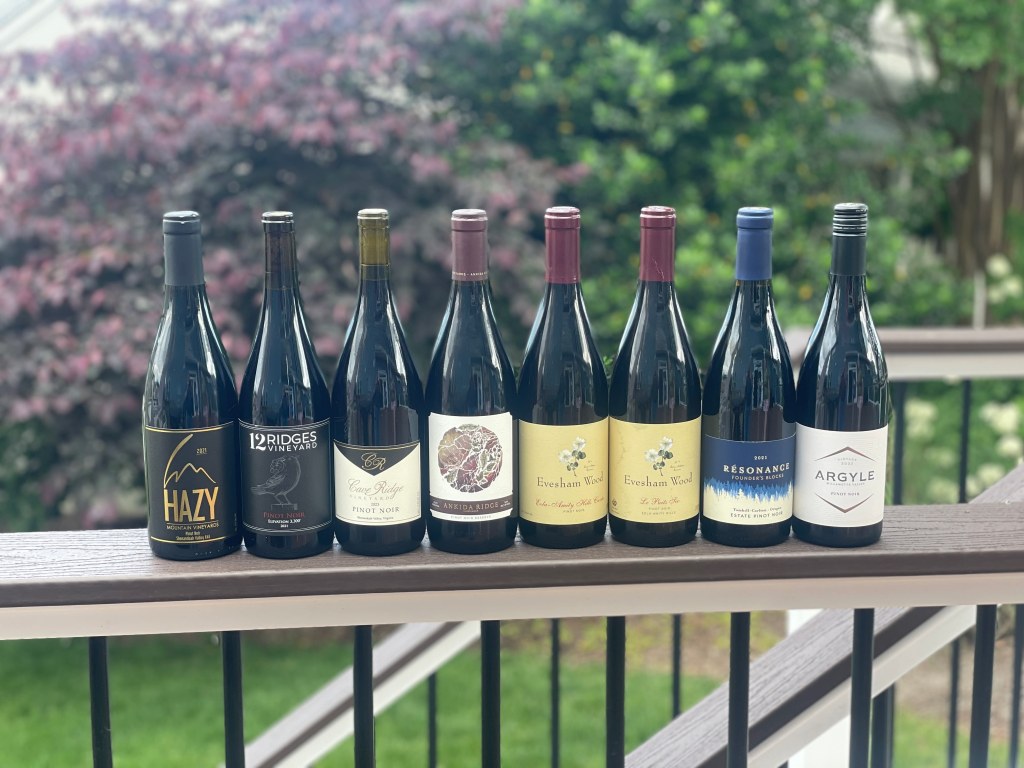
For my event I picked what I felt are the best 4 Pinot growers Virginia has to offer. These vineyards succeed in growing Pinot where previous ones had failed by planting at relatively high elevations: 12 Ridges (3,300 ft), Ankida Ridge (1,800 ft.), Cave Ridge (1,200 ft), and Hazy Mountain (1,600 ft). All are located in the Shenandoah Valley or the adjoining Blue Ridge Mountains, areas that have strong track records for growing cool weather varieties.
My group picked 4 Oregon Pinots to pair them against. I recently attended a wine dinner with Evesham Wood, so I had 2 wines from this quality producer. Other guests brought two more wines; a low-cost Pinot from Argyle, and a high-quality wine from Résonance.
I honestly had no idea how Virginia would fare here. Oregon has a great reputation for Pinot Noir, so I would have been happy if Virginia simply showed well against a heavy hitter in this category.
Tasting & Scoring Methodology
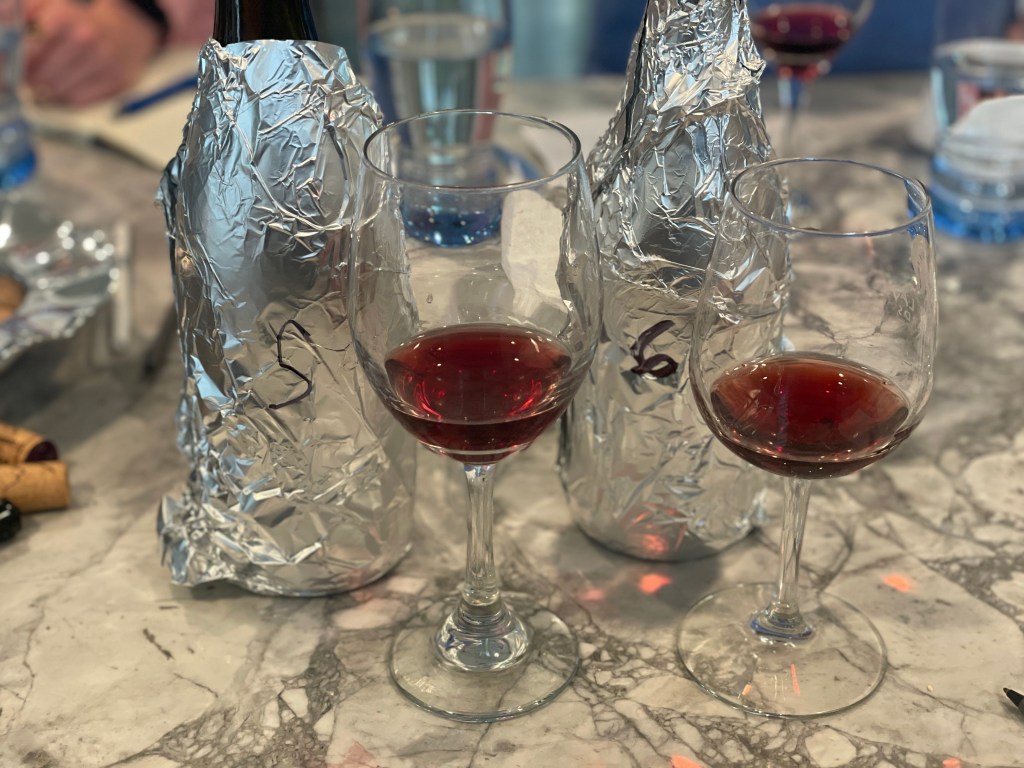
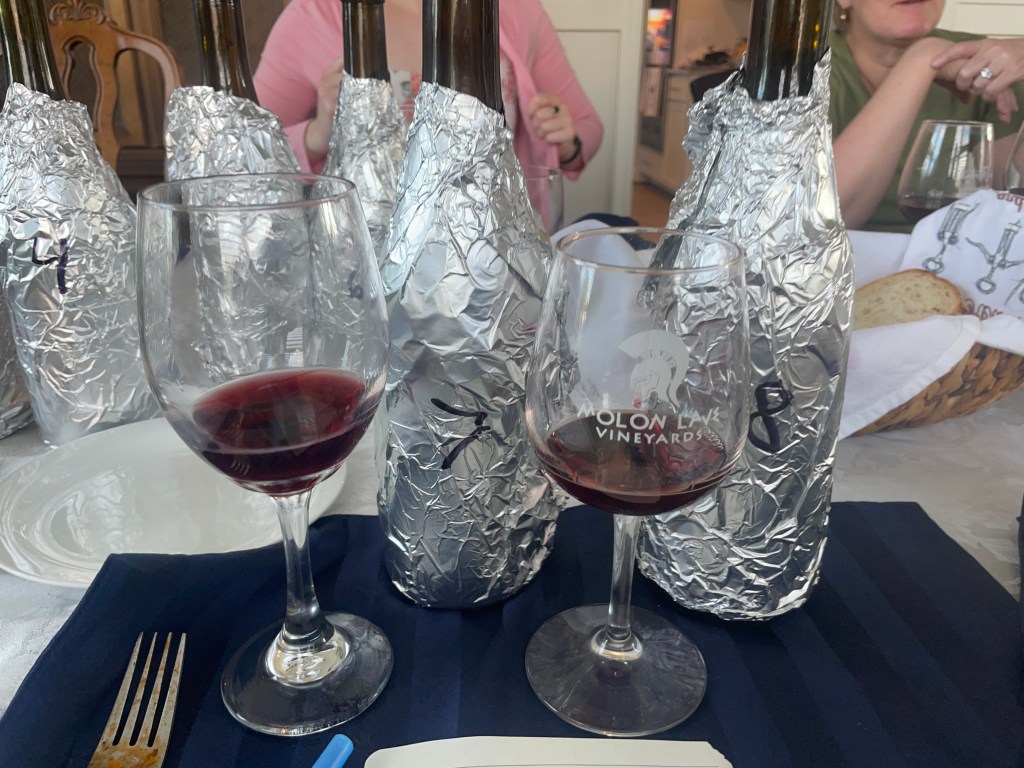
We did 4 rounds of 2 wines, consisting of a Virginia and Oregon Pinot Noir side-by-side, served blind. After we finished all 8 wines, we voted which were our Top 2 of the day. The Top 2 were set aside and revisited during a ‘Finalist” round.
The advantage of revisiting these wines is this gave the Top 2 more time to open up. The introduction of food changed our palates, adding another dimension to the event. After re-tasting them, we declared an overall winner.
The 4 flights were generally arranged lowest-to-highest in terms of price point.
Admittedly this was not our favorite round; not surprisingly as I started with the lower-priced wines and worked my way up.
This round ended with Oregon as the favorite by a wide margin. While this particular Oregon wine isn’t this producer’s top-tier wine, it did have all the rich fruit qualities you’d want from a mid-$30 Oregon Pinot Noir.
Bottle #1 / 2022 Evesham “Eola-Amity Hills Cuvée”. Overall we felt this wine showcased fresh fruit, with some earthiness. Most attendees felt this was the Oregon bottle, although not everyone felt confident enough to vote.
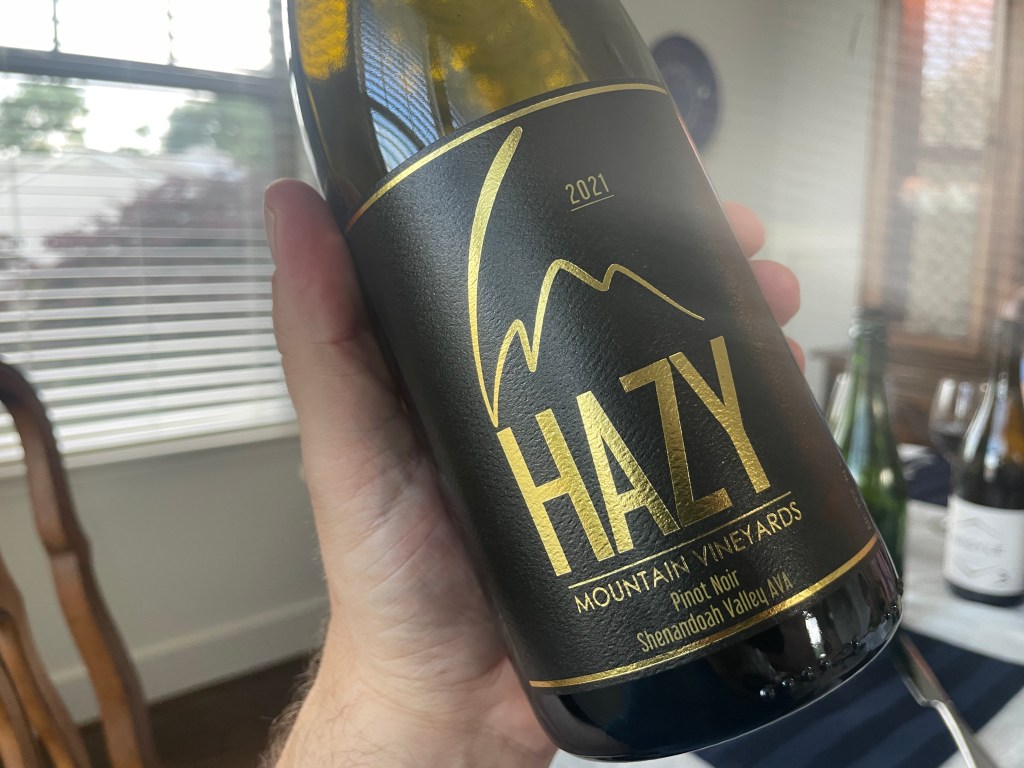
Bottle #2 / 2021 Hazy Mountain. This wine was more expressive on the nose; maybe with some notes of oak. On the palate several guests detected notes of earth and allspice.
Votes:
Annie: Voted #1
Chris: Voted #1
Larry: Voted #2, since he preferred the more earthy, ‘aged’ qualities of this wine.
Matt: Voted #1
Kathy: Voted #1. Noted #1 was fresher, while #2 had notes of forest floor but seemed too cooked.
Stacy: Voted #1
Patti: Voted #1. Enjoyed #1 for its richer body; could tell it was Oregon. Felt #2 was too tart.
In retrospect I should have paired #1 vs #4, since the #3/Argyle was arguably our least favorite wine of the day. But since Cave Ridge’s Pinot isn’t yet priced, I wasn’t sure which wine to pair against it.
That said, I think Cave Ridge was the surprise of the night. 8 out of 8 attendees felt this wine was from Oregon, which I’ll take as a compliment for this wine.
Bottle #3 / 2023 Argyle. We could tell this wine was mass produced. It had too much of an effervescent ‘cherry coke’ quality to it, or maybe candy notes.
Bottle #4 / 2023 Cave Ridge. Lots of compliments regarding the fruit notes in this wine. Others noted it had notes of almond or marzipan. Multiple people (including myself) really enjoyed the initial ‘attack’ on our first sip.
Now we’re talking! At 3,300’, 12 Ridges is the 2nd highest-elevation vineyard on the east coast. Evesham’s Le Puits Sec was also an excellent wine.
While we definitely liked the 12 Ridges, it just didn’t compare well to an excellent vineyard-specific Oregon wine.
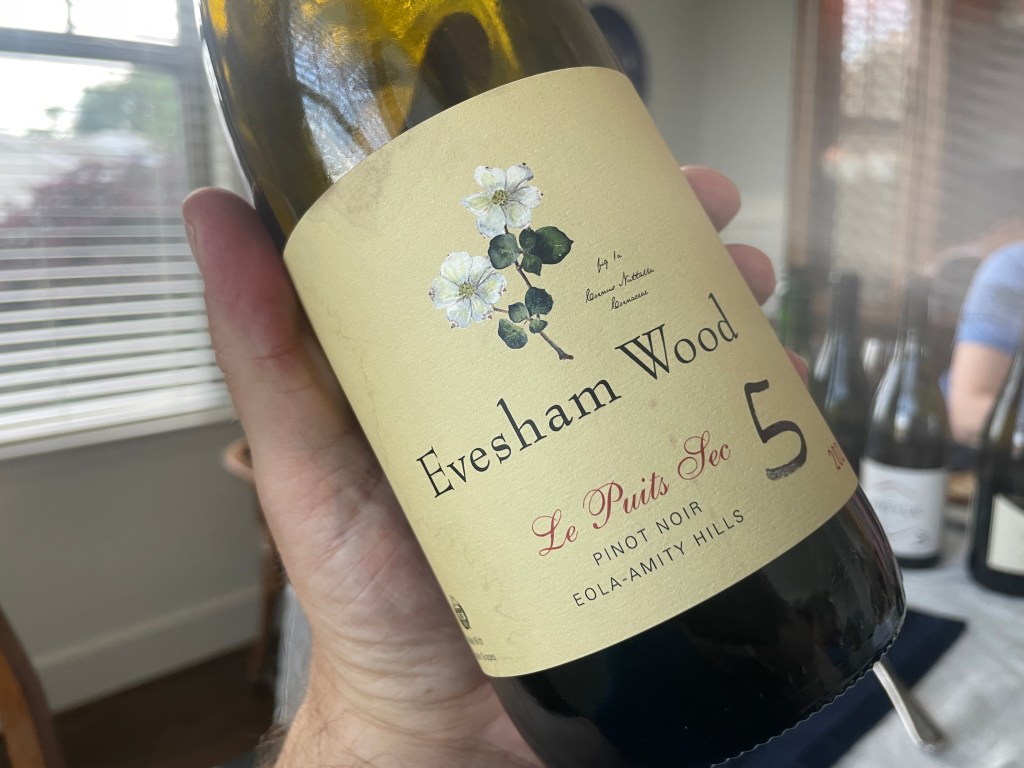
Bottle #5 / 2021 Evesham Woods Le Puits Sec. We generally identified this as the Oregon wine, although not universally. This was very well-enjoyed with lots of great descriptors, ranging from “Fresh and well-integrated”, “delicate”, and “balanced”. A few picked up on notes of baking spice, maybe dark cherry. Harissa was mentioned by one guest. I detected a lot of mushroom on the nose.
I felt this particular wine had, hands down, the best nose of any wine enjoyed that evening.
Bottle #6 / 2021 12 Ridges. This was definitely a higher-acid wine, which in retrospect makes sense since it was grown at 3,300 ft’.
Our tasting notes were all over the place. One guest mentioned notes of salted caramel; another said they got notes of sea salt. Yet another mentioned smoke or sour cherry. I didn’t get a lot on the nose, but I did feel it had nice complexity.
Votes:
Annie: Voted #5
Chris: Voted #5
Kathy: Voted #5
Larry: Voted #6 (still the outlier!)
Matt: Voted #5
Patti: Voted #5; her ‘happy place’ since she’s a big Oregon pinot fan
This was by far our favorite pairing of the night. Not everyone voted to identify the region, although most of the guesses were accurate. It was very much a competition between ‘grace (#7)’ vs ‘power (#8)’. We were evenly divided on which we preferred, so it was a tie.
The #7 was rounder and more balanced. #8 was a ‘big’, but in a good way. Someone said it was “ready to party”, if you will. Both had great complexity, and opinions differed on which was heavier.
Bottle #7 / 2021 Résonance Founders Block. Notes of sour cherries and mushrooms. It had a perceived sweetness; not from sugar levels but had a ‘fruit sweet’ quality to it.
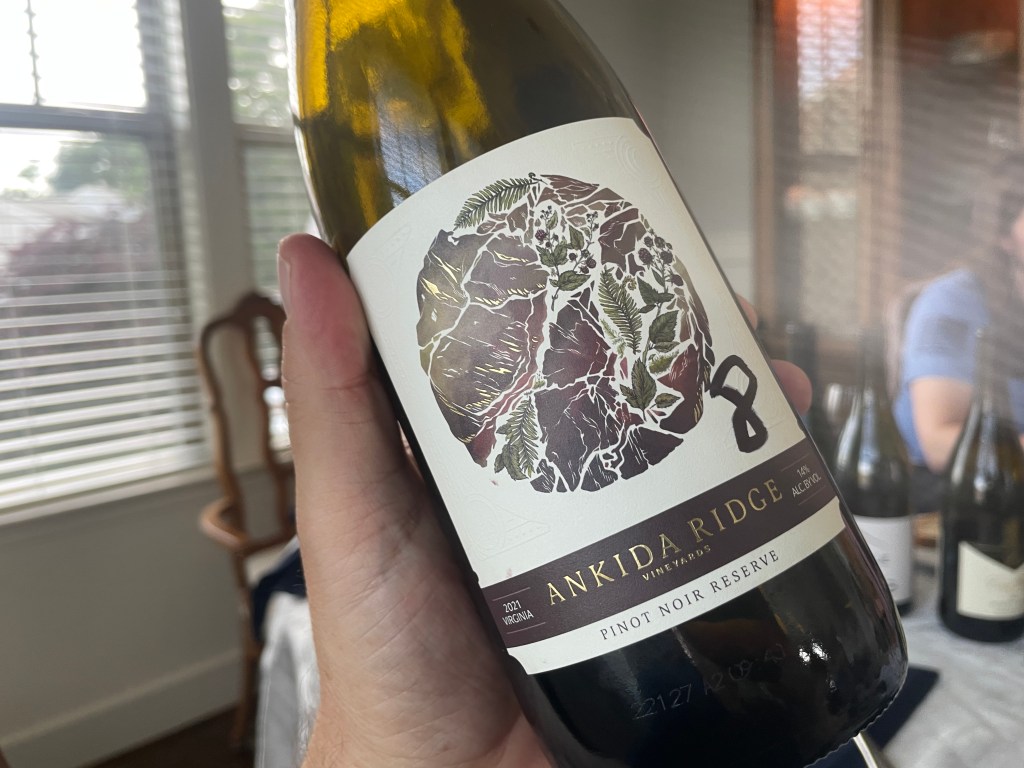
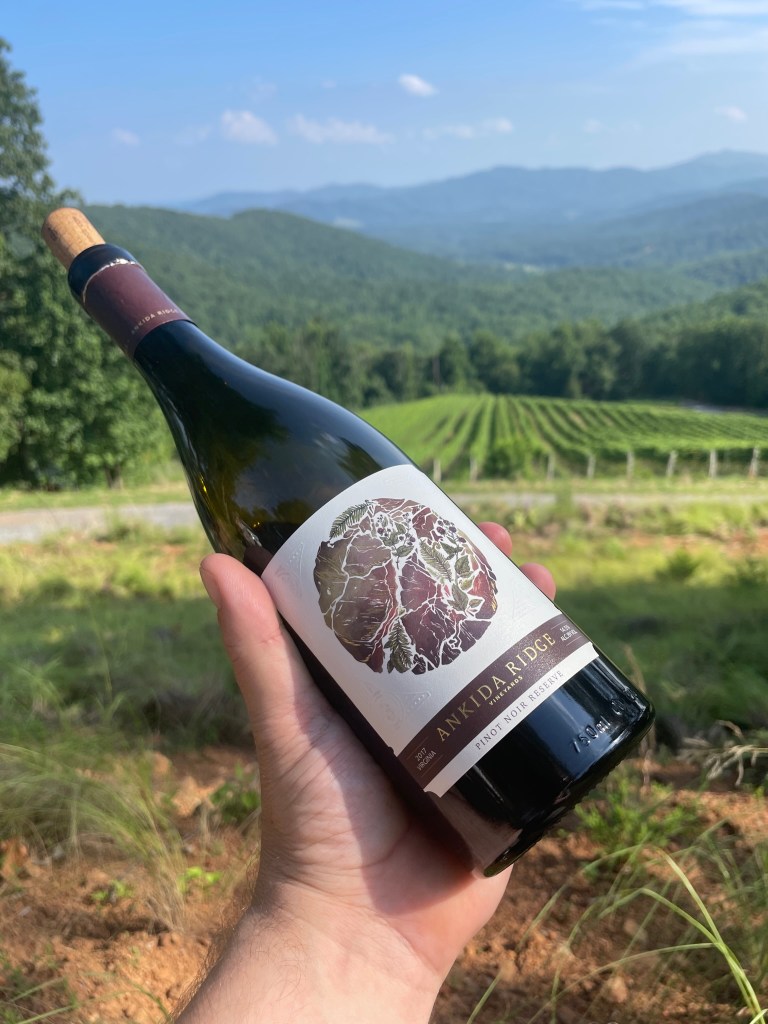
Bottle #8 / 2021 Ankida Ridge Pinot Noir Reserve. “Grabby” was my favorite descriptor. Several mentioned notes of sour cherry. The wine was lighter than I expected, although conversely it was still a ‘big’ win in terms of tannin. Kathy mentioned it was ‘layered, had complexity, and notes of forest floor’.
Of all the wines we tasted that evening, #8/Ankida was the most capable of standing up to heavier foods, especially a dish like steak. It was very drinkable now but could still use more time. I later learned the tannin came from the heavy use of stem inclusion.
Votes:
Annie: Voted #7
Chris: Voted #7
Kathy: Voted #8
Larry: Voted #8
Matt: Voted #8
Patti: Voted #7
Rob: Voted #7
Stacy: Voted #8
Finalist Flight
After the last round we did a poll to pick two wines from any flight to go into the finalist round. 7 votes went to wine #7/Résonance, 5 votes went to wine #8/Ankida, and 3 votes went to wine #5/Evesham Woods Le Puits Sec. #4/Cave Ridge was generally considered the #4 wine of the evening.
With the votes in, #7 and #8 went to the finalist round, and we enjoyed dinner drinking the remaining wines.
This food break worked to our favor as #7 and #8 opened up. The complexity of both improved, with the Ankida especially becoming more graceful. An Ox Eye Blanc de Noir accompanied our beef bourguignon.
We voted a second time…and for the second time in a row, it was again a tie. Ironically, 2 people from each ‘team’ switched sides.
Virginia represented very well; far better than I could have hoped for. It’s fair to say that the state has very few high-quality examples to pull from, but the top ones we used were well received.
I should note that most of the attendees didn’t have pre-conceived notions of what Pinot should taste like. Our self-described Oregon wine aficionado almost always went for the Oregon wine (the Cave Ridge being the exception), but overall the attendees simply wanted something tasty.
Winners round: Our “Top 2” wines were the Résonance and Ankida…and they tied again.
PS – the 2021 Ankida Reserve and 2023 Cave Ridge were both gifted to me for this event (thank you Christine and Randy!). While the Reserve is Ankida’s ‘top’ wine currently being sold, their 2022 Pinot is also getting headlines of its own.
For Virginia to tie Oregon as the evening’s ‘best’ wine is remarkable. Ankida Ridge should be very happy with that result.
I still say that the 2023 Cave Ridge Pinot Noir was the surprise of the evening. It was only recently bottled, so it has time to go. Yet it could easily have fared well against an Oregon wine in the mid-$30 price range.
Few wines are as versatile as Pinot Noir. Its high acidity and ‘silky’ tannins makes it a go-to pairing for many dishes, while Pinot’s lighter body makes it easy to drink on its own. Pinot Noir is also popular for higher-end sparkling wines, which is why it accounts for 38% of the grapes grown in Champagne.
Yet Pinot Noir’s popularity is almost equally matched by its fragility. Pinot is nicknamed “the heartbreak grape” because of its vulnerability to spring frost, disease, and harsh weather. Its need for very specific growing conditions would give even Goldilocks fits.
Virginia’s warm, humid climate makes this task especially hard. Dennis Horton, a man famous for introducing multiple varieties to the Old Dominion, reportedly once said of Pinot, “I don’t think Jesus Christ could grow Pinot Noir in Virginia. You can do it, but it doesn’t taste like Pinot should.”
Pinot’s reputation as a finicky grape is why it only makes up 41 out of nearly 3,500 acres of Virginia grapevines. Difficulties pushing their grapes to full ripeness also means many winegrowers only use them for sparkling wine or rosé, adding to Pinot’s scarcity as a red wine.
Fortunately, the tide is turning. A growing number of wine growers, mostly in the Shenandoah Valley and Blue Ridge Mountains, have finally cracked the code on how to properly cultivate Pinot. A grape once confined to 2-3 consistent producers is slowly becoming more accessible.
New pinot vines at Cave Ridge VineyardCave Ridge Vineyard
The Evolution of Virginia’s Pinot Noir
It’s difficult to say which winery first planted Pinot, but several, including Barboursville and Swedenburg, tried in the 1990s and early 2000s. These viticultural pioneers didn’t yet realize how badly their low-lying sites would struggle, and eventually ripped out their vines. “Pinot is hard for Virginia. It doesn’t do very well here for still wine,” one grower admitted.
The key change from the wines that Dennis Horton tried is these newer vineyards usually select higher-elevation sites, often 1,600 feet and above. This elevation ensures a constant flow of cool air and moderate temperature swings, which protect Pinot’s tightly bunched clusters from damage and allow them to evenly ripen.
Ankida Ridge became Virginia’s most famous Pinot producer based on the strength of their high-elevation site; a 1,800’ mountaintop vineyard with a steep slope. Its inaugural 2010 vintage received such acclaim it became the first Mid-Atlantic wine to participate in the invite-only International Pinot Noir Celebration.
While Ankida may have paved the way in demonstrating Pinot Noir’s place in Virginia, others were close behind. Ox Eye Vineyards planted Pinot vines at their 1,780’ foot site in 2009, as did Hazy Mountain at its Swoope vineyard in 2016. 12 Ridges founded their 3,300’ foot site in 2016, which includes 3 acres of Pinot Noir. Fox Meadow and Stone Mountain, both with 1800’ vineyards, recently joined the Pinot club as well.
Elevation helps, but that’s not Pinot’s only requirement. John Kiers of Ox Eye Vineyards was encouraged to plant Pinot after seeing its success in the Finger Lakes, a region which shares a similar climate to the Shenandoah Valley. The valley’s limestone soil and limited rainfall provide additional advantages.
Randy Philips of Cave Ridge Vineyards likewise sees parallels between the Shenandoah Valley and upstate New York. “It was partly an experiment, partly a business plan,” Randy said during our chat. “We grow Riesling, which shares many of the growing conditions that Pinot requires. Pinot also has name recognition, which helps with sales.” Today, Cave Ridge and Ox Eye both have an acre of Pinot.
12 Ridges Vineyard
Where To Find Virginia Pinot
The roster of wineries which typically produce a full Pinot is far larger than most realize. Ankida Ridge and 12 Ridges are Virginia’s most famous producers, but they’ve since been joined by Above Ground, Cave Ridge, Hazy Mountain, JBR, and Ox Eye.
Other wineries, including CrossKeys, Rockbridge, and Trump, occasionally make a still Pinot during better vintages. Mediterranean Cellars uses Pinot in its rosé.
Pinot Noir has also been a boon for sparkling producers. CrossKeys Vineyards’ 2019 Estate Blanc de Noir took “Best of Show” at the 2022 Atlantic Seaboard Wine Association, while Trump Winery’s 2015 Blanc de Noir won the San Francisco Chronicle “Sparking Sweepstakes” award. Ankida, Ox Eye, and others also make Blanc de Noirs.
Must Try Virginia Pinot Noirs:
12 Ridges: Located along the Blue Ridge Parkway, 12 Ridges is the 2nd highest elevation winery on the east coast. Their wines are difficult to find, as the growing conditions which promote great acidity and minerality comes with the tradeoff of lower tonnage per acre. This shouldn’t deter local Pinot lovers from making a pilgrimage.
Ankida Ridge: They weren’t the first winery in Virginia to make Pinot, but they certainly put it on the map. During an 2025 industry tasting of Virginia Pinot Noirs, their 2022 vintage was the consensus favorite.
Cave Ridge Vineyards: Megan Philips was so convinced their 2023 vintage was ready to go she convinced her dad Randy to bottle their Pinot as a still wine instead of making it into a sparking. Clean, fruity, and with notes of cherry and red plumb, she was right.
Ox Eye Vineyards: Their 2022 vintage is charming and approachable, and 2023 promises to be even more so. At $27, this is also one of the best values local Pinot lovers will ever find. Owner/winemaker John Kiers doesn’t make a still Pinot every year, but his $35 Blanc de Noir is a great alternative.
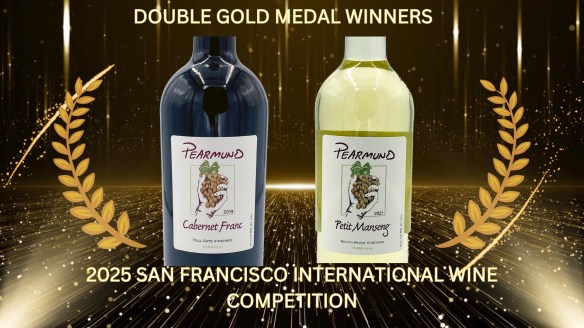
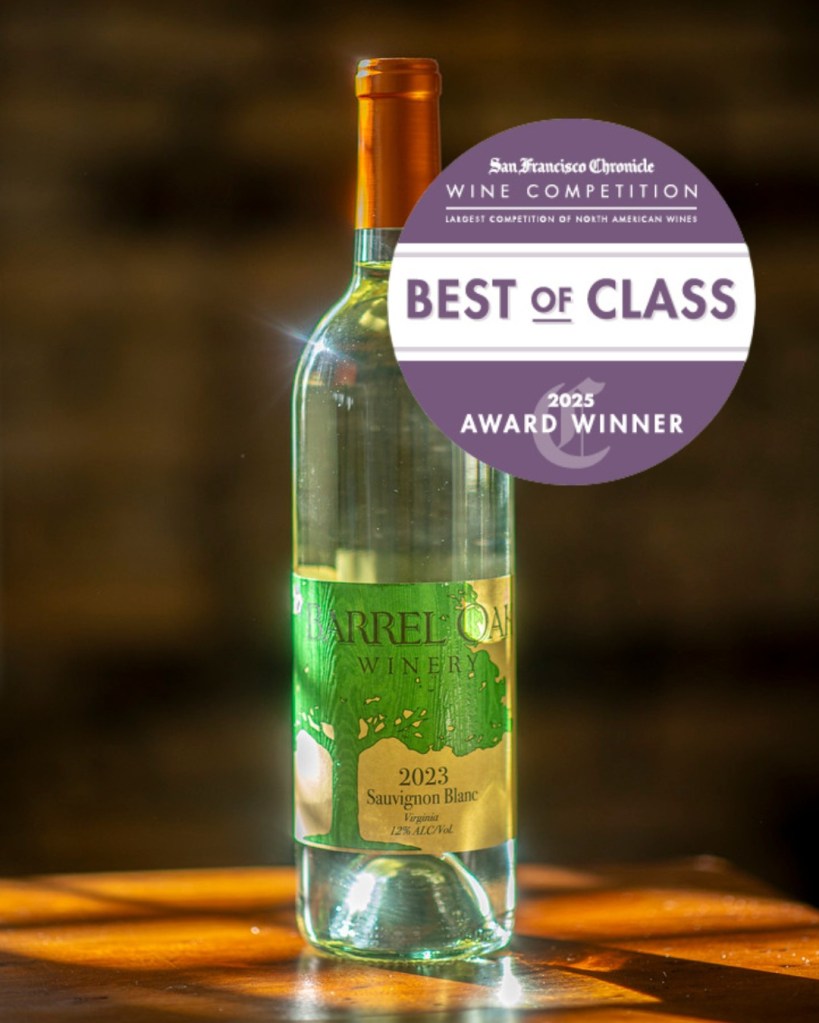
Barrel Oak winemaker Jeremy Ligon took home a Best in Class for his 2023 Sauvignon Blanc and a Double Gold for a rosé at the SFCWC. Vint Hill’s Mark Ward earned a total of 5 Double Golds, including the “Best White Wine in Show” at the SFIWC for his 2023 “Madison” Petit Manseng.
These were just a few of the 182 medals won by Virginia wineries at these events. Many Best in Class and Double Golds were won by Virginia in categories where California wine traditionally dominates.
This is especially impressive given the boutique nature of the Virginia wine industry. California produces 81% of American wine, according to recent industry statistics. By comparison, Virginia only produces 0.3% of this total.
This over-performance hasn’t gone unnoticed by the international wine community. SFCWC wine judge Mike Dunne wrote on the event website, “Each year, some wine region of North America seems to gain recognition for a disproportionate share of high awards at the San Francisco Chronicle Wine Competition. In 2025, it was Virginia…”
While not all wineries enter major competitions, they nevertheless provide an important metric on how Virginia wine fares on the international stage.
Pearmund Cellars owner Chris Pearmund has long advocated Virginia wineries showcase their work in settings beyond state-level competitions. “National competitions bring Virginia to the national stage,’ he wrote on Facebook. “The wine industry needs consistent, top-quality producers to participate in national competitions to sustain and grow our industry.”
While Barrel Oak and Vint Hill have been part of the Virginia wine industry for decades, their winemakers tend to stay out of the limelight. Jeremy and Mark have been making wine for over a decade, and this recent acclaim will only raise their profile.
I caught up with both winemakers to talk more about their career paths, as well as the importance major awards have on highlighting Virginia wine as a whole.
Barrel Oak Sauv Blanc (left) and Vint Hill “Madison” Petit Manseng (right)
Jeremy Ligon, Barrel Oak Winery
Jeremy grew up in southern Virginia on a winery owned by his parents, but some of his best career advice came from none other than Bruce Zoecklein. Wine geeks may recognize that name, as Bruce was the Professor of Enology at Virginia Tech.
On Bruce’s advice, Jeremy applied to the wine program at Fresno State. After graduating, he found his way back to Virginia, bouncing around several wineries before accepting the winemaker job at Barrel Oak in 2021.
A year after his arrival, Barrel Oak was purchased by Kavelle and Ken Bajaj, IT entrepreneurs with a love of wine. The Bajajs not only brought with them a wealth of managerial experience, they were willing to invest in Barrel Oak’s success.
Those investments have translated into visible upgrades to the tasting room and kitchen, but what really excites Jeremy is the new equipment in the cellar.
“We brought in new red wine tanks which help us with the processing, plus new pumps and a new sorting table. The table has already paid for itself in the first harvest; it’s just smoother and more efficient.
Ken keeps insisting we make the best wine possible, so I suggested we invest in some new barrels. When I asked him how many we should get, Ken said, ‘Let’s get 10 of them!’”
Part of elevating their tasting experience is to make the wine list more manageable. Jeremy started at Barrel Oak making 32 different wines, but is aiming to streamline his roster to around 15. Fortunately, this hasn’t prevented Ken from exploring new options, such as adding a sparkling wine program.
Another part of raising the bar is to get feedback from world-class judges, like those at the SFCWC and SFIWC. Such exposure helps Barrel Oak push for greater distribution.
“I think it’s important to get out there and get that feedback,” Jeremy exclaimed. “Those judges are serious! We want to be judged by our peers.”
Mark Ward, Winemaker for Vint Hill, Effingham Manor, and Pearmund Cellars
Mark started his winemaking career the way many of his Virginia peers did – by first working in a field completely unrelated to viticulture.
His first job was in IT consulting where he was often on the road. After 25 years of this, Mark was open to a career change, he explained during a chat at Vint Hill.
“I got to thinking; I grew up on a farm. I was interested in wine. How can I combine all of these things that I’m interested in?
So I went back to school in Washington State for their Enology and then Viticulture programs. That led to my first internship in Oregon in 2013.”
Mark’s family encouraged him to consider Virginia, and his school put him in touch with Chris Pearmund, the managing partner of Vint Hill, Effingham Manor, and Pearmund Cellars. These wineries form a trifecta, sharing the same staff and winemaking facilities.
By 2015, Mark was the Assistant Winemaker for this trio, and rose to the Head Winemaker position in 2020. Since then, Mark (and his team, he’s quick to note) has racked up a series of awards.
Mark explained deciding what wines to submit to major competitions is often complicated, but these events play an important role in elevating Virginia’s profile.
“If you look at the national competitions in San Francisco, we’re always sending the kind of wine Virginia is known for. For a more regional competition like the Atlantic Seaboard, we’ll send a broader sample.
I think the rest of the world is starting to understand what Virginia wine drinkers have always known; there are talented growers and winemakers in the state.
Not only are we getting awards for things we’ve traditionally done well – cabernet franc, petit manseng, petit verdot – places like Barrel Oak and Veritas are doing great things with sauvignon blanc. Outsiders don’t always think Virginia can compete across the board, but when they see a wine like our Effingham ‘Kings Ransom’ Bordeaux blend get 97 Points/Double Gold, they start to appreciate we can win against the best in the world.”
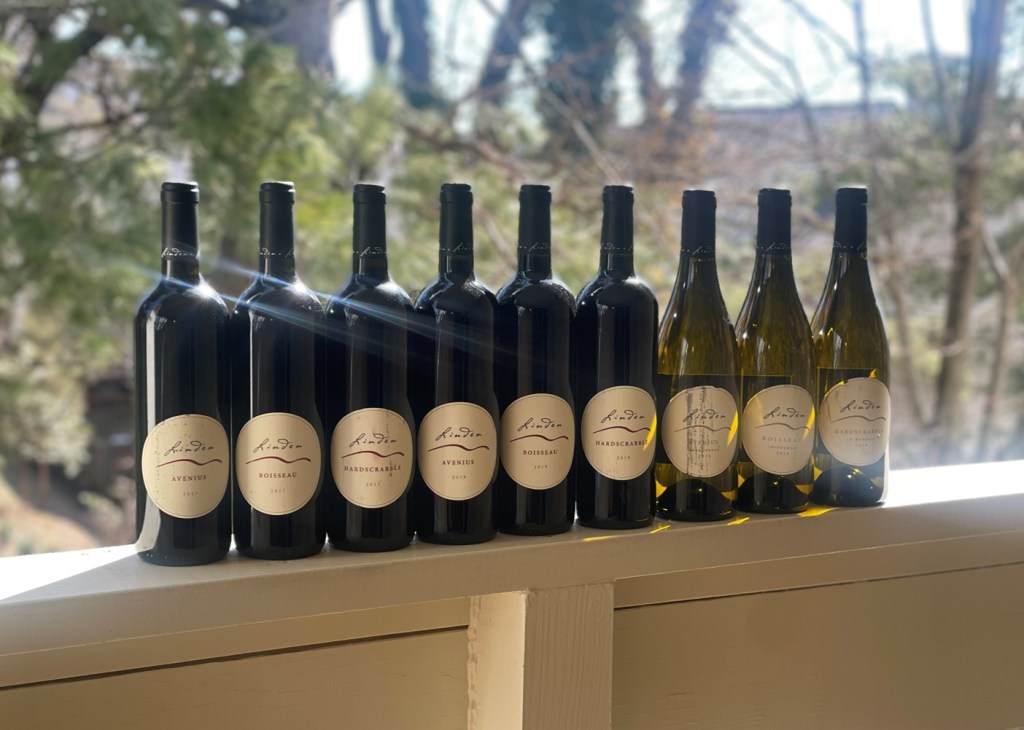
Few Virginia wineries are as terroir-driven as Linden Vineyards. Probably the best proof behind this statement is how many of Linden’s wines are named after the vineyards they come from; namely Avenius, Boisseau, and Hardscrabble.
These vineyards are the only places Linden uses for fruit, and their varying soil types and elevation means each provide a different tasting profile. While not every wine Linden produces is vineyard-specific (they also make a multi-vineyard Chardonnay called “Village” and red-blend named “Claret”), owner/winegrower Jim Law prefers to let the vineyards speak for themselves.
Avenius Vineyard (5 acres, 1,300-1,400 feet elevation). Linden’s highest and coolest site. Named for and farmed by Shari Avenius. Located less than a mile from the winery, but on a very different soil profile.
Boisseau Vineyard (4 acres, 600 feet). This is Linden’s lowest and warmest site. Named for and farmed by Richard Boisseau. As the smallest vineyard, it’s not uncommon for a vintage to lack a vineyard-specific Boisseau wine as the fruit was blended into Claret or Village.
Hardscrabble Vineyard (~20 acres, 1,100-1,400 feet elevation). This is Linden’s largest, oldest, and most diverse vineyard, located at the winery. The best blocks go into Hardscrabble (red or white), while the younger ones go into Claret & Village. Some vines date back to 1985.
Picking a favorite Linden vineyard is something of a parlor game for Virginia wine nerds. Hardscrabble arguably produces Linden’s most famous wines, but don’t discount the other two. “Acid-heads” love Avenius’ higher-elevation fruit, while Boisseau produces some of Linden’s easiest-drinking, more fruit-forward wines.
Nevertheless, I wanted to try all three side-by-side, and it wasn’t difficult to find helpers for this task. Most had tried Linden wine before, although only a few of them had been exposed to this kind of multi-vineyard, multi-vintage experience.
My tasting was both a vertical in that the reds came from two different years (2017 and 2019), and a horizontal in we had all three vineyards represented. 2017 and 2019 were also two of the better growing years in recent Virginia history.
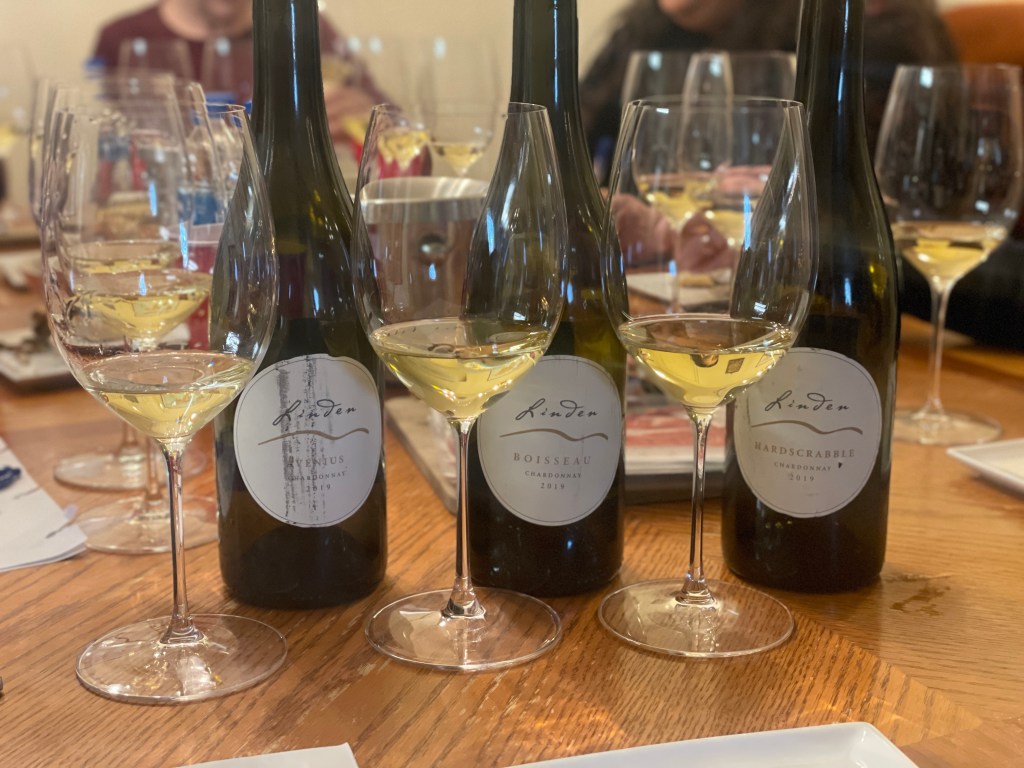
Our Chardonnay flight (only 2019 vintage)
2019 Avenius
2019 Boisseau
2019 Hardscrabble
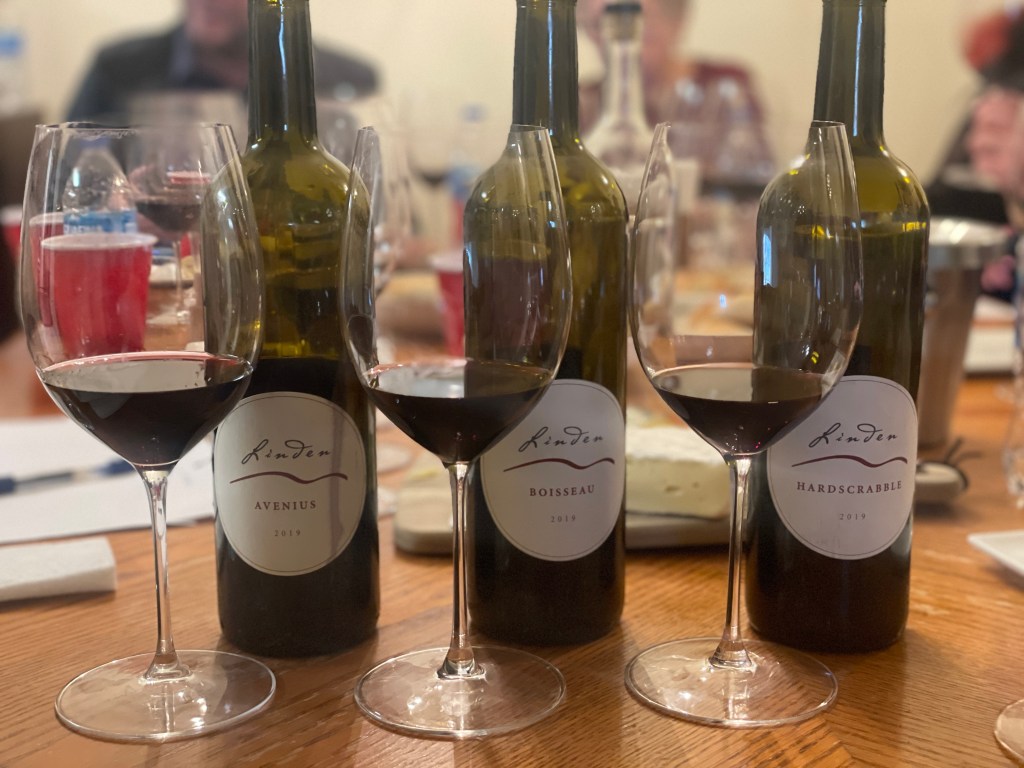
Our Bordeaux blend flights (2017 and 2019 vintages)
2017 Avenius (54% Merlot, 46% Cabernet Sauvignon)
2017 Boisseau (40% Cabernet Sauvignon, 34% Petit Verdot, 20% Merlot and 6% Cabernet Franc)
At the end of every round, I did a poll to determine our favorite from the flight. But in reality, “Best” was entirely subjective. Even the wine that was the ‘least’ favorite was something we’d have happily enjoyed.
All reds were decanted for 1.5-2 hours prior to the event. Jim has exceptionally detailed notes describing the vintage years and individual wines, so follow the embedded links more information on the Linden website.
2019 Chardonnay Round
Linden vineyards exist in no small part because Jim Law was inspired by Chablis. While most winemakers tend to advertise red blends as their ‘flagship’ wines, Chardonnay is of such importance that I’d argue Linden’s ‘flagship’ is its Hardscrabble Chardonnay.
These three Chardonnays had distinct personalities, but we usually saw more similarities than differences. Avenius and Hardscrabble are definitely ‘cousins’, while Boisseau was more of an outlier. Yet there was still a common thread of fruit and minerality to all three.
Linden 2019 Avenius Chardonnay. You could tell this was ‘mountain’ fruit because its acidity was more pronounced, plus it showcased minerality and structure. Very *bright*. Several of us detected notes of citrus, specifically lemon. Kathy mentioned chalk. Daniel mentioned ‘apple tart’.
Linden 2019 Boisseau Chardonnay. Lots of fruit notes. Tropical nose, notes of banana. Daniel mentioned maybe an herbal note. I heard someone mention tarragon and kiwi. Another guest mentioned a bitter note.
Linden 2019 Hardcrabble Chardonnay: This wine just felt ‘big’ on the palate. Apple and butterscotch notes. Also notes of orange peel, citrus, specifically a sweeter orange. The acidity is there, but you sometimes had to wait a moment for it to hit you. One person mentioned it had almost a certain waxiness to it.
When I did my poll, 7 out of 8 of us preferred Avenius. We almost universally felt the 2019 Avenius was very clean and ready to drink.
Hardscrabble was the runner up. It also had acidity, just not to the degree of Avenius. That said, we felt HS would only get better and better. Boisseau was definitely well enjoyed, but it was just a different animal than the other two.
Favorites:
Alex: 2/1/3. The outlier of my group!
Daniel: 1/3/2. By technical standards, he felt #3/Hardscrabble was the ‘best’ wine of the lineup, but felt Avenius was drinking great now. While both still had years to go, the Hardscrabble hadn’t yet peaked.
Kathy: 1/3/2.
Lieven: 1/3/2. Felt the Avenius was ‘ready to drink’ right now.
Matt: 1/3/2
Mark: 1/2/3
Todd: 1/3/2
Vanessa: 1/3/2. Felt the Avenius had the most lift and was clean, even waxy.
2017 Red blend round
2017 was one of Linden’s best vintages in years, for both reds and whites. These wines are likely to last for many, many years to come.
I was surprised that a vintage 8 years old tasted so fresh. As Virginia’s weather becomes increasingly erratic we are seeing more instances of ‘hot years’ that causes local fruit to become disjointed, or ‘rainy years’ which results in underripe fruit. But 2017 was a goldilocks year where the pieces fit almost perfectly.
Linden 2017 Avenius red: 54% Merlot, 46% Cabernet Sauvignon. Refined tannin but a shorter finish. We detected newer oak but it’s so integrated you don’t mind at all. It also leaned heavily on the fruit, with notes of blackberry and boysenberry. Someone mentioned notes of pine, eucalyptus, and it was ‘forest-y’. This wine also evolved the most in the glass.
Linden 2017 Boisseau red: 40% Cabernet Sauvignon, 34% Petit Verdot, 20% Merlot and 6% Cabernet Franc. Fruit notes, especially dark cherry. Some felt it was almost too fruity, and they struggled to find notes beyond it. Others noted a root beer quality to it, plus notes of pyrazines and pepper. While the general consensus was while this wine had more fruit than we preferred, it was “nice” fruit; not jammy at all. It also had a good structure to it.
Linden 2017 Hardscrabble red: 57% Cabernet Sauvignon, 43% Merlot. Balanced; medium/medium plus acidity. Ripe fruit, especially plumb. But there were also notes of minerality, including graphite. Notes of cassis were mentioned, while another guest said it was “meaty” and had a cigar box quality to it. This was also the most food-centric wine of the trio.
By a unanimous vote, the 2017 Hardscrabble red was our favorite. Avenius came in 2nd and Boisseau 3rd, also with unanimous votes by all eight attendees.
I’m absolutely not surprised that the 2017 Hardscrabble red was the favorite wine here. I’ve blind tasted it numerous times, and it’s nearly always my favorite in a contest of other championship-level wines.
Note to self; I should decant it more the next time I pop a bottle, since I felt the 2017 HS initially presented more earthy notes than I personally prefer, but the complexity popped out once swirled in the glass.
Favorites:
Alex: 3/1/2. Thought of steak when drinking the Hardscrabble, but felt the Avenius could be enjoyed on its own
Daniel: 3/1/2. The Hardscrabble was “balanced and complex”. The Avenius shared many of its qualities, just less so.
Kathy: 3/1/2
Lieven: 3/1/2. Felt the Hardscrabble was “elegant and elevated”
Matt: 3/1/2
Mark: 3/1/2
Todd: 3/1/2
Vanessa: 3/1/2. Said “The Avenius has structure, but the Hardscrabble has everything”
2019 Red blend round
While this vintage was two years younger than the 2017 round, the 2019 reds actually presented as being older and smoother than the 2017s. I attribute that to 2017 being such a great year that balance was easy to achieve, while 2019 was a hotter, riper year.
Linden 2019 Avenius red: 50% Cab Sauv, 42% Merlot, 8% Petit Verdot. The barrel notes were well integrated. Notes of black cherry and raspberry were mentioned. Tart. Higher acidity than the other wines in this flight.
Linden 2019 Boisseau red: 61% Cab Franc, 19% Petit Verdot, 17% Merlot, 3% Cab Sauv. Our notes were all over, but my favorite descriptor was “Hedonistic”. Long list of fruit and/or earthy notes, with some tasters leaning one way or the other. Many mentioned notes of black cherry, perhaps with a compote/sweet fruit note to it. A few mentioned liquorish. Others said it was ‘grippy’ and chewy. Still others felt it had more earthy characteristics, maybe a little mushroom, even ‘spice box’.
Linden 2019 Hardscrabble red: 65% Cab Sauv, 19% Cab Franc, 16% Merlot. Balanced. Notes of bramble fruit, baking spices, maybe a little brett. Cigar box and leather was mentioned. The tannin was chewy bur refined. Not a lot of fruit notes, though.
By another 8-person unanimous vote, the 2019 Boisseau red was decreed the favorite of our 3rd round. When he first tried it, I believe Daniel said something to the effect of, “That’s what I’m talking about!”. Avenius was almost universally the runner-up, and Hardscrabble was 3rd.
My best guess was the warmer year accentuated the fruit qualities of the Boisseau. It was also an outlier in this was our only red that was Cabernet Franc heavy, and people seemed to gravitate towards some of the spice notes that better Cab Francs have.
Favorites:
Alex: 2/3/1. Felt the #3/Hardscrabble needed more time
Daniel: 2/1/3. Likewise felt the Hardscrabble needed more time
Kathy: 2/1/3
Lieven: 2/1/3
Matt: 2/1/3
Mark: 2/1/3
Todd: 2/1/3. Felt #2 was the most open and balanced
Vanessa: 2/1/3. Said that #2/ was “great right now”
The results
In summary, here were the favorites per round:
2019 Avenius Chardonnay (7 out 8 votes)
2017 Hardscrabble red (8 out of 8 votes)
2019 Boisseau red (8 out of 8 votes)
I love that every round picked a different vineyard as their favorite. The qualities of each vineyard definitely shined through, influenced by the year the wine was made.
That said, I’m positive that had we tried this event either a year earlier or later, we easily could have come up with different results. Certain wines we tried this day were just ‘in their prime’, while others (especially Hardscrabble) arguably needed another year to reach their peak.
I admit I was somewhat surprised how unanimous we tended to be, given my group was rather diverse. 3 of us had been visiting Linden for years. Another 3 were DC-based wine experts who had experienced Linden, although not necessarily older vintages. The last 2 guests had until recently been living in Sonoma and were just starting their Virginia wine journey. Yet this group was extremely consistent in how we rated all 3 flights.
I did one last poll regarding favorite vineyard…and the overall favorite vineyard was Avenius. Guests seemed split whether they preferred the Avenius red or white. Again; ask us on another day, or with a different variety, we may have selected otherwise.
The Governor’s Cup may be Virginia wine’s best-known event, but the wine world is full of wine competitions large and small. Two of the most prestigious are held annually in San Francisco nearly back-to-back.
30 Virginia wineries and cideries entered these events, earning a total of 182 medals. Of these, 22 were Double Gold and 38 were Gold.
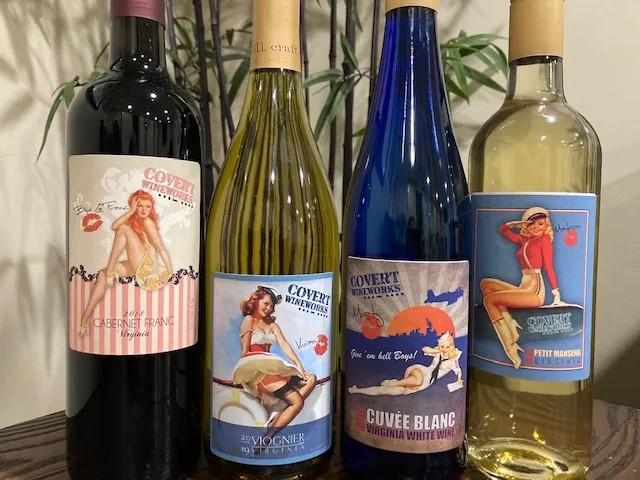
A number of these Double Golds earned top honors in their respective categories. The SFIWC awarded Vint Hill’s Covert Wineworks “Madison” 2023 Story Petit Manseng “Best White Wine in Show”, as well as “Best Other White Varietal”. The SFCWC gave “Best in Class” awards to 6 of Virginia wines.
One of the judges at the SFCWC summarized his view of Virginia’s impact with this statement:
“Each year, some wine region of North America seems to gain recognition for a disproportionate share of high awards at the San Francisco Chronicle Wine Competition. In 2025, it was Virginia” SFCWC wine judge Mike Dunne, on Virginia’s entries
While not all wineries enter major competitions, they nevertheless provide an important metric on how Virginia wine fares on the international stage. These competitions also provide increased visibility, marketing value, and bragging rights to those who do well.
I asked Mark and Maggie Malick, former owners of Maggie Malick Wine Caves, their view of these events. Maggie once earned Best in Class/Double Gold at the 2021 SFCWC for her 2017 Tannat, and Double Gold for her 2014 Tannat at the 2017 SFIWC.
According to Maggie, “They’re both big hitters. Judging is pretty strict in both. If you enter a Virginia wine and beat another country, you’re doing good.”
Biggest Winners at San Francisco
Winning Gold is a major kudo at either the SFCWC or SFIWC, but Virginia’s haul of 22 Double Golds and numerous “Best of” awards is especially impressive for a wine region that makes less than 0.3% of the nation’s wine production.
It’s too much to describe every one of these Double Gold winners. But if I were to narrow it down to a handful of the Virginia’s ‘biggest winners’ by winemaker, winery, or as a category that deserves highlighting, these are my picks:
Mark Ward, Winemaker for Effingham, Pearmund, and Vint Hill. Mark took home 5 Double Gold and 5 Golds between the SFC and SFI events. His Vint Hill 2023 Petit Manseng also earned “Best White Wine in Show” at the SFIWC. He’s been the head winemaker for the “Pearmund trifecta” since 2020.
Jeremy Ligon, Barrel Oak Winery.Jeremy was awarded a Best In Class/Double Gold for his Sauvignon Blanc (in the $35 and over category), Double Gold and runner-up for Best of Class for this dry Rosé, Double Gold at the SFI for his sparkling Norton, and three Golds.
Philip Carter Winery. PCW earned two SFCWC Best in Class awards, for its Nomini Hall Cabernet Franc ($35.00 – $49.99), and Chardonnay ($38.00 – $42.99). Matthieu Finot is their winemaker.
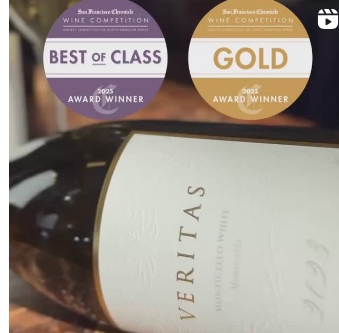
Veritas Vineyard. Emily Hodson of Veritas earned SFCWC Best in Class awards for her 2023 Sauvignon Blanc ($30.00 – $34.99) and 2023 Monticello White ($31.00 and over White blend), plus four Golds.
The 2023 Vintage. 2023 is the kind of high-quality vintage that is often only seen once a decade. Virginia wine lovers already knew this, but now the rest of the world does too.
It’s notable that 28 of the 59 Virginia wines (discounting one that used fruit from the west coast) that earned either Gold or Double Gold came from this magical juice. So far, most of what’s been released were white wines. That means our recently bottled reds are going to be making incredible waves on the competition circuit, once they are unleashed.
Virginia Sauvignon Blanc. I admit, I didn’t see this one coming. Yet it’s important enough to warrant its own mention, because the respective winemakers deserve it.
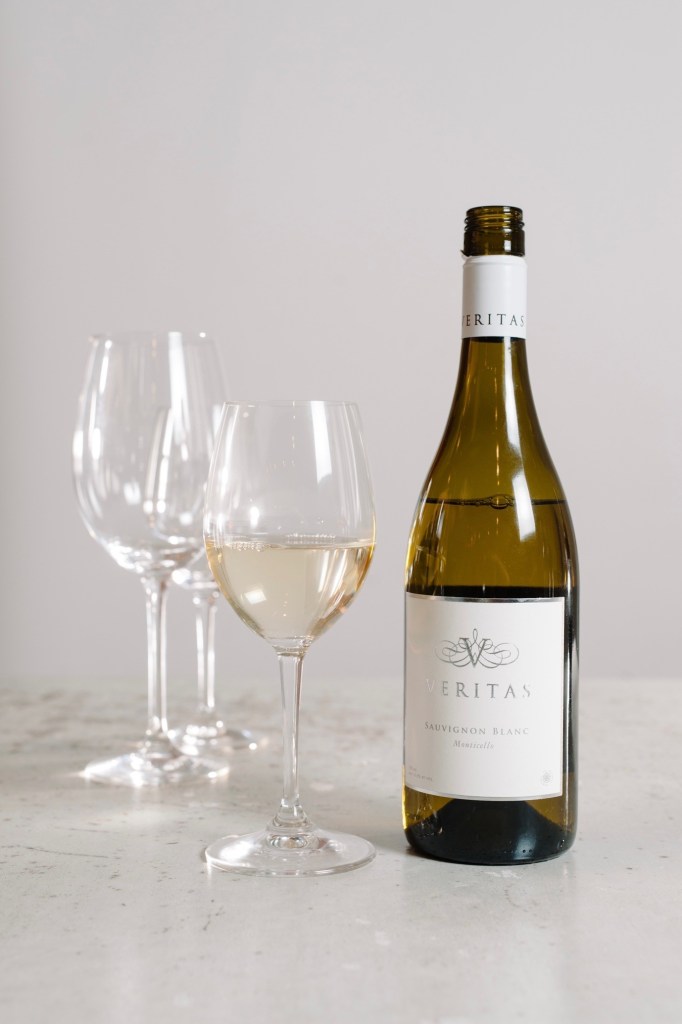
Virginia earned two SFCWC “Best in Class” awards for Sauvignon Blanc; Barrel Oak ($35 and over) and Veritas ($30.00 – $34.99). Endhardt earned a Double Gold and was runner-up to Veritas for its Upper Block Sauvignon Blanc.
This is a massive win for a category that is usually dominated by California. If we kicked-ass in Sauv Blanc, think of what the rest of the 2023 vintage is going to do.
The SFCWC website had this to say on these Sauv Blancs:
“At the 2025 San Francisco Chronicle Wine Competition, two of the five best-of-class Sauvignon Blancs were from Virginia, an unprecedented showing. (In all, 198 Sauvignon Blancs were in the competition.)”
“The Barrel Oak the richer, riper, and rounder of the two, its fruit fleshy and saturating,” while saying of the Veritas, “The wine is frank, lithe, dry, citric and astonishingly persistent for a Sauvignon Blanc. Its perky acidity makes it a perfect match for raw oysters.”
San Francisco Chronicle Wine Competition (SFCWC) and San Francisco International Wine Competition (SFIWC) combined roster
The 2025 San Francisco Chronicle Wine Competition (2025 SFCWC) reviewed 5,500 wines submitted from over 910 wineries throughout the United States, Canada and Mexico, making it the largest wine competition in North America. 4,991 medals were awarded.
There are often multiple awards for the same variety or style for different price brackets. The “Best in Class” award goes to the highest-scoring bottle within that price bracket. It additionally has a “Sweepstakes” award to identify the top wine from among the “Bests” in different categories (no Virginia wine won this category this year).
The wines were judged in mid-January, and the results were released on 17 January 2025.
The 2024 San Francisco International Wine Competition (2024 SFIWC) reviewed wine submitted from 20 countries. 1590 medals were awarded to 476 wineries.
The wines were judged in mid-December, and the results were released on 13 January 2025.
Note on the Virginia medal winners: The La Grange Winery Syrah that earned Gold in the 2025 SFC used non-Virginia fruit. The other 59 Golds/Double Golds all used Virginia fruit. The ‘182’ medals includes 16 wines made using non-Virginia fruit. I include these numbers here only for the sake of being complete.
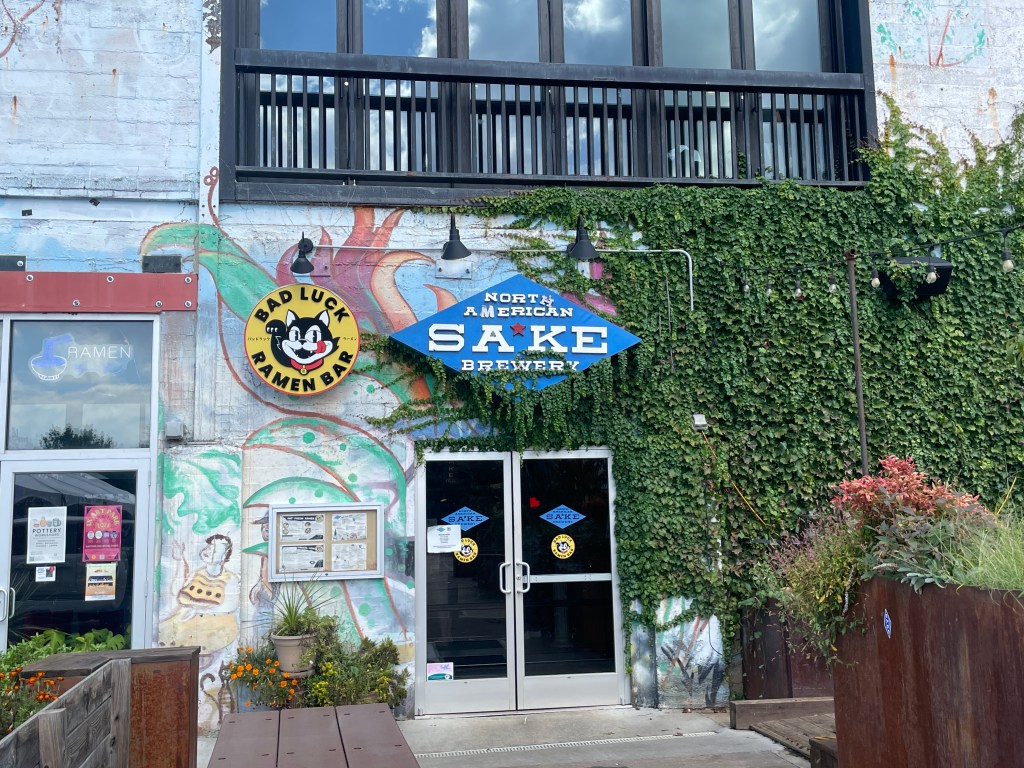
Several years ago while visiting wineries around Charlottesville, I encountered a curious sight. In the city that is the epicenter of Virginia wine was…a sake brewery.
What? Sake??? In Virginia?
Yet thinking about it, my surprise was misplaced. Sake exports from Japan have more than doubled from 2012 to 2022, according to figures provided by the Japanese Sake & Shochu Makers Association. Not only is the US the world’s top sake importer, there’s a growing local sake industry as well.
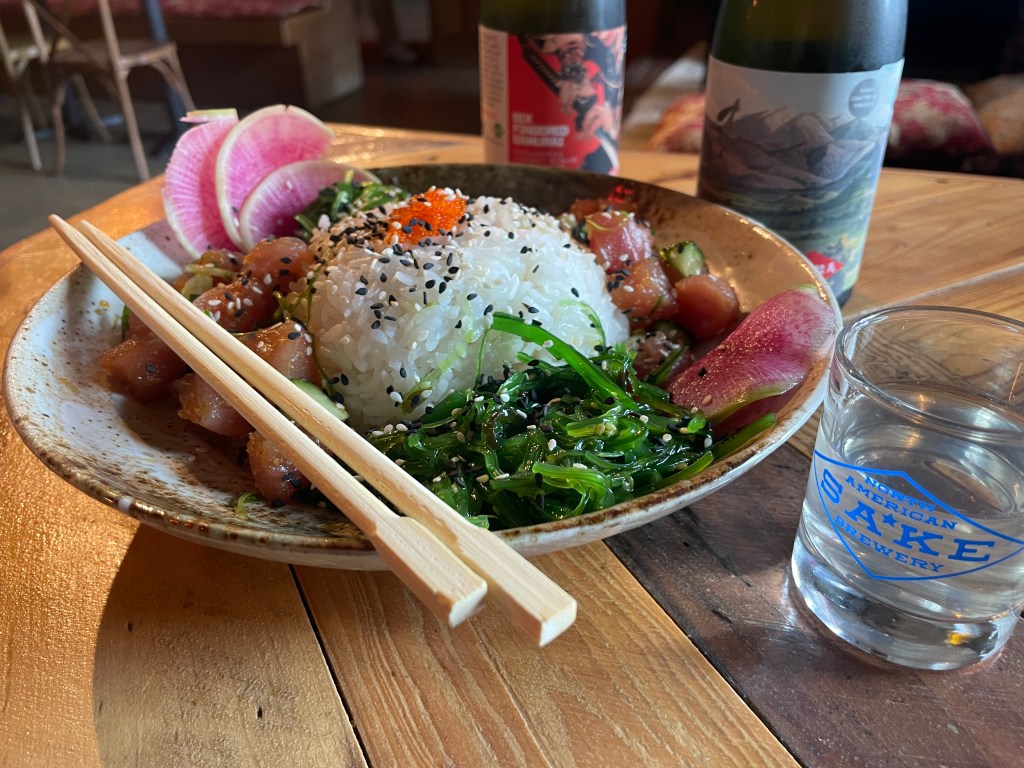
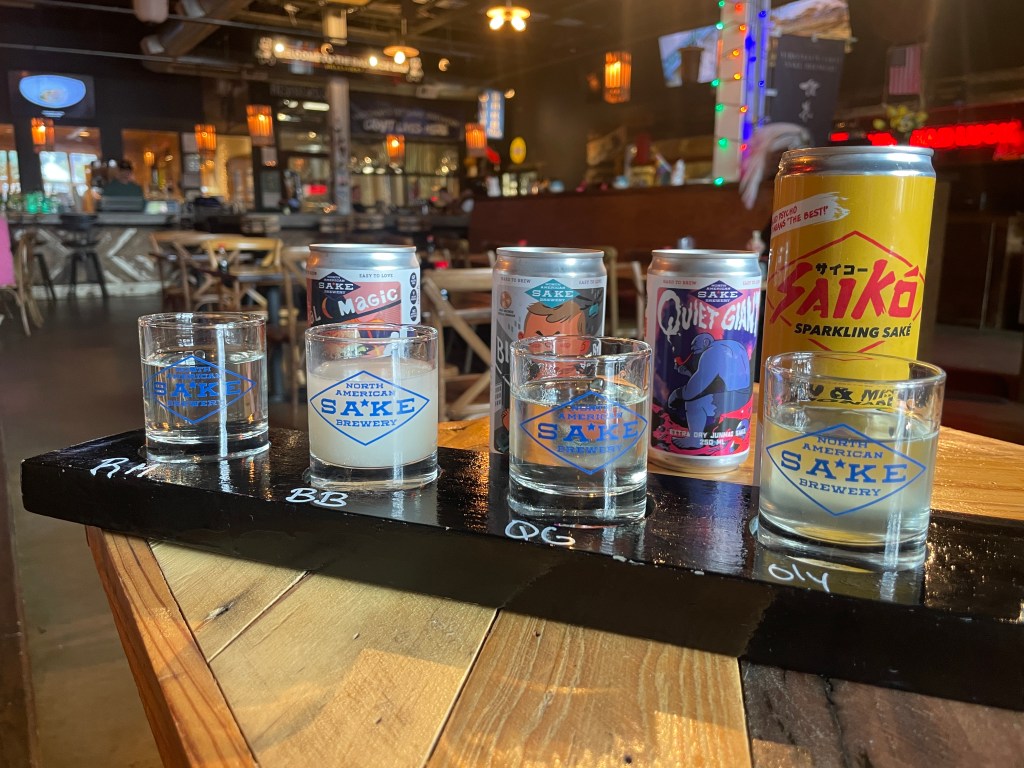
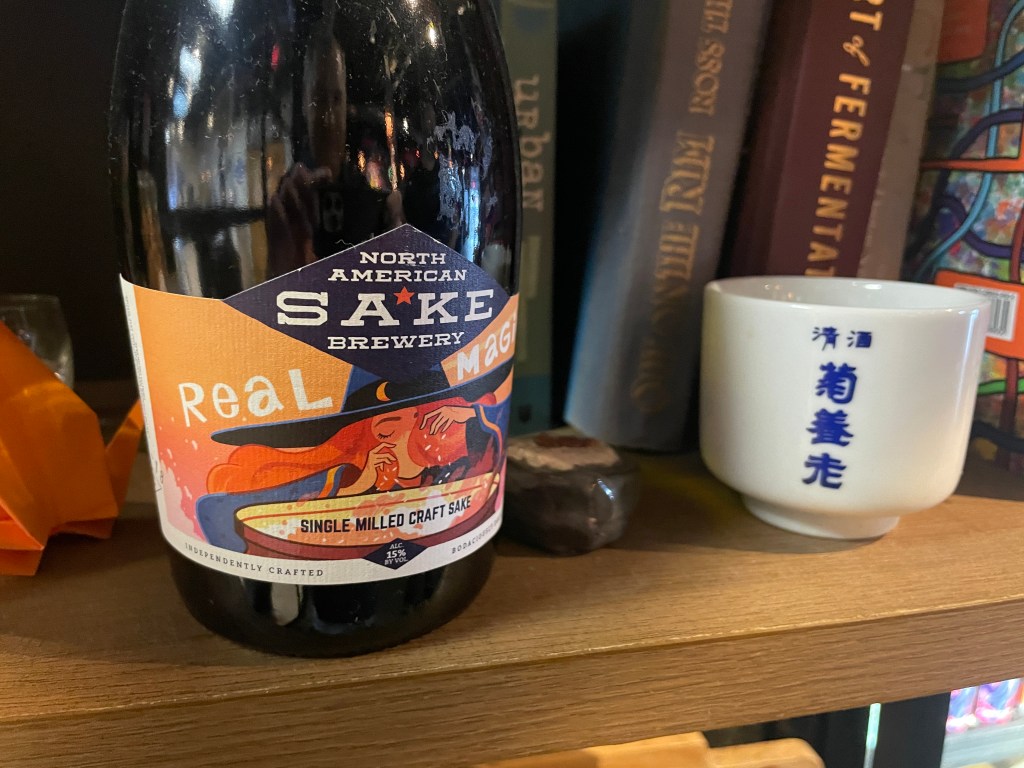
Charlottesville based North American Sake Brewery is one of only 20 or so sake breweries in the US, and the first (and only) in Virginia. Founder and head brewer Andrew Centofante gave me a lesson on sake brewing and a tour of his facility.
“Sake is such a fascinating and historic beverage. It’s a pretty niche market, but it’s one of the fastest growing beverages there is,” Andrew said during our interview. “As people explore Japanese cuisine, they are finding sake is a key part of it.
About 15 years ago, I went to an “izakaya” (casual drinking establishment) in Japan,” he continued. “The bartender walked me through different styles, regions, and profiles of sake, and it hit me that sake was similar to the craft beer movement. A few years later, I started making sake at home, and that led me to go back to Japan to work at a 200-year old brewery outside Osaka to learn the craft.
We’ve been open since 2018, making very traditionally handcrafted sake as well as some experimental styles.”
Defining Sake: Beer? Rice Wine? Or Something Unique?
The four basic ingredients for sake are rice, koji, water, and yeast. Of these, koji is likely the ingredient least-understood by American audiences.
Koji is a mold, cultured in hot, humid conditions to promote propagation. It’s an integral part of many of Japan’s most famous drinks and dishes, including sake, miso, and soy sauce.
Brewers apply the mold to rice, ensuring it’s thoroughly spread over every grain. When the brewing starts in the tank, the mold provides the enzymes to convert the rice starch into sugar. This sugar is then devoured by the yeast, which turns it into alcohol.
This process is called “multiple parallel fermentation,” and it’s what makes sake brewing unique.
While sake is usually referred to as ‘rice wine,’ that definition is a misnomer. Sake is its own category of alcoholic beverage, despite often being classified as either a wine or beer in the western world.
Andrew gets the question of, “Is sake a rice wine?” all the time. “Like wine, you can sip it, savor it, pair it with food. Sake is the same way. It has nuance of character, but the process is grain based, so it’s much closer to brewing than winemaking.
While they use similar processes, sake and beer come out at very different strengths. Since sake usually has around 15% alcohol and is sipped like wine, it’s often classified as rice wine.”
Balancing Creativity With Tradition
Unlike wine, which is ‘terroir’ driven, sake is more brewer-driven, according to Andrew.
“We talk a lot about the concept of intent in sake making. That’s what makes sake a difficult beverage to understand.”
The brewer’s treatment of their rice greatly influences the end product, a process called milling.
“Milling is where we remove fats and other proteins to get to the grain’s “shimpaku,” or starchy core, and it helps delimitate the style of sake you create,” Andrew explained while showing a handful of rice grains. “The more milled the rice is, the fruitier and more aromatic the end product is. The less it’s milled, the more earthy and savory notes you’ll get.
“Daiginjo” (50% milled) sake rice on the left, and sushi-grade rice on the right
The kind of rice you use is important, but think of it like a white canvas. It’s the brewing that helps bring out the nuanced flavor and aroma.
We get our rice from Arkansas. The farm we use has been making sake-specific rice for years. Sake rice is a short-grained style, usually with a great shimpaku that’s easy to mill and melts well in the tank.”
Japanese sake already comes in many different styles, based on the ingredients and production methods used. Local producers like North American Sake aren’t afraid to get even more creative to appeal to American consumers.
Andrew pondered my question regarding how far local sake diverges from what’s found in Japan before answering.
“It’s an interesting question. The sake industry in North America is so young, there aren’t defined styles of sake in terms of regionality. Being in the US, we have this huge opportunity to break out of traditional sake conventions.
We play on the edge of what sake is, and make everything from super-premium to fun, table sakes. There are people who are casual drinkers who just want something fun, or something gluten free.
For this crowd we make fruited styles using regional fruits or herbs, we make sparkling sake, and we’ve done collaborations with different brewers to make hopped sake.
But we also have customers who are looking for great sake. Since we’re in the game of making sake, we have to be as good or better than any Japanese sake out there.”




































 Wine Trails and Wanderlust