Linden recently hosted what might be my favorite event of the year – a pair of Friday-only library tastings. Being an overachiever, I went to both.
Jim Law produced his first vintage in 1987, so it’s fair to say that Linden has a considerable number of older bottles to choose from. He’s often spoken about the need to hold on to bottles for the future, be it comparative tastings or just for his own education. Even now, Jim’s older bottles often portend the direction his current releases are going.
Linden used to do Library tastings every December until COVID hit, so this is something of a return to norm. I was really impressed that Linden charged the same price for this library tasting that they do for their regular tastings. I attribute that to Jim being a ‘wine educator’ at heart, and he wants to make the study material available to everyone.
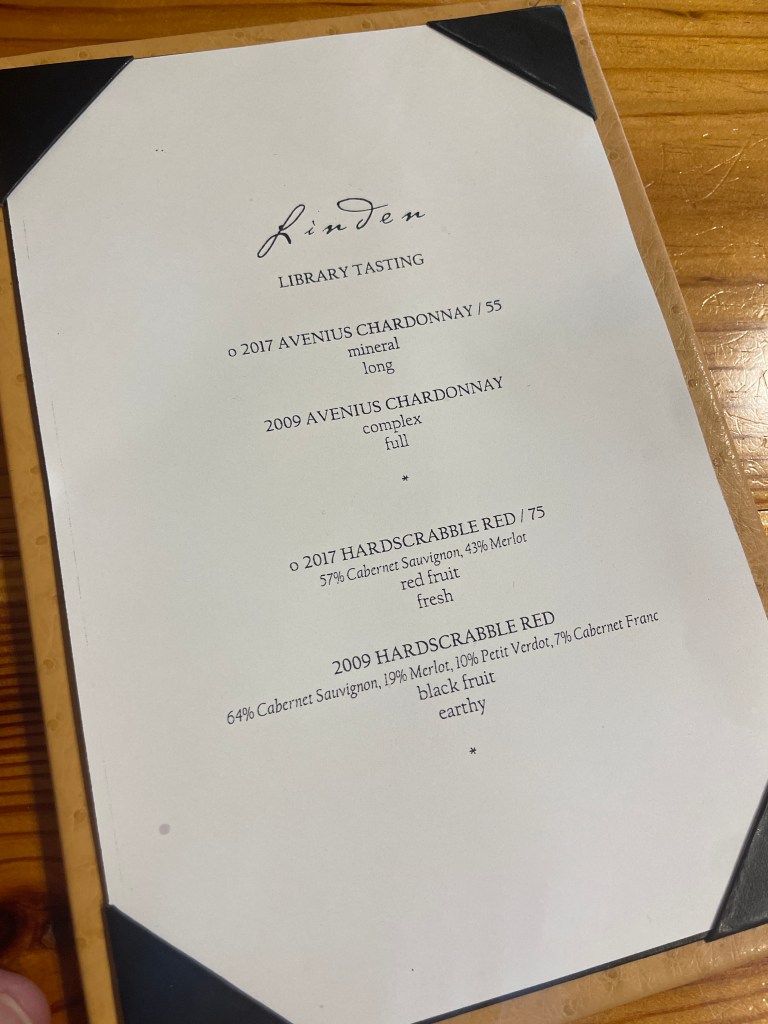
Both days included a pair of comparison flights of a 2009 and a 2017, which Jim selected because stylistically these are similar vintages. He also threw in a few extra bottles during both days.
The first flight included a 2009 and 2017 Avenius Chardonnays. Both were especially warm and dry years; arguably 2 of the best in the past 15 years. The 2009 was considerably darker compared to the 2017.
I bought a number of bottles from the 2017 vintage, so I know it’s great. Yet compared to the 2009, the 2017 just paled in comparison. It really didn’t seem fair to put 2009 compared to anything else, since 14 years of age just gave it so many extra layers.
By comparison, the 2017 was still tight, even if it was excellent. If in 8 years it turns into the 2009, then I’d be very happy.
On top of these bottles, Jim brought over a sample of the 2007 Avenius Chardonnay to make this flight a trio.
The 2007 was considerably softer but still provided plenty to savor. My friends who joined me for my 1st visited debated which was better. Some preferred the 2007 for its complexity, while the 2009 ‘was more delicious’.
I ended up getting a glass of the 2009 Avenius to enjoy in the members room.
Comparative flight #2: 2009 Hardscrabble red and 2017 Hardscrabble red
To be fair, the 2017 Hardscrabble red is one of my all-time favorite Virginia wines ever. I’ve used it in blind tastings and wine professionals (including one born and raised in Bordeaux) insisted this was a Bordeaux wine. This bottle had maybe a tiny bit of brett in it, but only in a way that added to its complexity in a good way.
The 2009 was more leathery, no fruit but plenty of power. The rim was a little watery but it didn’t present as an ‘old’ wine.
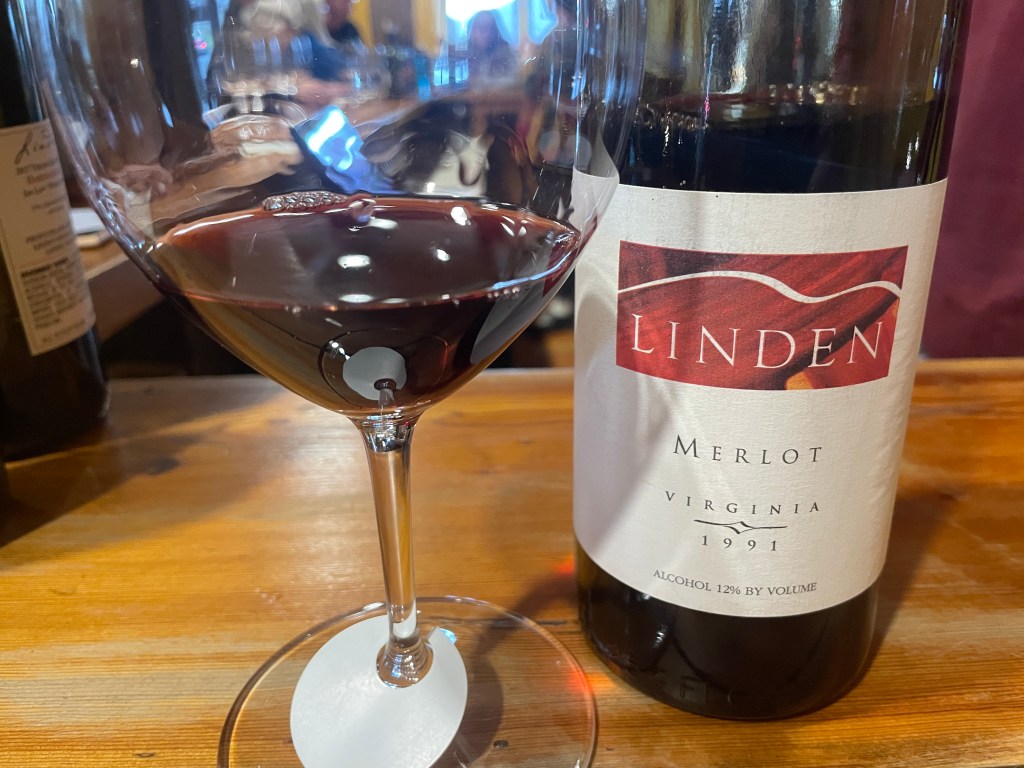
“Bonus flight” #1: 1991 Merlot and 2001 Reserve
Neither of these bottles were on the original tasting. But when Jim opens a ‘bonus’ tasting, you just sit back and enjoy.
While drinking the 1991 Merlot I learned a new wine descriptor; ‘sanguine’. It directly translates as ‘bloody’, and is a reference to not just the color but the iron notes it exudes.
To me, if a red wine could be minerally, this is it. It also had some history to it, since the red label came from a finger painting of Jim’s daughter Sam (who now works at Linden full time).
Jim explained the 2001 Reserve was an example of him chasing the current trends of the time. He designed it to be all power, no finesse. It also seemed to predate his focus on vineyard-specific wines. Shockingly, it still had some fruit notes to it.
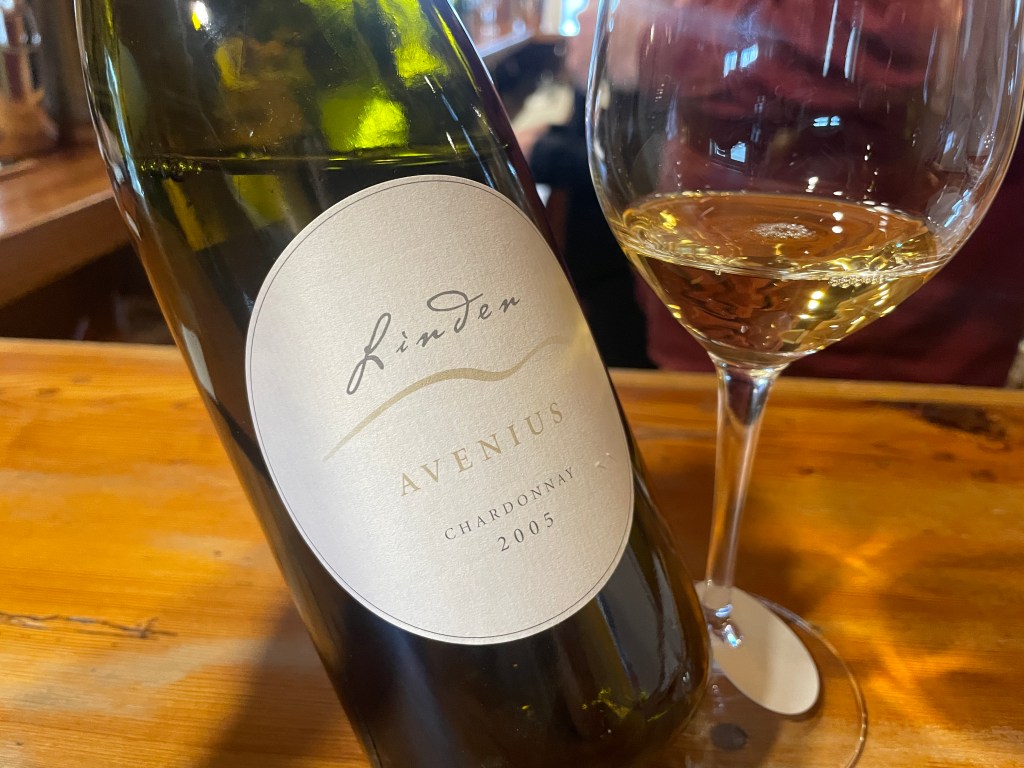
During my 2nd visit I was able to get a new trio of wines; flight of 2005 and 2006 Avenius Chardonnays, and a 1997 Reserve.
The 2005 had very little fruit left; it was like biting into an old lemon that was becoming a husk. The 2006 was livelier. Of course, neither held a candle to the 2009 Avenius.
The 1997 Reserve was perhaps the best ‘old Virginia wine’ I’d ever had. There was still some fruit there, despite being 27 years old. Earthy but still drinkable.
Turns out Jim only made 2 ‘Reserves’; one in 1997 and one in 2001. Both were precursors to today’s Hardscrabble reds.
I enjoyed one last glass of the 2009 Chardonnay, then off to Walsh Family Wine.
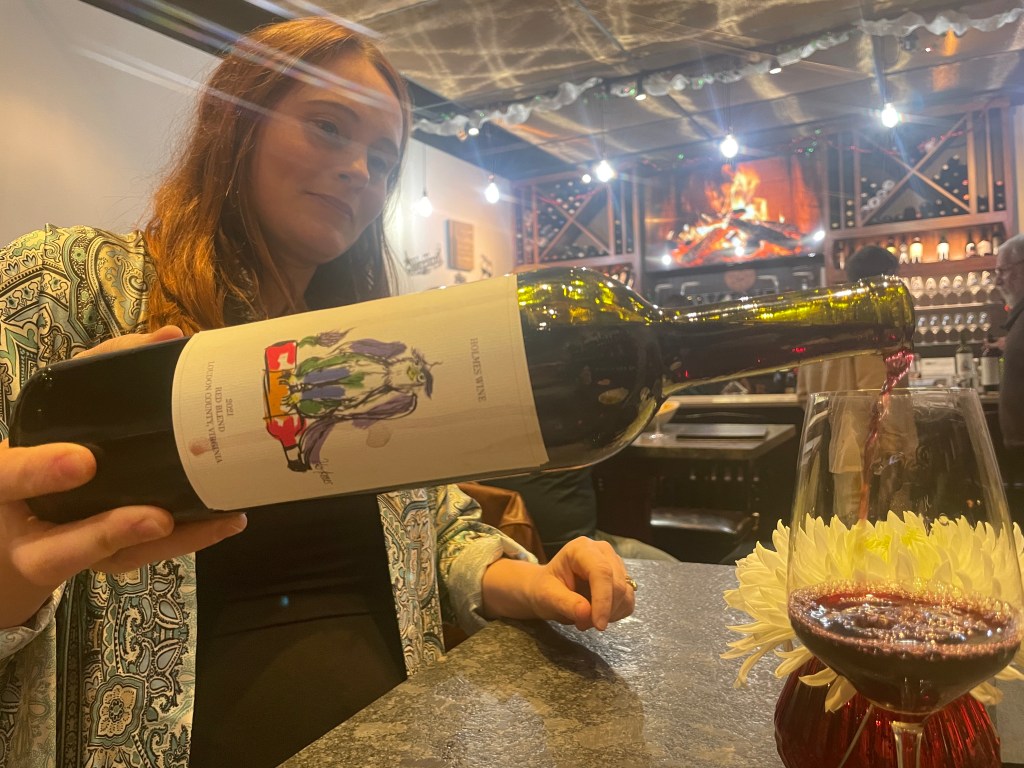
Holmes Wine a micro-wine project owned by Jackie Moriarty, who’s currently selling her trio of wines at the Ashburn Wine Shop. I had the chance to catch up with her when she was pouring her label this Saturday.
Jackie described herself as a “Traveling Winemaker”, although for now she’s staying put in Virginia. The term sounds cliché, but it’s actually very common.
Jackie explained how she started her winemaking career working at Bluemont Vineyard, then traveled the world. Like many winemakers, she would work a harvest in the southern hemisphere at the beginning of the year (where it’s summer/fall), then travel back to the USA for another harvest at the end of the year.
This strategy gave her exposure to different regions and winemaking styles. It also allowed her to meet her future husband Gonçalo while they were both working in New Zealand. Now that they have a baby on the way, they decided to (at least temporarily) settle in Virginia.
The brand includes three wines; a cabernet franc and two red blends. The fruit is purchased from Williams Gap and October One, while the wines are made at Lost Creek. Meanwhile, Gonçalo makes a separate set of wines at a winery he’s associated in the Douro Valley, Portugal.
Jackie’s wines tend to be fairly low-intervention, with a restrained use of oak and a focus on natural yeast fermentation. We started with her 2020 cabernet franc, made from Williams Gap fruit. It was on the lighter side, with some peppery notes.
Next up was the first of her 2021 reds, a 58%/42% blend of merlot and cabernet franc. She explained she made it with a ‘hard press’ to extract a different set of phenolics from the fruit.
Last was her 2nd 2021 red, a blend of 50% merlot/40% cabernet franc/10% petit verdot. Her she took the opposite direction than the first blend, with this being a much lighter press, almost to the verge of using free run juice. This was my favorite of the day, with notes of dark cherry and some earthy notes. I got a bottle to go.
Since they plan to eventually move back to Portugal, Jackie isn’t planning on opening a tasting room. But her wines will be in local distribution, and can be found at the Ashburn Wine Shop.
The European wine industry is steeped in tradition, much of which is codified into law. Bordeaux famously regulates everything from the kind of grapes grown within its borders, the amount of irrigation its wineries can use, and even the level of alcohol.
While the Virginia wine industry isn’t bound by the kind of regulations found in Europe, winemaking traditions derived from the ‘Old World’ still dominate the state. It has taken Virginia wineries decades to appreciate that not everything that works in Europe can be replicated locally.
This gives leeway to innovators to redefine how wine should be made. Whether it be trying out new grape varieties, exploring new blends, or creating new twists on old favorites, local innovators are pushing the industry’s boundaries forward.
Dennis Horton might be Virginia’s foremost innovator. When he founded Horton Vineyards in the early 1990s, Virginia wineries were relying upon either popular but fragile grapes such as cabernet sauvignon, or tougher but less commercially desirable hybrid grapes. Not satisfied with either option, he planted a dizzying array of less famous vinifera including viognier, petit manseng, touriga nacional, and tannat.
Dennis discovered these grapes by researching which wine growing regions have climates similar to Virginia. He reasoned that if a place like Condrieu had hot summers coupled with cool wet winters, then a Condrieu grape such as viognier would work here.
Given the changing landscape of the wine industry, this out-of-the box thinking remains relevant. Many grape varieties are becoming vulnerable to climate change in places they long called home, while others are flourishing in new locations.
At the same time, the clientele the industry caters to is changing. Younger buyers prefer sustainability and affordability over a wine’s fancy classification. Such consumers are open to wines that ‘break the rules.’
For oenophiles who want to try something new, here are four options from wineries that lean into this spirit of innovation.
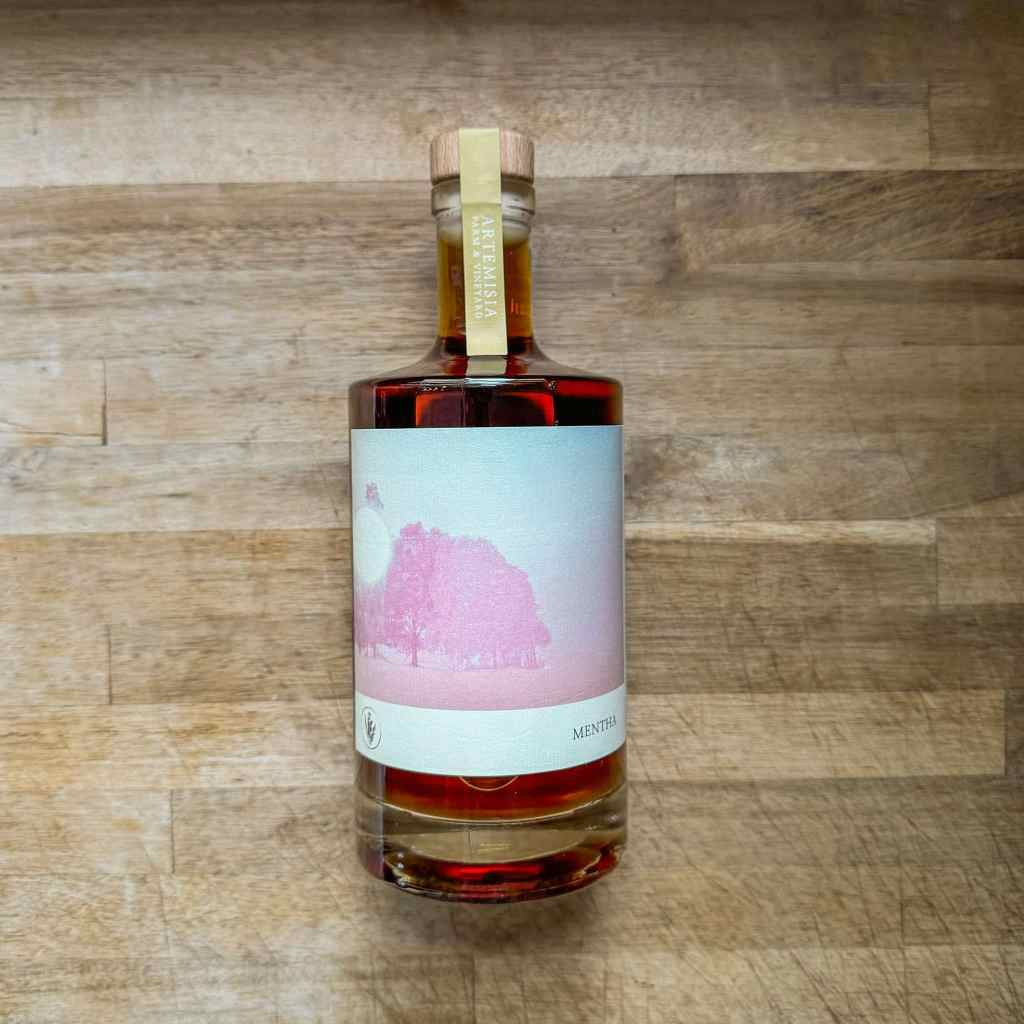
Artemisia Farm & Vineyard’s Mentha
Artemisia is one of a handful of Virginia farms crafting vermouth, an aromatized, fortified wine. Vermouth may seem an odd choice for wine lovers, but Artemisia is proving doubters wrong with an assortment of uniquely crafted options.
Vermouth is typically thought of as a cocktail mixer, but Artemisia’s bottles are finding an audience as a stand-alone drink with ingredients that emphasize their local nature. Co-owner Kelly Allen explained, “We want to capture Virginia’s terroir as an abstract essence”.
One vermouth that particularly shines is Mentha, a mint-rhubarb aperitif made with traminette. Mentha is aged in apple wood and pecan, bittered with dandelion and wormwood, and infused with Kentucky colonel mint, mojito mint, and spearmint. The last ingredient is especially prevalent, giving it a full, fresh flavor.
Artemisia Farm & Vineyard’s Mentha
Briedé Family Vineyards’ 2023 Arandell Special Reserve
Briedé Family Vineyards’ 2023 Arandell Special Reserve
Owners Paul and Loretta Briedé originally farmed their vineyard to organic standards. While harsh weather forced the Briedés to drop their organic certification, they continue to apply many of the same techniques.
One lesson they took to heart is organic farming requires grapes that are naturally disease resistant. That led them to plant a number of hybrid and native grapes, including cayuga, marquette, la crescent, and arandell.
That last variety deserves special mention. Arandell was created by Cornell University, which is developing a new generation of hybrid grapes that are as flavorful as they are hardy.
Arandell’s flavor profile combines earthiness and acidity, with a hint of tobacco. While many oenophiles tend to look down their nose at hybrid grapes, such snobbery is uncalled for. Arandell is a standout in the pantheon of hybrids and is one of the few hybrid wines to earn a Gold medal at the 2024 Shenandoah Wine Cup competition.
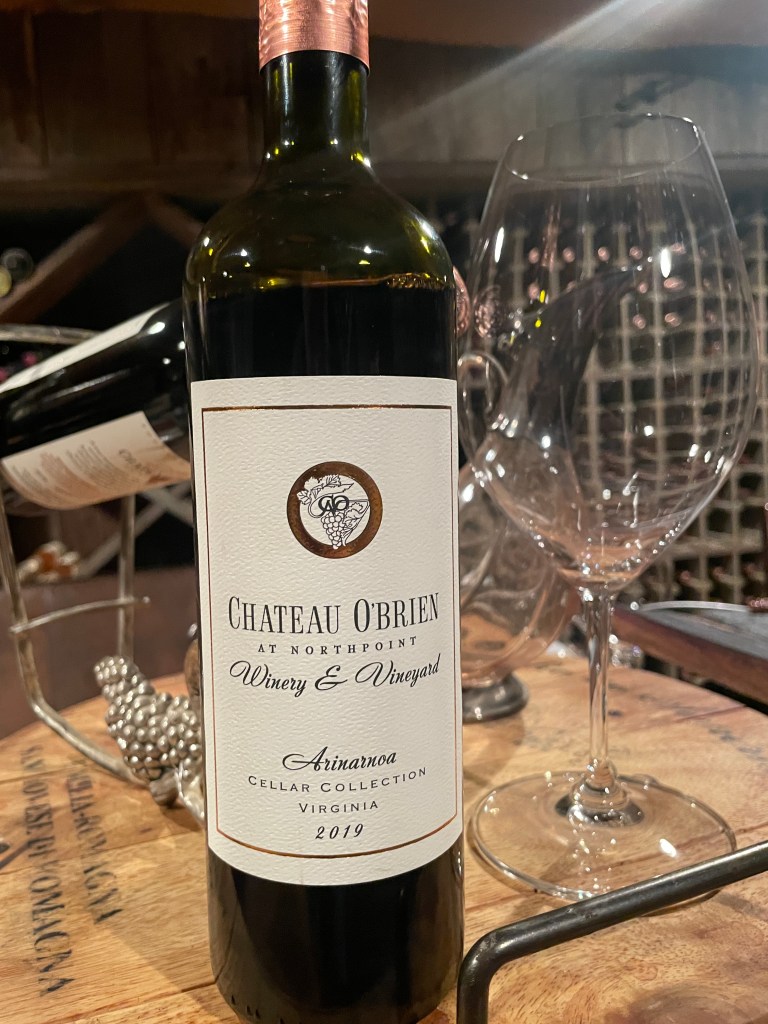
Chateau O’Brien 2019 Arinarnoa
The French wine industry is notorious for being a stickler for tradition. This means when arinarnoa was announced as one of a handful of varieties now authorized for planting in Bordeaux, the wine industry took notice.
Arinarnoa is a cross of tannat and cabernet sauvignon, making it suitable to both Virginia’s and Bordeaux’s increasingly warm climate. Chateau O’Brien is the first winery on the east coast to plant this grape.
Owner Howard O’Brien explained, “I got the idea to plant arinarnoa during one of my trips to Uruguay, where they plant it next to their tannat. In the vineyard, it has characteristics from both of its parents. Arinarnoa has a leaf structure like tannat, berries like cab sauv, ripens like cab, and its growing season is very similar to tannat. I only do 1-3 tons an acre, but it crops very well.”
Howard’s arinarnoa showcases a nice balance of earth and mushroom notes on the nose, with soft tannin and some dark fruit on the palate.
Chateau O’Brien Arinarnoa
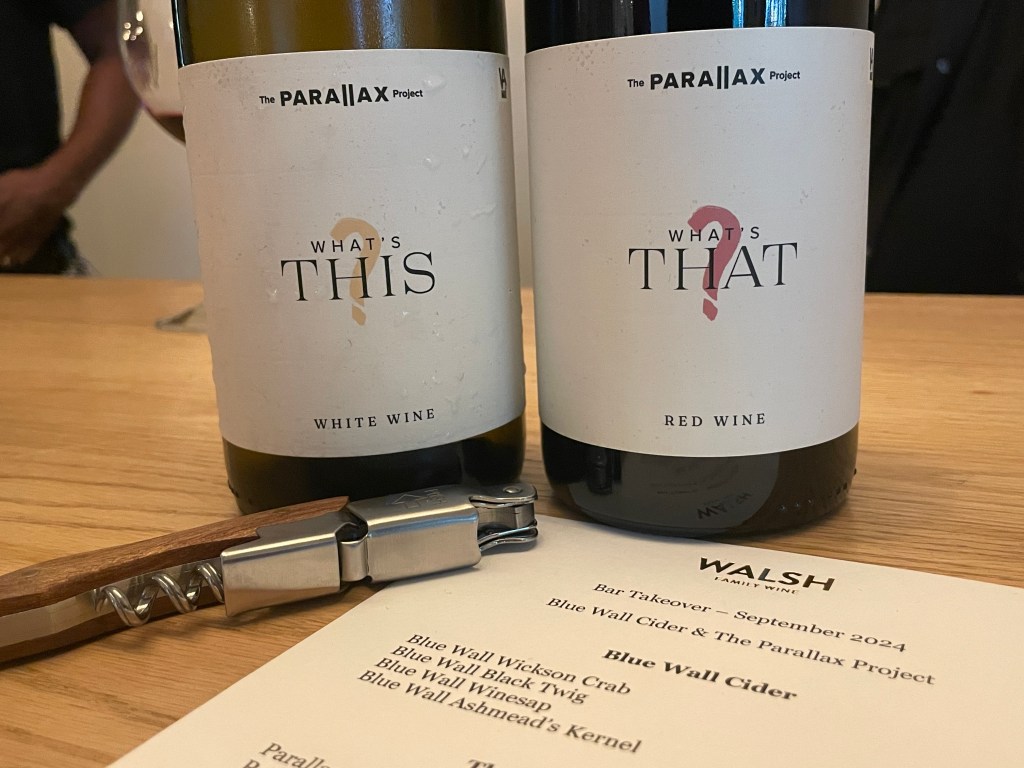
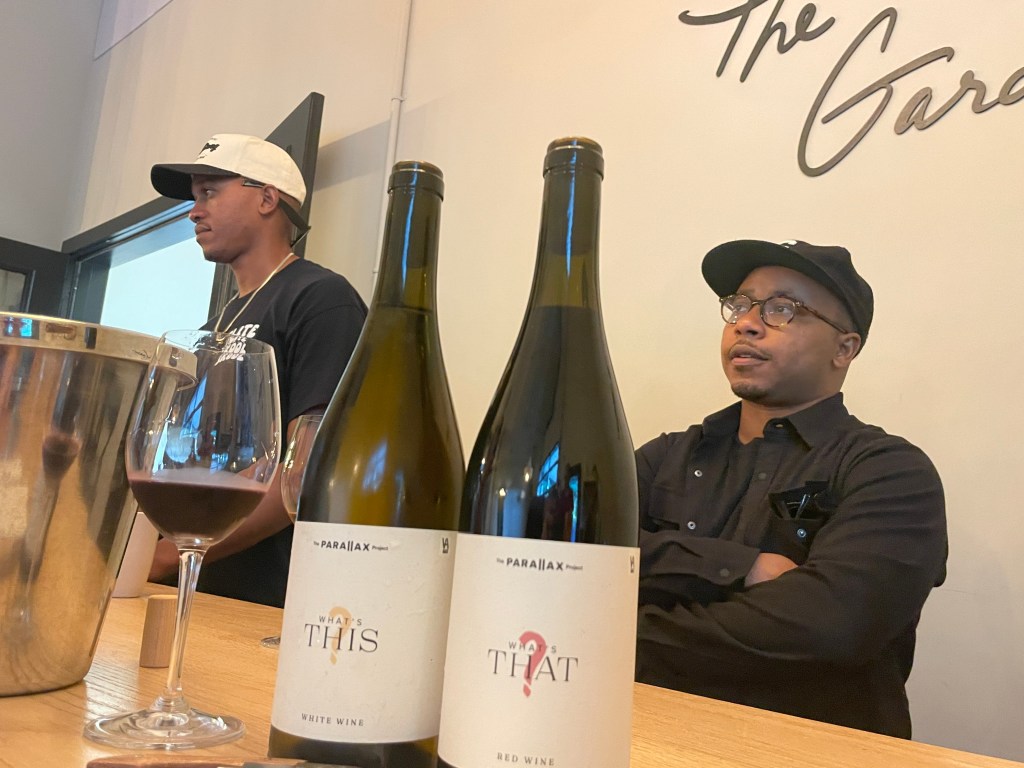
The Parallax Project What’s This? and What’s That?
The Parallax Project is a collaboration between winemakers Ben and Tim Jordan and owners Lance Lemon and Reggie Leonard. The Jordan brothers already have a flair for unusual blends, but these wines topped even their wildly creative imagination.
The project’s name was inspired by what’s called “The Parallax Effect”, which is “a difference in the apparent position of an object when viewed along two different lines of sight”. That name was inspired by how these two wines were crafted.
While What’s This? and What’s That? were both made using vidal blanc, chardonel, tannat, petit manseng, traminette, and albariño, they are very different wines. What’s This? is a white wine that leans more heavily on vidal and chardonel, giving it citrus notes and a floral aroma. “What’s That?” is a juicy red made with 83% tannat, yet it’s low on tannin and highly aromatic.
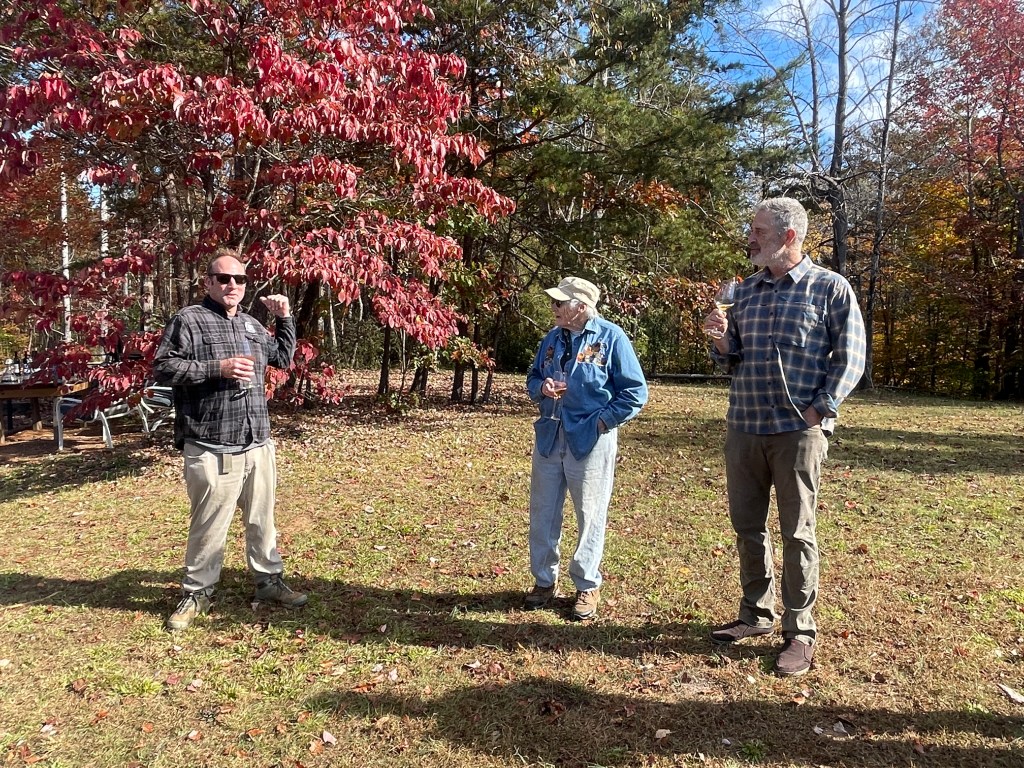
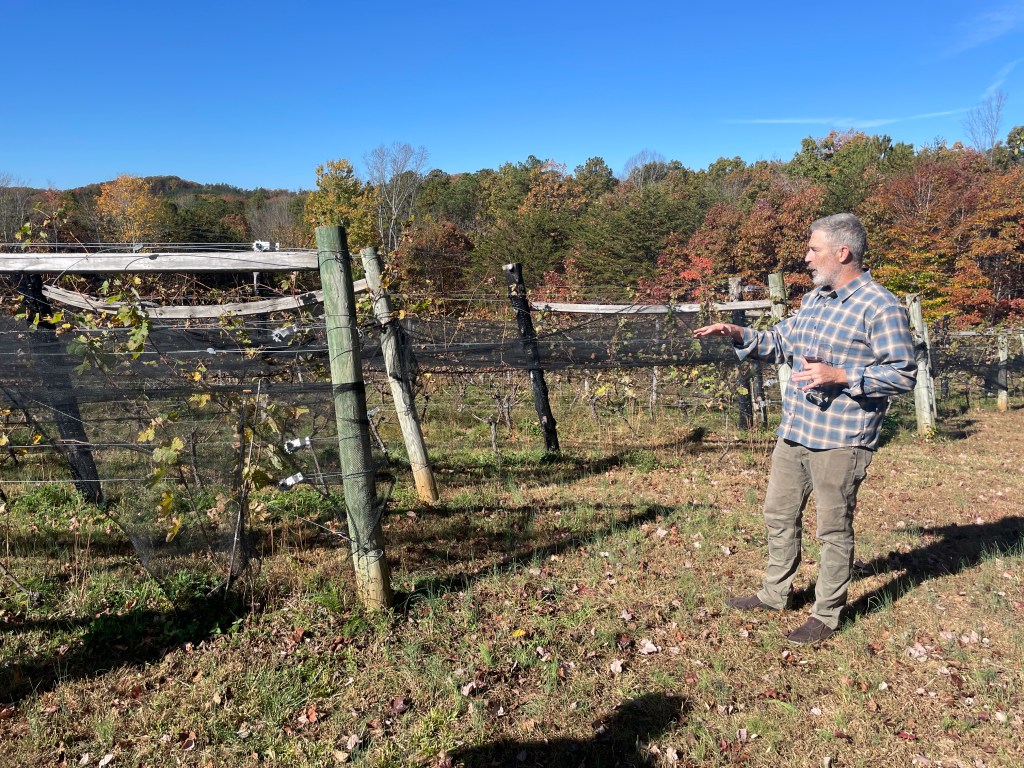
Owners David Achkio and Robert Burgholzerput out the welcome mat for us, pouring four wines and three barrel samples, ranging from 2018 to 2024. They also gave us a tour of the vineyard.
It’s understandable if the name “Mount Alto” isn’t recognizable. The vineyard is 45 minutes south of Charlottesville, and only produces 50-70 cases/year from 2 acres of vines (some additional petit verdot is sourced from nearby O’Brien Vineyard). Since there’s no tasting room, we feasted and drank at a table outdoors.
This limited production means their wine can only be purchased at the vineyard, or at a few wine shops in Richmond. This is a shame because Dave and Robert are making great wine.
Rob attributes the inspiration to build a winery from a visit to Linden Vineyards; not coincidentally, one of the state’s best locations for high-quality, terroir-driven wine. In 2005, he and Dave started taking classes with Jim Law.
One lesson they took to heart was Jim’s advice that ‘the best vineyards in Virginia are still under trees’. Rob started looking for a site that was both suitable for viticulture and no more than 90 minutes from Richmond or Charlottesville. This eventually led him to a property in Esmont, located on the southern end of the Monticello AVA.
While Rob knew he had a good site, a visit from Jim provided an additional confidence booster. Jim was visiting the area and offered to take a look at the newly-purchased property. It must have been a surprise that Jim recommended they only plant cabernet sauvignon, a grape that is normally difficult to grow in Virginia due to needing very rocky soil. Mount Alto had the ‘goldilocks’ conditions cab needed to thrive.
“Manteo-Nason” Soil and the Vine-Soil Relationship
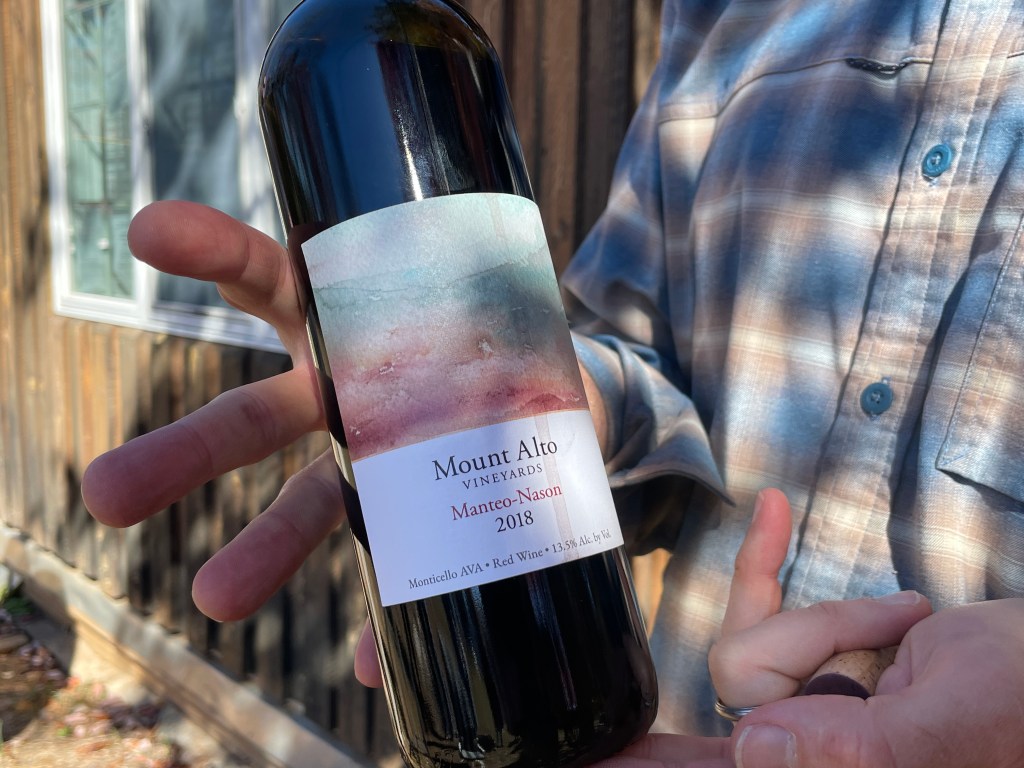
The soil that Jim was so impressed with is a well-draining type known as “Manteo-Nason”. Well-drained soils are a crucial element to another of Jim’s lessons; the relationship of water to wine quality.
Vines planted in poorly draining soils are constantly at risk to over-saturation, as rainfall only needs to go a few feet down to reach their root system. Water saturation undermine a grape’s chemistry and ripening potential, leading to lower-quality wine.
By contrast, rocky soils force these roots to go deep to seek the water they crave, putting distance between them and any rainwater that manages to penetrate this rocky ground. Well-draining soil is especially important in Virginia, where vineyards typically suffer from the state’s excessive precipitation.
Robert also explained that Mount Alto doesn’t use herbicides. He feels this creates greater competition between the vineyard and other plant life, giving the vines another incentive to go deeper for additional nutrition. This deep root system also makes the vines more drought-resistant, something that must have come in handy in a dry year like 2024.
Mount Alto has 1.7 acres of cabernet sauvignon and .25 acres of petit verdot. Cabernet sauvignon is normally a curious choice in Virginia, but it makes sense here.
Many local winegrowers have a love-hate relationship with cabernet because while commercially popular, few vineyards possess the conditions to grow it well. It’s a tribute to Mount Alto’s Maneto-Nason soil that when Jim visited the site, he recommended they only plant this vine.
Tasting Five Vintages of Mount Alto Wine
Jim Law isn’t the only great vigneron who’s advised Mount Alto. Matthieu Finot was initially their winemaker and still consults with them. Today, David and Robert are now taking the lead.
While I love a good vineyard tour, tasting their 4 wines and 3 barrel samples was the highlight of the visit. Having tasted all of them, I can say these are high-structure wines that will last.
2018 Manteo-Nason (91% cabernet sauvignon, 9% petit verdot): Mount Alto’s first vintage, and the product of an incredibly wet season. It was good in 2020 but it’s since become smoother, even acquiring some tertiary notes. Probably peaking so drink now.
2019 Manteo-Nason (55% petit verdot and 45% cabernet sauvignon): Made primarily with Mount Alto grapes and some PV from O’Brien. Great balance of fruit and tannin. My favorite wine of the day! Bought a bottle.
2021 Manteo-Nason (60% cabernet sauvignon, 40% petit verdot): No tasting notes but a good buy at $35.
2021 Tributary (60% petit verdot, 40% cabernet sauvignon): Made with a combination of O’Brien Vineyard PV and PV & cab sauv from Mount Alto. Lovely, but the tannins really dried out my mouth. Give this wine a little more time.
We also barrel samples from their 2023 cab sauv, 2024 cab sauv, and a 2024 merlot (made with fruit purchased from Grace Estate). Great structure on both of the cabs, and I especially loved the floral notes on the 2023. Merlot was good too, which is no surprise because 2023 reds are going to be awesome all round.
Many thanks for the cider aperitif that kicked things off, and for Kathy’s ‘Princess’ cake.
Comic book films have popularized the idea of “shared universes,” where heroes from multiple worlds join together. It’s great movie fodder, but it wasn’t until Reggie Leonard described the breadth of the wine club/wine community/access & opportunity program he co-founded that I realized why this initiative refers to itself under a similar moniker.
I say this because the “Oenoverse” (Ee-Nuh-Verse) is all of those things and more.
Reggie’s passion for wine began in 2015 when he took a job at the University of Virginia’s School of Data Science. An urge to meet people and try something new led to the discovery of free tastings at Market Street Wine in downtown Charlottesville. Little did he realize these tastings would introduce him to an entirely new community.
Photo credit: Kori Price
“I’m an ambivert; an introvert but in an extroverted way,” Reggie said over the phone. “I knew that community is important to me, and I wanted to make sure that I found a community that allowed me to be extroverted.
At first I didn’t understand any of the terminology used at these wine tastings. But over time, I surprised myself by starting to remember different names, recognizing different tasting profiles.
I connected to wine more than I realized, and through that realization I eventually discovered a Black Wine Lovers Facebook group.”
Learning the terminology of wine is difficult enough. But Reggie was encountering another barrier; the world of wine isn’t easily accessible to people of color.
The lexicon of wine relies on Eurocentric descriptors and food pairings that the BIPOC community doesn’t always relate to. On top of that, the lack of other Black faces made the experience more daunting.
“When I experienced wine, it didn’t mirror the rest of my life, since the traditional wine experience wasn’t built with me in mind,” he explained. Reggie didn’t realize it at that time, but this realization must have triggered an idea. If there wasn’t a community for those outside their comfort zone to learn about wine, he’d help build one.
Building a Community
In late 2020 Market Street Wine approached Reggie about hosting virtual events. One of the participants was Blenheim Vineyards Sales/Marketing Director Tracey Love. The two eventually connected in-person, leading to a collaboration with Blenheim.
Tracey encouraged Reggie to host an event to talk about his wine journey. That led to further discussions how they could replicate this theme of ‘community’, all along the backdrop of wine.
Reggie Leonard
The “Oenoverse” was born.
According to its website, Blenheim’s Oenoverse Club is “dedicated to expanding opportunity and perspective through Virginia wine for people who have never joined a wine club or are seasoned professionals.” While outreach to members of historically underrepresented communities is a key part of its mission, the club is open to everyone. Members are also encouraged to share their wine tasting experience during their events.
Yet the Oenoverse doesn’t exist by itself; it’s part of an ecosystem of similarly-minded organizations. Among them are Charlottesville’s Ethos Wine & Tea and RichWine, an online wine club based in Richmond. Both businesses focus on low-intervention, sustainable wines.
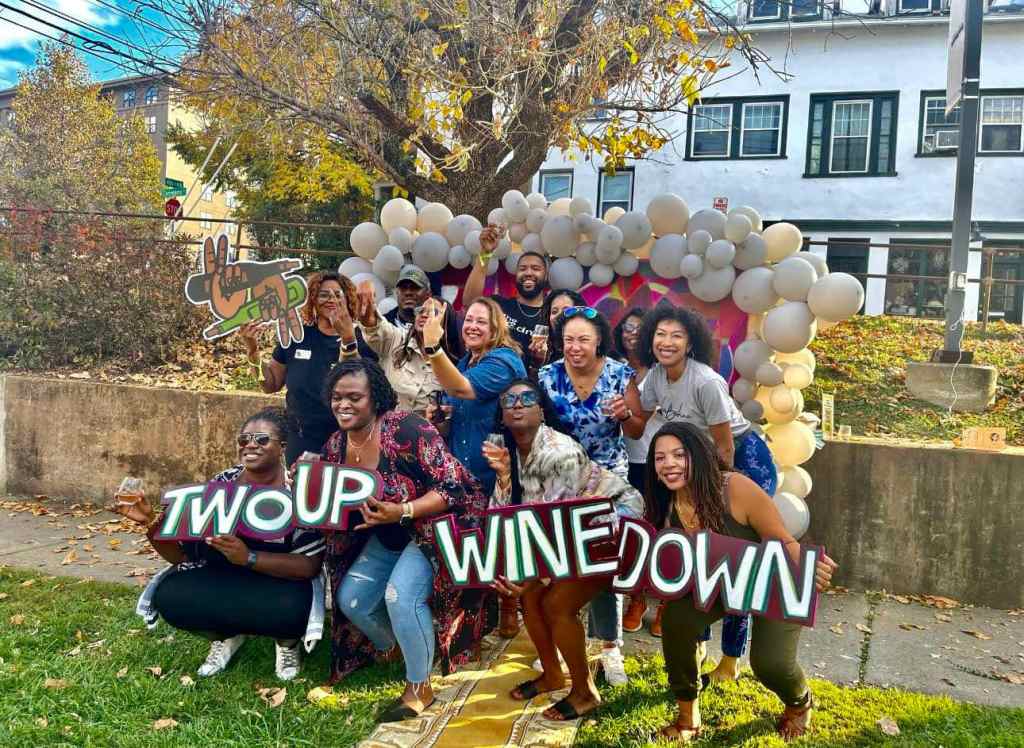
Probably their most active partner is The Veraison Project, which co-hosts the Two Up Wine Down music festival and Oeno Camp. The former takes place every November at the Jefferson School African American Heritage Center, while the latter is a three-day Virginia wine immersion program for historically underrepresented consumers and industry professionals.
Lee CampbellKindra DionneSeidah Armstrong
Showcasing Non-Traditional Grapes and Styles
The Oenoverse’s advocacy for the underrepresented goes beyond outreach to communities of color; it showcases other parts of the wine industry that are often overlooked.
“What else can wine look like?” Reggie asked rhetorically. “Historically, we’ve only paid attention to vinifera wine. But who doesn’t like more options?”
Reggie and Lance Lemon, owner of RichWine, were deeply inspired by Jahdè Marley’s “Anything But Vinifera” wine movement. Jahdè’s desire to spotlight hybrid and non-traditional grapes encouraged the two to found their latest initiative; The Parallax Project.
Lance Lemon and Reggie Leonard
Several years ago, winemakers Ben and Tim Jordan of Commonwealth Crush reached out to Reggie and Lance to explore ideas for a partnership of their own. At the end of that conversation, the quartet came up with the idea of making a small-batch of wine, produced at Commonwealth but under Reggie and Lance’s direction.
The project’s name was inspired by what’s called “The Parallax Effect,” which is “a difference in the apparent position of an object when viewed along two different lines of sight.”
Lance and Reggie applied this principle to their two wines, both made with a mix of vinifera and hybrid grapes. While one is a red and the other is a white, both were made using nearly the same grapes but blended in different proportions and made using different winemaking styles.
Reggie summarized his myriad of projects with this; “We are building a space for something that has not been built for. That’s not just for people of color but other aspects of wine, like hybrids and lower-alcohol wine.
If we do that, we can bring in customers that weren’t part of the market before.”
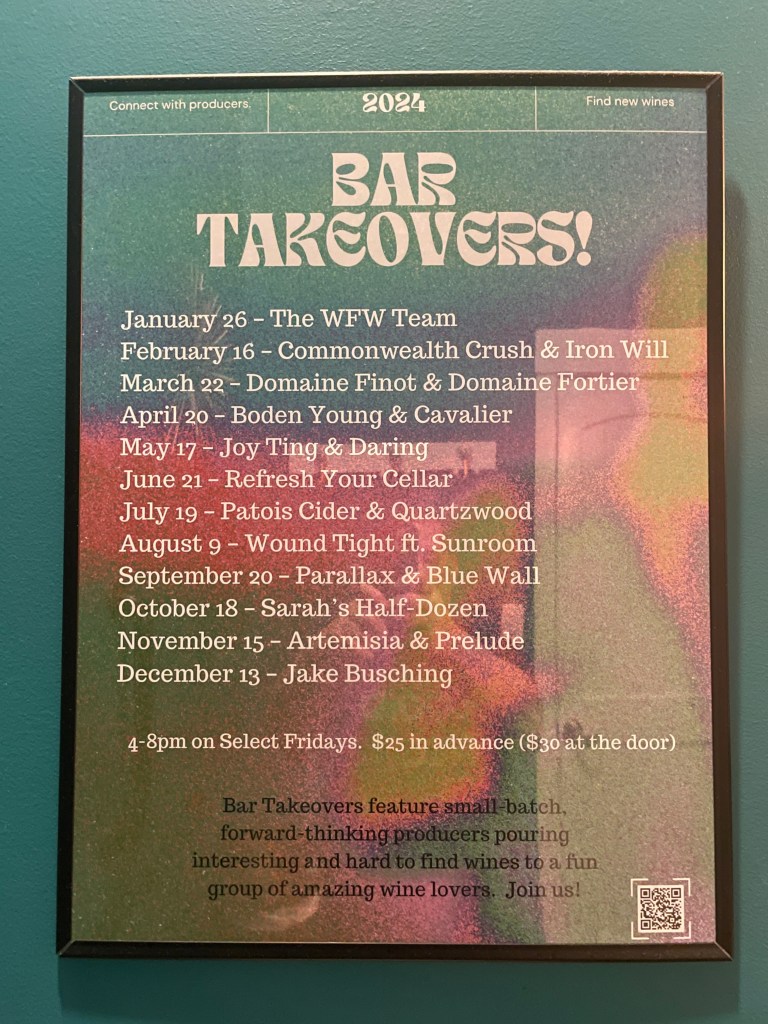
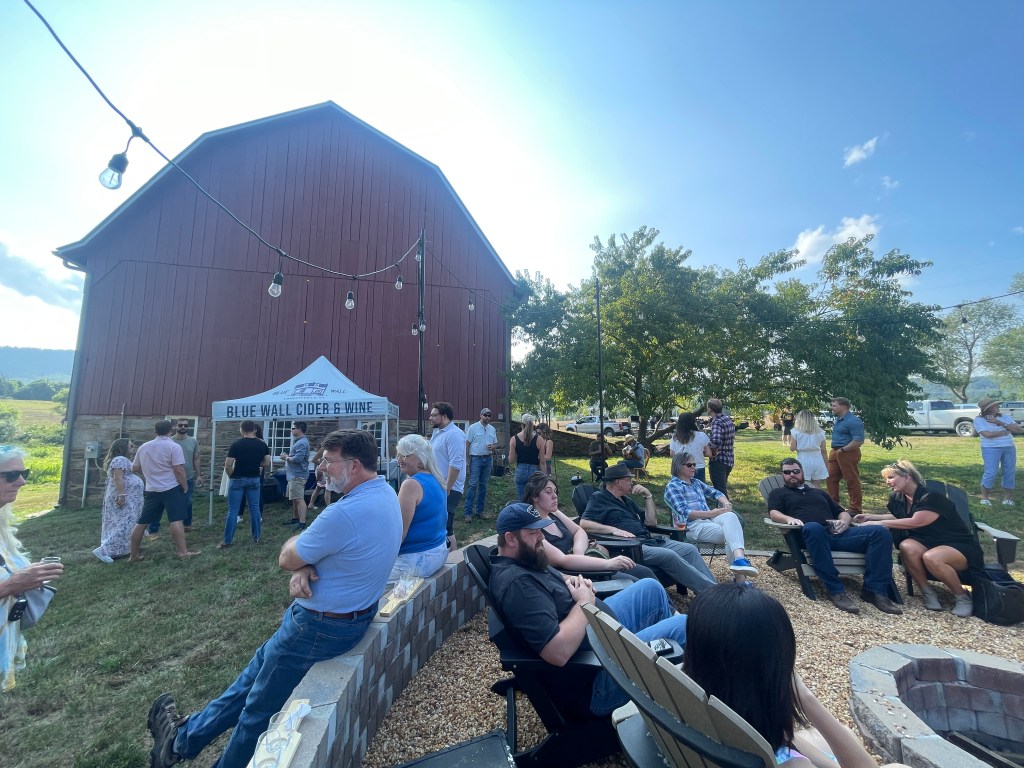
Last month (after a hard day of sorting grapes at Linden) I went over to Walsh for their latest Friday Bar Takeover. This event included a pair of new participants, The Parallax Project and Blue Wall Cider & Wine.
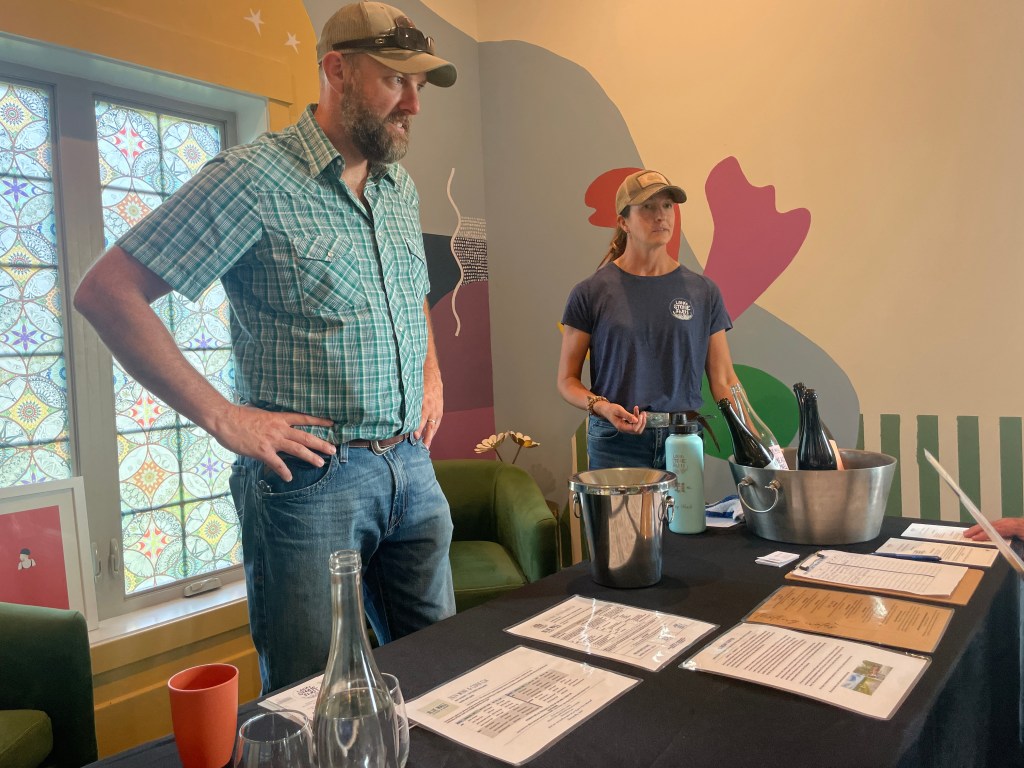
I’ve become accustomed to visiting old friends at these Bar Takeovers (looking at you, Jake Busching, Joy Ting, Daring Wine Co) but it’s exciting to try new, small brands. Some projects showcased here are actually produced at Walsh Family Wine, while others are what you might call ‘visiting friends’.
Parallax falls into the ‘visiting friends’ category. The brand is owned by entrepreneur and jack-of-all-trades Lance Lemon & “Virginia wine hype guy” Reggie Leonard, friends who decided to collaborate with Commonwealth Crush Co to create wines unique to them. These gents are also helping lead the charge for greater diversity in the Virginia wine scene.
Blue Wall is owned by Justin and Casey Wisch, who also own nearby Long Stone Farm. Blue Wall is one of the many small projects that Nate Walsh and his winemaking team support. The Wisches source their apples from their estate orchard and grapes from Nate’s vineyards, all of which is made at Walsh Family and labeled under the Blue Wall brand name.
The Parallax Project
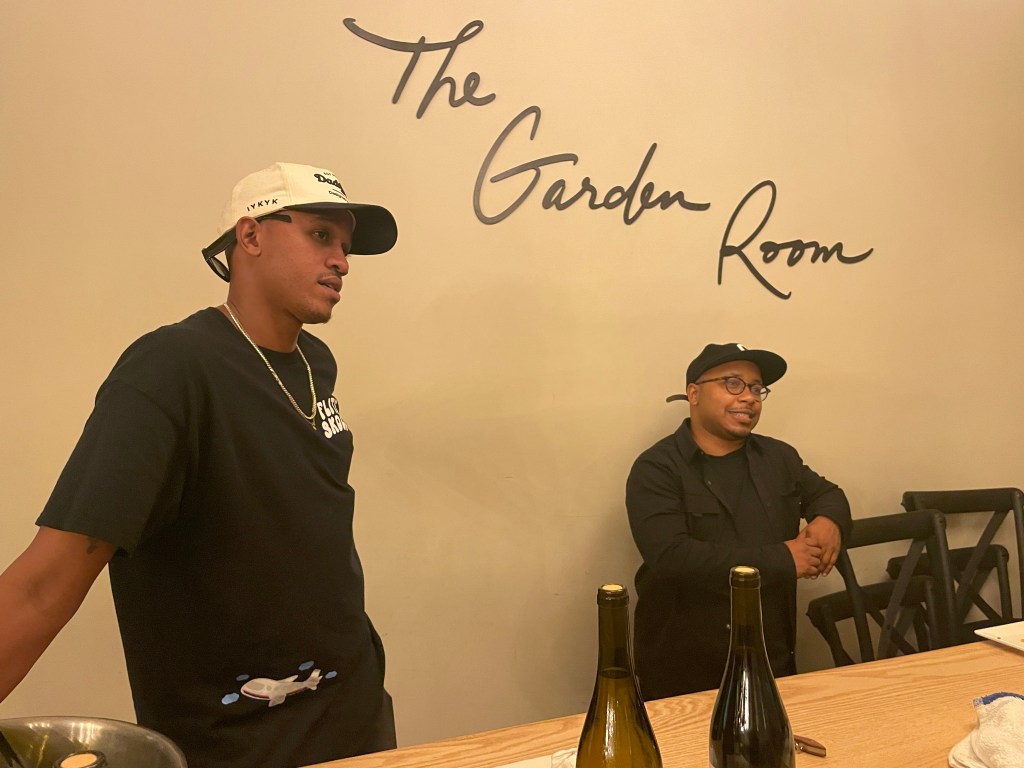
Kathy Wiedemann & I decided to start our visit with Parallax, who were hanging out in Walsh’s Garden Room. Reggie and Lance have so far produced two wines; “What’s This”, and “What’s That”.
The project’s name was inspired by what’s called “The Parallax Effect”, which is “a difference in the apparent position of an object when viewed along two different lines of sight”.
Lance and Reggie applied this principle to their wines. While one is a red wine and the other is a white, both were made using nearly the same grapes but in different blends and winemaking styles.
The 2023 “What’s This” is their white wine, a blend of 32% Vidal Blanc, 29% Chardonel, 29% Tannat (direct press), 6% Petit Manseng, 3% Traminette, 1% Albariño.
I’d never heard of a blend that even approaches this wine, and it was just as tasty as it was interesting; the kind of wine you need to keep sipping just to figure out what’s in your glass. Very floral with citrus notes (amongst others). I bought a bottle.
The 2023 “What’s That” is 83% Tannat, 8% Vidal Blanc, 7% Chardonel, 1% Petit Manseng, and 1% Traminette. While technically you could call this a ‘tannat’, it’s the farthest thing from one. Lower on the tannin, more fruit, and also highly aromatic.
The blending may seem odd – but they work. Both wines were designed to be enjoyed young and are very much in line with the off-beat style I’ve come to expect from their wine mentors, Ben and Tim Jordan of Commonwealth Crush.
Blue Wall Cider & Wine
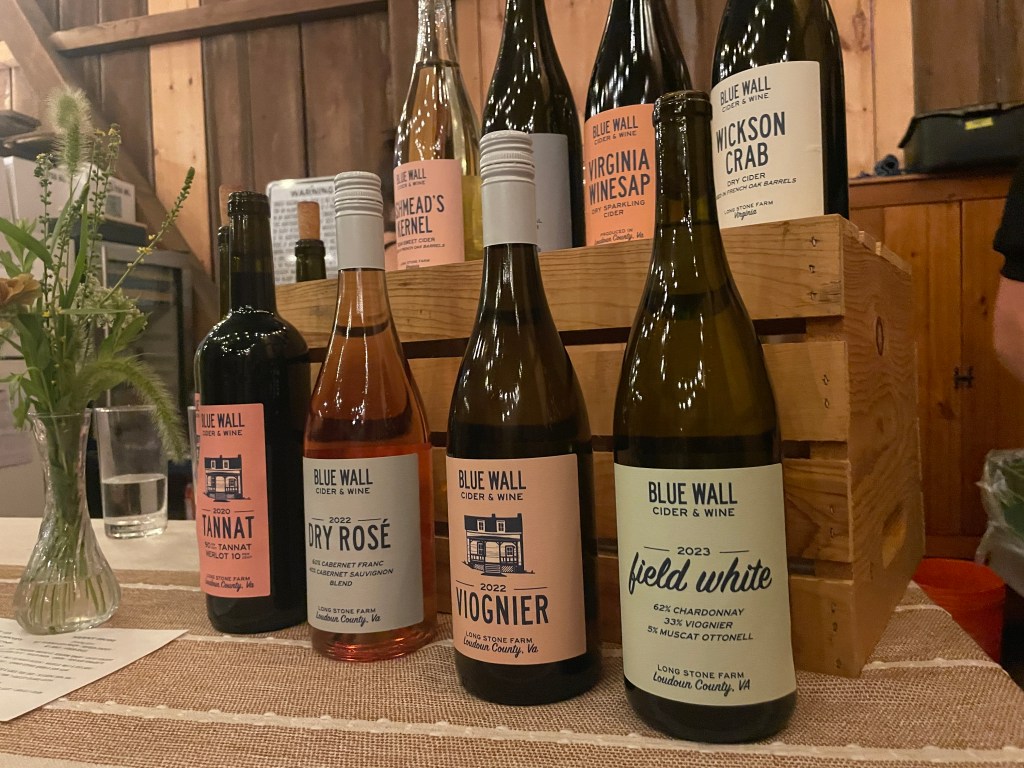
In the main tasting room was Justin and Casey Wisch, who were pouring four of their ciders; Black Twig, Wickson Crab, Ashmead’s Kernel, and Virginia WineSap.
Blue Wall is actually just one component of Long Stone Farm, a sustainable farming operation that offers everything from CSA shares, a farm store for their meat and produce (which doubles as a wine/cider tasting room), even a monthly ‘Sunday Supper’.
The last is perhaps my favorite initiative of theirs, as it showcases everything that’s made at their farm but served by a local chef.
Blue Wall’s ciders are made in a ‘traditional’ style, which I nickname ‘wine cider’. No carbonation here; these ciders are meant to showcase the fruit they came from.
Wickson Crab was the ‘biggest’ of the four in terms of flavor, probably because it was barrel aged. It was my favorite of the more standard ciders.
Next up were Black Twig and Ashmead. Black Twig is off dry, while Ashmead is definitely the sweetest of the lineup. Had it been warmer the Ashmead would be a summer pounder outside (in fact it was when I attended their dinner).
But my favorite was Winesap, made as a sparkling pet-nat style cider. Very light and drinkable, and I suspect extremely food friendly. I got a bottle of this to go and will definitely open it with friends at dinner.
Special shout-out to Kathy’s husband, who brought the pizza that we ate outside.
I’d never thought I’d write a blog about sorting grapes at a winery – but here we are.
2024 was an odd year for Virginia wine. We had an abnormally hot and dry summer, to the point many winegrowers were openly hoping for an inch or two of rain to relieve their parched vineyards. While dry conditions will reduce the volume of wine they produce, it gifted vineyards with intensely flavored berries which (we hope) will result in high-quality wine.
Yet when the rain finally came, it came in torrents. Tough decisions had to be made whether to let the fruit hang on the vine in hopes of achieving additional ripeness, or bring it in, else risk the grapes falling apart in the vineyard.
Hardscrabble Vineyard
Owner/winegrower Jim Law would have preferred to let his Cabernet Sauvignon hang for another week or two. But Mother Nature wasn’t cooperating, so it had to come in.
I had planned on making last Friday a leisurely wine-tasting day, but Linden Vineyards put out a last-minute request for assistance in sorting grapes that were being harvested that morning. They were short-staffed, the regular vineyard team was busy in the field, and Fridays are a tough day to get volunteers. I alerted a few like-minded friends about the opportunity, and we offered our services.
I told myself, “I’ve harvested grapes before; sorting them could be fun. How hard could it be?”.
It turns out – a lot.
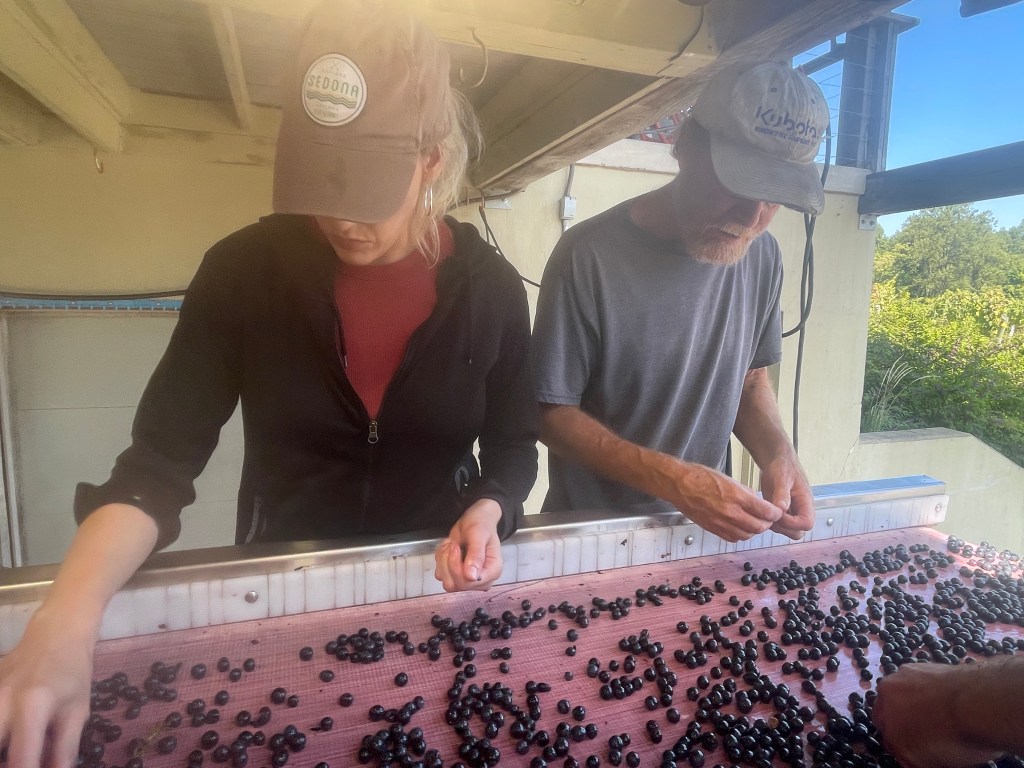
So on a Friday morning, Linden harvested 10 tons of Cabernet Sauvignon from their estate ‘Hardscrabble’ vineyard. The harvest team was on the top floor with their destemmer, which separates vines and stems from the grapes. Those grapes would drop through a chute to the ground floor into a conveyor belt, where the rest of us stood ready to pick out bad grapes and smaller organic matter before they went into the grape bins.
If it sounds very “I Love Lucy at the Chocolate Factory”, that’s not too far off.
What is Sorting?
Sorting isn’t a sexy job, but it’s an important one. Alex Wilde, Jim Law’s son-in-law and newly-minted apprentice winemaker, related a story from one of Linden’s harvest interns. This intern asked Jim what was his most-important lesson-learned in improving wine quality during harvest.
Jim’s answer? ‘Good sorting’.
Alex gave us a quick lesson on what to look for. Priority should be given to tiny green berries (far too tart). Second priority were lightly colored berries (still too under-ripe to be helpful). Also watch out for the occasional grape with white-ish coating which indicated noble rot (good in some white wines, but not good for red grapes), grapes with insect punctures (they are also probably rotting), and grab any bugs that went along for the ride (be careful of yellow jackets!).
I tossed some bad grapes, but the vast majority of stuff we removed during sorting was green matter. This included tiny branches, some leaves, and stem fragments still attached to the grape which Alex called ‘stem jacks’. All of these contribute tannin; something important in small doses, but not the style Jim likes in his wine.
Alex assured us that there was no way we’d get 100% of this detritus, as there was simply too much even a group of 6 people (occasionally dropping to 3-4 people) working in concert could grab. Just do what you can, and don’t chase any grapes that gets away.
Since I’m a big fan of Linden’s Hardscrabble red blend, I had a vested interest in doing a good job. I’d quickly scan for objectionable material and toss the offender into the bucket next to me. Ideally, I’d remove stem jacks from the grape and send the grape back on its way. Occasionally, the pace was so fast it was easier to toss the entire berry out. Grab-yank-drop and repeat, usually for an hour on end.
We had 6 bins of grapes come down the line, each with fruit that usually aligned to a different vineyard block. Seeing the fruit first-hand was a lesson in what Jim calls the ‘vine-soil relationship’.
Older blocks have deeper root systems, which generally protects them from rainwater penetrating the ground. By contrast, younger vines get their nutrients closer to the surface, which makes them more likely to absorb surface water. This meant younger block fruit was sometimes water-logged and sloppy, while fruit from older vines were fairly clean and dry.
Not every winery performs this labor-intensive task. While nearby RdV has a fancy optical sorter, most Virginia wineries (if they bother at all) rely on humans for the job. ‘Human optical sorters’, Alex joked.
Once the grapes dropped into the bin, they were off to the cellar to begin their transition into wine.
While I complained about how much my back hurt afterwards, you always learn something when talking with the team at Linden. Plus, helping out gives you a deeper respect for the hard work that goes on ‘behind the curtain’. Everyone who loves local wine should volunteer at a winery, even if only once.
Over the years I’ve poured wines at festivals, planted a new vineyard, harvested grapes, and now helped sort them. Anybody need a junior apprentice winemaker?
“Fcking” Merlot is arguably the least-appreciated wine in Virginia. Petit Verdot and Petit Manseng are the rising stars people like to talk about, while Cabernet Franc and Chardonnay are vineyard workhorses. Yet for some reason, Merlot doesn’t get the same level of attention.
A look at Virginia’s recent wine competitions doesn’t help its case. Merlot has earned a grand total of 8 Gold medals in the past three Governor’s Cup competitions. Not bad…but that pales compared to 49 Golds for Petit Verdots and 24 for Petit Mansengs in the same space of time. Heck, even Albariño has earned 10 VA Governor’s Cup Golds recently, and that’s with a fraction of the plantings Merlot has.
This would seemly indicate Merlot doesn’t have the same luster enjoyed by other well-known varieties. Yet that statement defies logic, for two reasons.
First, Merlot is the 2nd most planted grape in the entire state, according to a 2024 survey of Virginia grape growers. This isn’t what you’d expect from a variety that’s unappreciated. It helps there is lots of clay (this variety’s preferred soil) in Virginia, enhancing Merlot’s suitability for the state’s terroir.
Second, Merlot is a key component of a number of Virginia’s most iconic Bordeaux-style wines (looking at you, King Family, Barboursville, and Michael Shaps, to name a few). In many of them, Merlot is often their largest contributor.
Merlot’s most famous expression is found on Bordeaux’s Right Bank, although arguably that’s somewhat an unfair statement as these wines are blends. That’s a big difference to Virginia Merlots, where 100% expressions are the norm.
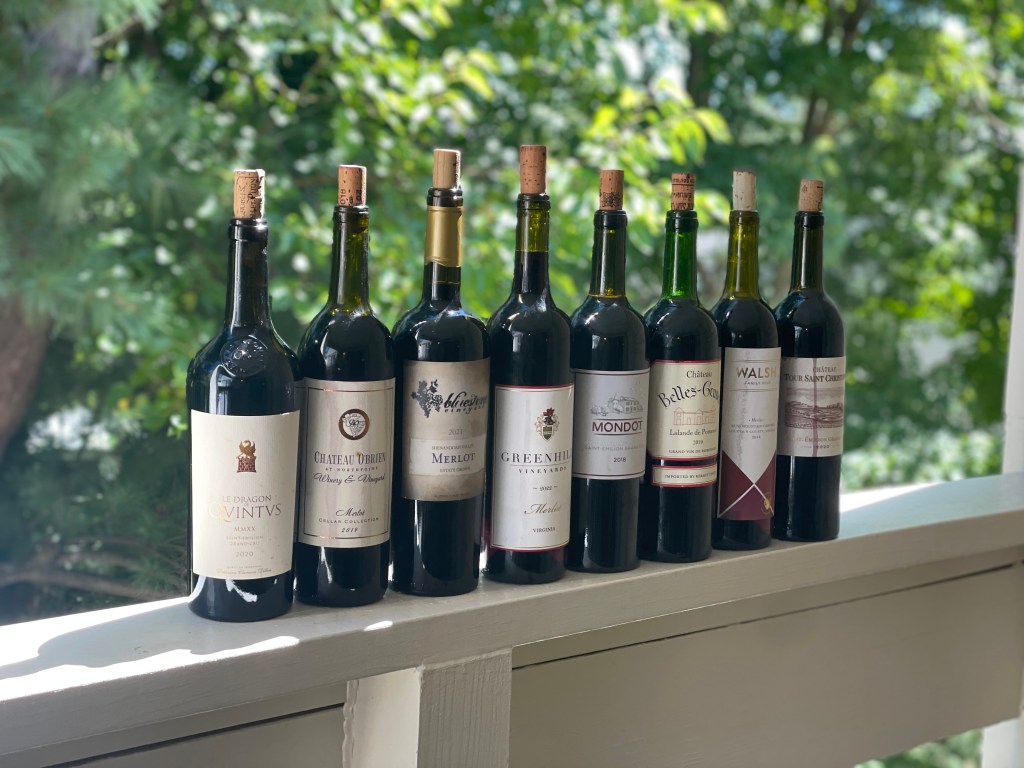
So when I decided to do a Merlot comparison, it wasn’t a straight-up comparison. All four bottles from Virginia were 100% Merlot, while only one of the French bottles was 100%. The remaining three Bordeaux were anywhere from 80%-88% Merlot, and finding bottles with that high a percentage was difficult.
Tasting & Scoring Methodology
I picked the Bordeaux bottles in advance, selecting ones that were anywhere from $35-$45 and composed of least 80% Merlot. I paired the French and Virginia bottles according to vintage age as best as I could.
I felt ~$40 was a sweet spot price-wise since the French bottles would largely be at the same price point as their Virginia counterparts. I assume I was getting more export-oriented bottles (France tends to keep its best stuff, or put it outside my price point), but such is Bordeaux’s esteem that even ‘budget-friendly’ Bordeaux wines punch above their weight.
I also took the unusual step of decanting all of my wines. Young Bordeaux are notorious for taking time to open up, so I made sure they all received a good 2 hours in my decanters. The Virginia wines usually got an hour.
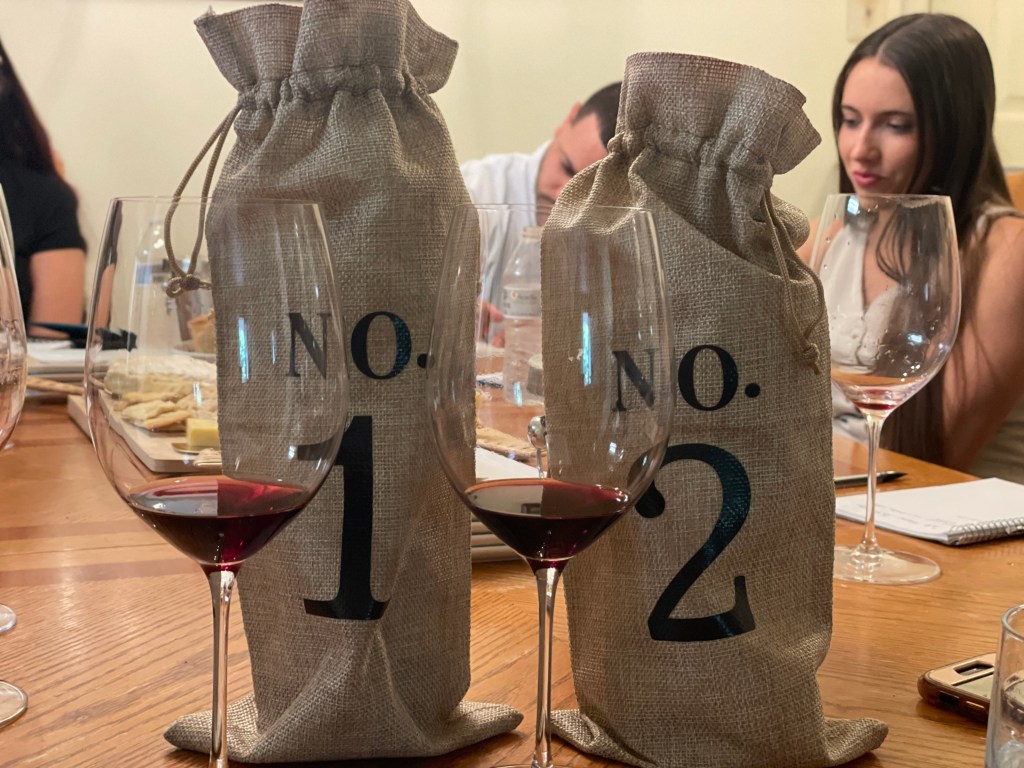
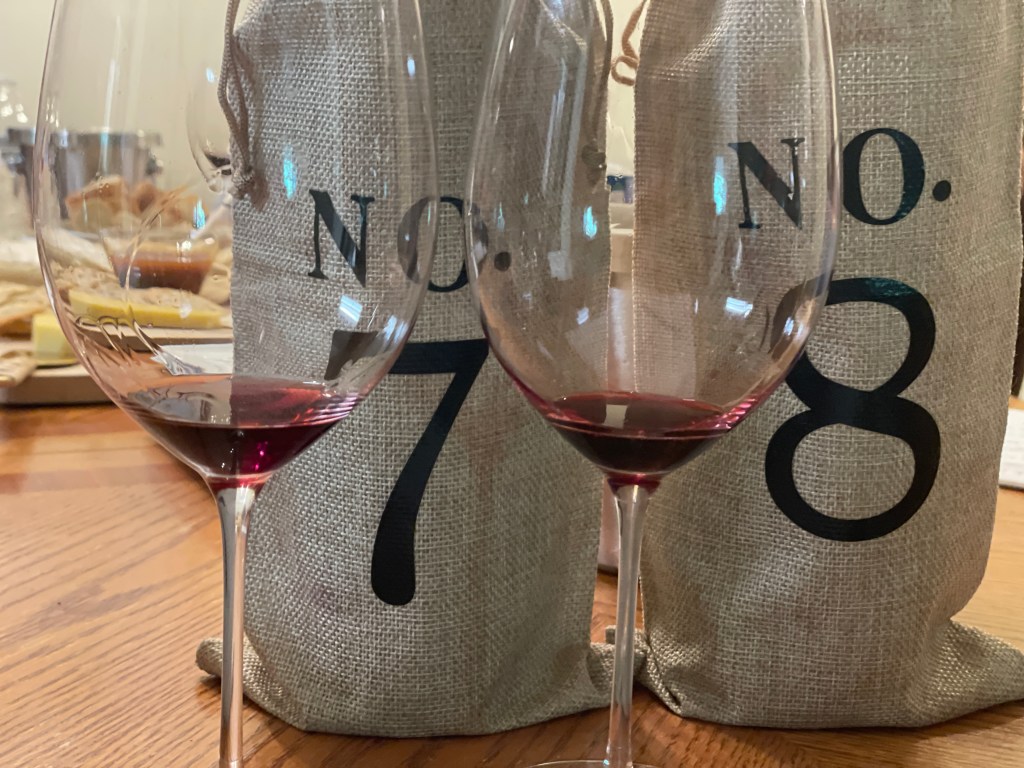
A group of friends & I blind tasted 4 comparison flights, each consisting of one French and one Virginia wine. All the flights were bagged blind. It wasn’t planned that way, but it turned out the odd numbers were always Virginia and even numbers were France.
Every round my guests picked a favorite, and also told me what region they felt it came from. After we sampled all of them, we did a vote to decide the top 3 wines of the day, then revisited the top wines for a 2nd tasting.
The contenders:
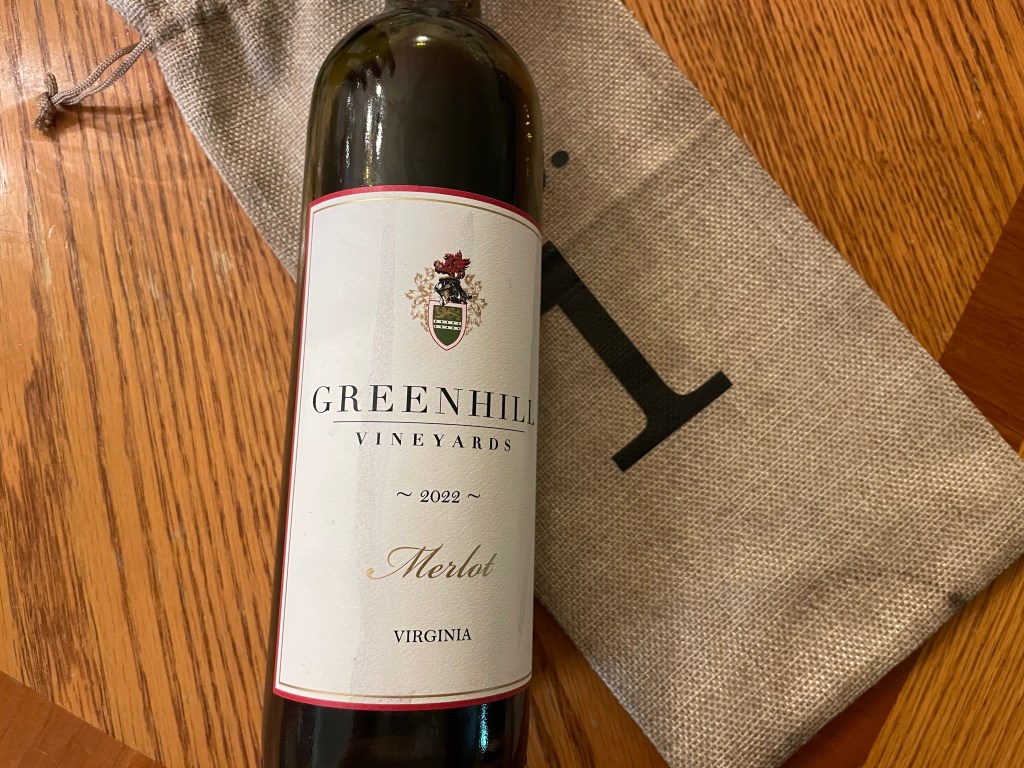
1. 2022 Greenhill Vineyards Merlot
2. 2020 Chateau Dragon de Quintus – St. Emilion (84.7% Merlot, 15.3% Cabernet Franc; roughly $40)
3. 2019 “Russ Mountain” Walsh Family Wine Merlot ($42)
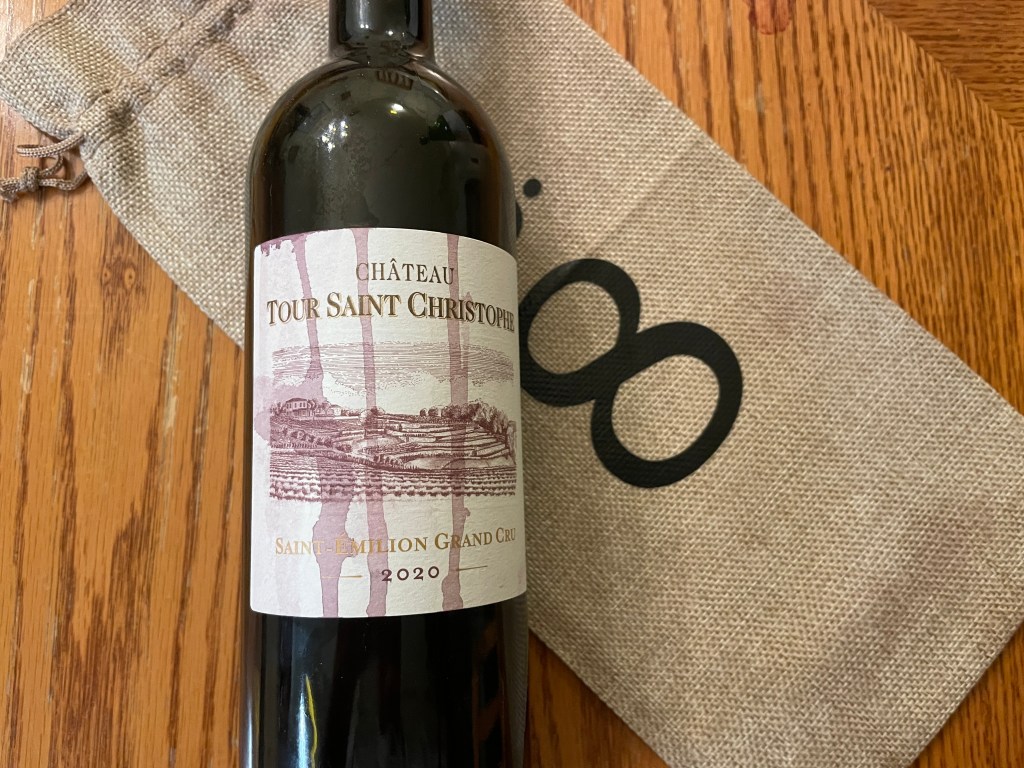
8. 2020 Chateau Tour St Christophe – St. Emilion (80% Merlot, 20% Cabernet Franc; $35)
Flight #1
Bottle #1: 2022 Greenhill Vineyards (4 votes)
Bottle #2: 2020 Chateau Dragon de Quintus (4 votes)
This was a tough round to judge. The results were evenly split, with #1/Greenhill generally being described as more smokey/spicy while #2/Dragon de Quintus was more tannic/punchy, with notes of dark fruit and forest floor. We didn’t do a great job identifying the correct region, as Greenhill really came off as ‘old world’.
Bottle #1 / 2022 Greenhill Vineyards (Virginia). The first wine (Greenhill) was a shade lighter, had some earth notes, but didn’t present as ‘New World’ to me. Our tasting notes generally focused on how it was more smokey/spicy, smooth, with reminders of autumn.
Bottle #2 / 2020 Chateau Dragon de Quintus (France). This wine was definitely the earthier and bolder of the two. I felt #2 was France, but I wasn’t completely certain of that call.
Most of the tasting descriptors listed #2 as more tannic/punchy, with notes of dark fruit; blackberry specifically. The higher level of alcohol (15.5%) was a turn-off for some people.
Votes:
Matt: Voted #1, felt it was Virginia.
Dominick: Voted #1, felt it was VA. Detected a woodsy, barrel-y char to it. Felt #2 had darker fruit, a more cranberry nose, and was tannic.
Hailey: Voted #2, felt it was VA. Described #1 was smoky and peppery, while #2 had more cloves and forest floor.
Ann: Voted #2 and thought it was Virginia. Felt #1 was ‘woodsy’. Felt #2 was bolder, with a blackberry note.
Emily: Voted #1, felt it was from VA. Thought #1 had a cherry nose, ‘autumnal spice’ notes on the palate. Thought it was nicely balanced. Thought #2 was ‘punchy’ (it did have 15.5% alcohol), was more fruit forward, and notes to blackberry and cherry.
Brandon: Voted #1, thought #1 was VA. Thought #2 was higher in tannin.
Ashley: Voted #2, thought #2 was France. Thought #1 had notes of coco and detected smooth tannin, maybe cherry coco on the notes and some pumpkin spice, nutmeg on the palate. Thought #2 was more caramelized, maybe a bit of brett and notes of liquorish.
Mica: Voted #2, thought #2 was France. Thought #1 was ‘mustardy’ (maybe spicy?), peppery.
I immediately liked this round much more than the previous one, even if both came off as somewhat barnyard-y. Again, the Virginia wine was lighter in color. I wasn’t a fan of #4 (Lalande de Pomerol) although by and large it was enjoyed by the table. #3/Walsh was almost universally pinned as our Virginia wine, if only because #4 was so unmistakenly France.
Bottle #3 / 2019 “Russ Mountain” Walsh Family Wine Merlot. I was surprised how many notes of ‘barnyard’ came out; having tried this in the past I don’t remember that at all. There were fruit notes here, but you had to look for them. Some noted notes of jamminess with that fruit.
Bottle #4 / 2019 Chateau Belles Graves. 13.5% alcohol but some felt it was higher. If #3 was barnyard-y, this was VERY barnyard-y with a side of funk. More than a few guests said they detected notes of green pepper and overall ‘earth’ notes.
Votes:
Matt: Voted #3, thought #3 was Virginia. I felt it was the far more balanced of the two, while #4 was rather monolithic to me (ironic because #3 was 100% Merlot while #4 had some Cab Franc).
Dominick: Voted #4, thought #4 was Virginia. Detected notes of thick jam, specifically strawberry in #3. Detected more green pepper on the nose and some on the palate of #4.
Hailey: Voted #3, thought #3 was Virginia. Felt #3 had a longer finish, more tart cherry, black pepper, with some barnyard characteristics. Felt #4 was more vegetal.
Ann: Voted #3, thought #3 was Virginia. #3 had a petrol nose, more fruit forward, floral, grippy and jammy.
Emily: Voted #3, thought #3 was Virginia. Thought #3 was very funky and barnyard-y on the nose. Thought #4 had higher alcohol and more green pepper notes.
Brandon: Voted #3, thought #3 was Virginia. Thought both were funky, but #4 was more so. #4 also had more alcohol.
Ashley: Voted #4, thought #4 was France. Thought #3 had notes of barnyard on the palate. Was tannic, notes of green pepper, ‘pesto sauce’. #4 was earthier.
Mica: Voted #3, thought #3 was Virginia. Thought #3 was ‘mildly memorable’, had a pepper tang, was earthy. #4 was more acidic.
Flight #3
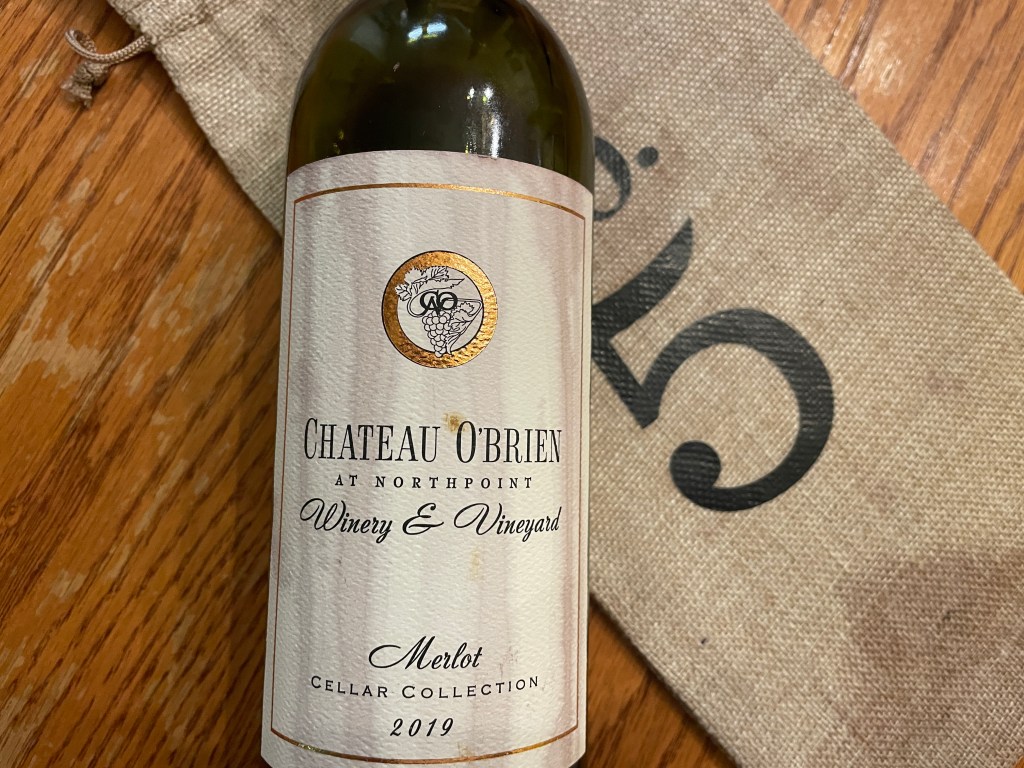
Bottle #5: 2019 Chateau O’Brien Merlot (6 votes)
Bottle #6: Troplong Mondot – St. Emilion (2 votes)
This was perhaps my favorite round of the day, and the group agreed these wines had two of the nicest finishes of the entire lineup.
Bottle #5 / 2019 Chateau O’Brien. Lots of great descriptors, with fruit notes of black or tart cherry, blackberry, blueberry, clove. “Fun” and “Vibrant” were my two favorite tasting descriptors. I suspect many of us knew this would be in the finalist round.
Bottle #6 / 2020 Troplong Mondot – St. Emilion. A rare 100% Merlot from Bordeaux. I liked it when I first sampled it at a wine store and my palate remembered it, since I was one of two people to vote for this wine as the round favorite. I thought this would go into the finalist round too, but I got outvoted.
This wine was almost universally praised for its balance, body, and black cherry/blackberry notes. Someone mentioned this was a ‘sit by the fire’ wine, and I think there was a lot of agreement on that.
Votes:
Matt: Voted #6, thought #6 was France. Thought #6 had wonderful black cherry notes.
Dominick: Voted #5, thought #5 was Virginia. Thought #5 had notes of dark fruit, noted a nice finish.
Hailey: Voted #6, thought #6 was Virginia. Thought #5 had notes of cloves, cherry, blackberry, and was tart. #6 had black cherry, blackberry, and was velvety.
Ann: Voted #5, thought #5 was Virginia. Thought #5 was ‘vibrant and fun’, fruit forward, with notes of boysenberry. #6 was more savory and had a good body.
Emily: Voted #5, thought #5 was Virginia. #5 was tart cherry, a little musty, liked the fruity aroma. #6 changed a lot in the glass (no tasting notes though).
Brandon: Voted #5, thought #5 was Virginia. #5 had notes of tart cherry, while #6 had an almost Pillsbury note to it, maybe brioche.
Ashley: Voted #5, thought #5 was Virginia. (I think this was #6); thought the nose and palate had different flavors.
Mica: Voted #5, thought #5 was France. Thought #5 had notes of blackberry and chocolate, with some mild pepper. #6 was tangier on the finish but was balanced.
Bottle #8: 2020 Chateau Tour Saint Christophe – St. Emilion (0 votes)
This was my 2nd favorite round. Both wines were well balanced and complex, although we overwhelmingly thought the Bluestone simply had more going for it.
Bottle #7 / 2021 Bluestone Vineyard Merlot. People LOVED the nose on this one. Very well balanced (I thought the best balance of the day), and this is the first time I ever heard someone describe ‘tomato leaf’ as a descriptor. Notes of tart cherry were also mentioned.
I do want to give a special shout out – at $27.50 this was possibly the best buy of the day. Try that Shenandoah Valley fruit!
Bottle #8 / 2020 Chateau Tour St Christophe. I looked online and this had some amazing ratings to it. This wine was almost universally praised for its balance, body, and black cherry/blackberry notes. Several noted its higher level of acidity, notes of mocha or chocolate, and many agreed with comments of its richness.
Votes:
Matt: Voted for #7 and I leaned towards France but couldn’t really decide. I thought #7 was complex and balance.
Dominick: Voted for #7 and thought it was Virginia. Thought #7 had a tomato leave nose, while the palate was more tomato and bell pepper. #8 was more dark chocolate.
Hailey: Voted for #7 and thought it was Virginia. Thought #7 was more tart cherry, red cherry, basil, and baking spice. #8 was more blackberry, clove, was more fruit-forward.
Ann: Voted for #7 and thought it was Virginia. Thought #7 had an almost sweet nose to it, and found notes of plumb. #8 had more brioche to it.
Emily: Voted for #7 and thought it was Virginia. Loved the nose on #7. Thought #8 was more of a cherry pie nose, and noted the great color.
Brandon: Voted for #7 and thought it was Virginia. #7 was more vegetal, well balanced, #8 was more jammy and rich.
Ashley: Voted for #7 and thought it was Virginia. #7 had an almost butter popcorn nose to it, toasty oak, coco. #8 had higher acidity and a chocolate pop to it.
Mica: Voted for #7 and thought it was Virginia. #7 reminded her of blackberry jam, while #8 was more acidity, maybe a lime and blackberry note to it.
Finalist Flight
Bottle #3: 2019 ‘Russ Mountain’ Walsh Family Wine (2nd place)
Bottle #5: 2019 Chateau O’Brien (#1st place)
Bottle #7: 2021 Bluestone Vineyard (#3rd place)
I did a poll of our favorite wines, and #3/Walsh Family, #5/Chateau O’Brien, and #7/Bluestone Vineyard were picked. As it so happened, all were from Virginia!
I wasn’t surprised that #5 (Chateau O’Brien) or #7 (Bluestone) made the list; there seemed to be a consensus to include those two. The hard part was choosing a 3rd option.
While I wasn’t a big fan of our 2nd round, we had more than a few guests who LOVED that round the most. There was just something about the ‘Old World’ quality that spoke to some people.
In the end, complexity of the #5/Chateau O’Brien earned the most #1st place votes, as well as many 2nd place votes. Walsh and Bluestone were almost tied.
Matt: Voted #5 / #7 / #3.
Dominick: Voted #7 / #5 / #3.
Hailey: Voted #3 / #7 / #5.
Ann: Voted #5 / #3 / #7.
Emily: #5 / #3 / #7.
Brandon: #5 / #7 / #3.
Ashley: #5 / #3 / #7.
Mica: #3 / #5 / #7.
Lessons Learned
I hadn’t done a straight-up Bordeaux comparison before, so it was interesting to see the results. I have to say though; I was genuinely surprised to see that in 1-vs-1, Virginia won 3 out of 4 and tied with the 4th. On top of that, the top 3 were all Virginia.
I have to wonder if maybe my guests having a ‘Virginia palate’ may have influenced the results (we picked the Virginia wine around 75% of the time). That’s not entirely true though; we often liked the Bordeaux wine, and several chose Bordeaux over Virginia…but the purity of the fruit of the Virginia wines often carried them to the ‘win’.
That in itself was surprising. Normally you think that blends are an improvement, since the combination is supposed to give them an edge over single-varietal wines. Yet here, the most popular French wine was probably the 100% Merlot. The other three (with 12-20% Cab Franc) were at times too tannic, or too acidic, or too alcohol-y.
I do think I need to up my game in finding equivalent French bottles. You’d think wines in the $40-range would be equivalent to what Virginia can produce, but here that wasn’t so.
I also have to give credit to Howard O’Brien of Chateau O’Brien, who introduced this wine to me on a visit earlier this year. O’Brien is known for smooth but big reds, especially his Tannat. This was the first time he’d had a 100% Merlot, and he knocked it out of the park. I probably should have put this against a higher-priced Bordeaux to make it a more equitable challenge.
Most importantly, everyone in attendance loved these 100% Merlots. So screw that Sideways movie and try one yourself.
Farm-to-table dinners are by definition designed to showcase food that’s locally produced. Yet it’s less common for the dinner hosts to also be the farmers who grew your meal, and especially rare to see exactly where and how those provisions were sourced.
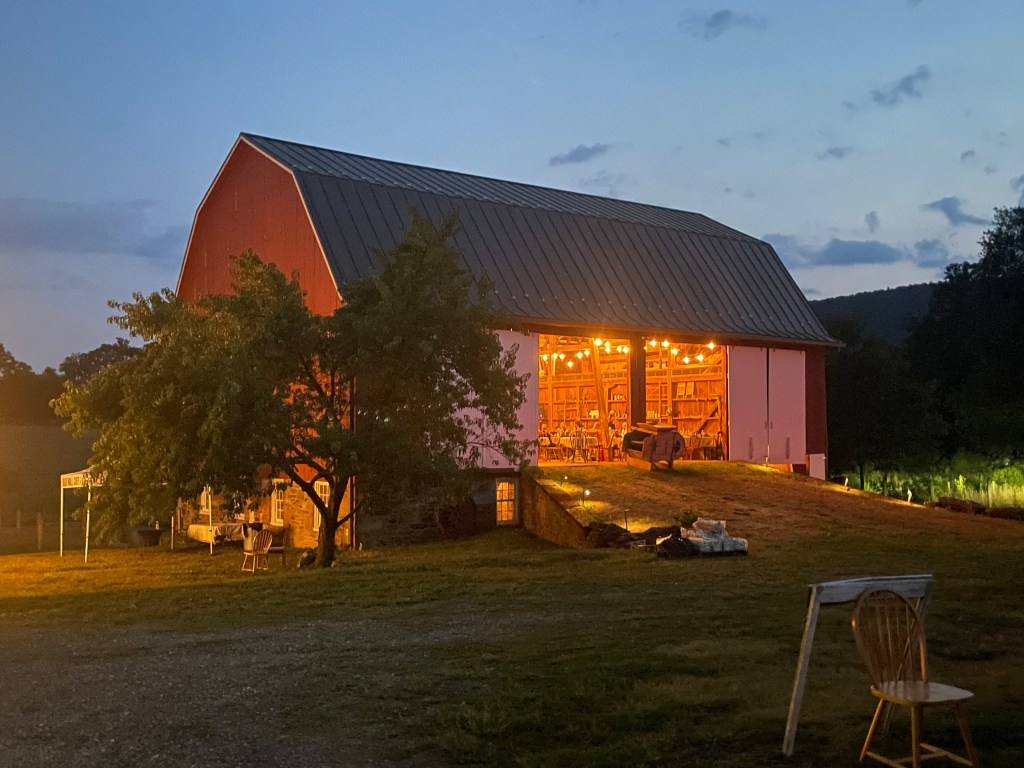
So when Long Stone Farm owners Justin & Casey Wisch took my group on a ride through their farm, right before enjoying one of their culinary experiences, it really took the ‘farm-to-table’ idea to new heights.
I discovered Long Stone when visiting the Wischs’ new tasting room, Blue Wall Cider & Wine, located just outside Leesburg. Blue Wall doubles as a storefront for their trio of CSAs, which specialize in meat, oysters, and cider.
Long Stone is all about sustainable agriculture, producing all of their own meat and cider with an emphasis on farming organically and integrating livestock into their operation. The Wischs also partner with those who share their values, so they serve wine made by Nate Walsh of nearby Walsh Family Wine, while the CSA oysters come from Chesapeake Bay-based Rouge Oysters.
After my visit I found out about their culinary tour, which combines an educational farm ride followed by a meal initially described as ‘southern comfort food’. I later learned this dinner was far more high-end than this descriptor implies, and the tour greatly complimented the meal.
What is Sustainable Agriculture?
We kicked off the event with a quick meet-and-greet with cider, wine, and cathead chicken biscuits as our hors d’oeuvres. Then we hopped into the hay wagon for the educational part of the visit.
In describing the Sunday Supper, Casey explained, “The meals here are usually gluten free and highly nutritious. You won’t find a more local meal even if you go to a farm-to-fork dinner, since a lot of time you’re missing the farmer in that relationship.”
The Wischs also discussed how the farm got started, their CSAs, and the overall philosophy that guides their business.
The book definition of sustainable farming is “farming in such a way that it protects, if not aids, the natural environment”. That’s true at Long Stone Farm, but only covers part of what goes on.
The Wischs described sustainable agricultural in very practical terms. The short version: sustainable farming is not just good for the land, it provides healthy and delicious food. Their customers seem to think so as well, which is why their CSAs have a 90% renewal rate.
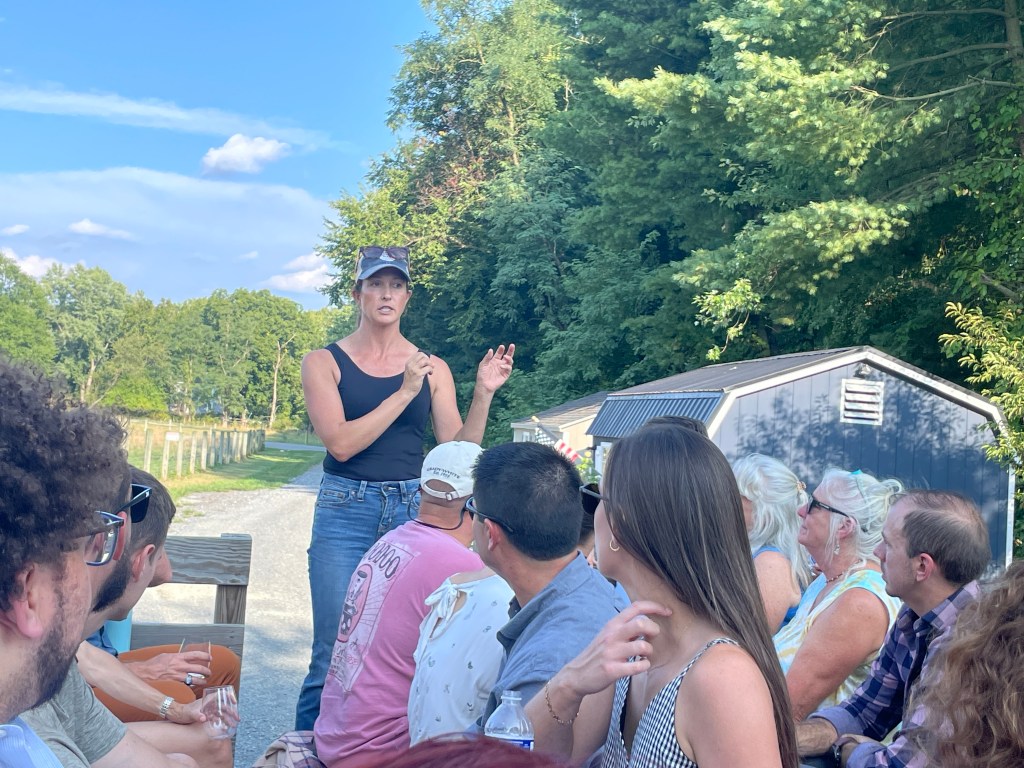
As we passed chicken coops and cow pastures, Casey gave us the full story of what makes their farm truly sustainable. “The integration is mutually beneficial. Our chickens drop nitrates, which fertilizes the grass for the cows. Those areas are the first places our cows want to graze. The cows also provide a great ecosystem benefit by eating unwanted underbrush, which manages a lot of land in a regenerative way.
Our livestock also provides pest prevention by grazing dropped fruits, and reduces costs associated with mowing under the trees. We have the ability to run our poultry, hogs, and cattle to assist with understory management and additional fertilizer applications during various times of the year.
All of this leads to healthier food and better fruit.”
We also learned about their cider operation, which they named “Blue Wall” due to the farm’s western view of Short Hill Mountain. They manage the farm to organic standards, and their cider is only made from this estate orchard. As with the rest of the farm, it benefits from being integrated with their livestock.
“We have four varieties of apples right now, with a focus on Winesap. We pick new varieties based on their disease-resistance and performance. Because we are integrating the orchard into our operations instead of selecting a farm and planting an orchard, we select varieties that grow best on this particular site.
We have beautiful north to south runs for the trees and have been rehabilitating our soil in this field via our livestock and cover crops for the last 5 years. We feel soil preparation is vital to our tree health and it has taken a few years to prepare for trees to be planted.”
Time for “Sunday Supper”
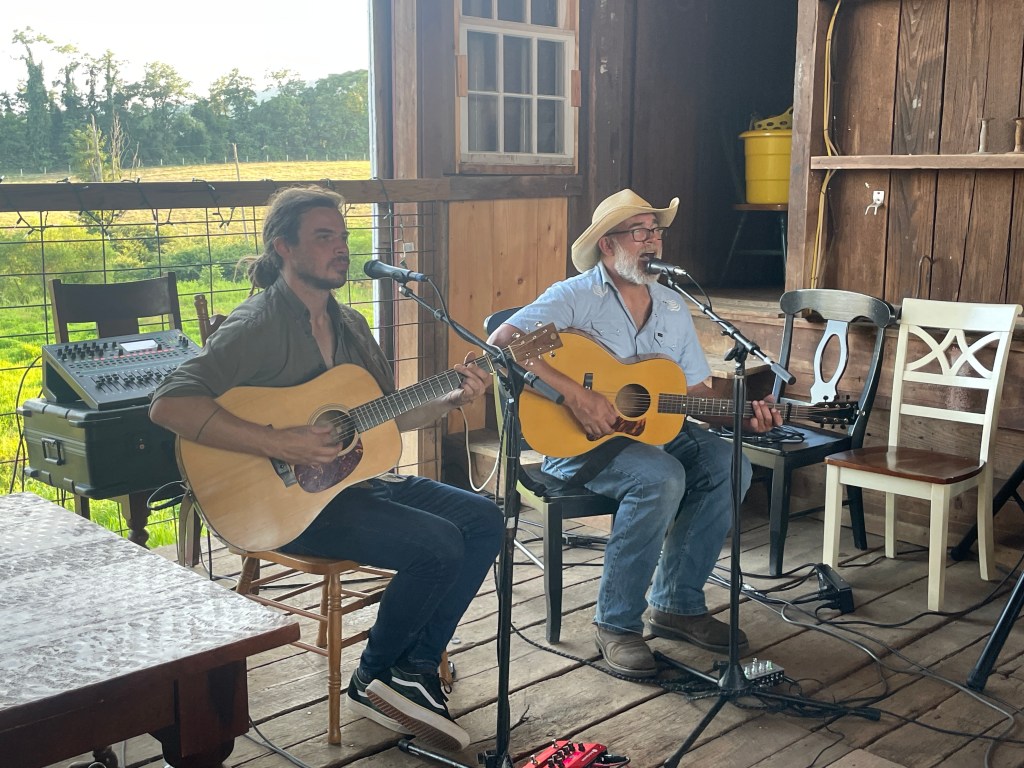
After our tour was complete it was time for our 3-course meal (plus dessert), with live music in the background.
Justin & Casey picked Leesburg-based Buford’s Biscuits as our chefs for two reasons. First of all, Long Stone always uses local businesses as their chef partner. Just as importantly, Buford’s Biscuits is amazing.
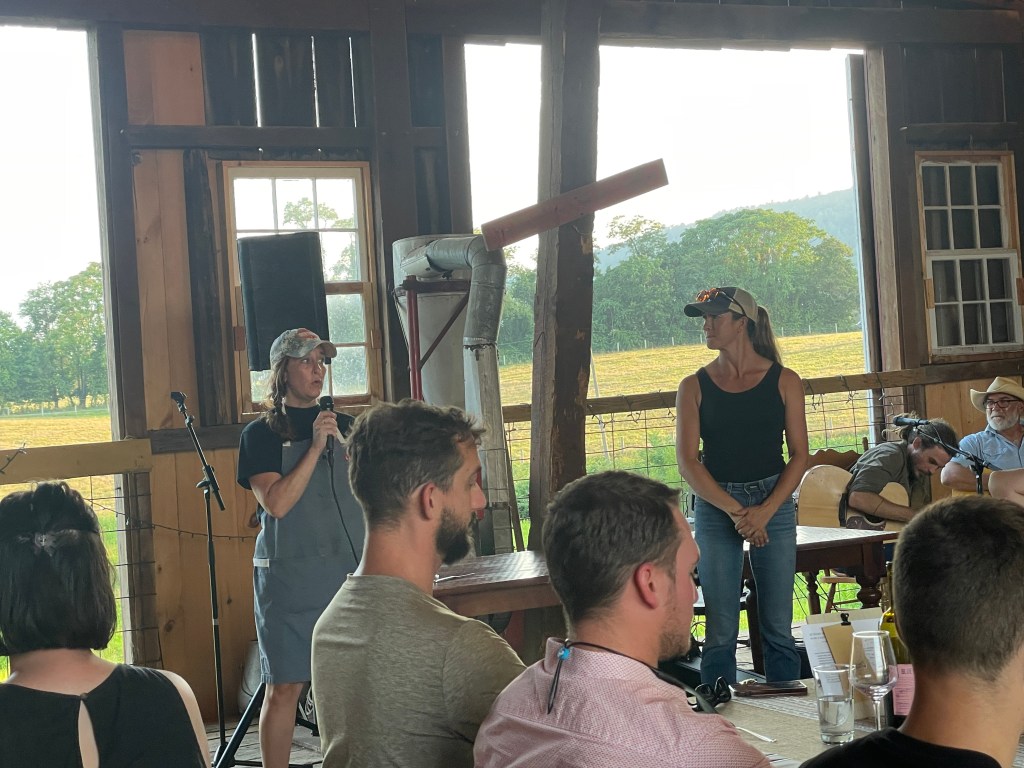
Co-owner Lauren Barret explained to the audience what ingredients she used and where they came from, while Casey told us about the hogs that gave ‘their last full measure’ for this meal.
The first course consisted of an Appalachian Panzanella, a crouton-based salad using Buford’s dried biscuits rehydrated in vinaigrette, with cheese and heirloom tomatoes.
Our second course was a sweet tea-brined chicken served with Nashville sweet & spicy sauce, alongside a fresh squash & corn salad.
The third course consisted of seared herb & garlic pork chop, with nectarine jam, roasted bacon, and collards.
Topping it all off was a strawberry short cake with chocolate gravy. Lauren emphasized the Appalachian roots of all of Buford’s dishes, laughing how “down South we love chocolate gravy”.
Every meal was paired with cider or wine. We started with their Ashmead’s semi-sweet cider, but our hosts provided samples from a wide variety of other beverages from Blue Wall.
Most cideries focus on what I call ‘beer cider’; carbonated, often flavored, usually served in a can. The cider from Blue Wall is what I think of as ‘wine cider’; lighter, elegant, and more representative of the fruit they came from. Most are dry, although the off-dry Ashmead’s hit the spot on a warm evening.
After our meal I picked up some duck eggs at the local farm store.
I loved my entire visit! You’ll appreciate farm-to-table food even more once you visit the farm. Their next event is September 22, this time with The Wine Kitchen and Wined & Dined. Check it out and tell me what you think.
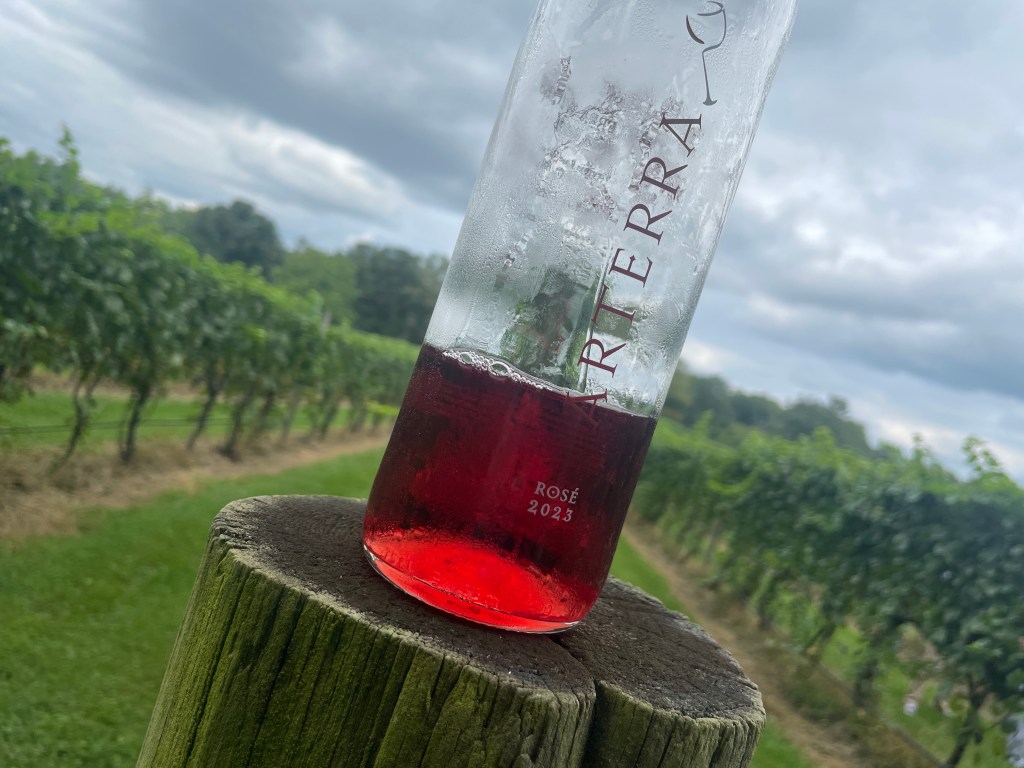
This Saturday I joined Jason Murray of Arterra Wines for a fall wine release/vineyard tour of Seven Oaks, his main satellite vineyard. Joining us was Seven Oaks owners Mark and Madeline Skinner.
For those unfamiliar with Arterra, Jason is a huge proponent of low-intervention winemaking. I’d go so far to call it ‘ultra-low’ intervention, given his focus on using only natural yeast fermentation and basically allowing his wines to decide ‘what they want to be’ rather than force them into a certain direction.
The result is Jason produces wine that, if you tasted them blind in a lineup, you can always tell which are his. During the tour he explained, “I like wine that’s distinctive, that doesn’t taste like every other wine”. All his wines are made to be variety-specific or vineyard-specific.
Arterra’s estate vineyard provides most of their fruit. But since 2005 he’s also partnered with the Skinners to grow wine at their home in the town of Philomont (roughly halfway between Middleburg and Purcellville). Today, Seven Oaks Vineyard has 8.5 acres under vine.
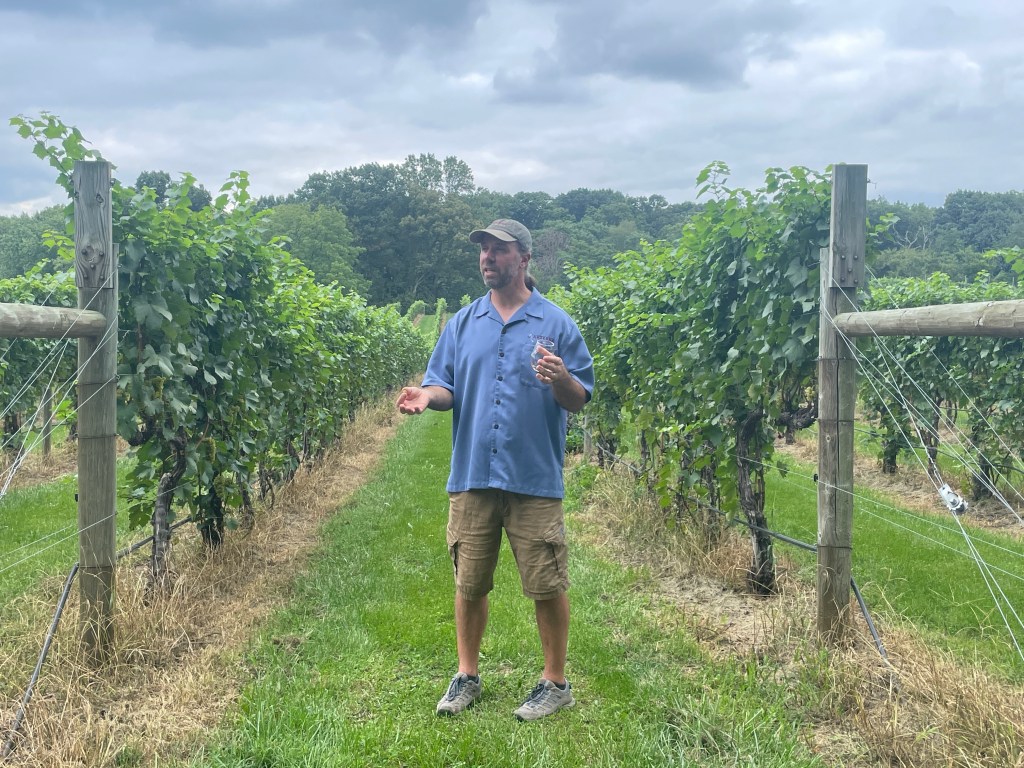
When we got started, Mark and Jason gave us the low-down of the property.
It turns out the farm is historic, going back to colonial times when Lord Fairfax was sub-dividing his land grant into different segments (driving in you pass a sign that says “Seven Oaks Circa 1795”). You wouldn’t know by looking at it, but the main house started as a log cabin and was repeatedly expanded upon over time.
The land was purchased years back by Mark’s father Ben Skinner, a retired Marine Corps aviator who wanted a place away from the city. It’s also really, really pretty and I hope the Skinners host more events here. I especially loved the pond with a sitting area in front of it.
Seven Oaks is what Jason calls a “Piedmont site”, which he defines as relatively lower-elevation site with more energetic soil, as opposed to the thinner soils of a mountain site such as his 950-foot elevation estate vineyard. Seven Oaks’ lower 450-foot elevation drives much of the decision-making on what to plant here.
The vineyard’s original plantings includes Chardonnay, Petit Verdot, and Cabernet Franc. More recently it’s become home to Arterra’s Grüner Veltliner, Blaufränkisch, and Zweigelt. It used to grow Arterra’s Malbec, until it was torn out around 2019.
Planning for cold weather events is actually why Jason chose the last three varieties. All three are indigenous to Austria, which only grows grapes suitable for cooler climates.
At first I was confused why someone would plant cool-climate varieties in warm-climate Virginia. But Jason explained “It’s all about the right grape in the right site”.
While Virginia’s summers are characterized as ‘hot and humid’, its winters can occasionally be very cold (as the polar vortex of 2014 demonstrated). Low-elevation sites are especially vulnerable to cold weather, which is why Jason decided to keep his most tender vinifera at his estate vineyard while focusing on early ripening, cold-hardy varieties here.
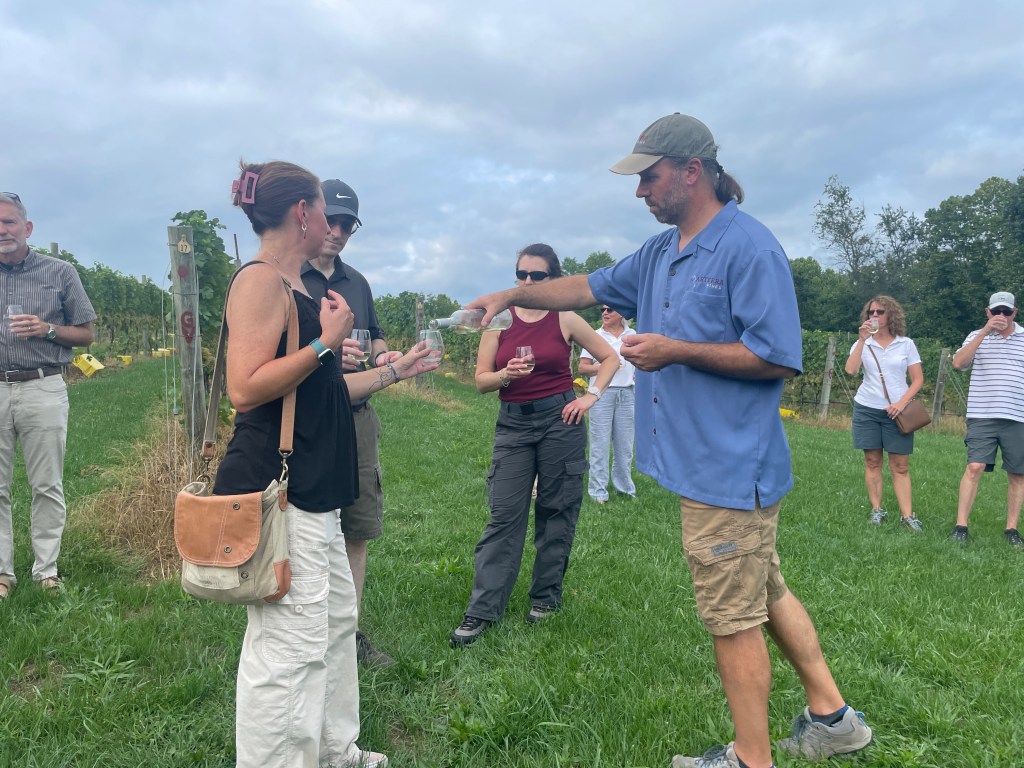
Jason and Mark walked us through their various plantings and we sampled grapes from the vine while tasting wine made from those plots. It was my first time tasting the Zweigelt and Blau, and only second time tasting the Grüner.
I felt the Blau was very fresh and juicy; a summer/fall wine that can be enjoyed a little chilled. The Zweigelt was more of a fall/winter or food wine; it was too warm for me to enjoy on our walk but I’d enjoy it with hearty meal. It was also a favorite of the local wildlife, apparently.
I loved the Grüner as well. This was different from the lean, austere wines of Austria. It was ‘bigger’ in volume and richer in texture than the typical Grüners you find. Some of that may be its location, but I think most of the credit is because of Jason’s focus on ‘clean’ wine and use of natural yeast.
All three varieties were recent additions, with 2022 being their first vintages. Sandy and Jason Murray were really excited to see how the vine’s growing maturity would influence the wine.
We also tried the no-sulfite PV, Cab Franc, and his rosé. While Jason makes a more ‘traditional’ PV, this one only uses fruit from the Seven Oaks Vineyard. This PV was softer than his regular PV, while the Cab Franc might have been my favorite wine of the day.
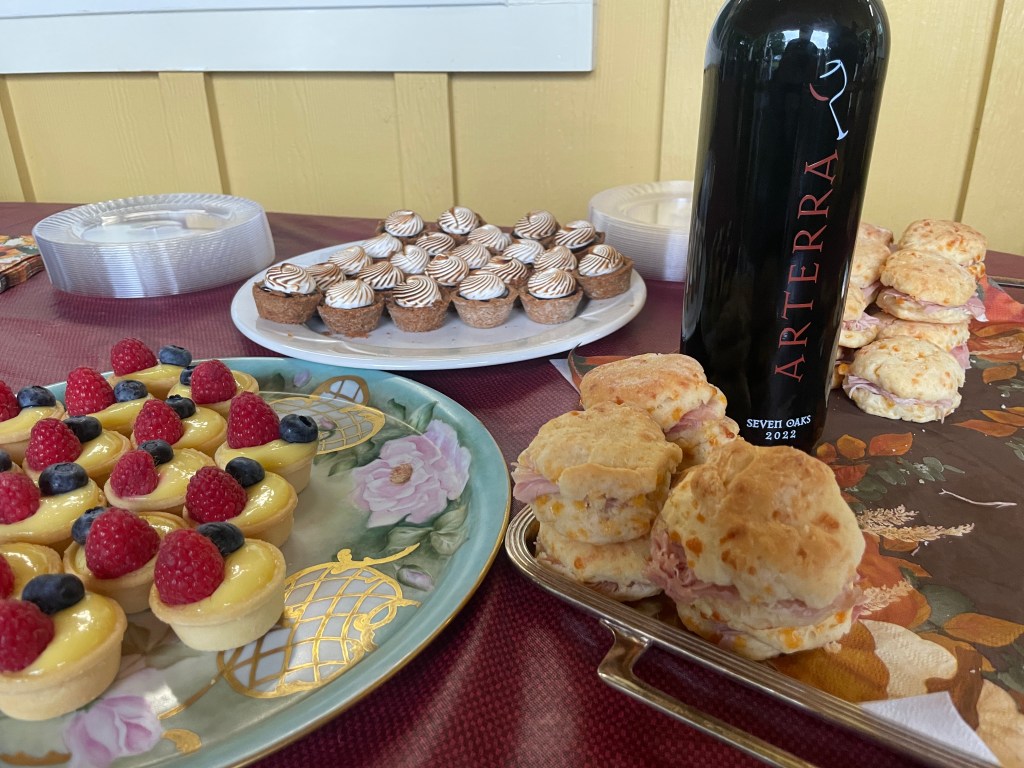
We finished the day with a big charcuterie plate and other light bites, which we paired with his Seven Oaks red blend.











































 Wine Trails and Wanderlust