When oenophiles think of events that changed the course of the American wine industry, they’ll likely mention the 1976 “Judgement of Paris.” During that event, a group of French wine judges blind tasted a lineup of American and French chardonnays and red blends, and ranked a pair of Napa wines as the best in both categories.
While not as famous, the Virginia wine industry has made its own contributions to the modern wine industry. Here are a few pieces of Virginia wine trivia that everyone should know.
The Carter Family – Colonial America’s First Internationally Recognized Winemakers
Thomas Jefferson is America’s most famous oenophile, yet he never made his own wine. While he believed America had great potential as a wine region and spent decades trying to grow European grapes, Jefferson’s experiments were constantly thwarted by pests and weather.
Few realize that almost 20 years prior to his viticultural trials at Monticello, the Carter family succeeded where even Jefferson failed.
The Carters were one of the “First Families of Virginia,” a group of early settlers who rose to social and political prominence. Looking to diversify their crops away from tobacco, Virginia farmers were encouraged to plant vines.
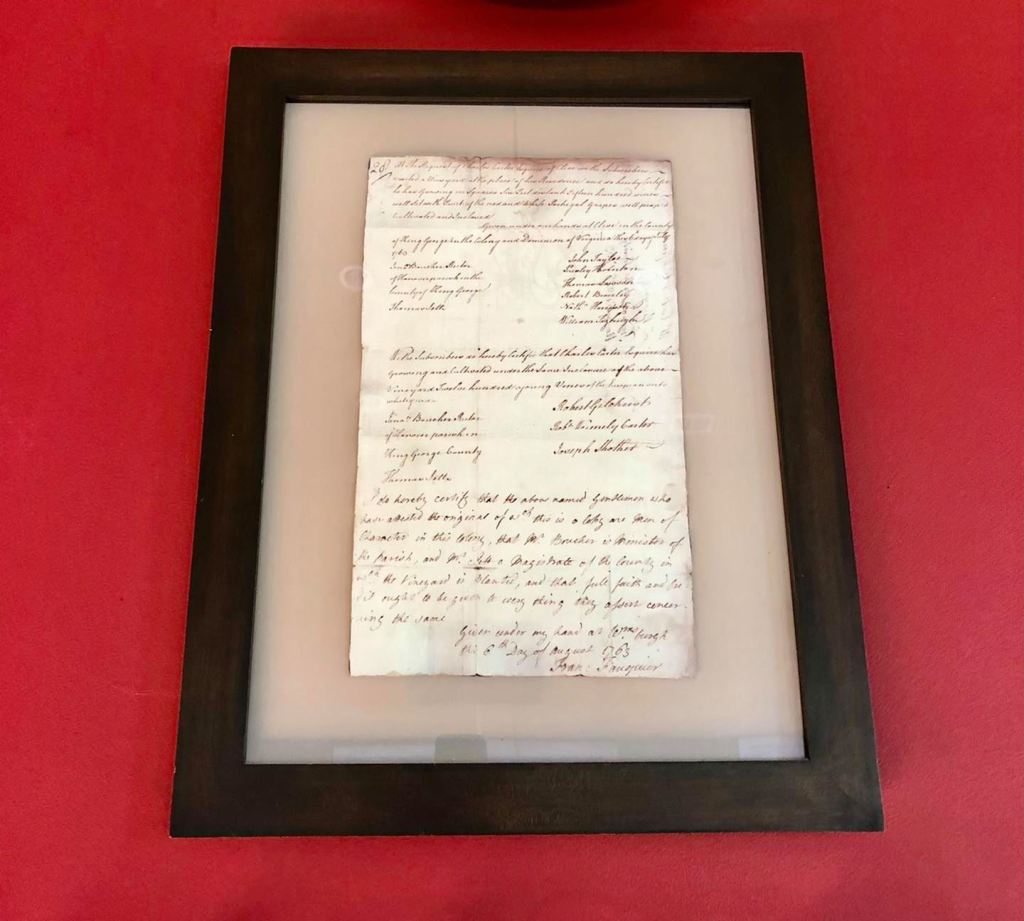
In 1762, Charles Carter sent a dozen bottles of wine produced at his plantation of Cleve (located in today’s King George County) to London’s Royal Society of Arts. The exact grapes he used is unknown, although they likely came from a mix of domestic and European vines.
Impressed with what they sampled, the Society awarded him a gold medal for his “spirited attempt towards the accomplishment of their views, respecting wine in America.” A year later, the Royal Governor of Virginia certified that the Carter family successfully grew European grapes.
The Carter family’s vines were short-lived, likely the victim of the same issues that beset Jefferson. Nevertheless, the Carters were the first successful winegrowers in Virginia (if only for a few years), and possibly all Colonial America.
The Story of Woburn Winery, America’s First Black Owned and Operated Winery
The American wine industry is notorious for its lack of diversity. According to a 2019 survey of 3,100 wine industry professionals by SevenFifty Daily, only 2% of participants identified as Black.
John June Lewis, Sr (1894–1974) was one of the pioneers of this movement, a Black man fathered by a former slave owner and Confederate veteran.
Born in Mecklenburg County, Lewis is listed in the 1910 United States Federal Census as a mulatto servant of Armistead Burwell. John’s son John June “Duckie” Lewis, Jr. previously indicated Burwell was also Lewis Sr’s father, and census records further link the Burwell and Lewis families.
Burwell taught the older Lewis winemaking when Lewis was a child, though it wasn’t until Lewis Sr. was stationed in Europe with the US Army during the aftermath of WW I that he discovered a passion for wine. He would later inherit the former Burwell farm, where he planted 10 acres of vines following the repeal of Prohibition.
This land became known as Woburn Winery, widely regarded as America’s first Black-owned and operated winery. Woburn made wine from native and hybrid grapes for 30 years and closed shortly after Lewis Sr.’s death in 1974.
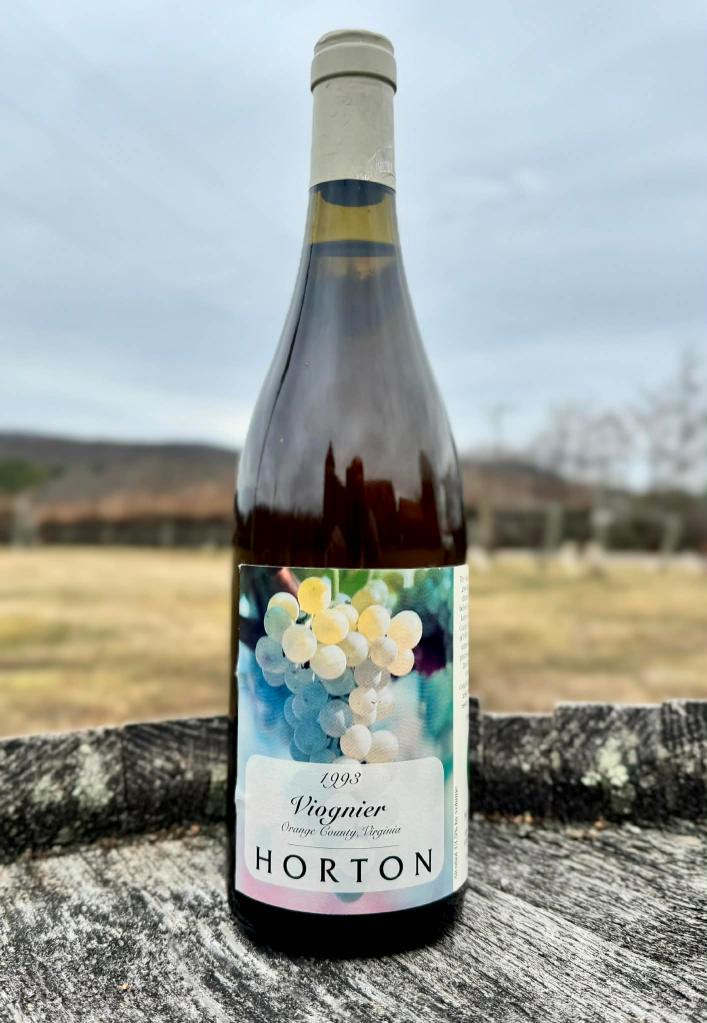
Horton Vineyards’ 1993 Viognier – The Wine That Helped Put Virginia On The Wine Map
The 1990s were a time of experimentation for the Virginia wine industry. Vineyards were finally reappearing after a long prohibition-induced absence, and information on how to grow vinifera (European-based grapes) in Virginia’s humid weather was scarce.
Few embraced this spirit of experimentation as passionately as Dennis Horton of Horton Vineyards. According to granddaughter Caitlin Horton, “My grandfather really didn’t like chardonnay. He wanted a white that he could pair with heavier food. While traveling in France he found viognier in the Rhône valley and fell in love with it. So he planted 14 acres off the bat – didn’t even do a test planting. People thought he was crazy.”
At the time, viognier was essentially dying out. When Jancis Robinson wrote Vines, Grapes & Wine in 1985 she could only identify records for 80 acres planted in the entire world, most of it in viognier’s home of Condrieu.
Dennis’s intuition paid off. Horton’s 1993 Viognier won first place at a California wine competition, providing Virginia some of its earliest national recognition as a wine region. The Napa-based French Laundry (one of the most esteemed restaurants in the United States) took notice, and selected it as the first Virginia wine to have a place on their wine list.
Horton’s success not only gave a publicity boost to the nascent Virginia wine industry, it was also instrumental in saving this grape, which now has around 40,000 acres worldwide.
Looking at recent press praising American Cabernet Franc as a single varietal wine, you’d think this grape has only now been ‘discovered’ by US publications. In 2025 Wine Enthusiast declared “Cabernet Franc is in its “It” Era”. Other articles praise Cab Franc for losing its image as a grape that’s “Always the bridesmaid, rarely the bride” (a reference to how CF is a relatively minor player in Bordeaux).
The reality is winegrowers on the East Coast have long seen Cabernet Franc as one of their signature grapes. For example, New York wineries have become so enamored with this grape they recently instituted a “Cabernet Franc Forward” initiative to highlight its success.
As much as I love the idea, I believe NY is only now recognizing what Virginia has known all along. Cabernet Franc is one of the East Coast’s most reliable, versatile grapes.
Virginia has 629 acres of Cabernet Franc, as reported in Virginia’s 2024 Commercial Grape Report. Cabernet Franc is so important to local viticulture these acres comprise 18.5% of total wine grape plantings in the state (by contrast, it’s barely over 0.5% of California’s total vineyard acreage). It’s also been Virginia’s most widely planted wine grape since 2019.
When I asked Pearmund Cellars winemaker Mark Ward to explain Cabernet Franc’s appeal in Virginia, he put it like this:
“Cabernet Franc is well suited to Virginia from a growing perspective with thicker skins and looser clusters, important factors due to Virginia’s humid weather. It also ripens earlier, avoiding potential late-season rains. It’s flexibility in the cellar reflects a winemaker’s style while still allowing it to be approachable early from the consumer’s viewpoint.”
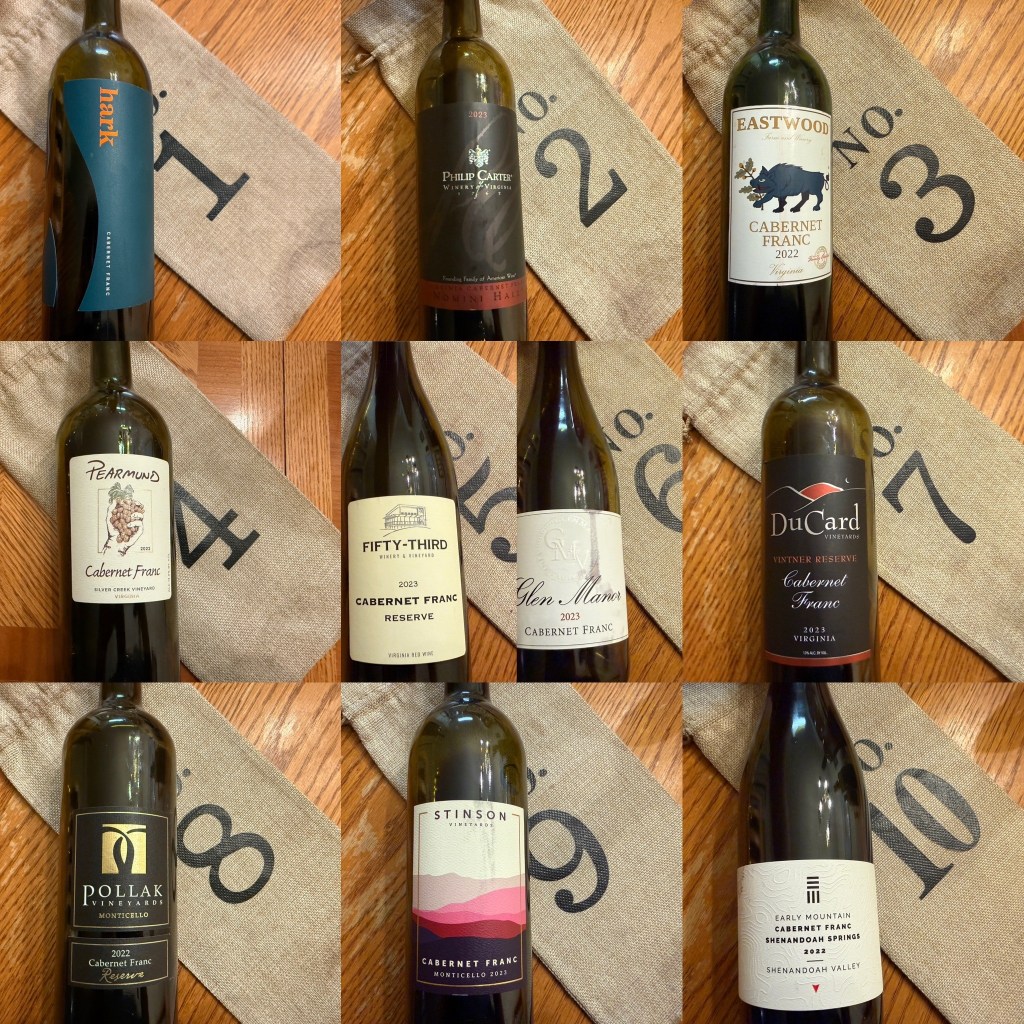
Not shown is the 2022 Early Mountain Vineyards “Shenandoah Springs”
Tasting & Scoring Methodology
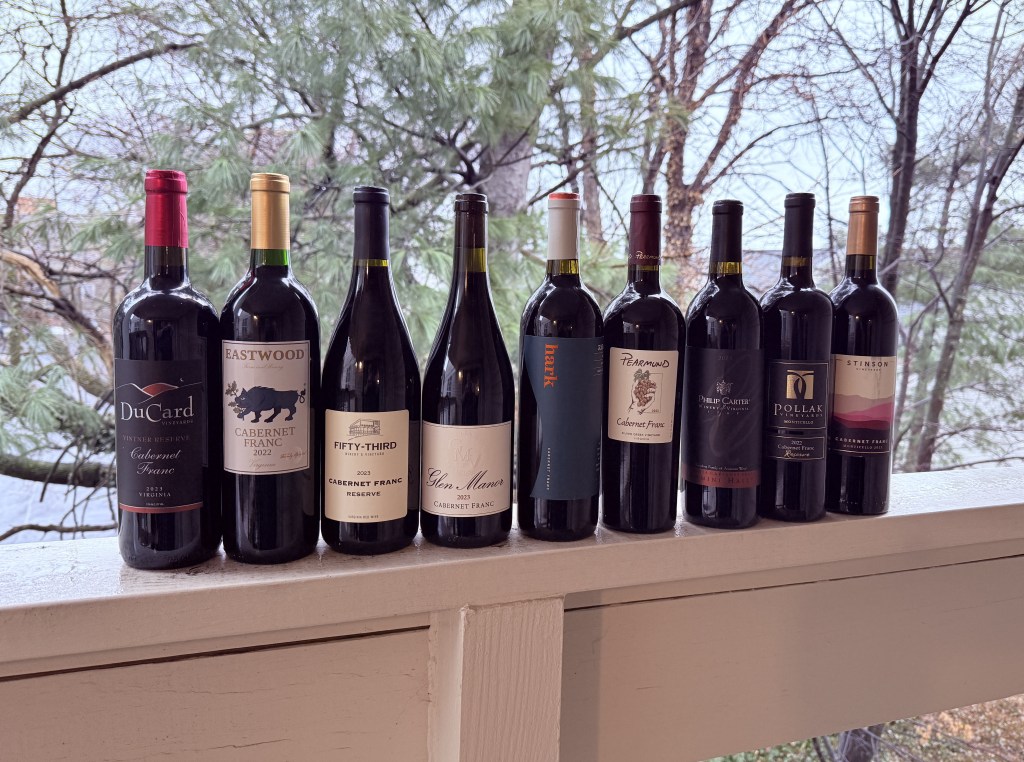
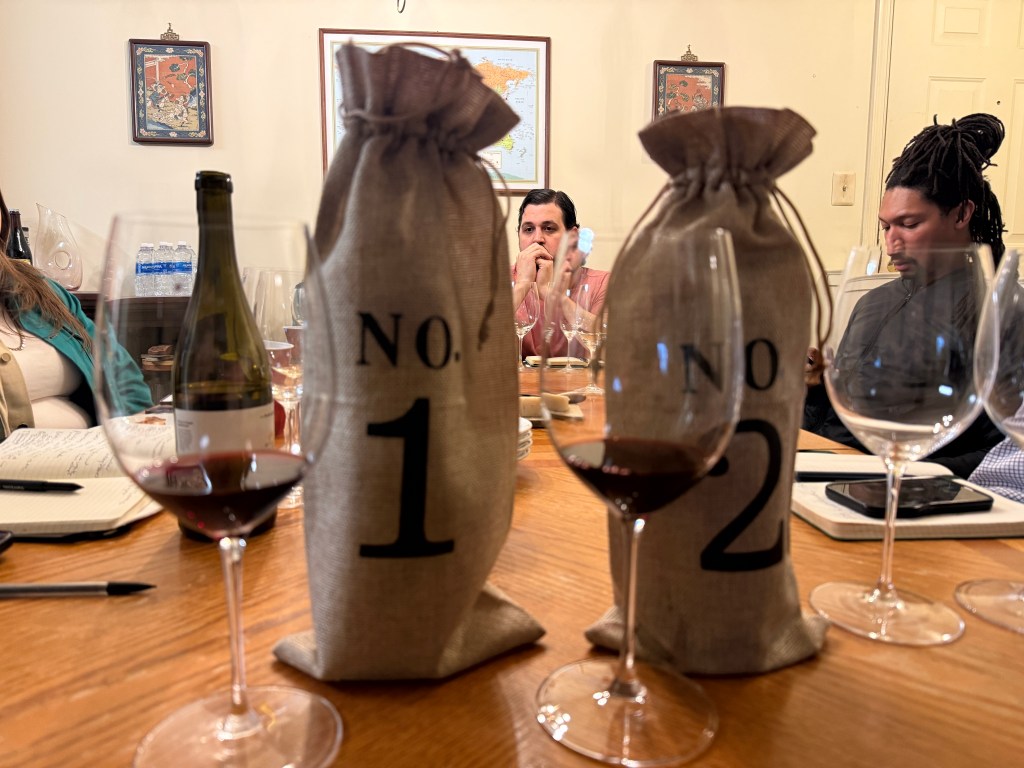
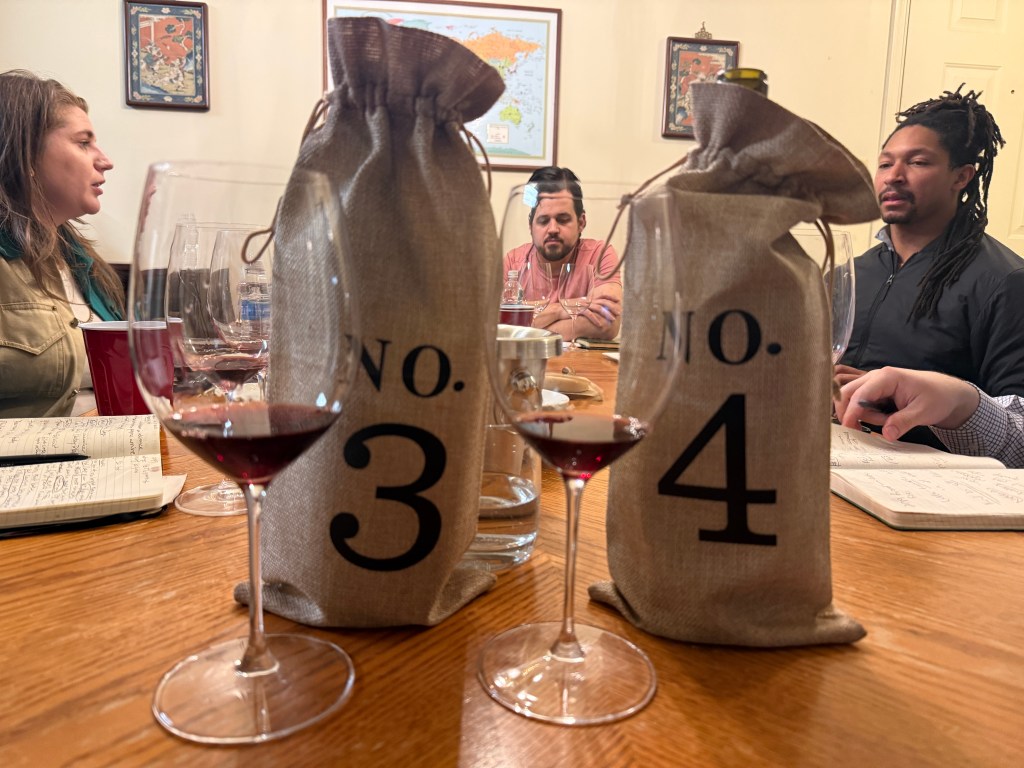
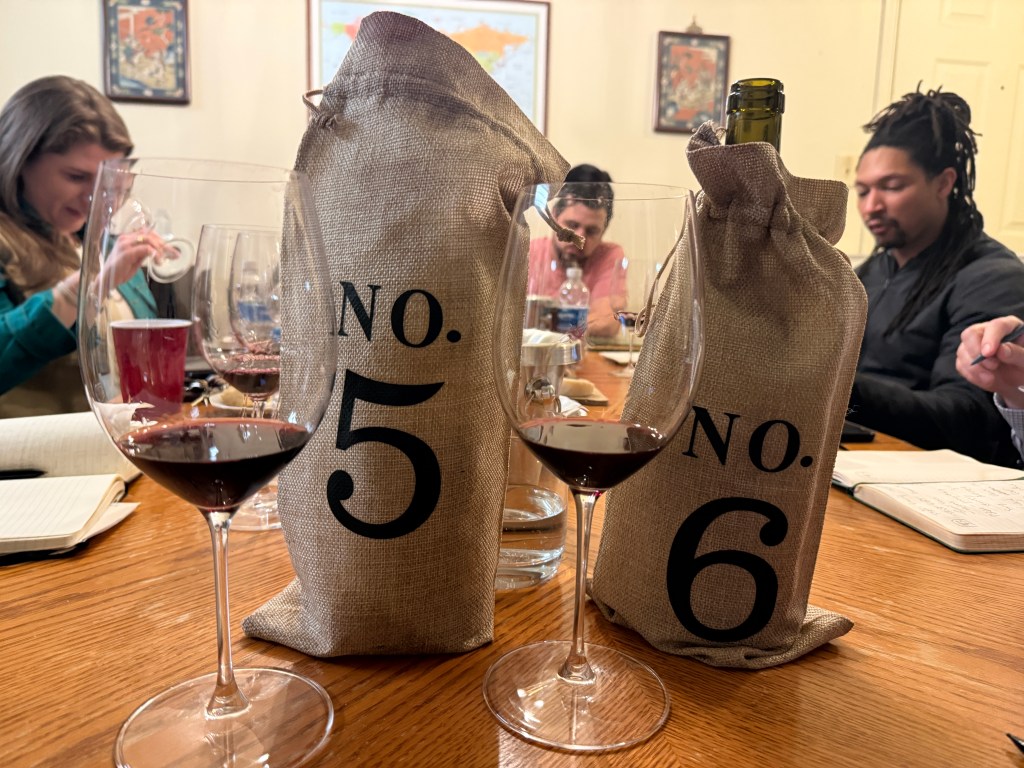
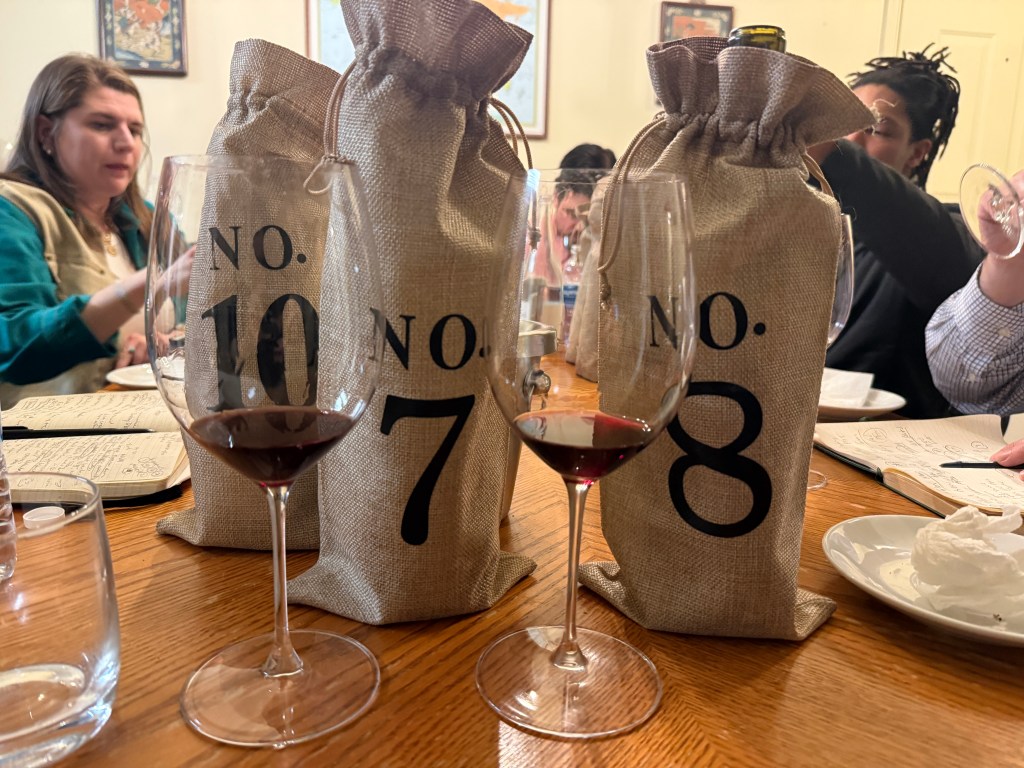
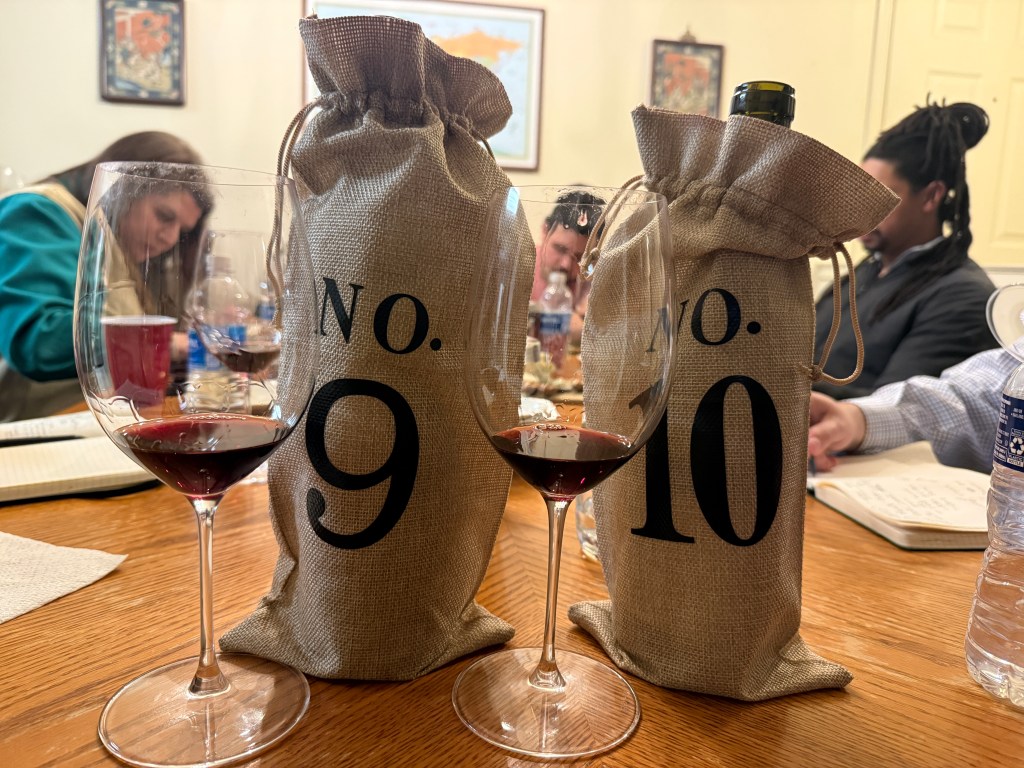
My group blind tasted 10 wines in 5 flights. All the flights were bagged blind (even to me).
The makeup of this particular group of tasters was a bit unusual for my events. While many of my blind tasting participants are already wine professionals, this particular comparison included 5 guests who work as professional somms in DC restaurants or wine stores. While all were broadly familiar with Virginia wine, many of the producers I featured were unfamiliar to them (note: around half these wines were industry gift samples).
One thing that stood out was how important ‘typicity’ was with this group. This was in line with something Matthieu Finot of King Family once told me, that Cabernet Franc must retain varietal characteristics such as pyrazines in order for it retain its ‘soul’. Without those markers, Cab Franc becomes just another red wine.
I specified the goal was for everyone to pick a ‘drink now’ personal favorite, as opposed to selecting wines that met the technical specifications for what should be the ‘best’ wine in a judging lineup. I use this method because that’s how most everyday drinkers choose their wines.
That said, I think the ‘favorites’ skewed towards wines that were more stereotypically ‘Cab Franc-y’, which is important in understanding how we voted. After typicity, the somms tended to focus on balance and integration. I heard more discussions about structure and alcohol levels at this event than probably any other tasting I’ve hosted.
For this event I used a new format. We went through all 10 wines first, then took palate-cleansing sparkling wine break before the ‘finals’.
For the finalist round, I put all the wines on the table to allow re-tastes, then had participants give me their “Top 3” wines.
The Contenders
2023 Hark Vineyards
2023 Philip Carter Winery “Nomini Hall”
2022 Eastwood Farm
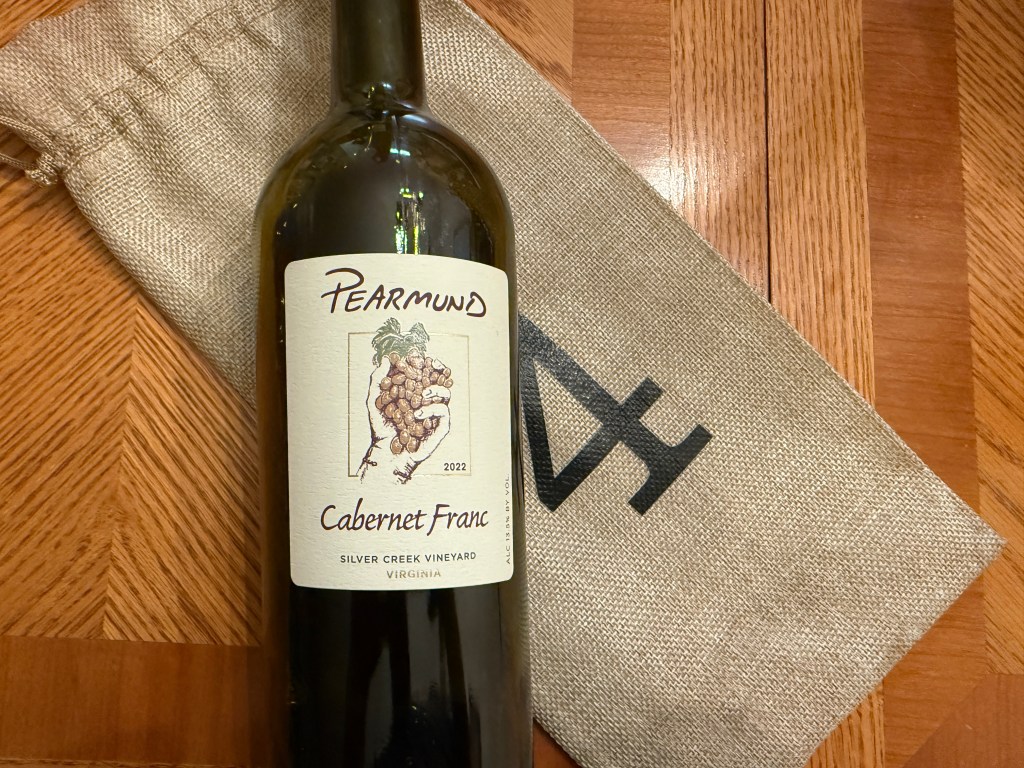
2022 Pearmund Cellars
2023 Fifty-Third Winery
2023 Glen Manor Vineyards
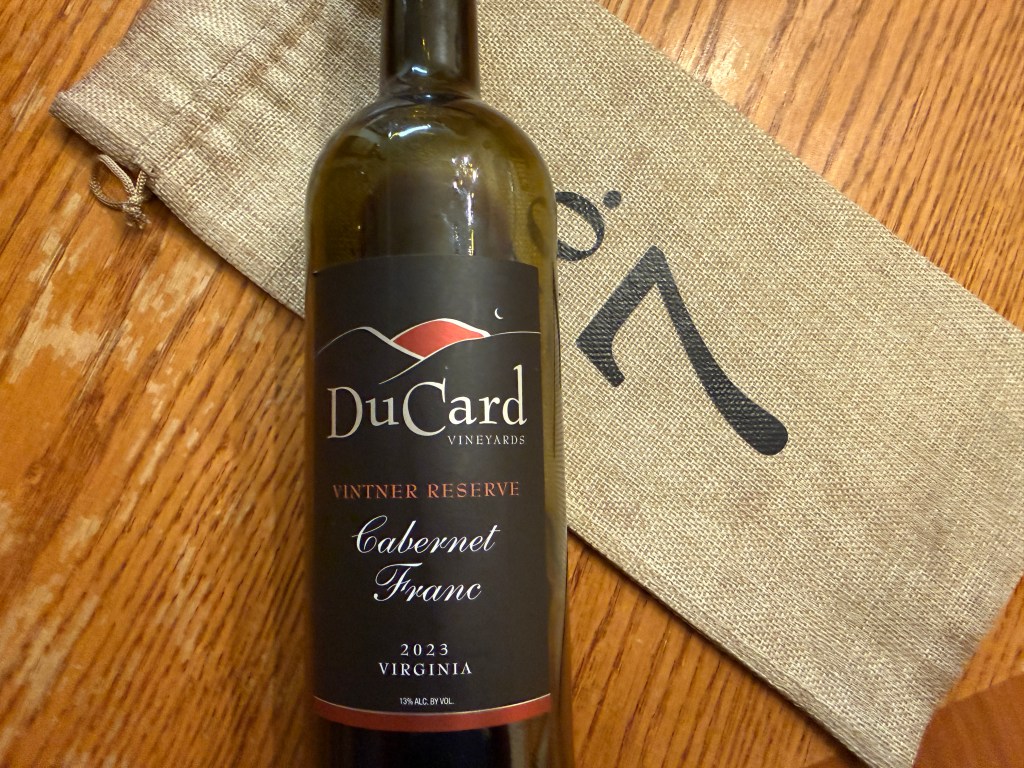
2023 DuCard Vineyards Reserve
2022 Pollak Reserve
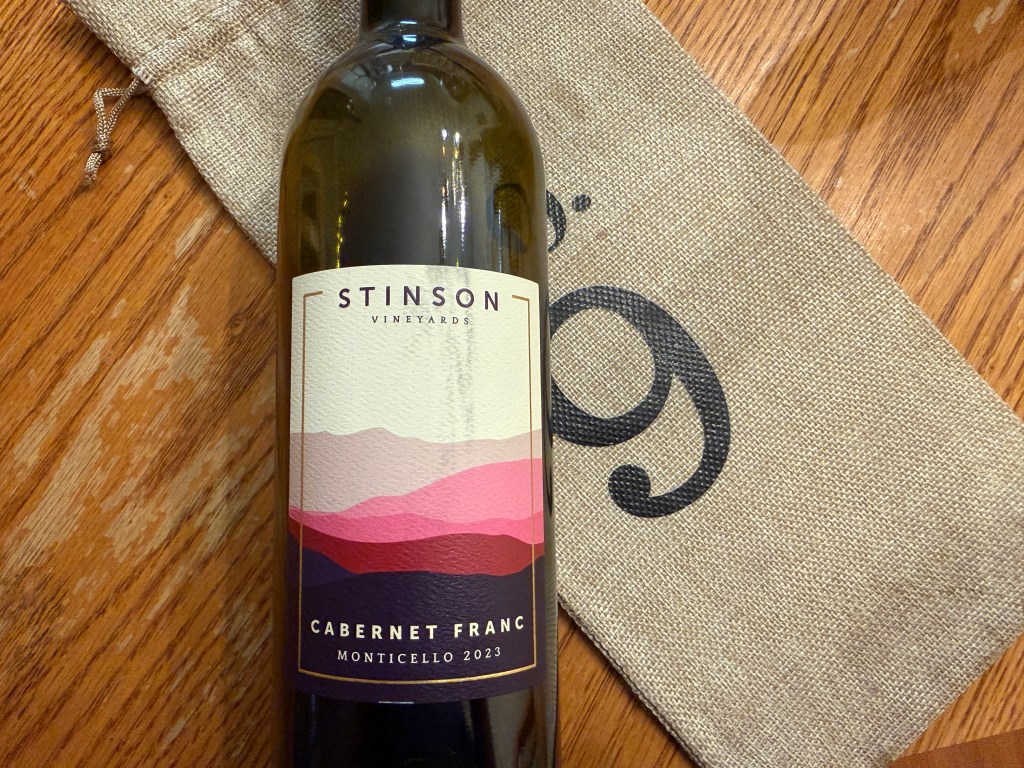
2023 Stinson Vineyards
2022 Early Mountain Vineyard “Shenandoah Springs”
Flight #1
Bottle #1 / 2023 Hark Vineyards: This wine had ‘soul’. People loved the aromatics, and noted it had a roasted pepper finish. Others mentioned the red fruit notes, and someone said it had a ‘stem-y’ note as well.
More than anything else, I heard praise for the winemaking style being very clean and fresh.
Bottle #2 / 2023 Philip Carter“Nomini Hall”: This struck us as an ‘old world’ wine (note – Matthieu Finot of King Family made this, so it tracks). It was hard for us to judge initially since it took a long time to open up, so some of these notes came at the end when we did re-tastes.
I felt it had a confectionary note to it. Others in my group mentioned red pepper and pyrazine notes, but we mostly discussed black fruit (especially before it fully opened). Other notes included a pickled spice note and tarragon. Another participant called out a savory note, “sandy” tannins were integrated, and the wine having ‘tension’.
Comparing the two, #1 was more red fruit, higher in acidity, and more obviously “New World” compared to the black fruit and “Old World” quality of #2. The Philip Carter wine was riper, had a longer finish, and had more complexity when we re-tasted it at the end of my event.
Flight #2
Bottle #3 /2022 Eastwood Farm: Note of Brett on the palate, sharp acidity. I wonder if I had an off bottle, since this was a Double Gold winner at the 2024 San Francisco Chronicle wine competition.
I heard notes of stewed black and red fruit, cacao, coffee notes, and it was richly textured. Another participant said there was some juicy red fruit on the palate, although the Brett and acid did overwhelm them.
Bottle #4 /2022 Pearmund Cellars: There were more notes given to this wine than perhaps any other of the day. I heard ‘roasted chili and ‘pecan chili’ called out. It was denser than #3 but still balanced. Aromatic, with tart, ripe fruit on the palate. “Long tannins” were mentioned several times.
Overall, this was just a super approachable, elevated wine. I had ‘floral’ underlined in my notes because that was the most popular description. A lesson in balance.
Flight #3
Bottle #5 / 2023 Fifty-Third Winery: Red fruit on the nose. I heard notes of bay leaves, spice, dried fruit on the palate. There was a hot note here; several felt the higher level of alcohol put this wine out of balance. Even so, the flavors were there. It also had an earthy quality to it.
I didn’t get a lot of notes of black vs red fruit, as much as this wine seemed to deliver a moderate level of both.
Bottle #6 / 2023 Glen Manor Vineyards: This wine encouraged a lot of debate. Everyone noted it was a well-made wine, but tasting it now compared to the other bottles seemed to be do it a disservice. But in 3-5 years, this may have been the winner of the day.
In terms of tasting notes, I heard conflicting notes about where to place it. Someone mentioned it struck them as more of a Bordeaux blend vs a full Cabernet Franc, while another said it was more like a California CF vs a Virginia CF.
The GMV was also very structured, with good ripeness. It had fruit notes, but just as importantly the fruit notes and the overall structure were in balance (balance was a key theme for this group).
I also heard ‘beet root’ and notes of graphite (this was one of two wines in the lineup with any mineral notes to it).
Flight #4
Bottle #7 / 2023 DuCard Vineyards Reserve: This was the most “Cab Franc-y” wine of the lineup. Judges who insist on typicity loved it (apparently, I prefer Cab Francs without the soul of Cab Franc, so I was an outlier).
I say I’m an outlier because I don’t love pyrazines, which were here in abundance. But they were the ‘good’ pyrazines you’d expect in a varietally-correct Cabernet Franc, and those pyrazines didn’t throw anything out of balance.
Other tasting notes included cassis and a smoky-chili pepper note. Tannin was there, which gave it some power. The oak was well integrated. Other notes include black cherry, raspberry, and cola notes, as well a beautiful finish.
Bottle #8 / 2022 Pollak Reserve: Sarsaparilla nose. This wine emphasized oak and tannin, which made it atypical to the Cabernet Francs we sampled that day.
The high levels of these qualities came at the expense of fruit notes. One participant noted that while it had moderate acidity, the high level of alcohol did the ‘heavy lifting’ for this wine. I tasted it 3 days later and it was much calmer. Maybe I should have held this wine for several more years.
Flight #5
Bottle #9 / 2023 Stinson Vineyards: This wine was well enjoyed, but the comments focused on it being more of a ‘red wine’ than a ‘Cabernet Franc’.
Group notes included herbaceous qualities such as tomato leaf and bay leaf. It was ‘plum-y’ but still had a red pepper note. The wine was ripe and soft. The somms praised the oak integration here, which they attributed to excellent winemaking. The floral notes also were praised.
I think it’s safe to say this was the most delicate wine of the day. One person mentioned it had a Pinot-like quality to it, sans the earth qualities (winemaker Rachael Stinson Vrooman is married to Ankida Ridge winemaker Nathan Vrooman of Pinot Noir fame, so there might be some truth to this).
Bottle #10 / 2022 Early Mountain Vineyard “Shenandoah Springs”: This wine was intense.
Someone mentioned it had an almost raisinated quality to it, which elicited agreement from the table. Another noted notes of potting soil. It had a higher level of alcohol than we expected in a Cab Franc. It had ‘dusty’ tannins, but the lack of fruit made it feel a bit astringent.
Finalist Round
Bottle #4: 2022 Pearmund Cellars (Top wine of the day)
Bottle #7: 2023 DuCard Vineyards (Runner Up)
Bottle #9: 2023 Stinson Vineyards (3rd place choice)
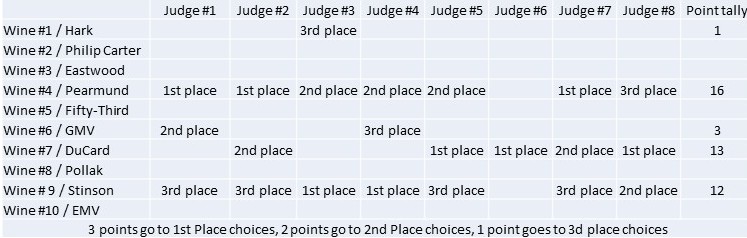
I tallied votes from our participants, asking them to vote their top favorite, 2nd favorite, and 3rd favorite wines of the day. To keep tally, I assigned 3 ‘points’ to 1st place choices, 2 points to 2nd place choices, and 1 point for a 3rd choice.
In summary, the 2022 Pearmund Cellars wine was our top choice of the day. It was described as the kind of wine you could put on the table and everyone would enjoy, and seemed to appeal to both judges who wanted something varietally correct, and those who didn’t want something overly Cab Franc-y. “Approachable” and “elevated” were its by-words
While this Pearmund wine was generally felt to be the best wine from a ‘drink now’ perspective, I want to give callouts to the other top scorers.
The 2023 DuCard Reserve was the top winner for those who want something that screams tipicity (note; winemaker Julien Durantie comes from France). One of the somms refused to consider any other wine than this. It came in 2nd overall in terms of voting.
The 2023 Stinson Vineyards was the 3rd top wine of the day for being a stunning red wine (although some naysayers may say it could have been more Cab Franc-y for their palate). The nose was one of the loveliest of the day; almost certainly the favorite of anyone who doesn’t love pyrazines. The oak integration had a ‘goldilocks’ quality of being ‘just enough’.
The 2023 Glen Manor Vineyards deserves a special mentioned for its structure. Its main drawback is we felt it needs more time in bottle. In 3-5 years though…this is going to be stunning. The somms noted that while the price point is high, its age-ability makes it worth that price.
So in a way, there were multiple ‘winners’, depending on the qualities you were looking for.
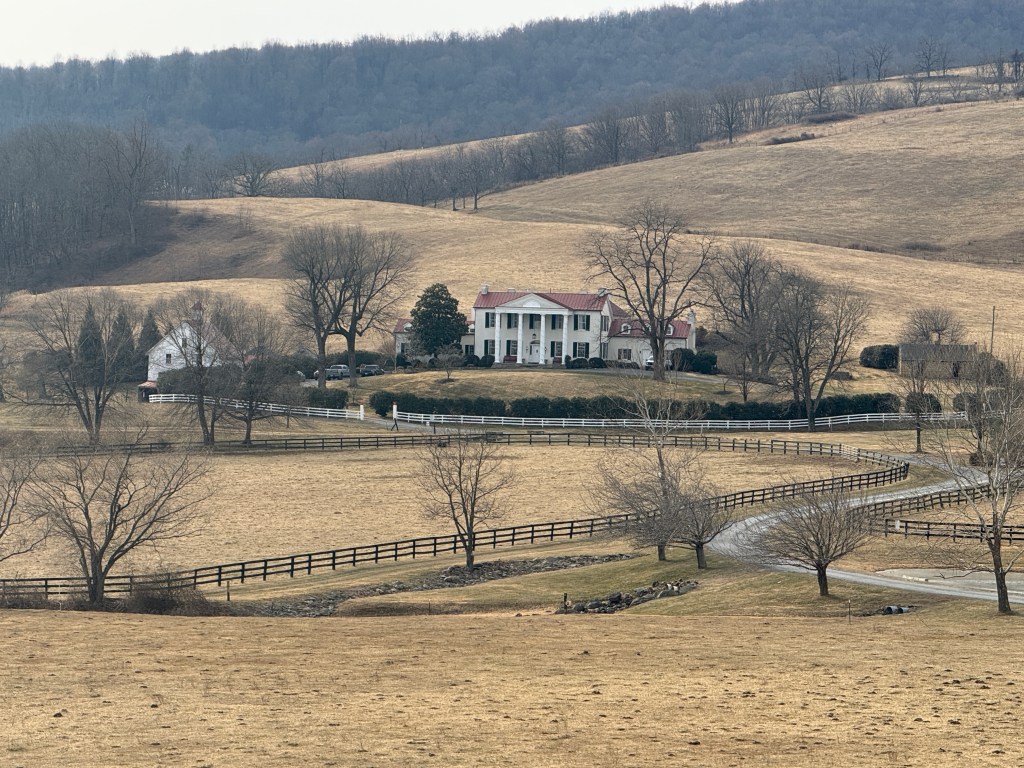
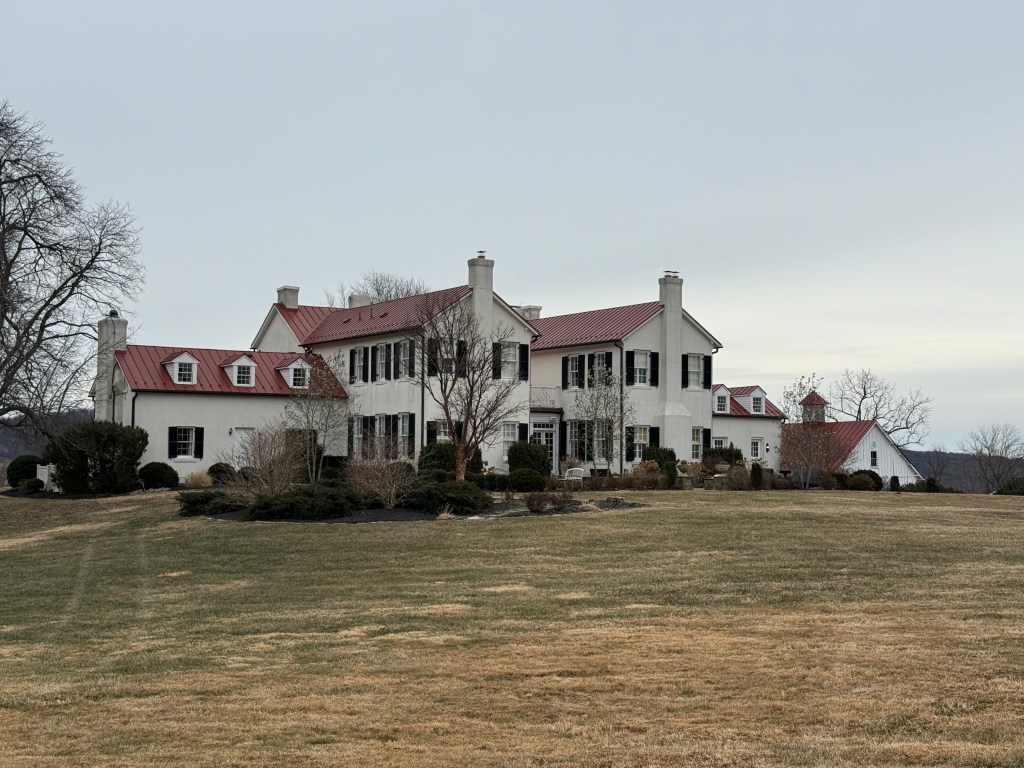
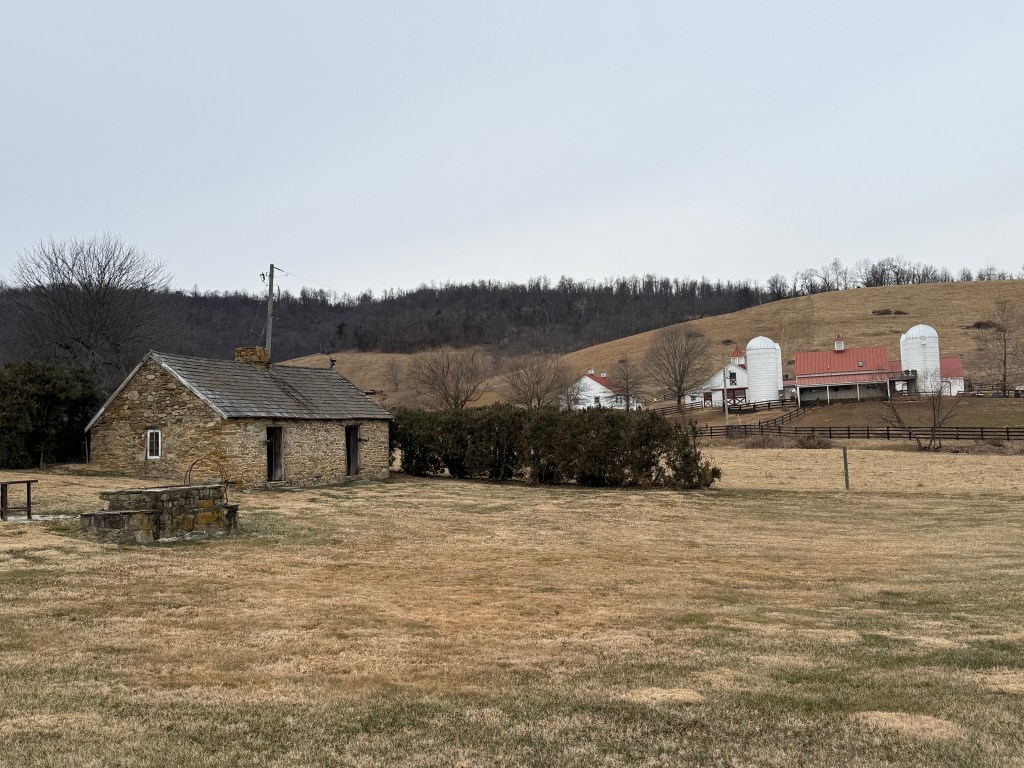
Anyone who’s hiked Sky Meadows Stake Park has seen Ovoka Farm in the distance. Situated on the northern end of the park, the farm’s red-roofed manor home and grain silos have long been magnets for local photographers.
Now, you can actually visit.
The property has gone through many iterations, ranging from an early 18th century farmstead, equestrian center, and personal residence. In 2012 it was purchased by the current owner, who slowly transitioned into an event space, AirBnB, and wagyu cattle farm.
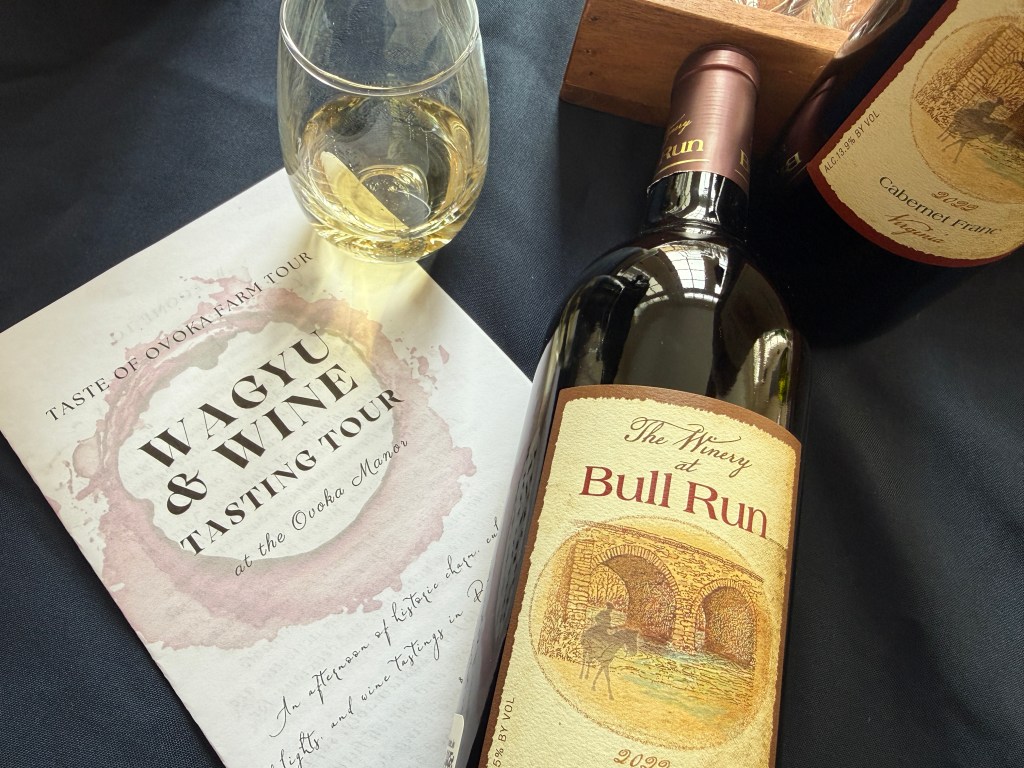
Adding to this series of ventures is its latest initiative; a partnership with The Winery at Bull Run to become a farm winery. I was quick to join their first official “Wagyu & Wine” tour, one a series of events now available on their website.
The Farm and Manor
I’d be remiss to just say ‘it’s an old farm’ and leave it at that.
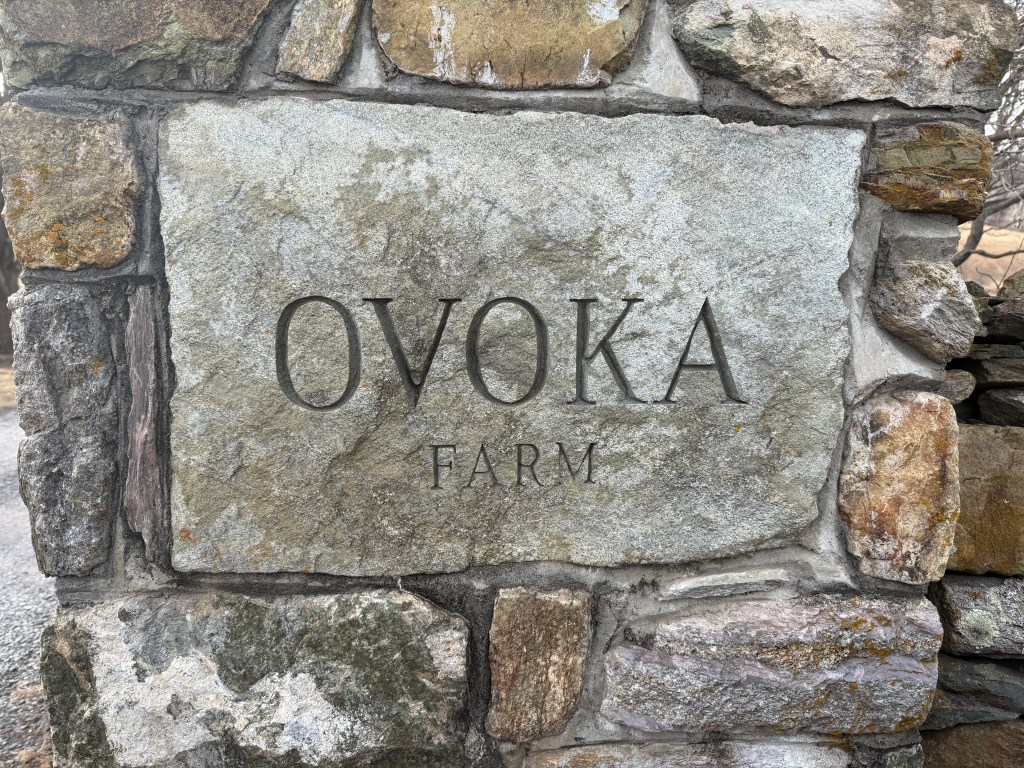
The land was part of an 18th century colonial land owned by Robert Carter, who at the time was one of Virginia’s largest landowners. In 1769 it was surveyed by George Washington, who stayed at a stone building that still stands today. The name ‘Ovoka’ means ‘ever running water’, although the owners aren’t sure what language it originated from.
Today, the farm consists of ~700 acres, including a farm store and a cira-1780s manor home. I came early for photos, which allowed me to stop at their pickup some Shepard’s pie for dinner at their future tasting room.
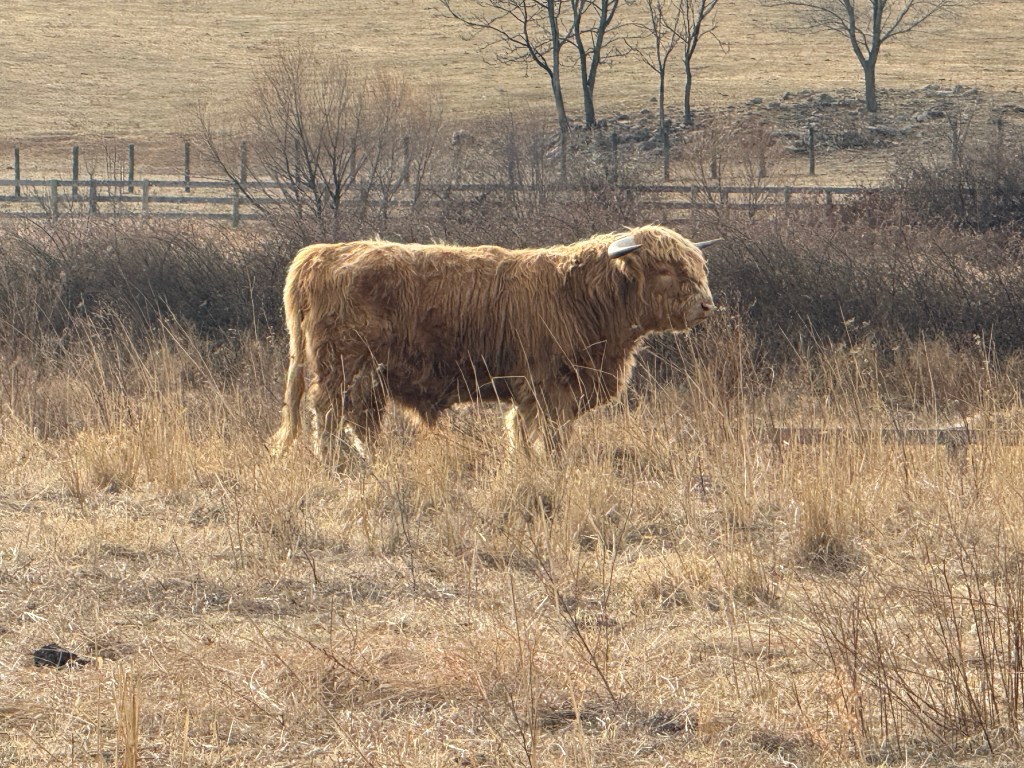
Owner Karen Wray moved here from Chicago for more space for her family. As the kids gradually moved out, she decided the farm was best suited for raising cattle. And not just any cattle – Japanese Wagyu.
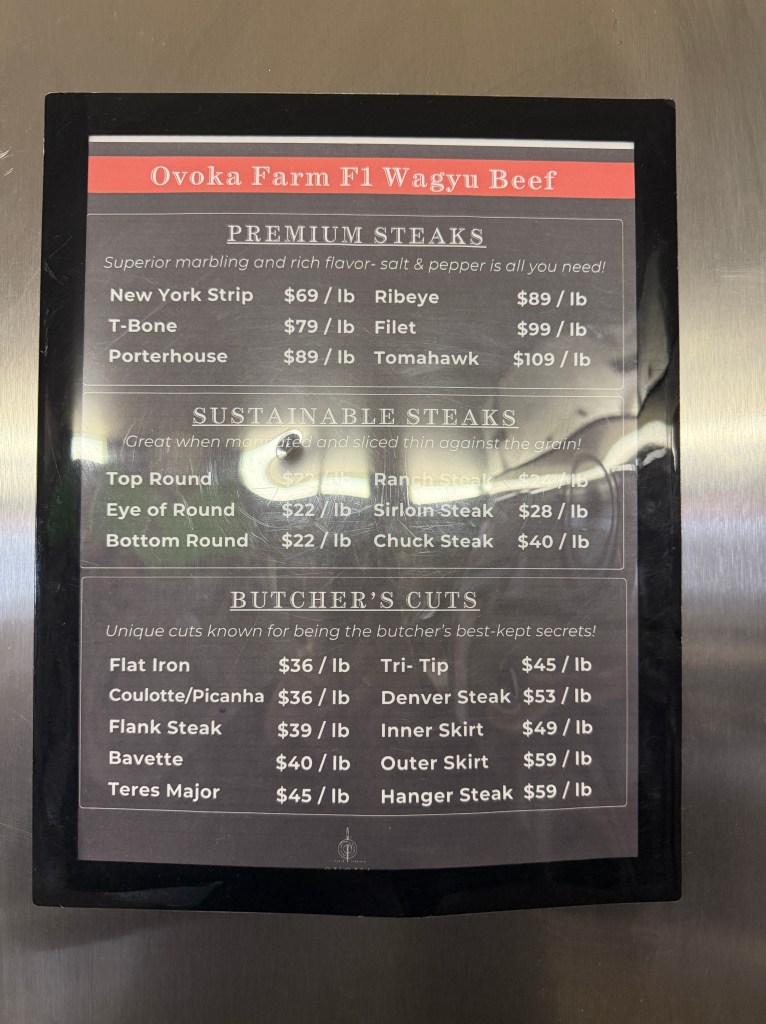
Wagyu beef is prized for its fine marbling and tenderness, the result a low-stress life (you might say they live charmed lives…until their very last day). Chefs love it, and Ovoka sells their beef to an assortment of fancy local restaurants. You can also find it at some farmers markets and their food truck.
One drawback about Wagyu is it’s not easy for non-chefs to cook. To compensate, Ovoka bred their cattle with more traditional American Angus. The 400-head herd is now “F1 Wagyu”, a 50/50 cross with the best traits of both.
GW stayed in the stone building
The Wine and Event
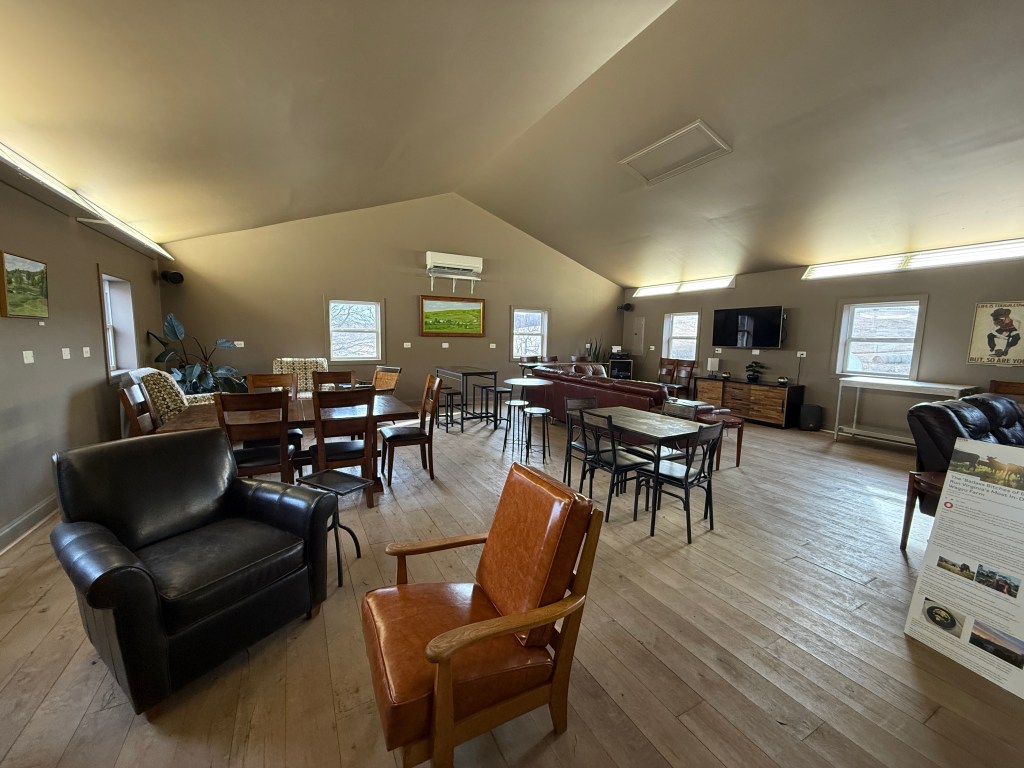
Our event was in the main dining space and den (nicknamed “The Cherry Room”), but guests got to wander around, gawking at the various bedrooms. I also sneaked out to take a picture of where George Washington slept.
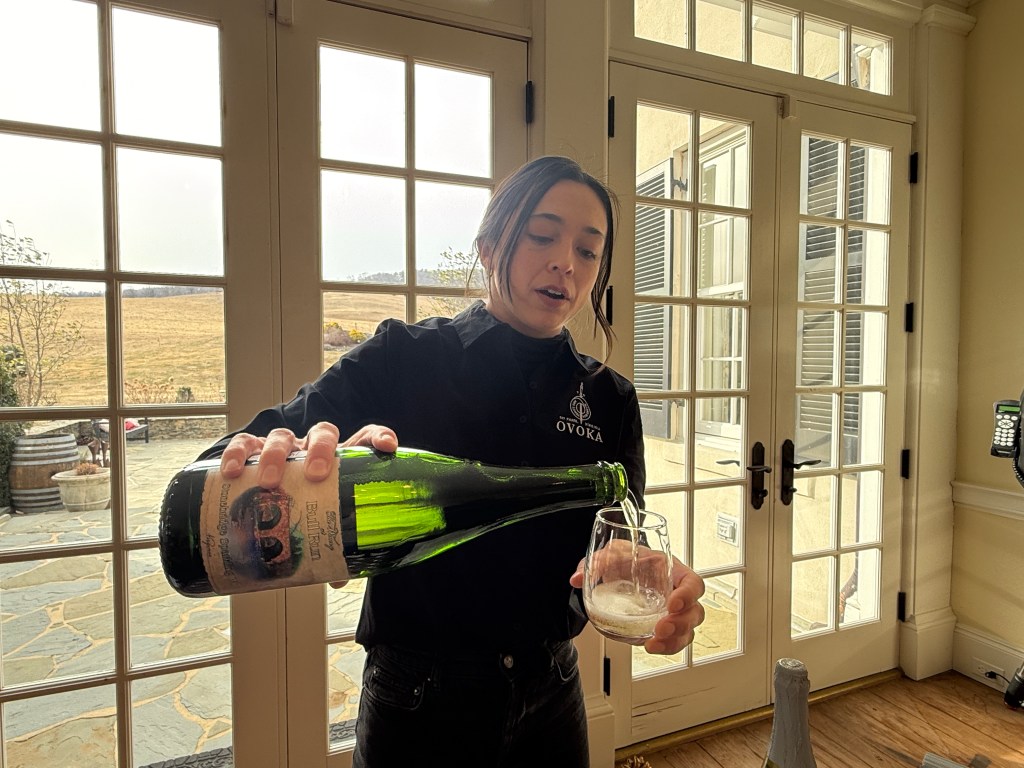
Operations Director Mel Freshwater gave the attendees the low-down on the property’s history and their newest direction, then followed up with a series of wine and food paring, highlighting Ovoka’s beef.
Ovoka doesn’t yet have vines on the property, so in the interim they serve Bull Run wine and rely upon their expertise. Bull Run’s Winemaker Kendell Anderson makes wine onsite for them using Virginia grapes, and Ovoka-branded wine is coming in the future.
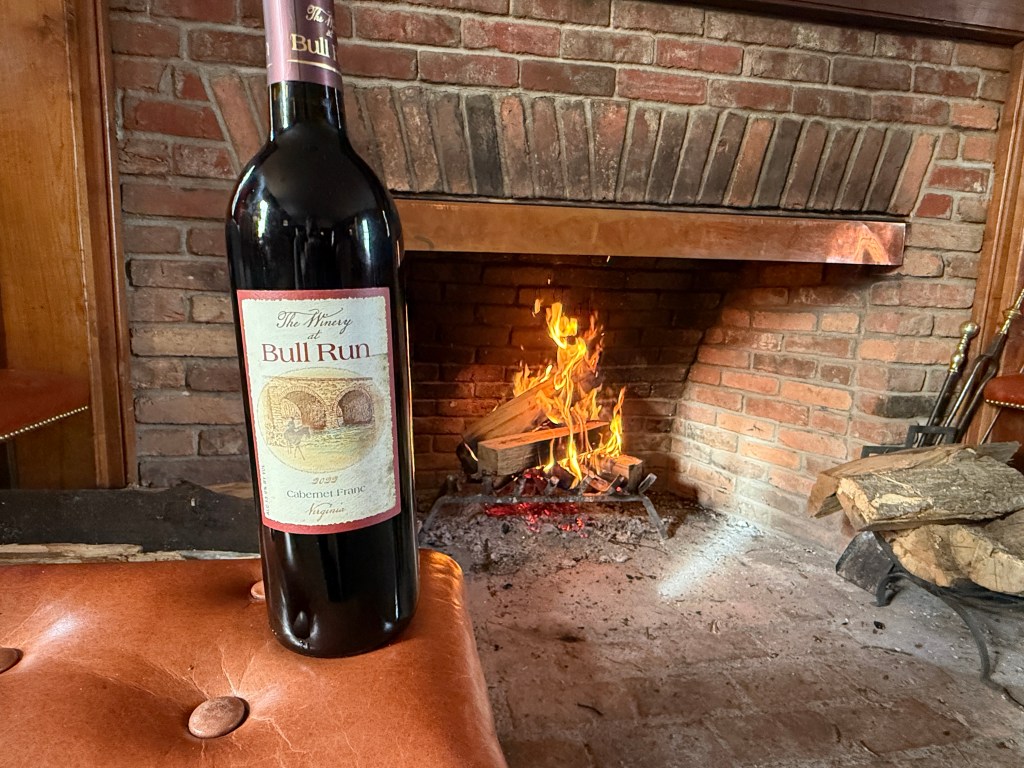
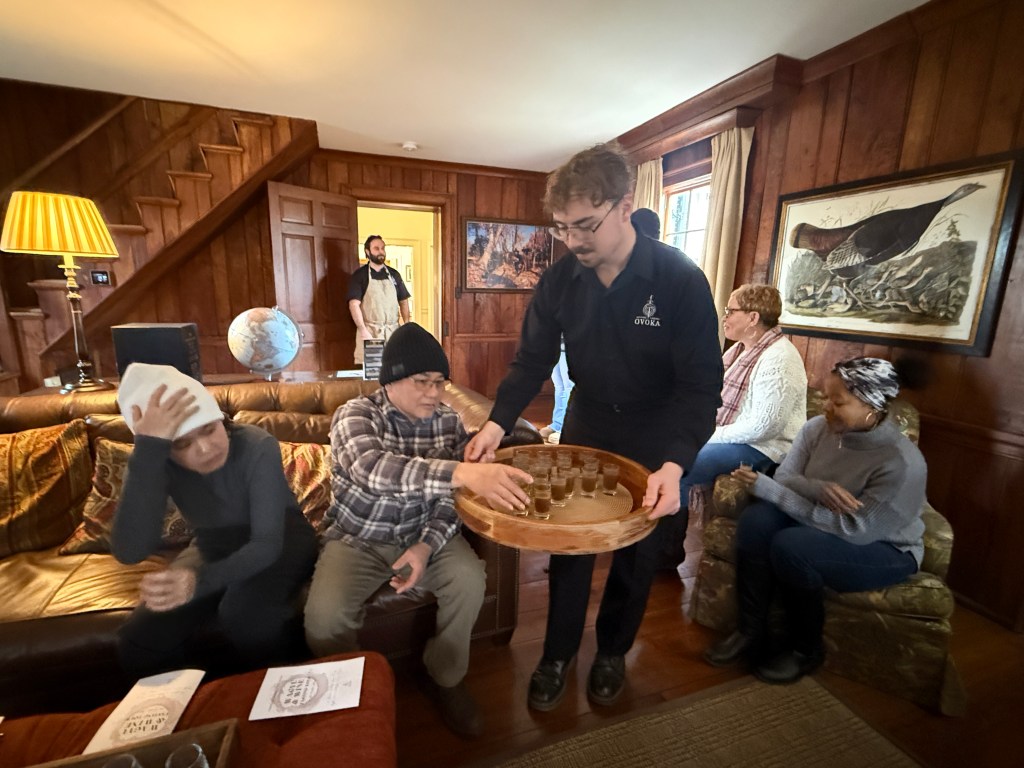
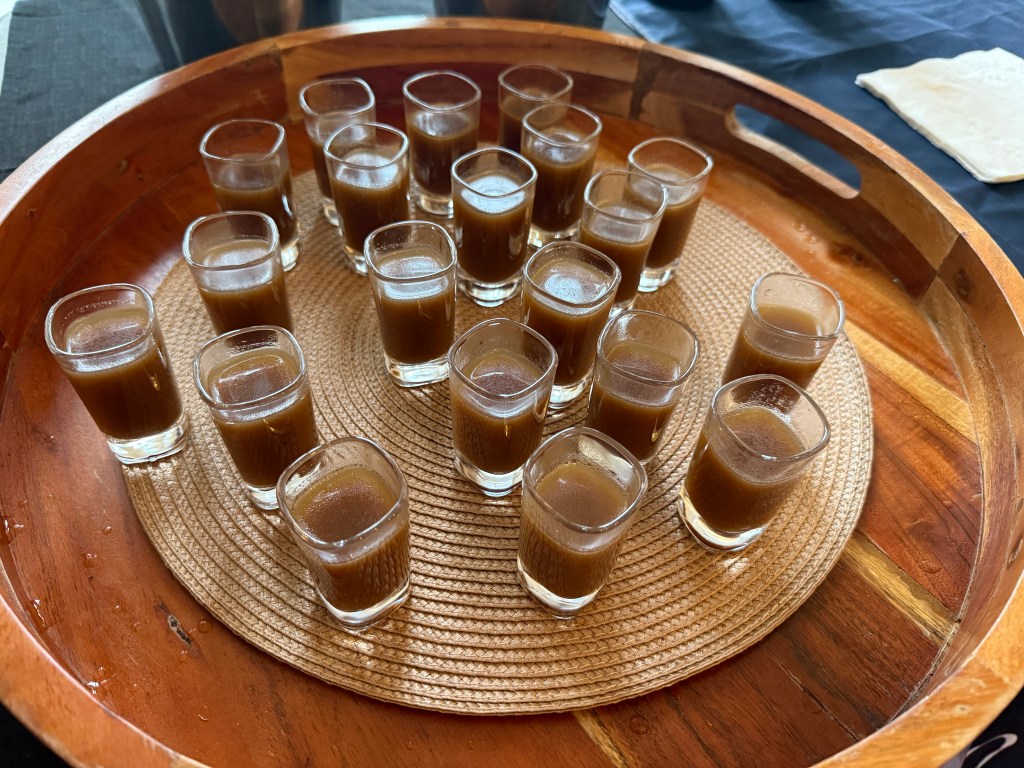
We lounged around next to the fireplace enjoyed our first sampling; a tasty amuse-bouche of beef bone broth made with thyme and cognac. Mel also did a show-and-tell using artifacts from the property (it was good I remember them, since they were part of an informal scavenger hunt).
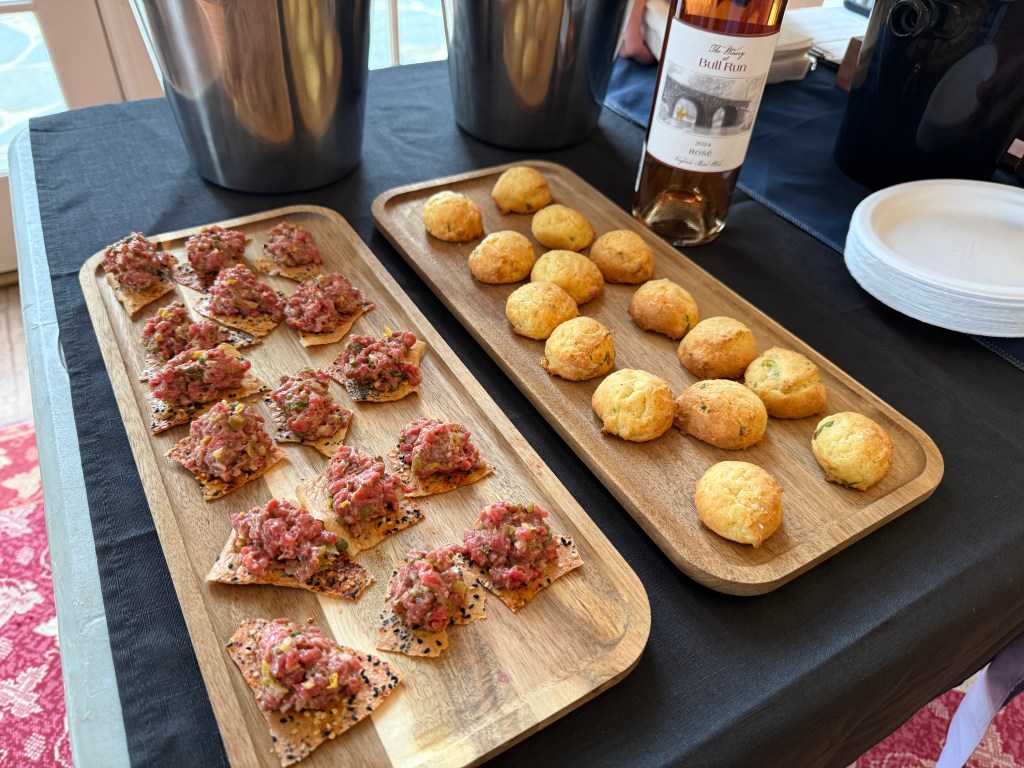
Of course, the highlight was our food and wine pairings. First off was a 2024 Viognier paired with a wagyu tartare, then a savory cheese puff (the fancy name is tallow gougère) to go along with their 2024 Rosé.
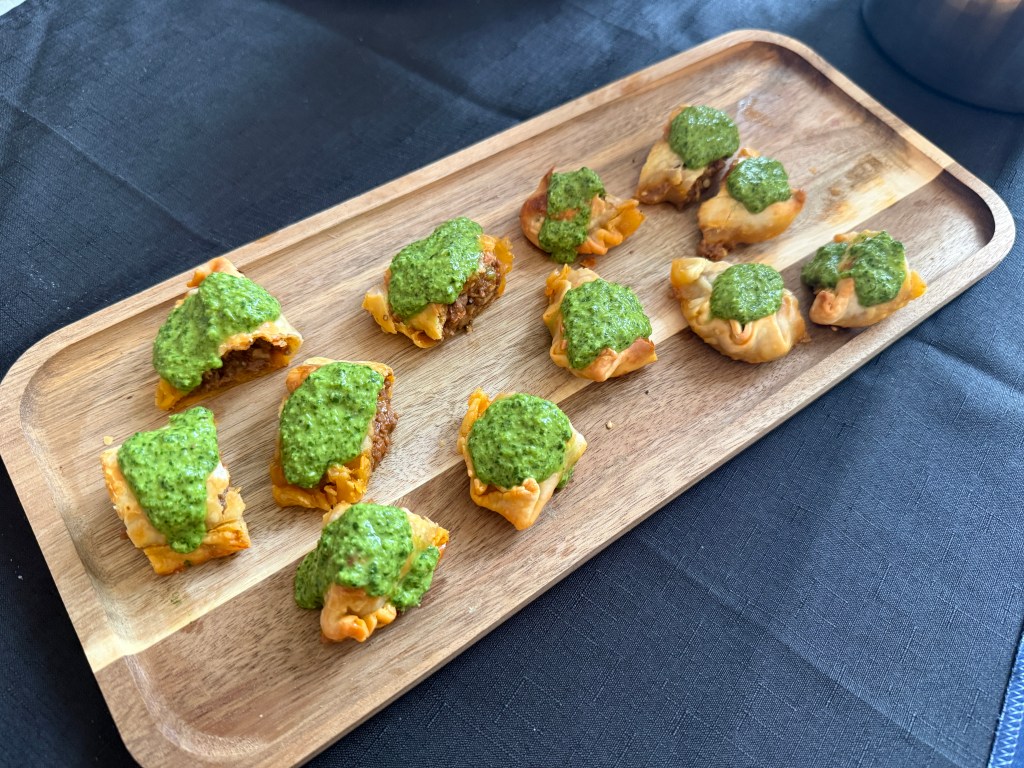
Then came the empanadas – lots of them. The salsa verde was spicy, but we cooled them off with Bull Run’s 2022 Cabernet Franc.
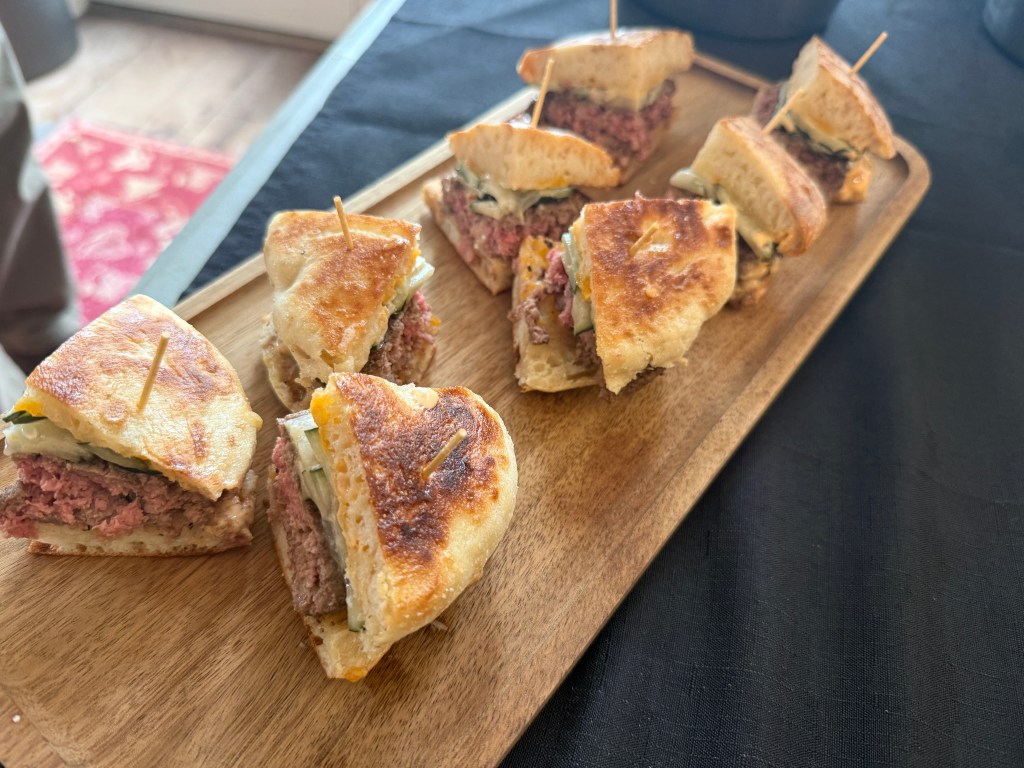
Not surprisingly, my favorite were the beef sliders made with that W1 Wagyu, paired with a 2020 Merlot.
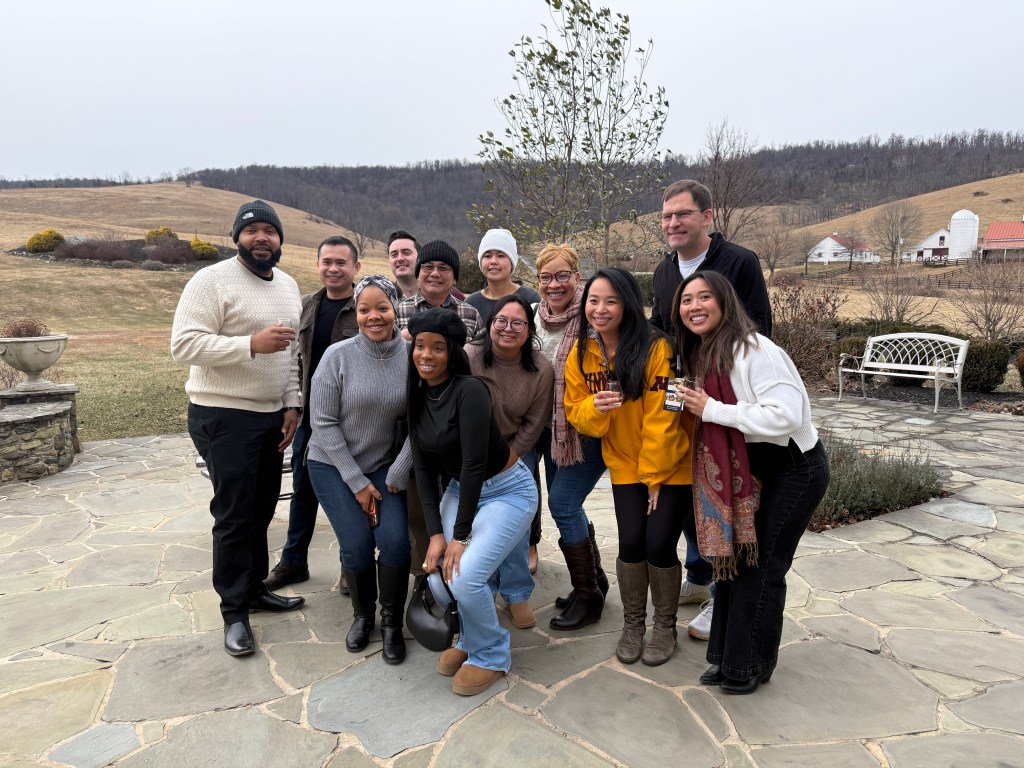
If it hadn’t been so cold I would have walked around outside more – although that didn’t stop the group from some picture-taking.
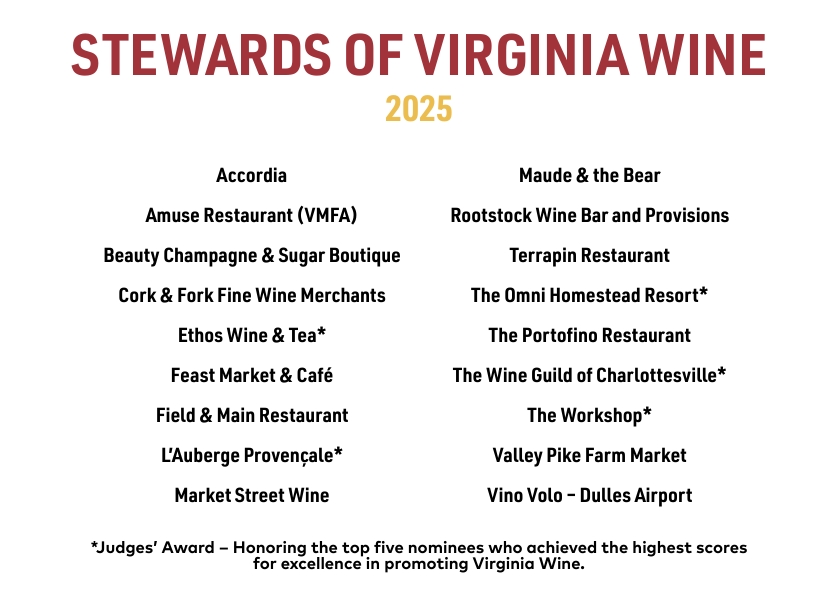
Have you ever looked for a bottle of Virginia wine but didn’t want to drive to a winery to find one? If so, then check out “The Stewards of Virginia Wine”.
This initiative from the Virginia Wine Marketing Office recognizes restaurants, bars, and retailers who have championed the Virginia wine industry. These businesses were rated on criteria such as their partnership with local wineries, presence on shelf space or wine lists, and overall commitment to Virginia wine.
These Stewards play an important marketing role for the Virginia wine industry. In 2019, an economic impact study found only 5.3% of wine sold in Virginia was locally produced. If Virginia is to increase this number, it will need retailers, restaurants, and bars such as these to increase the footprint of the local wine industry.
Sales from these venues also offer a ‘prestige factor’ that is hard to replicate. Horton Vineyard’s 1993 Viognier was the first Virginia wine ever sold at The French Laundry, one of the most prestigious restaurants in the US. This was a marketing boon for the then-nascent Virginia wine industry.
Why Virginia wine is hard to find outside the winery
The lack of availability of Virginia wine is linked to two intertwined culprits: high bottle prices and low production.
Most Virginia wineries make under 3,500 cases/year; only a handful produce more than 40,000 cases. The boutique nature of the business means wineries seldom achieve the economy of scale necessary to compete in the $25 and under market, even assuming they have bottles to spare. Many of Virginia’s most famous wineries price their premium bottles in the $45-$70 range.
These prices make it difficult for bars and restaurants to include Virginia wine on the menu. Around 21% of restaurant sales are from alcohol, according to data from the National Restaurant Association. Given alcohol is such a significant revenue stream, these venues are more inclined to include a less-pricy wine they can markup, rather than try to sell an already relatively expensive (but unknown to consumers) local bottle.
This pricing also makes it difficult for wineries to distribute their wine.
American alcohol sales are governed by the ‘Three Tier’ system of producers, distributors (who buy from wineries at a reduced price), and retailers (who buy from distributors and sell to consumers). The ‘farm winery’ license uses by most wineries allow them to cut out the distributer and producer middlemen and sell directly to consumers. This is why 77% of Virginia wine is sold directly from the tasting room.
Adding those second and third tiers means the winery must sell at a price barely above the cost of production. While some feel the increased exposure is worth the cost, it’s far less profitable for them to take this route.
If that’s not enough, marketing Virginia wine is also challenging. Virginia wine lacks the name-recognition enjoyed by California, Bordeaux, or even smaller wine producing states such as Oregon. Some Virginia winemakers toy with the idea of rallying around a specific grape to focus their advertising, but previous efforts have proven contentious.
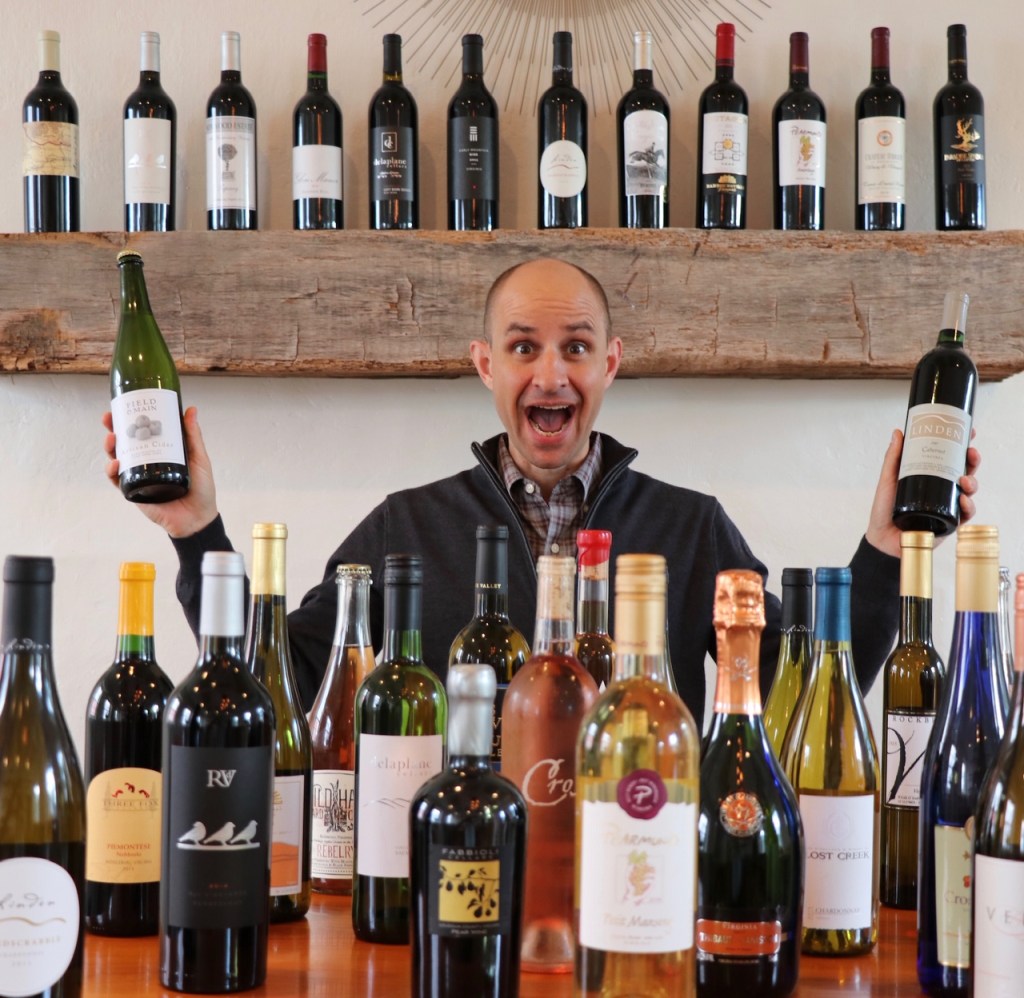
Neil Wavra, owner of Field & Main
Retailers and restaurants a key to industry growth
Even with these challenges, the Virginia wine industry’s future may rest with these restaurants, bars, and retailers. The Stewards of Virginia wine are leading the charge here, but they can’t do it alone.
The VA wine industry’s business model is heavily reliant upon agro-tourism, which inherently limits its audience. If it’s to grow beyond the boundaries of Virginia, these wineries must find a way to distribute their wine.
This will prove challenging. Many wineries are already hospitality-focused venues, relying upon the view and overall experience as much as the quality of their wine. Only a handful can afford the cost of using an intermediary.
Ultimately, it will be consumer demand that allows Virginia wine to rise to this challenge.
When accepting the award for the 2025 Virginia Governor’s Cup, Barboursville winemaker Luca Paschina told the audience, “When you go to your favorite restaurant, you must demand they carry Virginia wine!”. These Stewards are doing their part in advertising local vino, but it’s up to consumers to convince their favorite venues to include wine from the Dominion state.

 Wine Trails and Wanderlust