Virginia Sauvignon Blanc Showdown (2025)

Virginia wine seems to excel in certain varieties. Petit Verdot, Petit Manseng, and Cabernet Franc often come to mind. Tannat and Albariño are up-and-comers, from what I’ve seen.

But if you had told me Virginia was a hotspot for its Sauvignon Blancs, I’d have been…skeptical. The 99 acres currently in the state (according to 2023 figures) is a fairly large planting, but it seems to trail other whites in terms of awards. Only over the last few years have Virginia Sauv Blancs really surged in recognition.

That’s fairly surprising, as I’ve had a number of excellent examples. Linden and Walsh Family often come to mind, but I’ve found others that are also lovely. Unfortunately for me, the Sauv Blancs I most gravitate towards tend to be high-acid, mineral-driven Sancerre styles, which are tough to find in Virginia.

So when the 2025 San Francisco Chronical (SFC) Wine Competition gave two “Best in Class” awards (out of 5 Sauv blanc price categories and 198 bottles) to Virginia Sauv Blancs, and a 3rd Virginia wine was runner-up for one of these “Best in Class” awards, I was equally surprised and thrilled.

The competition judges seemed equally surprised. SFC wine judge Mike Dunne said of Virginia’s entries; “Each year, some wine region of North America sems to gain recognition for a disproportionate share of high awards at the San Francisco Chronical Wine competition. In 2024, it was Virginia”.

Tasting & Scoring Methodology

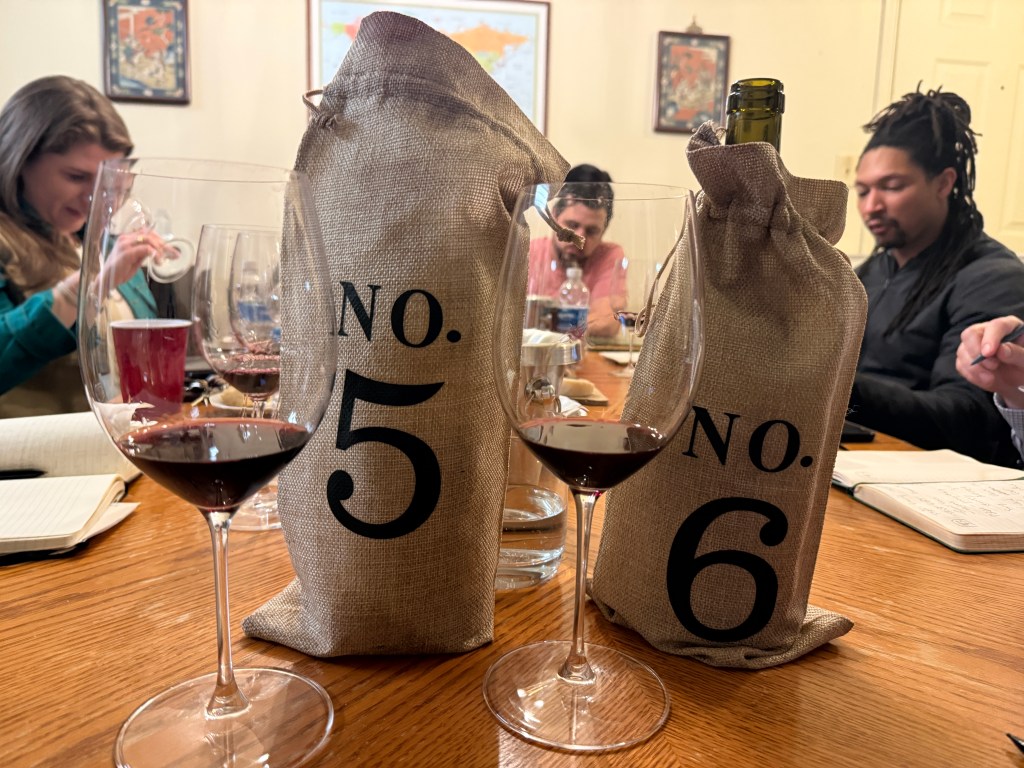
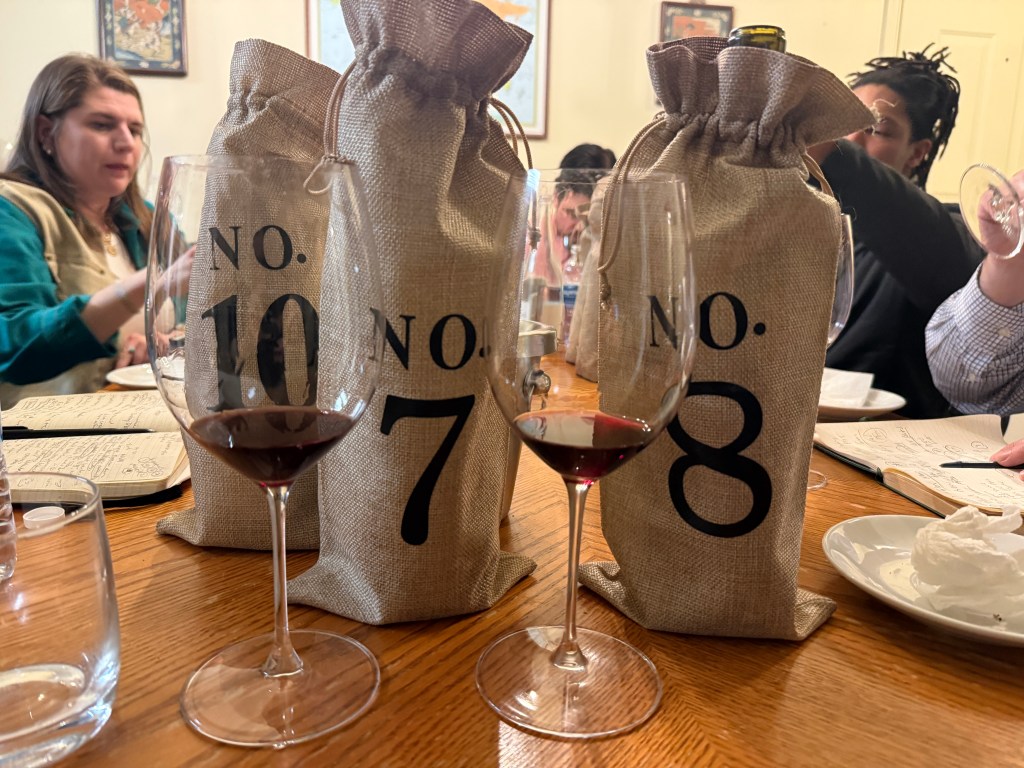
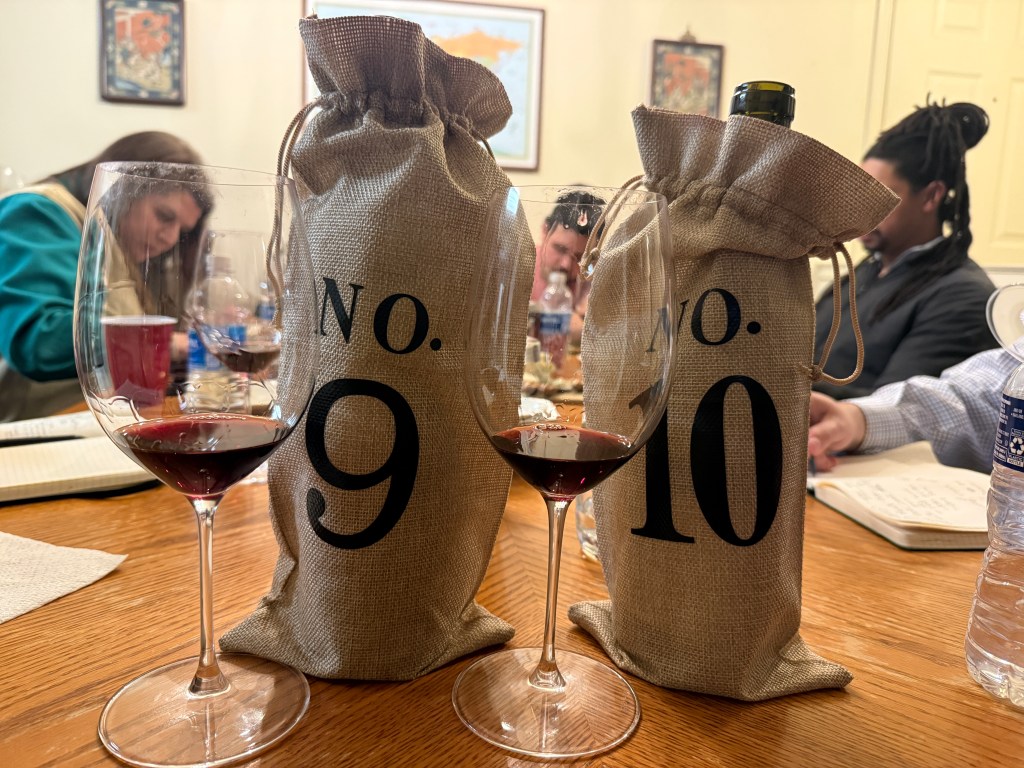
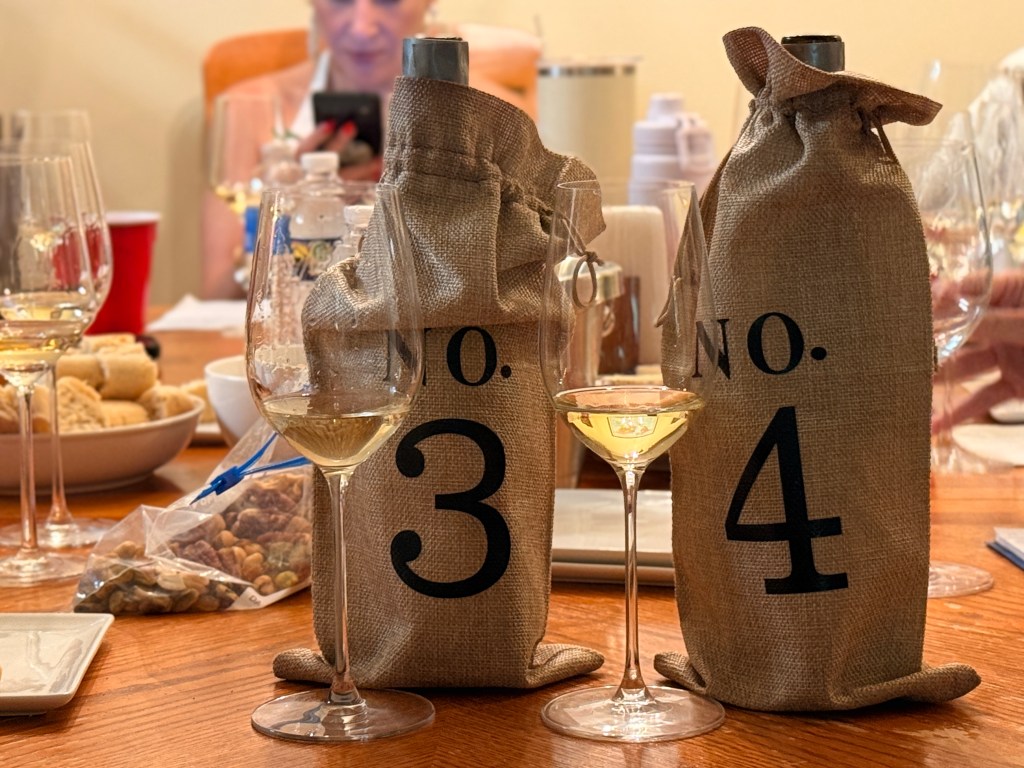
Every round my guests picked a favorite. After we finished all 8 wines, we voted to decide the Top 2 of the day. By coincidence we had a tie in picking which to go into the Top 2, so Top 2 became Top 3. We took a food break, then revisited the Top 3 finalist a second time

Caveat; there are a few other excellent examples that could have been used here. But being in NOVA my selection tends to be NOVA-heavy. Moreover; I don’t pretend what we chose were the “best”. I’d say that these were the “best” this day, but on another day or vintage, we may have selected differently.

The Contenders:

  1. The Winery at LaGrange 2021 Sauvignon Blanc (Washington State fruit)
  2. Glen Manor Vineyards 2023 Sauvignon Blanc
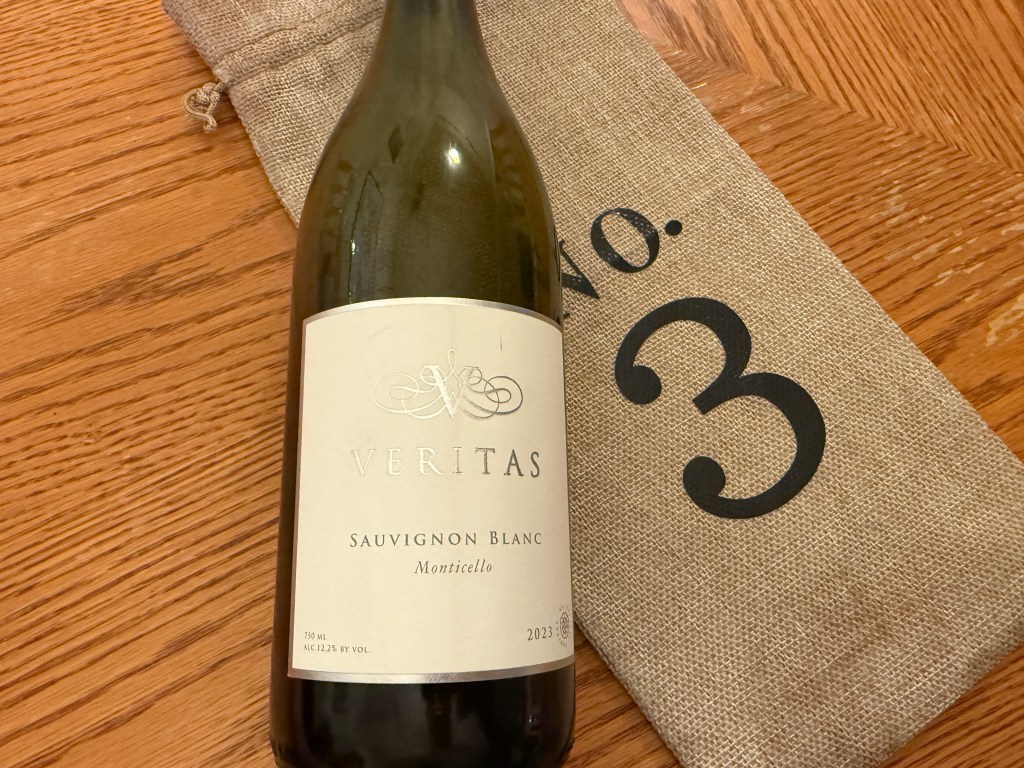
  3. Veritas Winery 2023 Sauvignon Blanc (2025 SFCWC Best in Class/$30-$34.99)
  4. Linden Vineyards 2021 Hardscrabble Sauvignon Blanc
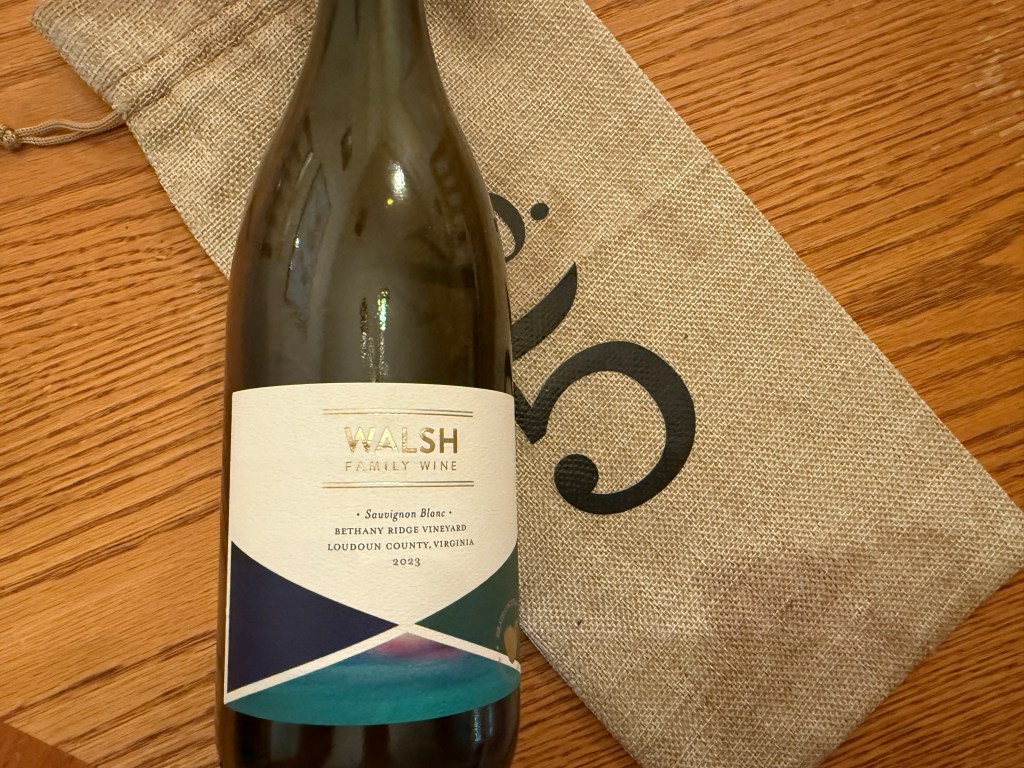
  5. Walsh Family Wine 2023 Bethany Ridge Sauvignon Blanc
  6. Capstone Vineyards 2023 Sauvignon Blanc
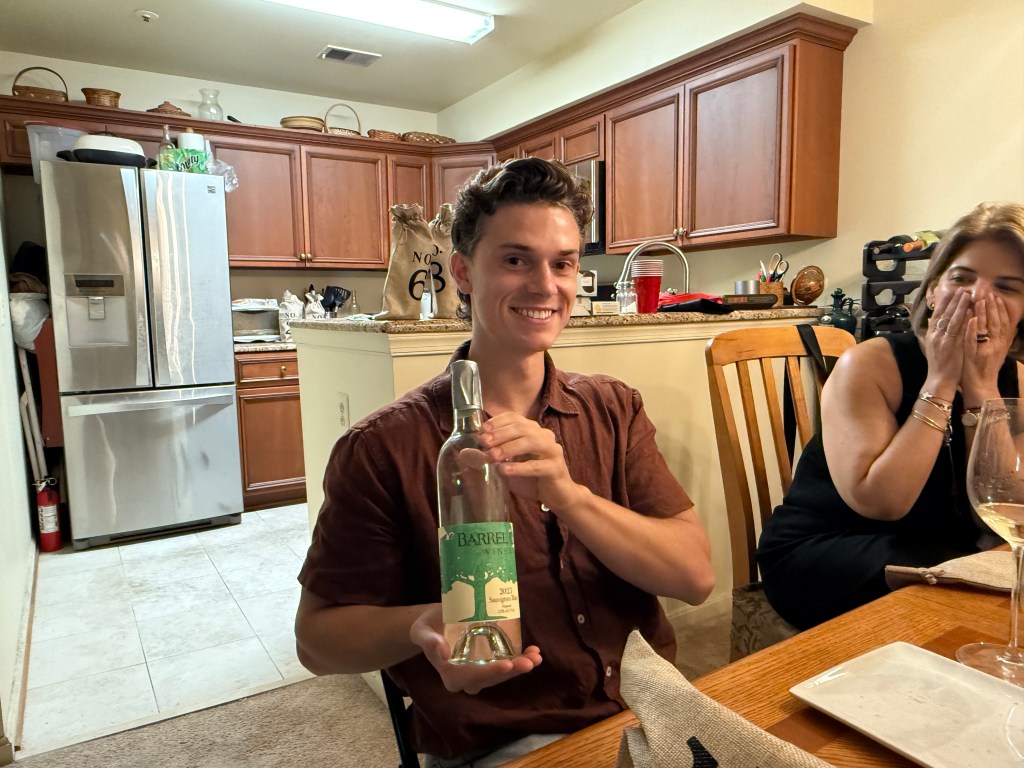
  7. Barrel Oak Winery 2023 Sauvignon Blanc (2025 SFCWC Best in Class/$34 and up)
  8. Endhardt Vineyards 2023 Sauvignon Blanc (2025 SFCWC Double Gold/$30-$34.99)

Flight #1

  • Bottle #1: LaGrange 2021 Sauvignon Blanc (Washington State) (7 votes, round winner)
  • Bottle #2: Glen Manor 2023 Sauvignon Blanc

While the original plan was to do all Virginia wine, we didn’t realize that the LaGrange’s fruit was sourced from Washington State. Oh well; it was made in Virginia, at least.

Looking back we were surprised that #2 was a Glen Manor wine; we thought we’d have enjoyed it more since they have a great reputation overall, but this one wasn’t a favorite.

Bottle #1 / LaGrange 2021 Sauvignon Blanc. This was our “patio wine”. Round; good finish and balanced. Somewhat golden in appearance. Someone mentioned green apple on the palate, plus notes of lime.

Bottle #2 / Glen Manor Vineyards 2023 Sauvignon Blanc. Aromatic and pale. Multiple people commented how fruit-forward this wine was. One said it was like ‘pop rocks on your tongue’. Cameron mentioned the citric acid was too high for his preference; maybe they let the fruit hang too long?

Votes:

  1. Matt: Voted #1
  2. Sarah: Voted #1
  3. Laura: Voted #1
  4. Isabel: Voted #1
  5. Emily: Voted #1
  6. Cameron: Voted #1
  7. Ashley: Voted #1

Flight #2

  • Bottle #3: Veritas Winery 2023 Sauvignon Blanc (3 votes)
  • Bottle #4: Linden Vineyards 2021 Hardscrabble Sauvignon Blanc (4 votes; round winner)

This was the favorite round for several attendees. Stylistically speaking, this was a “patio wine” (#3) vs a “dinner wine” (#4) comparison, and attendees tended to vote according to that preference.

I had more tasting notes than I could easily write down; the mark of a good round.

Bottle #3 / Veritas Winery 2023 Sauvignon Blanc. Lighter in acid, but the acid was definitely there. Comments including grapefruit, green apple, honey, and lime notes, but none were overwhelming present. I felt it had honey and grapefruit qualities.

It had great complexity, which opened up as the chill came off. It was very bright once it warmed up.

Bottle #4 / Linden Vineyards 2021 Hardscrabble Sauvignon Blanc. This was the fullest wine of the day, with more ‘aged’ and/or barrel notes (but definitely not newer oak). A few mentioned it had a caramel finish. Others mentioned candied lemon, stone fruit, hay, and herbs on the nose.

Votes:

  1. Matt: Voted #4
  2. Sarah: Voted #4, although #3 was ‘like a rave on the palate’
  3. Laura: Voted #4
  4. Isabel: Voted #3
  5. Emily: Voted #3
  6. Cameron: Voted #3
  7. Ashley: Voted #4

Flight #3

  • Bottle #5: Walsh Family Wine 2023 Bethany Ridge Sauvignon Blanc (4 votes; round winner)
  • Bottle #6: Capstone Vineyards 2023 Sauvignon Blanc (3 votes)

Bottle #5 / Walsh Family Wine 2023 Bethany Ridge Sauvignon Blanc. Peppery! Notes of honeysuckle and lemongrass on the nose and palate. Tart, citrusy and grassy on the palate. The tartness threw some people off. Smooth texture.

Bottle #6 / Capstone Vineyards 2023 Sauvignon Blanc. Pineapple and mango were mentioned. Had weight. Long lingering finish. We speculated these tropical notes indicated this was the Washington State wine we accidentally included in the lineup (nope; 100% grown in Virginia).

Votes:

  1. Matt: Voted #6
  2. Sarah: Voted #5
  3. Laura: Voted #5
  4. Isabel: Voted #6
  5. Emily: Voted #5
  6. Cameron: Voted #5
  7. Ashley: Voted #6

Flight #4

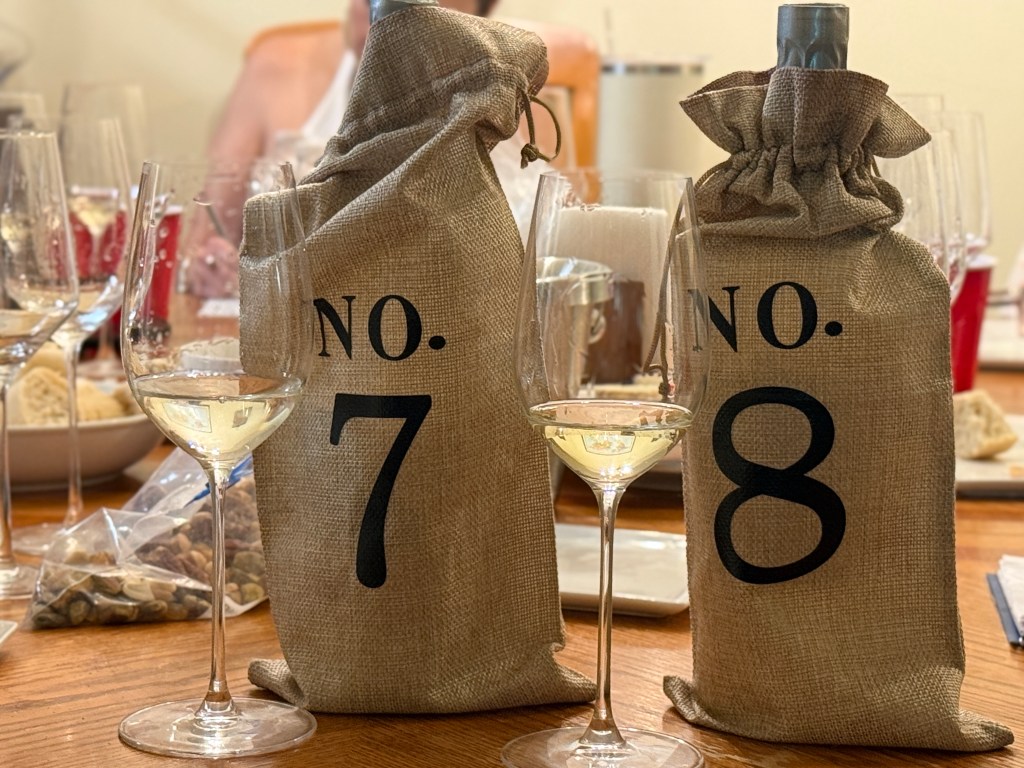
  • Bottle #7: Barrel Oak Winery 2023 Sauvignon Blanc (4 Votes; Winner)
  • Bottle #8: Endhardt Vineyards 2023 Sauvignon Blanc (3 Votes)

If Round #2 was the group favorite, this round was a close runner up. It also contained a SFC Best in Class ($35 and up), and a Double Gold (which was runner up for the Best in Class) winner.

Bottle #7 / Barrel Oak Winery 2023 Sauvignon Blanc. The color was very light and the nose wasn’t overly aromatic, but this wine packed a punch! Well balanced; notes of citrus and lemon were especially mentioned. I could have written more notes, but I was too busy just enjoying it.

Bottle #8 / Endhardt Vineyards 2023 Sauvignon Blanc. Had a ‘new tennis ball’ aroma to it. Bigger in body and more fruit forward than what we’d seen in the lineup so far (right below #4). Someone mentioned a note of vanilla cream at the end. Apricot on the nose and white peach on the nose and palate. Also well balanced.

Votes:

  1. Matt: Voted #8
  2. Sarah: Voted #7
  3. Laura: Voted #7; liked its smoothness
  4. Isabel: Voted #7
  5. Emily: Voted #8
  6. Cameron: Voted #7; said it had a ‘crescendo’ of different fruits
  7. Ashley: Voted #8

Finalist Flight

  • Bottle #3: Veritas Winery 2023 Sauvignon Blanc
  • Bottle #4: Linden Vineyards 2021 Hardscrabble Sauvignon Blanc
  • Bottle #7: Barrel Oak Winery 2023 Sauvignon Blanc

We tried to narrow it down to a “Top 2”, but we loved several so much I decided to add a 3rd glass to the finalist round. We ended up with #3/ #4/ #7 going into the finals.

#8 was also well loved, narrowing missing the finalist round (I tried, but got outvoted). #6 received a handful of votes as well.

We tasted the finalist and I awarded 3 ‘points’ for people’s 1st place choice, 2 points for 2nd place, and 1 point for 3rd place choice.

The final tally was 15 points for Barrel Oak, 14 points for Veritas, and 13 points for Linden. The 2023 Barrel Oak Winery Sauvignon Blanc was the overall favorite of the day.

  1. Matt: Voted #7 / #4 / #3
  2. Sarah: Voted #4 / #7 / #3. Felt #4 was the most complex; liked the ‘barnyard’ and hay qualities.
  3. Laura: Voted #7 / #3 / #4. Felt #7 was refreshing and smooth, but enjoyed the balance and dryness of #3.
  4. Isabel: Voted #3 / #7 / #4. #3 had developed a sweetness she liked
  5. Emily: Voted #3 / #4 / #7. Agreed that #3 was landing sweeter, while #7 was more consistent.
  6. Cameron: Voted #7 / #3 / #4. Really liked the complexity of #7.
  7. Ashley: Voted #4 / #3 / #7. Really liked the soft, caramel finish of #4.

I asked Barrel Oak winemaker Jeremy Ligon about his 2023 Sauv Blanc, and he shared these tech notes:

“In 2023 we partnered with a local vineyard in Paeonian Springs Virginia to bring in their beautiful Sauvignon Blanc. We harvested 7.57 tons on 8/31/2023. This Sauvignon Blanc is grown at over 700 feet in elevation with rolling hills with ideal airflow and soil conditions. We produce a Sauvignon Blanc that showcases Virginia Terrior, which is closer to a New Zealand style Sav Blanc than California, but still with its very own uniqueness. This Sauvignon Blanc is fermented and aged in 100% stainless steel, we forego malolactic fermentation to retain malic acid creating a bright and crisp wine.”

SFC described the Barrel Oak wine as “ripe and round” and “fleshy and saturating”, while the Veritas was “lithe, dry, citric, and astonishingly persistent”.

Lessons Learned:

A few observations:

The first is the Virginia Sauv Blancs were tried were very reflective of the specific site they came from. This resulted in an assortment of stylistic differences, with some presenting as West Coast-ish, a few as Bordeaux Blanc-ish, and others not fitting any particular regional profile (although none we had today were New Zealand or Sancerre-ish).

That’s not to say Virginia *must* fit into any stereotype. Virginia wine must represent Virginia; not try to copy someone else. Yet the variation was so dizzying that I couldn’t guess these wines were from the same state.

My second observation was how people seemed to separate these wines into ‘dinner’ and ‘patio’ styles, the former being ‘bigger’ and the later easier drinking. My group’s voting tended to fall along these preferences.

My last observation is I was very impressed with the judging of the San Francisco Chronicle. Wine judging in general can be very hit-or-miss, as I’ve seen the same wines get Bronze in one competition but get Double Gold (!) in another, or ‘shiners’ with the same wine but different labels get different scores.

But this time, 3 of the 4 top wines we tried today (except Linden, which doesn’t do competitions) were all Double Gold winners from the 2025 SFC wine competition. Except for Linden, none of the other wines were even close.

The Monticello Wine Trail “Women in Wine” Dinner at The Doyle Hotel

This June, the Monticello Wine Trail went into celebration mode. Its Wine Week kicked off with a pair of Friday night wine dinners, then segued to a Saturday gala that announced Afton Mountain Vineyard’s 2024 Albariño as winner of the 34th Monticello Wine Competition. This year also featured a number of special events, including a sparkling wine brunch, rosé picnic, and elevated wine tastings.

A key part of Wine Week’s popularity is it allows enthusiasts to mingle with their favorite Monticello winemakers. Recent media coverage of the “the birthplace of American wine” has given these vintners extra reason to celebrate.

Wine Enthusiast has proven to be a huge cheerleader for Virginia wine, crowning Charlottesville and the Monticello AVA as its “Wine Region of the Year” in 2023. More recently it pronounced “Its Ingénue Era Over, Virginia Wine Takes Center Stage”.

Not to be outdone, in late May the New York Times published “Virginia Wine Grows Up”, featuring several Charlottesville winemakers. Decanter, VinePair, Vogue, The Wall Street Journal, and other major outlets have likewise recently spotlighted Virginia wine.

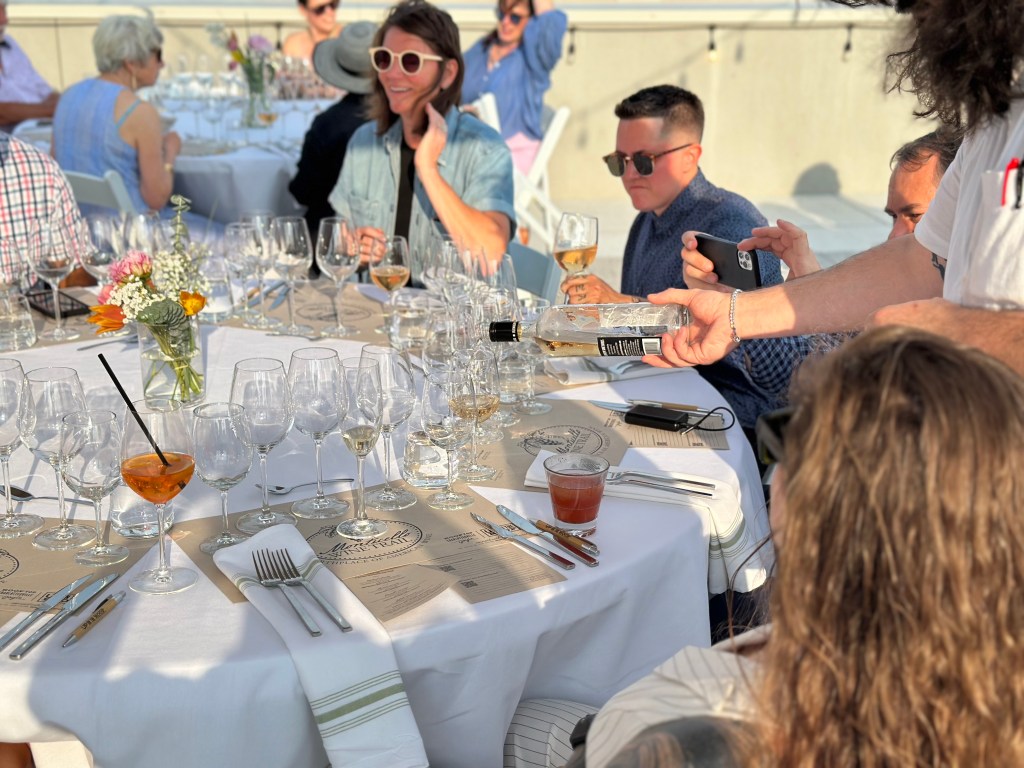
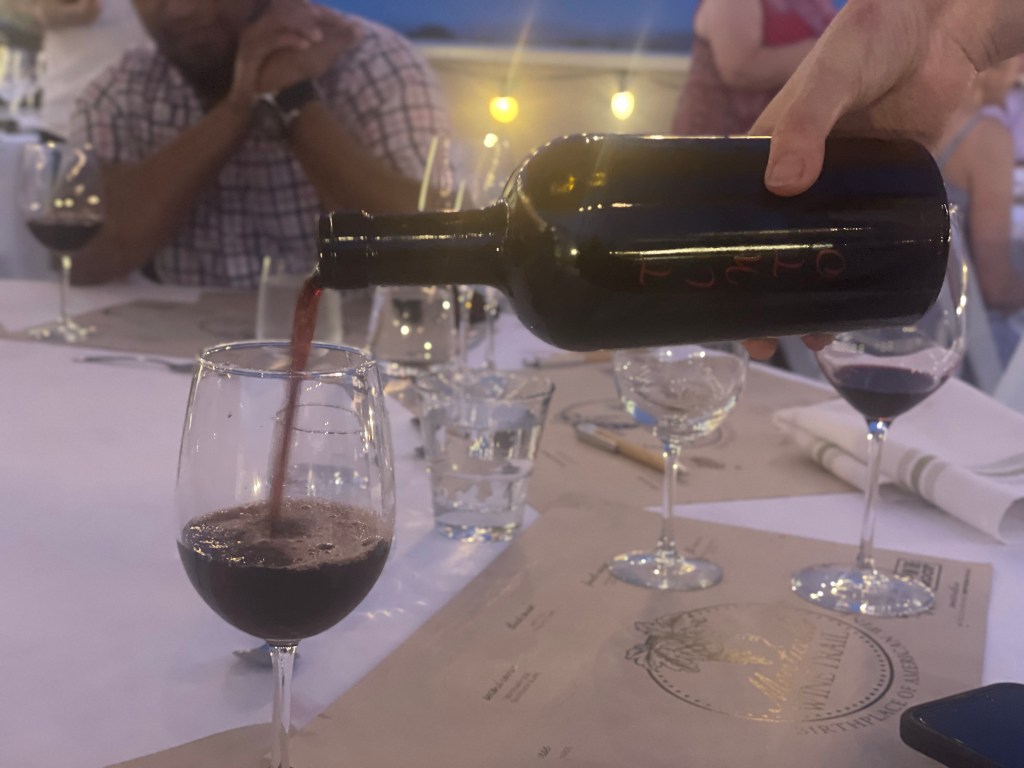
With this backdrop, it would be an understatement saying the mood at the Monticello winemaker dinner on the rooftop of Charlottsville’s Doyle hotel was festive. The theme of the evening; “Women in Wine”, was also a topic near to the audience’s heart.

Dining at The Doyle Hotel

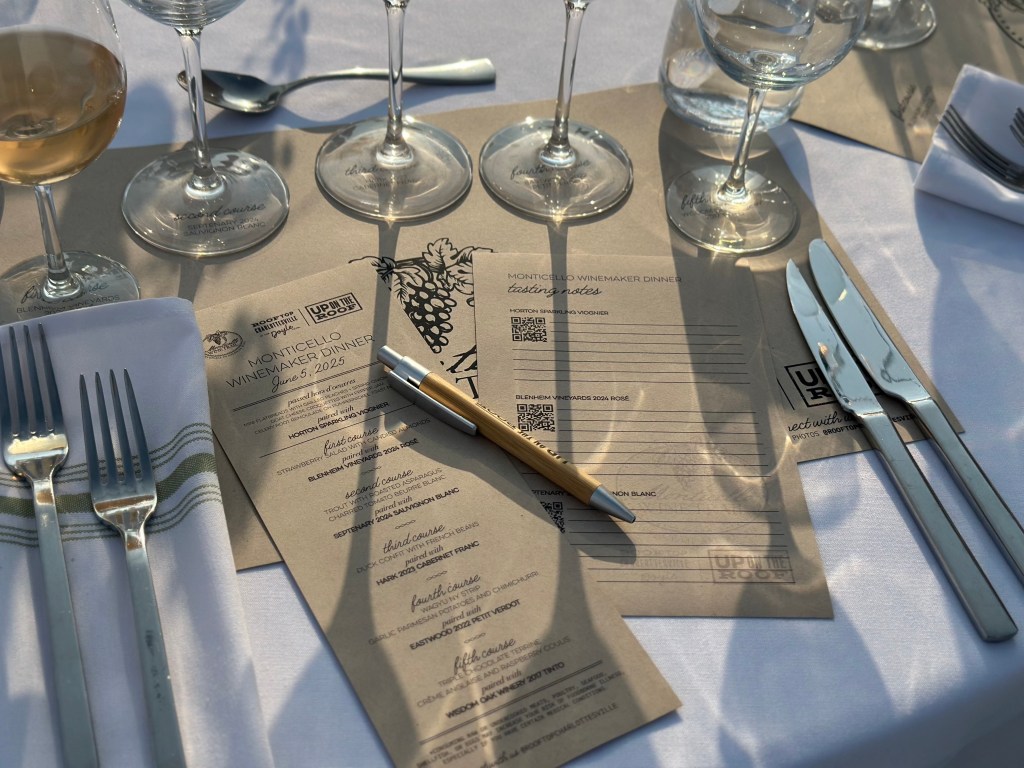
Our 5-course dinner included wine pairings from six wineries, nearly all of them represented by their female owner or winemaker. These vintners mingled with the crowd and shared their stories as their wine was poured.

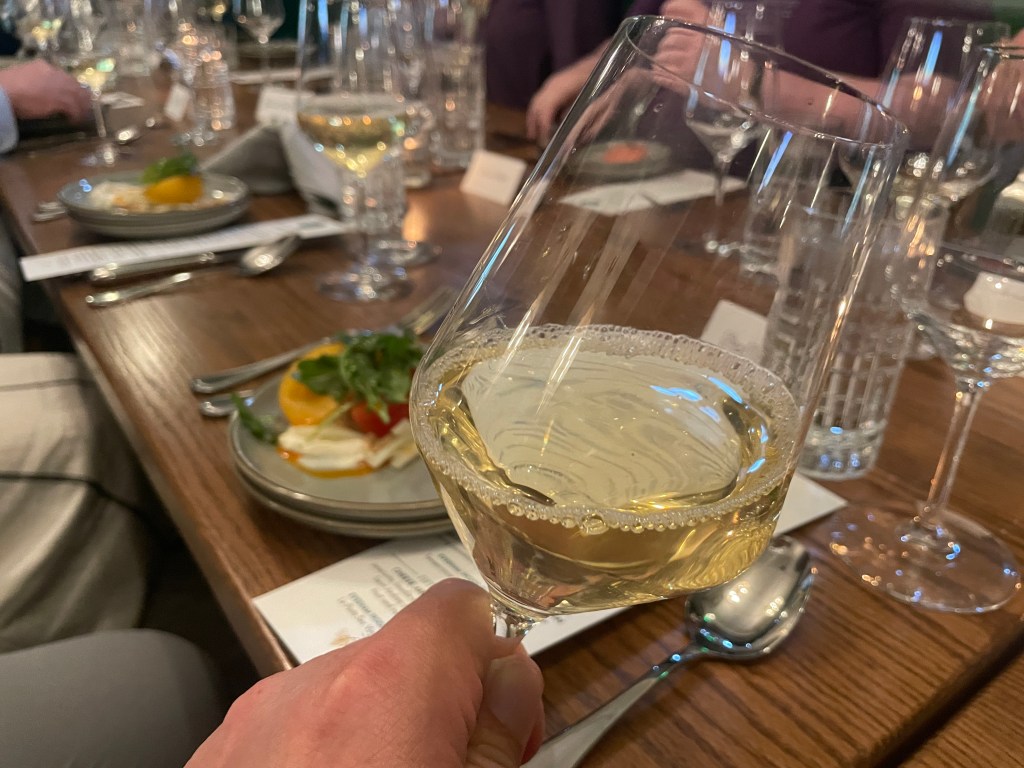
First up was Shannon Horton, pouring Horton Vineyards’ Sparkling Viognier, paired with our hors d’oeuvres.

Shannon explained how the idea behind this Méthode Champenoise crafted wine is an example of how quickly her father, Horton Vineyards founder Dennis Horton, could improvise.

Years ago, Dennis had an overly bountiful crop of viognier that needed to be thinned before harvest. Rather than waste fruit, he realized these still underripe grapes could potentially be used for sparkling wine. The chemistry was spot-on, and they’ve been making a sparkling Viognier ever since.

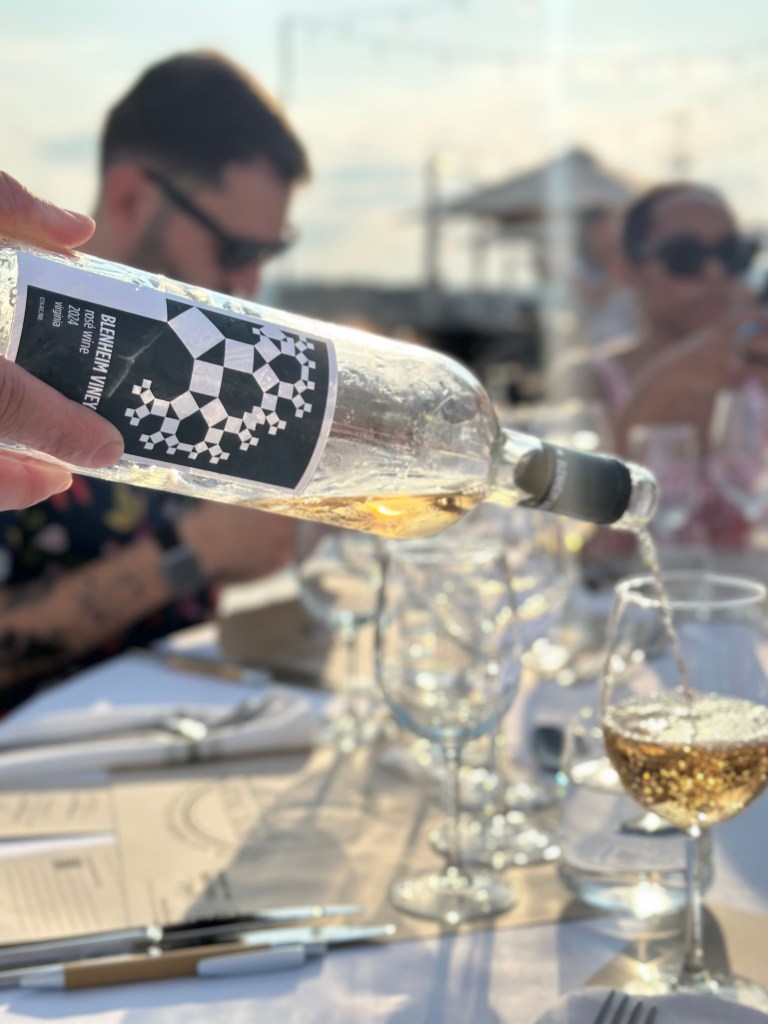
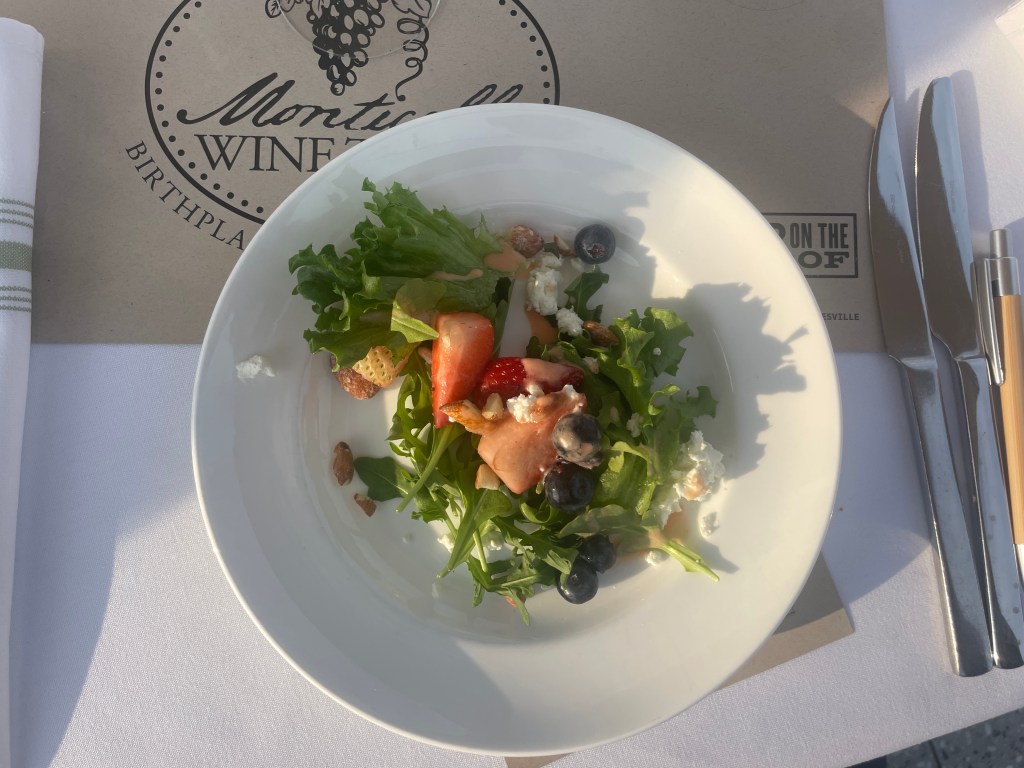
We then moved to the dining area where Kirsty Harmon of Blenheim Vineyards poured a 2024 rosé paired with our first course; a strawberry salad with candied almonds.

Kirsty is a big fan of rosés blended from multiple varieties, with this vintage using a combination of Merlot, Cabernet Franc, Cabernet Sauvignon, and Malbec (but no Pinot Noir or Syrah this time).

Corry Craighill’s 2024 Sauvignon Blanc from Septenary Winery was our next pairing, served with trout and a charred tomato beurre blanc.

Corry joined my table for a while and explained how owners Todd and Sarah Zimmerman love New Zealand-style Sauvignon Blanc, so she made this wine in a style that’s reminiscent of that region.

While her red wines have yet to hit the tasting room, Corry is the winemaker behind Septenary’s most recent white wine releases. Corry also owns Wound Tight, her personal label where she gets to be more experimental.

Once the starting dishes were finished, the red wine pairings with our main courses were served.

AJ Greely of Hark Vineyards poured our first red; a 2023 Cabernet Franc served with duck confit.

2023 was an exceptional year for Virginia wine, and AJ explained this was Hark’s biggest Cabernet Franc crop to date. I loved how AJ didn’t try to make it into a ‘big’ red and instead let the grape’s varietal characteristics shine through.

AJ hung out at my table for a bit and invited us to visit Hark’s brand new tasting room, which was opening that weekend.

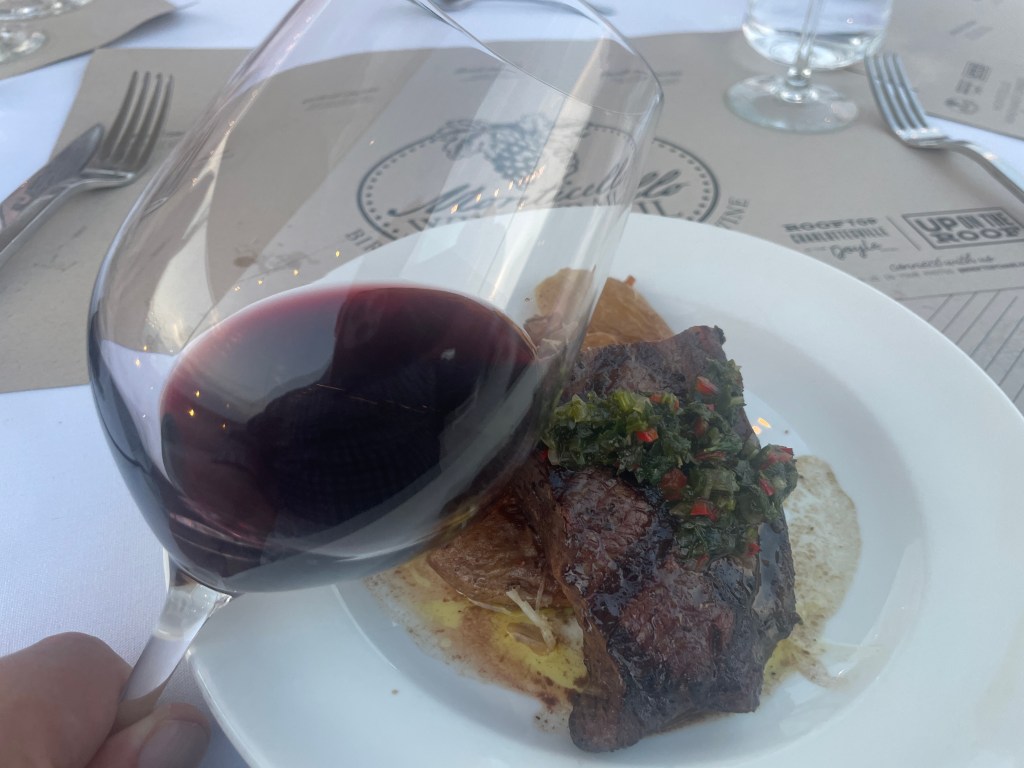
Next to last was Eastwood Farm winemaker Jake Busching sharing his 2022 Petit Verdot, served with wagyu NY strip and potatoes. Owner Athena Eastwood couldn’t attend, so Jake represented in her stead.

Petit Verdot is often thought of as a ‘steak wine’, with tannin and acid that can stand up to heavy foods. While those characteristics often means PVs need time to age, Jake crafted this wine to be fruit forward and easy drinking, enjoyable even without a food pairing.

Jake also told us about Athena’s newest venture, the Virginia Wine Collective. The Collective recently opened in downtown Charlottsville and features a number of micro wine brands that are difficult to find elsewhere.

Owner Laura Lavalle finished the evening with Wisdom Oak Winery’s 2017 Tinto, paired with a triple chocolate terrine.

Laura explained Tinto is Wisdom Oak’s interpretation of a port style wine, using a blend of Cabernet Sauvignon and brandy, aged in Kentucky Bourbon barrels.

Recognizing Monticello’s “Women in Wine”

The selection of female hosts to lead this event wasn’t coincidental. The “Women in Wine” theme continues to receive considerable attention in the world of Virginia wine.

In August of last year, local wine promoter Nancy Bauer launched the Virginia Women in Wine (VWW) professional organization. VWW has since partnered with the Monticello Wine Trail and other organizations to host additional events, ranging from winemaker dinners, communications roundtables, and the unveiling of the VWW’s “Closing the Gender Gap” white paper.

A breakdown of the demographics of the Virginia wine industry demonstrates the need for these initiatives. Only 18% of Virginia wineries employ a female Head Winemaker, yet females compose roughly 2/3rds of local winery staff.

The opening of Eastwood’s Wine Collective promises to open additional (cellar) doors for entrepreneurs by reducing startup costs that might bar them from the wine industry.

The Collective’s unique design includes individually rentable winemaking spaces, a shared production area, and a joint tasting room, all under the same roof. This allows participants to control their own winemaking process, while sharing equipment and retail space that would normally be outside the financial reach of a small operation.

This setup is especially important for female and BIPOC entrepreneurs, who often lack the networking opportunities and financial backing open to the majority of the industry. Members of the Collective also have the option to utilize Jake as a consultant to tutor them in winemaking.

Wine enthusiasts that missed Monticello Wine Week will soon have additional opportunities to engage the winemaking community. The Doyle will soon host Oeno Camp, an immersive experience that cultivates and supports BIPOC wine entrepreneurs.

Dining With Erin Nuccio of Evesham Wood

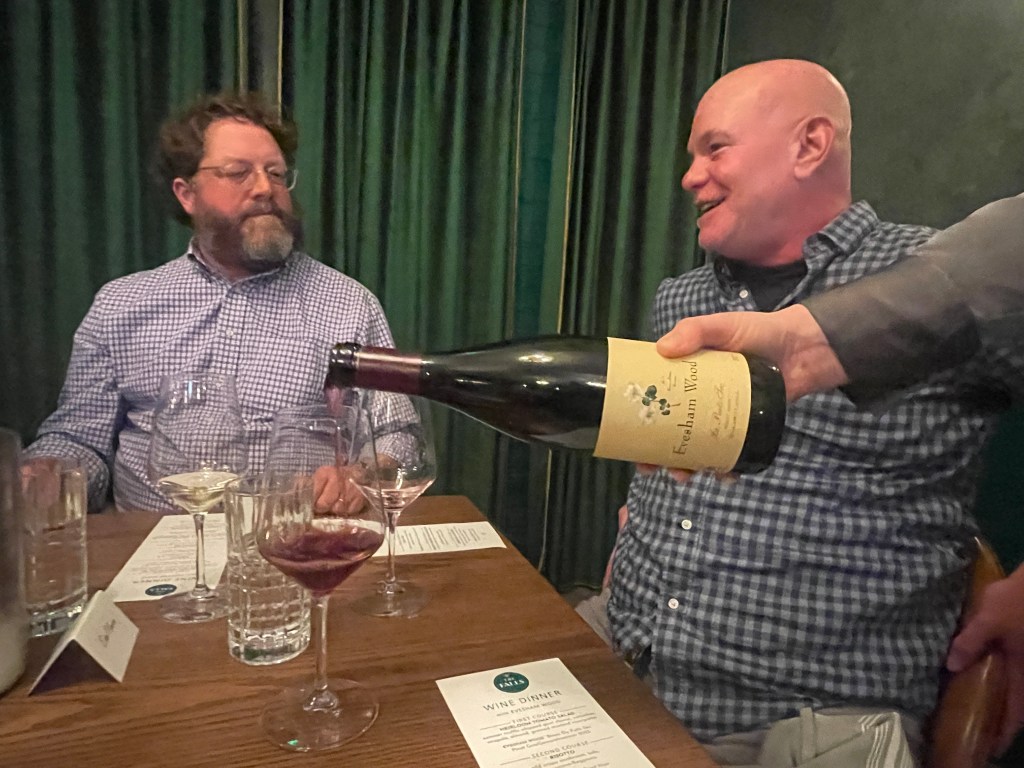
I recently had the opportunity to join owner/winemaker Erin Nuccio of Evesham Wood for a great dinner that showcased his wine, hosted by The Falls restaurant in Falls Church, Virginia. As a wine nerd it’s hard for me to pass a chance to try a new-to-me winery, especially when I get to chat with the winemaker.

Over a 5-course dinner we sampled 4 Pinot Noirs and a white blend. Just as importantly, I got to hear Erin tell the story of Evesham Wood.

The Vineyards & Winemaking

EW Le Puits Sec Vineyard

Evesham Wood is located in the Eola-Amity Hills AVA, one of 11 sub-appellations inside the larger Willamette Valley AVA. Evesham Wood and its sister operation, Haden Fig, are boutique wineries that focus mostly on Pinot Noir, including several single-vineyard expressions.

It turns out Erin is a local boy who got his start in the wine business at Arrowine, one of my favorite local wine stores. Inspired by the Oregon Pinot he was drinking, Erin made the jump from selling wine to making it, moving to the Willamette Valley in 2007 to pursue the dream.

Erin initially apprenticed under Russ Raney of Evesham Wood, one of Oregon’s oldest wineries. That experience allowed him to start his own wine brand, Haden Fig. Years later, he took over Evesham when Russ decided to move on.

Being unfamiliar with this area, I did a bit of research and discovered the AVA’s name is a brilliant (and accurate) bit of marketing. ‘Eola’ refers to a local town, whose name is derived from Aeolus, the Greek god of the winds.

These cool Pacific winds and the area’s volcanic soil define the area’s terroir. The former help grapes grown here to retain their acidity, while the later provide character to the wines.

Location aside, I found how Evesham Wood grows its wine to be as interesting as where this wine is grown.

Evesham is part of the handful of local wineries that hold an official organic wine certification, which they apply to their vineyard-specific wines. They are also a member of the ‘Deep Roots Coalition’, a grouping of local vintners who don’t irrigate their vines. This lack of irrigation promotes sustainability as well as allows their wine to be more expressive of the local terroir.

Erin explained how he initially didn’t feel strongly about the need to be certificated organic. But seeing how others were describing themselves as “basically organic” only to find they were spraying pesticides, he decided to take the extra step to become certified.

All that said, most of our conversation was about wine. Erin worked with The Falls to prepare a five-course dinner, with each dish paired with one of his wines.

The Wine

2023 Blanc Du Puits Sec. First up was Erin’s 2023 “Blanc Du Puits Sec” (Pinot Gris/Gewürztraminer blend), paired with heirloom tomato salad.

This wine is a field blend from Evesham Wood’s first estate vineyard, planted in 1986. Erin went for a fresh style, with a little bit of spice on the palate and nice texture. I also detected some flower notes on the nose.  

The story behind this wine was just as fascinating. The vines are planted on their own rootstock and are considered ‘old vines’ by Oregon standards. While this means they are susceptible to phylloxera, the louse hasn’t hit this block just yet, so the damage it’s suffered has been minimal so far.

2023 Willamette Valley Pinot Noir. Next up was his Willamette Valley 2023, paired with a risotto made with wild mushroom, kale, and cheese.

This is Evesham’s ‘introduction red’. Fun and approachable, Erin said this wine is designed to “capture the spirit of the season”. 2023 must have been very favorable, since this was darn tasty. I found notes of bramble fruit, especially raspberry. That said, the longer I tasted it, the more earth I detected.

2022 “Eola-Amity Hills Cuvée” Pinot Noir. Our third wine was Evesham’s “Eola-Amity Hills Cuvée” paired with a coq au vin, a French dish made with pomme purée, carrots, bacon lardon, mushrooms and pearl onions.

This was the Reserve version of their Willamette Valley Pinot, aged six months in barrel with a dash of new oak. I found it to be complex and rich, with firmer tannin and more structure. It also had nice dark cherry notes with a more lingering finish. I later opened a second bottle with friends and we agreed this was everything we’d look for in an Oregon pinot.

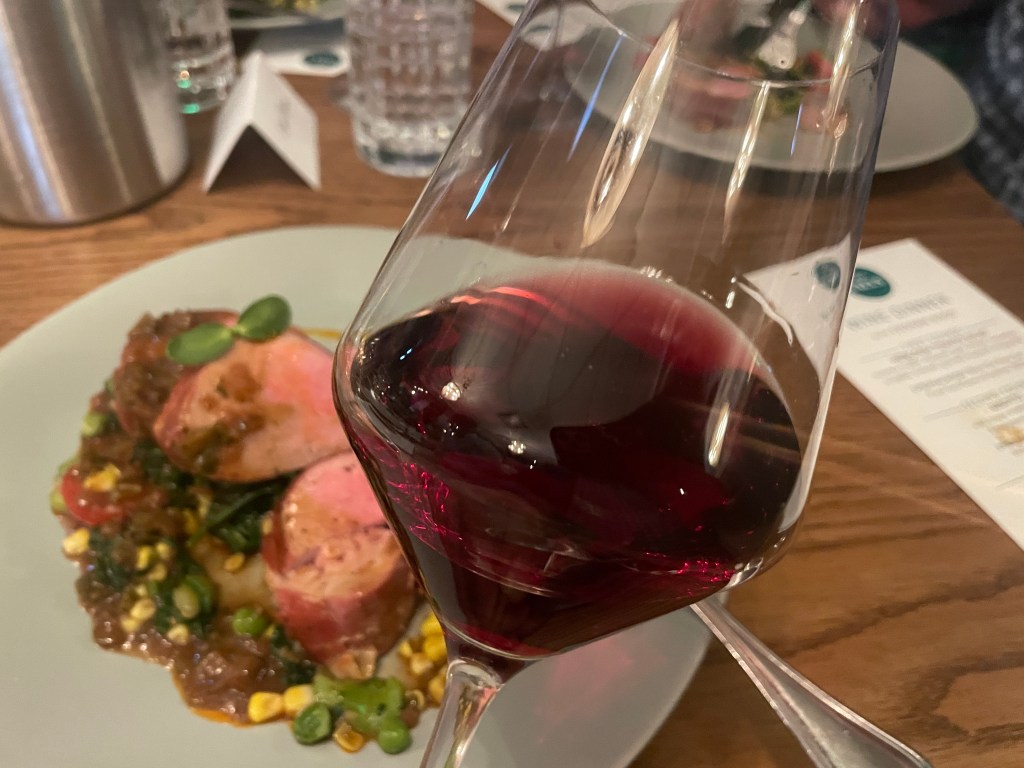
2022 Temperance Hill Pinot Noir. Our 3rd red was the first vineyard-designated wine of the evening, their Temperance Hill. This was paired with pancetta wrapped pork tenderloin.

This retro-style labelled wine was more restrained than the Eola Cuvée, with more earth notes on the nose. On the palate it started with earthiness but the notes transformed into dark fruit, especially blackberry. Erin mentioned it had some oak treatment, but I could barely notice.

This wine was grown at Temperance Hill, a 100-acre Pinot-heavy vineyard at 800’ ft elevation that produces fruit for a number of local wineries.

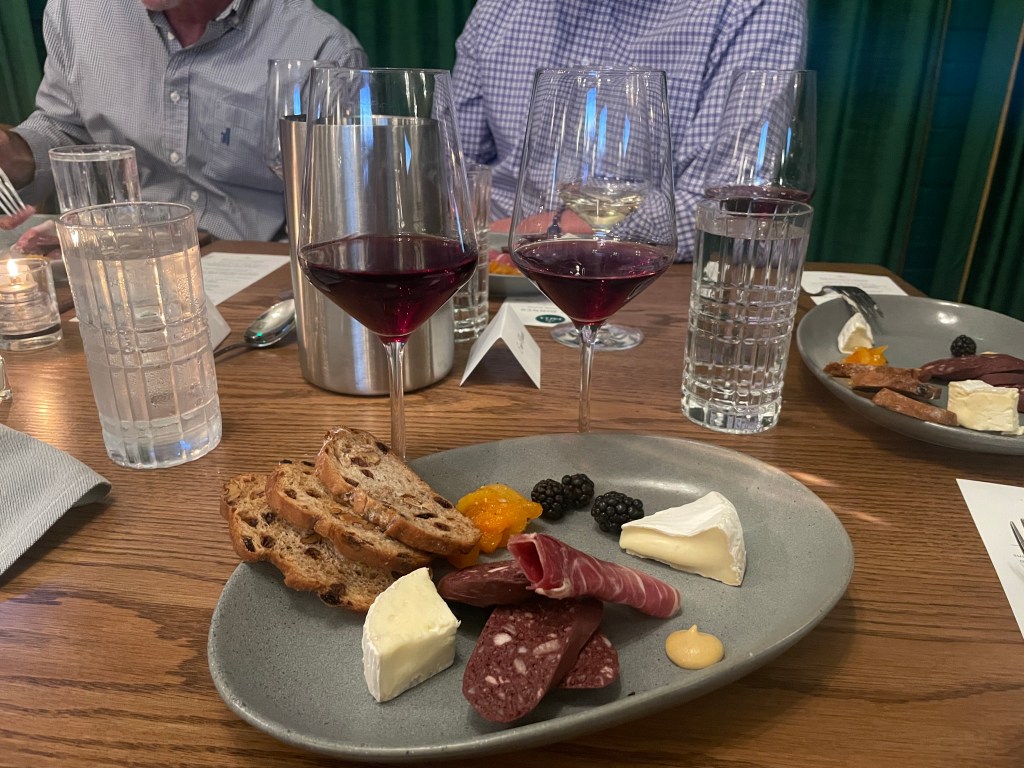
2021 Le Puits Sec Vineyard Pinot Noir. Saving the best for last, Erin brought out Evesham’s vineyard-designated Le Puits Sec (served with cheese and charcuterie).

This wine has structure and lift, yet what stood out the most were the wonderful earthy-mushroom notes on the nose that I wasn’t expecting.

More than anything else, this wine has ‘character’. You drink enough wine, you recognize varietals by their stereotypical tasting profiles. What I loved about the Le Puits Sec is I had to pause to think about it, as I couldn’t immediately identify everything I was encountering.

Fortunately, a second bottle enjoyed a week later yielded additional descriptors. That time I found notes of baking spice, maybe harissa. It was also fresh and well-integrated. But that nose – that alone could sell this wine.

The Le Puits Sec Pinot really demonstrates the importance of ‘place’. As it’s a lower-elevation site the fruit ripens earlier than Temperance, which is only a few miles away. Yet these are very different wines, despite similar soils and winemaking.

Evesham Wood & Haden Fig’s tasting room (located around 50 miles south of Portland) is open by appointment. Let me know what you think if you visit!

Virginia Tannat Tasteoff: Virginia vs South America

Days after I had a blind Virginia vs South America tannat tasting, Wine Enthusiast published an article on Virginia Tannat. Part of me was happy about the publicity. Another part said; “What took you so long to notice?”, as Virginia has made great Tannat for a while.

Tannat was born in the Madiran region of Southwest France. Yet it’s Uruguay that wears the crown as the world’s Tannat capital, growing more Tannat than even France. Dennis Horton of Horton Vineyards was the first to produce a Virginia Tannat, from his 1998 vintage.

As plantings go, Virginia’s 78 acres of Tannat is respectable but far below heavy hitters like Cabernet Franc (661 acres) or even Petit Manseng (200 acres). Tannat’s vulnerability to cold weather force vineyards to be selective in where they plant it, limiting its availability.

Vineyards that do have Tannat treat it like a premium grape, selling at one of the highest price points of any grape in Virginia. One small dash is a great way to beef up red blends with extra tannin and acid. According to Kendell Anderson, winemaker for Bull Run, “Tannat holds its acid but also has good brix. It also calms Petit Verdot without losing its body.”

While it’s increasingly seen in blends, Virginia produces many 100% (or close enough) Tannat wines. Virginia’s first Tannat wines were rustic tannin bombs (the word ‘tannin’ supposedly became bastardized into the name ‘Tannat’), but recent examples are more graceful. In many ways, Tannat is Virginia’s answer to Napa Cabernet, when wine drinkers want something big and bold.

Other than its lack of cold hardiness, Tannat is a great fit for Virginia’s climate. Its high level of acidity means it can hang longer on the vine without losing any punch. It also produces one of the highest tonnages of fruit per acre of any local vinifera. In a good growing site, Tannat can produce an average of 3.5 to as high of 5 tons an acre while still maintaining excellent levels of ripeness.

Lastly, Tannat doesn’t mind excessive water. Jason Murray of Arterra explained Tannat evacuates water from its grapes more quickly than other vinifera; an important consideration considering Virginia’s proclivity for late season storms.

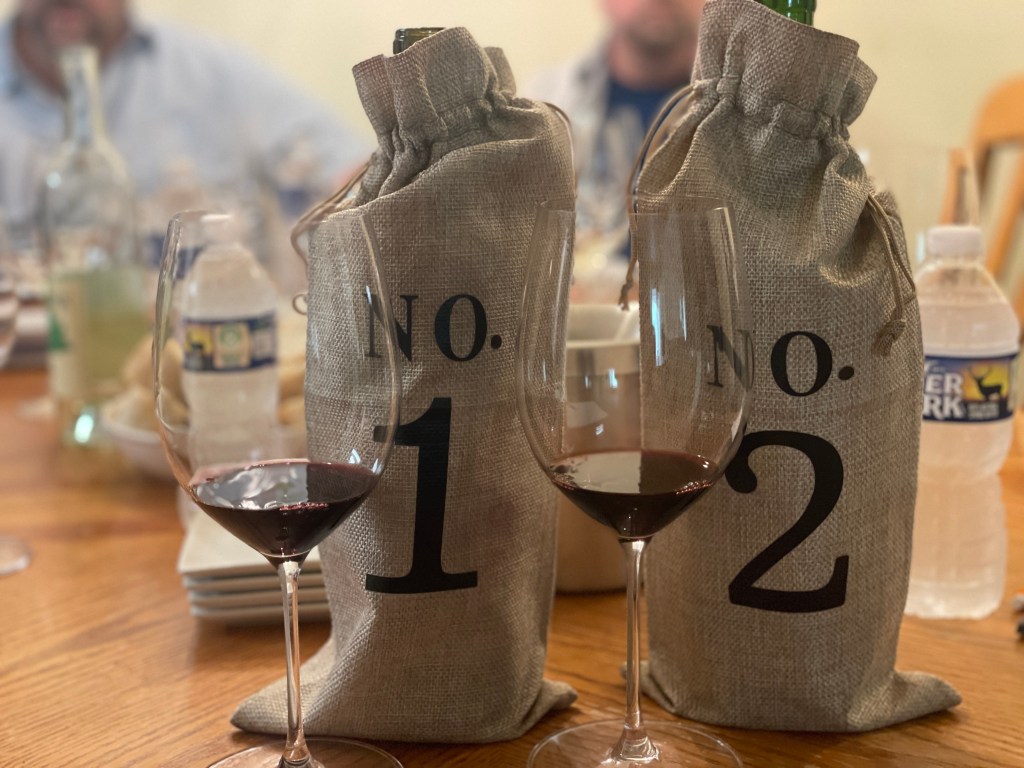
Tasting & Scoring Methodology

Every round my guests picked a favorite. I usually also wrote down the region it came from (if I remembered to ask). After we finished all 8 wines we did a vote to decide the top 2 of the day and revisited them in a ‘Finalist” round.

It was hard to find the specs on many of these wines. I suspect more than a few had a little something else blended in. For half the wines I couldn’t find anything that proved/denied these were 100% varietal wines.

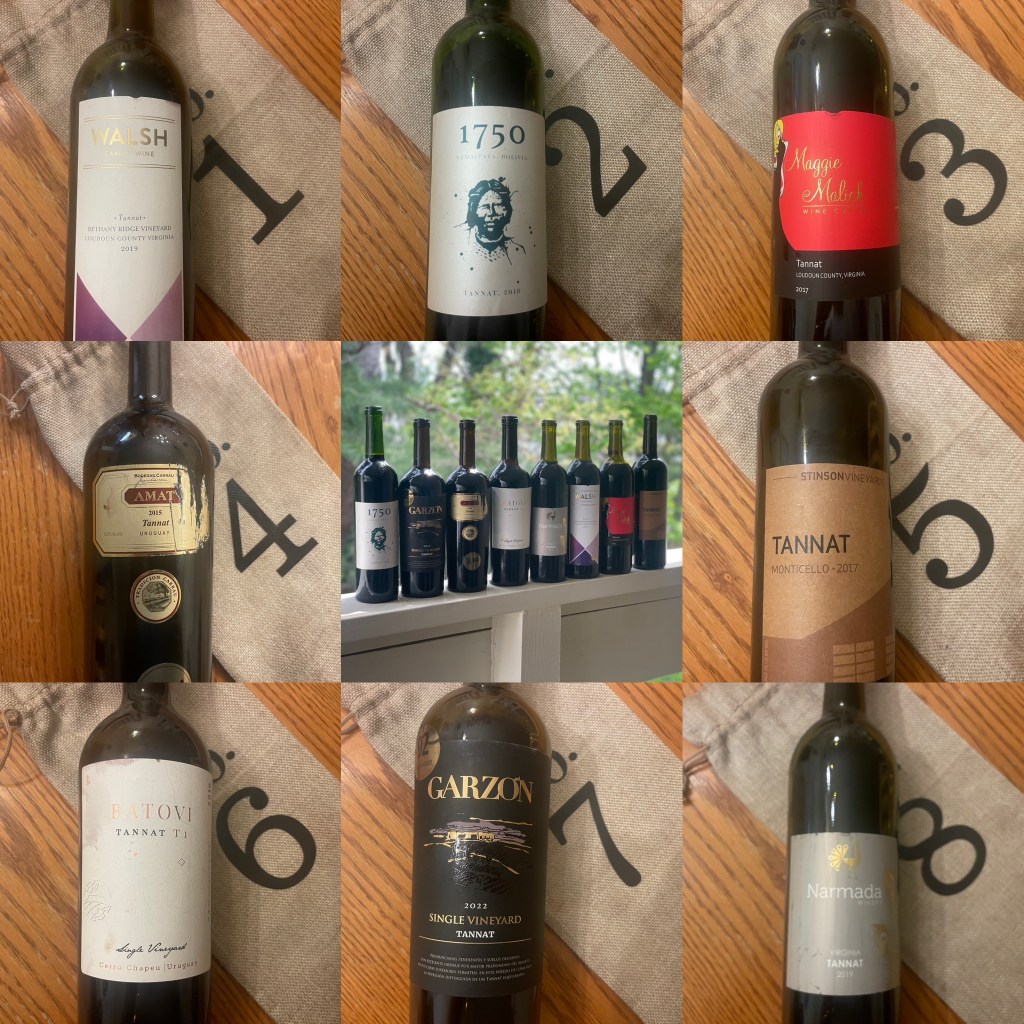
The Contenders:

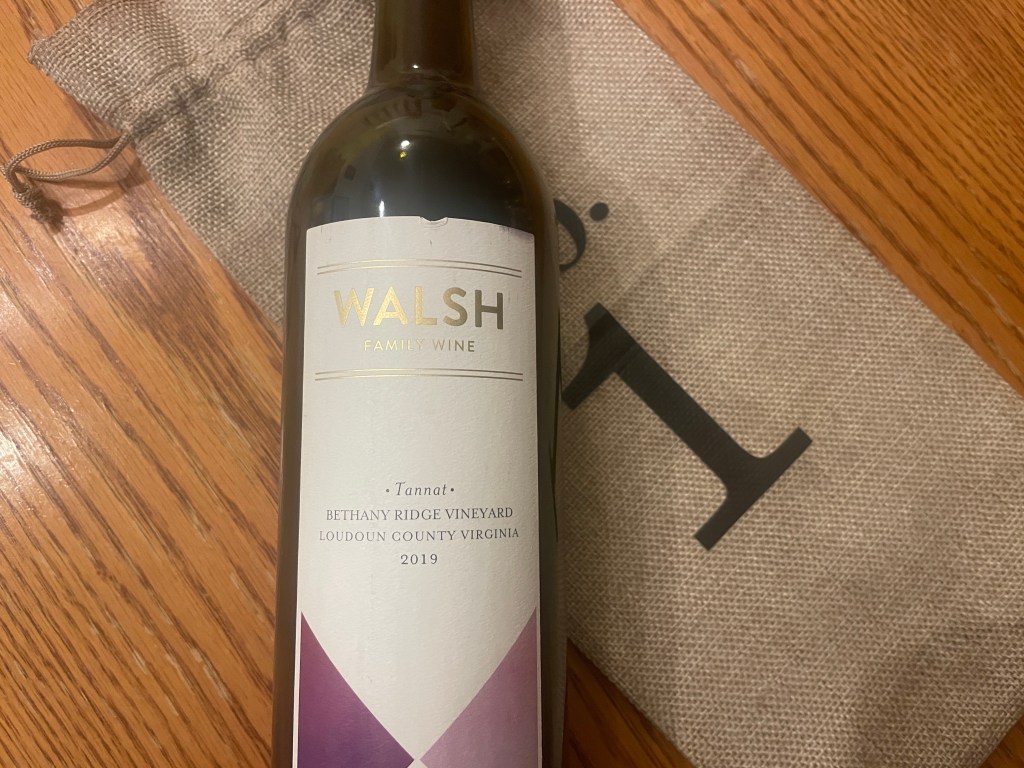
  1. Walsh Family Wine 2019 Tannat (Virginia) (90% Tannat/10% Cab Sauv)
  2. “1750” Uvairenda 2018 Tannat (Bolivia)
  3. Maggie Malick 2017 Tannat (Virginia) (95% Tannat/5% Merlot?)
  4. Amat 2015 Tannat (Uruguay)
  5. Stinson 2017 Tannat (Virginia) (100% Tannat)
  6. Batovi “T1” 2016 Tannat (Uruguay) (100% Tannat)
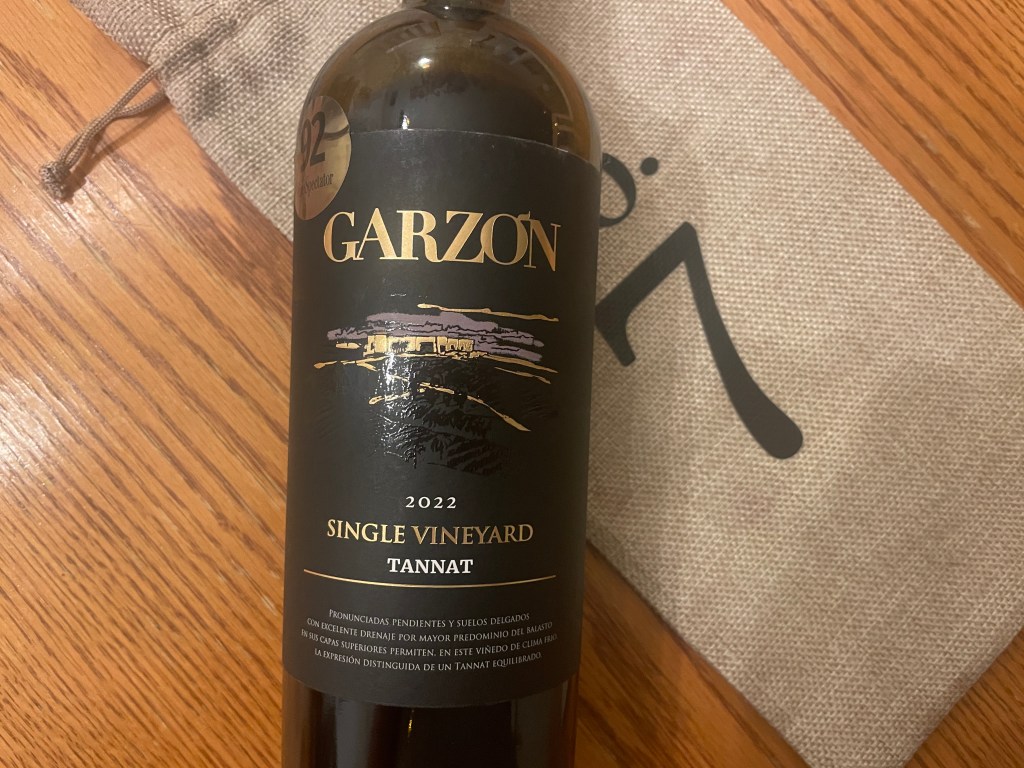
  7. Garzon 2022 Tannat (Uruguay)
  8. Narmada 2019 Tannat (Virginia)

Flight #1

  • Bottle #1: Walsh Family Wine 2019 Tannat (Virginia) (5 votes; round winner)
  • Bottle #2: 1750 Uvairenda 2018 Tannat (Bolivia) (2 votes)

Bottle #1 / Walsh Family Wine 2019 Tannat (Virginia). On the nose a variety of notes were mentioned, including cassis, lilac, and/or cocoa. A soft mid-palate with notes of cedar box and smoke. A good balance of fruit and tannin.

Bottle #2 /1750 Uvairenda 2018 Tannat (Bolivia). Slightly more aromatic than the first wine. It started off with a chemical or spice nose, while the descriptor ‘cheesy’ was also mentioned. The spice was there on the palate but wasn’t as prominent as the nose suggested. It had an almost grape-y ‘ripasso’-like flavor to it. The fruit wasn’t very strong here. We guessed it probably had some age to it.

I didn’t take notes on which region people thought the wines came from, but it was pretty obvious that #1 was Virginia because it was ‘familiar’ while the mustiness of #2 implied Uruguay.

Votes:

  1. Dan: Voted for #1
  2. Frank: Voted for #1.
  3. Jeremy: Voted for #1
  4. Kendell: Voted for #2.
  5. Matt C: Voted for #1.
  6. Matt F: Voted for #2.
  7. Sedale: Voted for #1.

Flight #2

  • Bottle #3: Maggie Malick 2017 Tannat (Virginia) (3 Votes)
  • Bottle #4: Amat 2015 Tannat (Uruguay) (4 Votes; round winner)

Bottle #3 / Maggie Malick 2017 Tannat (Virginia). The oak was noticeable, with people saying it was either borderline too much or maybe the oakiness level was right, but it had too high a toast factor on the oak.

That said, after we got past that oak it had nice fruit and lots of acidity. Nutty and toasted oak/violets were mentioned. Some earth notes as well.

Bottle #4 / Amat 2015 Tannat (Uruguay). Bright acidity. Notes of plumb, wildflowers were mentioned. The guests who preferred this wine felt it had a balance of red fruit and leather. Tannins were well integrated. Some felt it was the better balanced of the two. It was also lighter and felt less alcohol-y than #3. Maybe it was a blend, but I can’t confirm that.

Votes:

  1. Dan: Voted for #3; felt it was Virginia.
  2. Frank: Voted for #4; felt it was South America.
  3. Jeremy: Voted for #3; felt it was Virginia.
  4. Kendell: Voted for #3, felt it was Virginia.
  5. Matt C: Voted #4, felt it was from South America.
  6. Matt F: Voted for #4; felt it was South America
  7. Sedale: Voted for #3; felt it was Virginia.

Flight #3

  • Bottle #5: Stinson 2017 Tannat (Virginia) (5 votes; round winner)
  • Bottle #6: Batovi “T1” 2016 Tannat (Uruguay) (2 votes)

This was universally judged to be our favorite round of the day. By coincidence, both went to the ‘finalist’ round. It wasn’t planned that way; I had no idea in advance these two would be ‘ringers’; my pairing just happened to have the top 2 wines in the same initial round.

While most wines of the day were almost always easily identifiable by their country of origin, this round through us for a loop because both had “South America” vibes. We mostly still guessed them correctly, but I wouldn’t judge those who thought the Virginia wine was from Uruguay.

Bottle #5 / Stinson 2017 Tannat (Virginia). “Damn it’s good!” was quickly mentioned. Red and dark fruit notes on the palate. Beautiful depth. More fruity than sweet but with lots of complexity. Tannins were well integrated. Tea leaf on the nose; even a hint of butter.

“I need this with rib eye” was my favorite descriptor. I later learned it was 15.1% alcohol (the highest of any wine in the event), but it was so well balanced we didn’t notice it.
Bottle #6 / Batovi “T1” 2016 Tannat (Uruguay): Lots of great descriptors. Red fruit and ‘nice’ tannin. Creamy, soft texture; even a candied component. Good acidity and mouthfeel. Smokey and complex. Sour cream/sour cherry on the nose.

Someone mentioned this was a ‘sit by the fire’ wine. I was surprised it was 15.1% ABV; it didn’t taste ‘hot’ at all.

Votes:

  1. Dan: Voted for #5; felt it was Virginia.
  2. Frank: Voted for #5; felt it was South America.
  3. Jeremy: Voted for #6.
  4. Kendell: Voted for #5; felt it was Virginia.
  5. Matt C: Voted for #5; felt it was Virginia.
  6. Matt F: Voted for #6; felt it was South America.
  7. Sedale: Voted for #5; felt it was Virginia.

Flight #4

  • Bottle #7: Garzon 2022 Tannat (Uruguay) (5 votes; round winner)
  • Bottle #8: Narmada 2019 Tannat (Virginia) (2 votes)

Bottle #7 / Garzon 2022 Tannat (Uruguay). This wine was tight; we were guessing it was a younger wine. Ruby-esque color made us guess it may have been higher in alcohol. Tea leaf nose; soft tannin; ‘shy’.

It needed time to open up, but when it did we had descriptors of smokiness with some intensity and alcohol notes. Soft on the palate but drinkable. Hint of cocoa. Raspberry nose/ dark chocolate palate.

Bottle #8 / Narmada 2019 Tannat (Virginia). This was smoother and more ‘neutral’ compared to #7. Notes of prunes, cocoa spice, and licorice were mentioned. Soft palate, velvety, quaffable.

Votes:

  1. Dan: Voted #7
  2. Frank: Voted #7
  3. Jeremy: Voted #8
  4. Kendell: Voted #7, thought it was Virginia
  5. Matt C: Voted #7; thought it was Virginia.
  6. Matt F: Voted #8; thought it was South America
  7. Sedale: Voted #7

Finalist Flight

  • Bottle #5: Stinson 2017 Tannat (Virginia) (5 Votes; Event Winner)
  • Bottle #6: Batovi “T1” 2016 Tannat (Uruguay) (2 Votes; Runner Up)

Wines #5 and #6 were voted to advance to the ‘finalist’ round. After a 2nd tasting I did a poll of our favorite wines, and #5/Stinson was the event winner. The vintage was so strong, winemaker Rachel Stinson Vrooman later told me, “It made itself.”

#6/Batovi was the runner up. There was a consensus that Walsh Family’s 2019 Tannat was the third favorite, although we also liked Amat and Maggie Malick.
The Stinson and Batovi wines opened up just enough to make our 2nd tasting just different enough to make some of us rethink our votes. Most kept theirs, but Dan and I switched teams (him to Uruguay, me to Virginia).

I don’t know if this is surprising or not, but the top 2 wines were 100% Tannat. I still suspected several had something else blended in (the Walsh Family Wine definitely did; I suspect Maggie did as well).

In summary, the Stinson was judged to be a “I want this to drink by myself” wine (preferably with steak), while the Batovi was more versatile. It was a very tough choice to pick between the two. Dan of MyNoVaWineBlog was VERY happy he brought the winner!

  1. Dan: Voted #6/Batovi
  2. Frank: Voted #5/Stinson
  3. Jeremy: Voted #5/Stinson
  4. Kendell: Voted #5/Stinson
  5. Matt C: Voted #6/Batovi
  6. Matt F: Voted #5/Stinson
  7. Sedale: Voted #5/Stinson

Lessons Learned:

Both Virginia and Uruguay (with an assist from a Bolivian wine) presented very well. 2 rounds went to Virginia, 2 for Uruguay, and the ‘top’ wine was Virginia.

In terms of a tasting profile, the Virginia wines tended to be heavier on oak than their South American counterparts. All of them had some cedar box on the nose and trended towards dark fruit on the palate.

We felt the South American wines didn’t consistently have the same tasting notes, although most had notes of dried fruits/raisins. We also felt they may have spent at least some time in steel.

Yes – Virginia makes amazing Tannats. Nice to see Wine Enthusiast noticed!

Barboursville Vineyards Wins 2025 Virginia Governor’s Cup

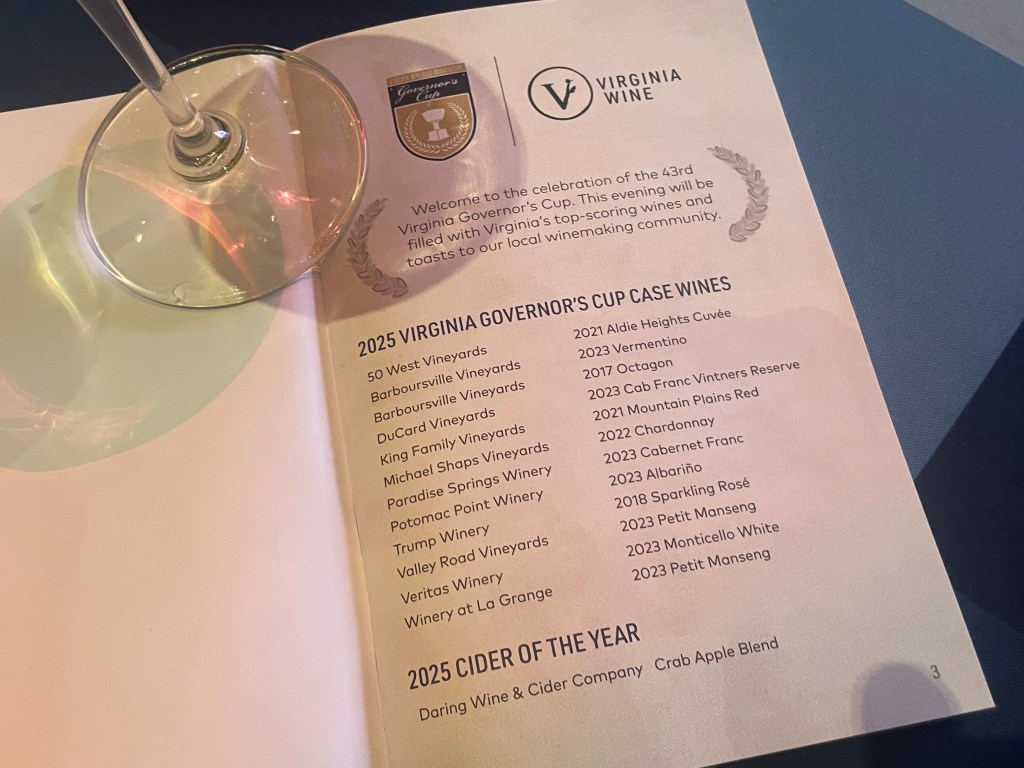
On March 13th, Governor Glenn Younkin announced Barboursville Vineyards’ 2023 Vermentino as the winner of the 2025 Virginia Governor’s Cup. Ever the advocate for his home state, Barboursville winemaker Luca Paschina told the audience, “When you go to your favorite restaurant, you must demand they carry Virginia wine!”

Barboursville is one of Virginia’s oldest and most prestigious wineries, and Luca has been its Estate Director and winemaker since 1990. He is also the record holder for most Governor’s Cup wins, taking the trophy home three times since the event was revamped in 2011.

Vermentino is a variety that’s rarely found outside Italy, mostly planted in the maritime regions of Liguria and Sardinia. While not as recognizable as Barboursville’s other Italian grapes, Luca’s team has been successfully growing vermentino since 2009.

“It’s the favorite of a lot of people who visit, even if they don’t know what it is,” Luca said of the event’s top wine. “The acidity isn’t very high, but it has great minerality and phenolics. It does well in Virginia because it likes heat, but it doesn’t mind Virginia’s rainy periods either. I’ve made 14 vintages so far, and it’s always been very consistent, even in a wet year like 2018.”

The underappreciated nature of this variety means it’s a great value for your money, selling for $23 a bottle at the winery. A zesty, light-bodied white, Barboursville’s 2023 Vermentino hits a sweet spot between pinot grigio and sauvignon blanc, with notes of Asian pear, white flowers, and an underlying salinity.

Barboursville’s Vermentino has long been a contender for the Cup, having entered the Governor’s Case (composed of the event’s top 12 wines) seven times but missing the top prize until now. Their 2017 Octagon red blend also made it into the Case.

Ten other wineries entered the Case, representing a cross-section of the local wine industry.

DuCard Vineyards and The Winery at La Grange became first-time entrants into the Case. Valley Road winemaker Corry Craighill also took her place on the Cup finalist stage for the first time.

The remaining Case members were veterans of previous competitions. Michael Shaps Wineworks now boasts 15 Case wines, with King Family not far behind. 50 West, Paradise Springs, Potomac Point, Trump Winery, and Veritas also added notches to their tallies.

This year’s Governor’s Case also set a record for its high number of white wines. The event guidelines require the Case to include a minimum of four non-red wines. This year’s Case included six whites and a sparkling.

The strong showing by white wines and lighter-bodied reds is likely a tribute to the quality of the 2023 vintage, often regarded as one of the best in recent Virginia history. Not only do 2023 vintage wines make up over half the Case, they’ve also brought home many “Best in Class” awards in national-level competitions that California typically dominates.

Daring Wine & Cider Company’s Crab Apple blend was awarded Cider of the Year. A new “Best in Show” category was also unveiled, recognizing the best examples of major varieties or styles that didn’t make it into the Case.

The 2025 Virginia’s Governor’s Case

  1. Barboursville Vineyards, 2023 Vermentino (Cup Winner)
  2. 50 West Vineyards, 2021 Aldie Heights Cuvée
  3. Barboursville Vineyards, 2017 Octagon
  4. DuCard Vineyards, 2023 Cabernet Franc Vintners Reserve
  5. King Family Vineyards, 2021 Mountain Plains Red
  6. Michael Shaps Wineworks, 2023 Chardonnay
  7. Paradise Springs Winery, 2023 Cabernet Franc, Brown Bear Vineyards
  8. Potomac Point Winery, 2023 Albariño
  9. Trump Winery, 2018 Sparkling Rosé
  10. Valley Road Vineyards, 2023 Petit Manseng
  11. Veritas Winery, 2023 Monticello White
  12. Winery at La Grange, 2023 Petit Manseng

Behind The Scenes Changes Help Even The Playing Field

A total of 622 medals were awarded in 2025, including 155 golds. While popular varieties and styles such as red blends, cabernet franc, and petit verdot dominated the medal count, several hybrid wines such as an organically-made cayuga from Loving Cup Vineyard also earned gold.

While the public’s attention is focused on the medal winners, the event was elevated by less-obvious changes in the submission and judging process.

For the first time, wineries were limited to a maximum of six entries. This increased the quality of the field by forcing wineries to be more selective in what they submitted.

This change wasn’t popular in all quarters. One owner confided he worried this limitation would undermine the event by encouraging wineries to only send wines with proven track records, rather than take risks with lesser-known varieties. Fewer entries also meant wineries could miss potential marketing opportunities.

The format under which wines are judged was also revamped. Director of Judging Frank Morgan wrote an extensive article outlining changes he instituted when he took over the role two years ago. The most notable change was having more judges in the preliminary round, mitigating the risk that palate fatigue would impact scoring.

As the stature of the event grows, Frank has correspondingly expanded its network of judges. “This year, we had four judges who hold the Master of Wine designation (the most ever), one Master Sommelier, and renowned wine writers. I now have a list of over 100 wine professionals from around the U.S. who have contacted me to express interest in serving as a judge,” Frank explained.

The final medal count demonstrates this combination of fewer entries and additional judges meant more nuanced wines showed better. In 2024, the event had 752 entries, 138 of which earned gold (18.4%). In 2025, the competition had 626 entries, 155 of which earned gold (24.8%).

Additional changes may be in the pipeline. The current Governor’s Cup format is somewhat inaccessible for micro-producers, or winemakers who make experimental styles that don’t show well with traditional judges. Frank hopes to eventually showcase these wines as well.

Virginia Pinot-Palooza

I was recently the emcee for a Virginia Pinot Noir event that I nicknamed “Pinot Palooza”. A considerable portion of Virginia’s community of Pinot growers gathered to share one another’s wines and discuss their vineyards. It was probably the single most diverse tasting of Virginia Pinot Noir that has ever occurred.

Wines we sampled

  1. 12 Ridges 2021 Pinot Noir (VA)
  2. 12 Ridges 2022 Pinot Noir (VA)
  3. Savigny-lès-Beaune “Vieilles Vignes” 2018 (Burgundy)
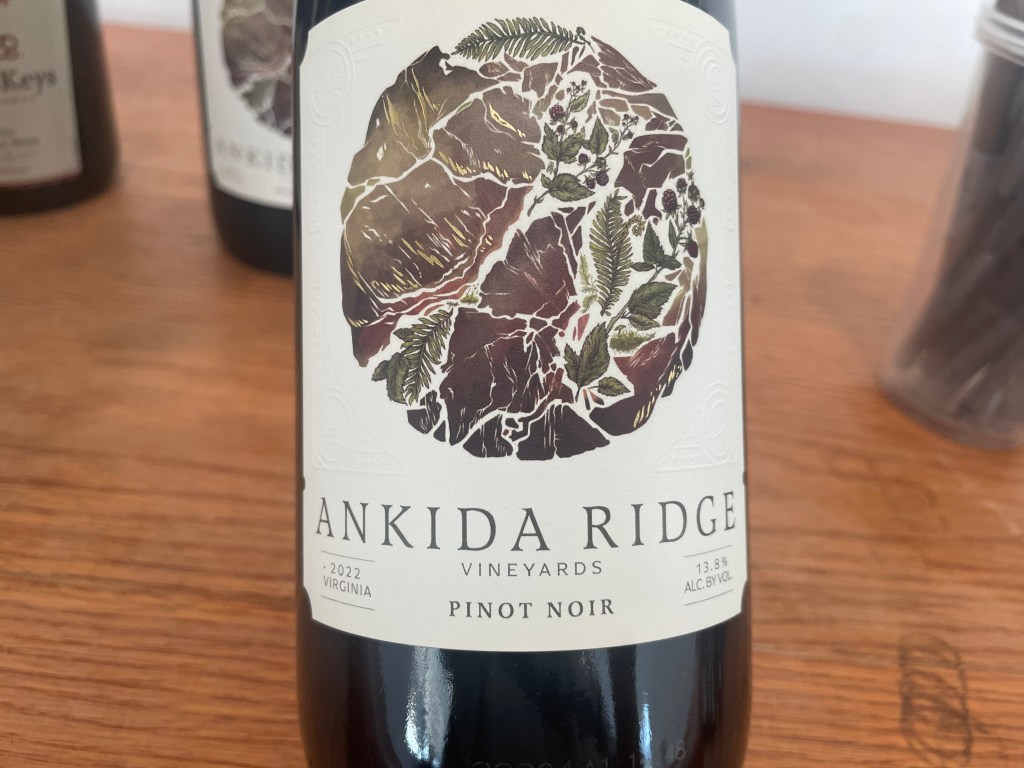
  4. Ankida Ridge 2022 Pinot Noir (VA)
  5. Cave Ridge 2023 Pinot Noir (not released) (VA)
  6. Cave Ridge 2024 Pinot Noir (barrel sample) (VA)
  7. Ox Eye 2022 Pinot Noir (VA)
  8. Hazy Mountain 2022 Pinot Noir (VA)
  9. DuMOL Pinot Noir (CA, Russian River Valley)
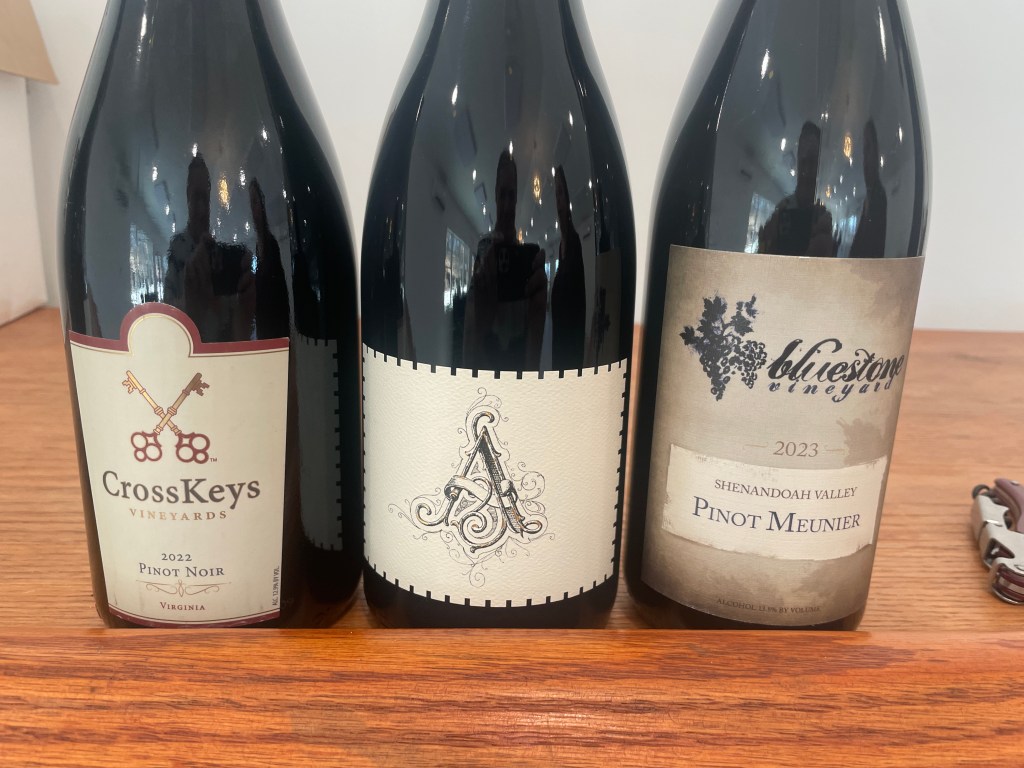
  10. Cross Keys 2022 Pinot Noir (VA)
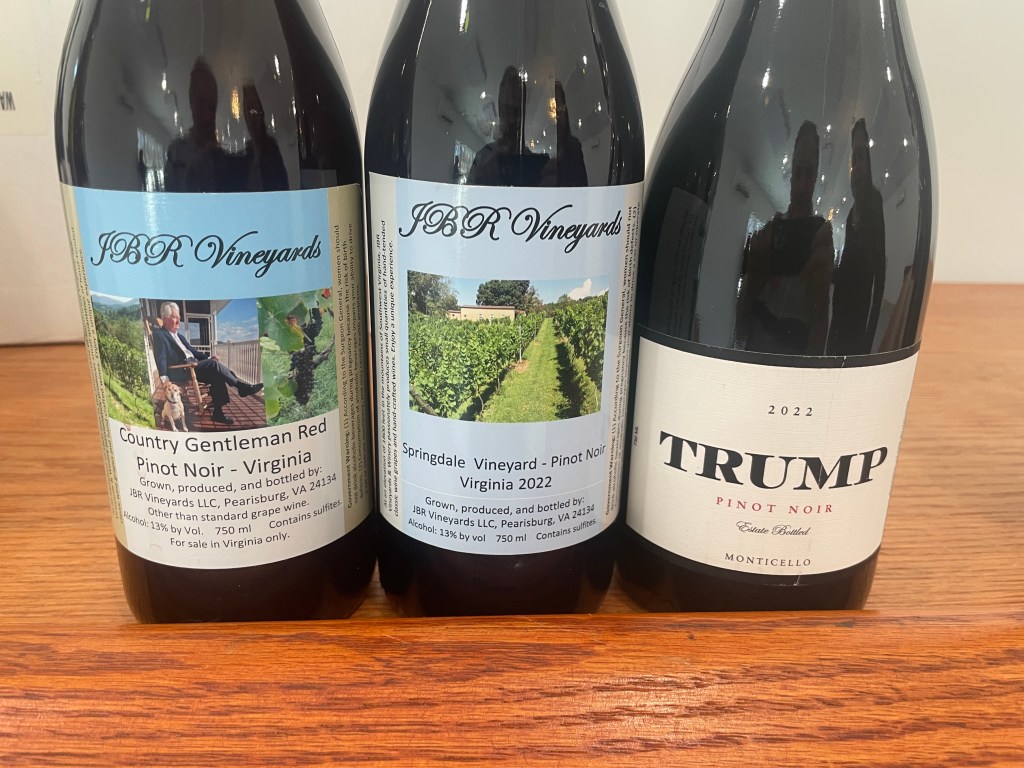
  11. JBR Vineyard 2021 Country Gentleman Red (Pinot) (VA)
  12. JBR Vineyards 2021 Springdale (Pinot) (VA)
  13. Trump Vineyards 2022 Pinot Noir (VA)
  14. Antiquum Farm Pinot (Oregon)
  15. Bluestone 2023 Pinot Meunier (VA) (the only non-Pinot Noir of the day)

While this sounds like it would be a big gathering, in reality we only shared 11 Pinot Noirs from 8 separate Virginia wineries, in a state that possesses around 15 growers. Of these, only a handful typically make a full Pinot Noir every year (the remaining focus on sparkling or rosé).

It’s difficult to say which Virginia winery first planted Pinot Noir, although several including Barboursville and Swedenburg tried in the 1990s and early 2000s. These viticultural pioneers didn’t yet realize Virginia’s warm summers would cause these sites to struggle. Dennis Horton, a man famous for introducing multiple varieties to Virginia, reportedly once said: “I don’t think Jesus Christ could grow Pinot Noir in Virginia. You can do it, but it doesn’t taste like Pinot should.”

The data shows not many have tried. Side by side metrics from Virginia’s 2008 and 2023 Commercial Wine Grape reports demonstrate that Pinot remains a niche grape in the state.

  • In 2008, there were 28 acres of Pinot Noir (25 bearing, 3 non-bearing) out of a total of 2,500 acres of grape vines in Virginia (barely over 1% of the total)
  • In 2023, there were 41 acres of Pinot Noir (30 bearing, 11 non-bearing) out of 4,318 acres of vines in the state (just under 1%).

Yet these metrics only tell part of the story.

According to conversations with various winegrowers, it appears much of the Pinot that existed when the 2008 report was written has since been torn out, as these growers couldn’t bring their grapes to full ripeness. Most of the vines that were planted from 2008 onward were planted in the Shenandoah Valley and Blue Ridge Mountains.

The key change from the wines that Dennis Horton tried was these newer vineyards focused on higher-elevation sites, often 1,600 feet and above. Such elevation ensures a constant flow of cool air and moderate temperature swings, which protect Pinot’s tightly-bunched clusters from damage and allow them to evenly ripen.

Membership in this ‘high elevation club’ is very select. Ankida Ridge planted their first vines in 2008, while Ox Eye Vineyards planted in 2009 based on advice from Finger Lakes grower Hermann Wiemer. Hazy Mountain started growing Pinot at its Swoope vineyard in 2016, and 12 Ridges Vineyard founded their site in 2019. Around the state, even more wineries followed.

Our tasting included a broad mix of vineyards, planted anywhere between 850 to 3,300 feet elevation. We asked ourselves; did this elevation make a difference, and what other factors influenced the wine in our glass?

Virginia Pinot Noir Growers

*Note: The Shenandoah Valley has around half of all Pinot Noir grown in Virginia, with smaller plantings at various locations along the Blue Ridge Mountains. Trump Winery has the largest single planting of Pinot Noir in Virginia, but in most years, it’s exclusively used for sparkling wine.

The Tastings

We sampled 15 different Pinots in flights of 3. I ensured nearly every flight had a non-Virginia Pinot for comparison purposes. My apologies for having better notes on some wines that others; at times I couldn’t write fast enough.

Flight 1:

  • 12 Ridges 2021: Lighter on nose and harmonious on the palate. Good complexity of aroma, tannins, and finish. One of the most ‘delicate’ wines of the day, and one of the favorites.
  • 12 Ridges 2022: Bolder, more fragrant than the 2021 vintage.
  • Savigny-lès-Beaune “Vieilles Vignes” 2018: Fleshier, more concentrated than anything else I tried that day.

Flight 2:

  • Ankida Ridge 2022: Floral nose. Notes of earth, specifically wet dirt. The wine had some heft to it but was well balanced. It also had just the right amount of oak, tannin, and structure.
  • Cave Ridge 2023: Not yet released! Clean, flawless, fruity, but needs some bottle age. Notes of red plumb and cherries. Less earthy than the Ankida. Owner Randy Philips explained he was going to only make a sparkling wine, but his daughter Megan loved the 2023 so much they decided to make it as a still wine. This was the first time he’d made a regular Pinot, which makes it all the more impressive.
  • Cave Ridge 2024 (barrel sample): This was so young it was hard to judge, but we had fun sampling it. Some attendees actually thought the 2024 was better than the 2023, or would be in time.

Flight 3:

  • Hazy Mountain 2022: Lighter in color, fresh mouthfeel. It had some earthiness to it and nice tannin.
  • Ox Eye 2022: Very charming and approachable. At $27, this was one of the best values of the entire event. Owner/winemaker John Kiers doesn’t make a still Pinot every year, but his $35 Blanc de Noir is a great alternative.
  • DuMOL Pinot Noir (CA, Russian River Valley): One of the fullest wines of the day. The ripeness made it stand out as a California wine.

Flight 4:

  • JBR 2021 “Country Gentleman Red”: Light and fruity, lots of strawberry notes. Unfiltered? At $15, this was made for a crowd looking for something that’s easy drinking.
  • JBR 2021 “Springdale”: More intense than the “Country Gentleman”, and closer to the traditional Pinots we are accustomed to.
  • Trump Winery 2022: Good body and structure, but at the expense of the fruit. Trump only infrequently makes a Pinot Noir, but you can usually find these grapes as a Blanc de Noir.

Flight 5:

  • Antiquum Farm Pinot (Oregon): No notes, but good!
  • CrossKeys 2022: CrossKeys only infrequently makes a still wine, but their Blanc de Noir is excellent. Barnyard note to it, maybe a little brett.
  • Bluestone 2023 Pinot Meunier (from Verona Farm Vineyard): Our only non-Pinot of the day. One guest referred to this as a ‘starter red for white drinkers’, because it’s so easy drinking.

I should also mention the amazing food that Cave Ridge arranged for us, courtesy of Woodstock-based Flour & Water.

I polled the 9 guests who didn’t present a wine they made, and the top three Virginia wines were the 2022 Ankida Ridge, 2021 12 Ridges Vineyard, and the 2023 Cave Ridge (which narrowly beat the 2022 Ox Eye).

Ankida was the overall favorite by a fair margin, but the 2021 12 Ridges wine had many compliments as well. Notably, these two were specifically designed as ‘high elevation’ vineyards, with Pinot being some of the first grapes they planted.

Lessons learned

“High elevation Pinot is in its infancy. I am excited for its future,” wrote Christine Vrooman of Ankida Ridge. “The bar has been raised from 20 years ago,” said another guest after completing the tasting.

Here are a few of my take-aways from the day’s discussions:

1. Winemaking is more important than elevation to make good wine. Site selection is important to tease out Pinot’s best expressions, but good winemaking is still crucial to make a good wine. Likewise, a winemaker can make a good wine made with Pinot grapes, even if it doesn’t express the ‘typical’ Pinot characteristics consumers are accustomed to. We saw both sides of this coin at this event.

2. Elevation is important – but so are other factors. While much of the discussion focused on the importance of elevation as a key criterion to bring out Pinot’s best qualities, that’s just one part of the equation. Soil type, vine density, relative altitude, and good vine material are also important to get healthy fruit.

My observation of the day’s conversations is while Pinot does love elevation, it takes more than elevation to make a good Pinot vineyard.

3. Blanc de Noir is a great alternative. Many Pinot growers readily admit how difficult it is to achieve full ripeness. This means sparkling wine is usually the best use of their fruit. These wineries (including but not limited to Afton Mountain, CrossKeys, Rockbridge, and Trump) may only offer a Pinot Noir in better growing years.

Linden Vineyards December Library Tastings

Linden recently hosted what might be my favorite event of the year – a pair of Friday-only library tastings. Being an overachiever, I went to both.

Jim Law produced his first vintage in 1987, so it’s fair to say that Linden has a considerable number of older bottles to choose from. He’s often spoken about the need to hold on to bottles for the future, be it comparative tastings or just for his own education. Even now, Jim’s older bottles often portend the direction his current releases are going.

Linden used to do Library tastings every December until COVID hit, so this is something of a return to norm. I was really impressed that Linden charged the same price for this library tasting that they do for their regular tastings. I attribute that to Jim being a ‘wine educator’ at heart, and he wants to make the study material available to everyone.

Both days included a pair of comparison flights of a 2009 and a 2017, which Jim selected because stylistically these are similar vintages. He also threw in a few extra bottles during both days.

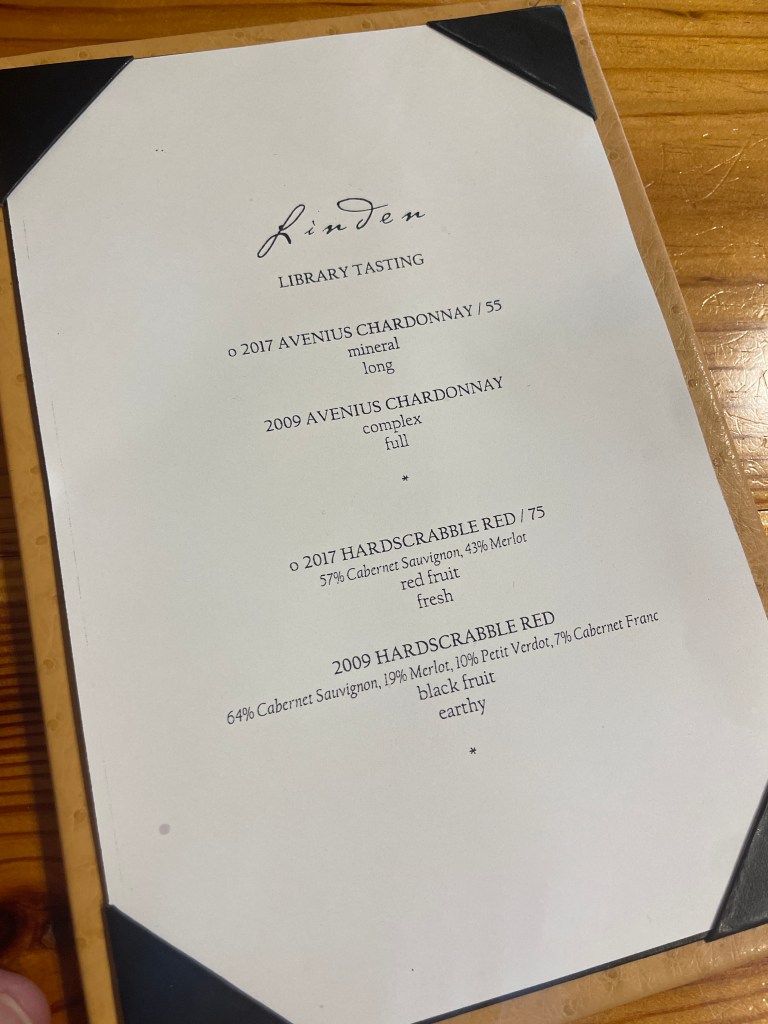
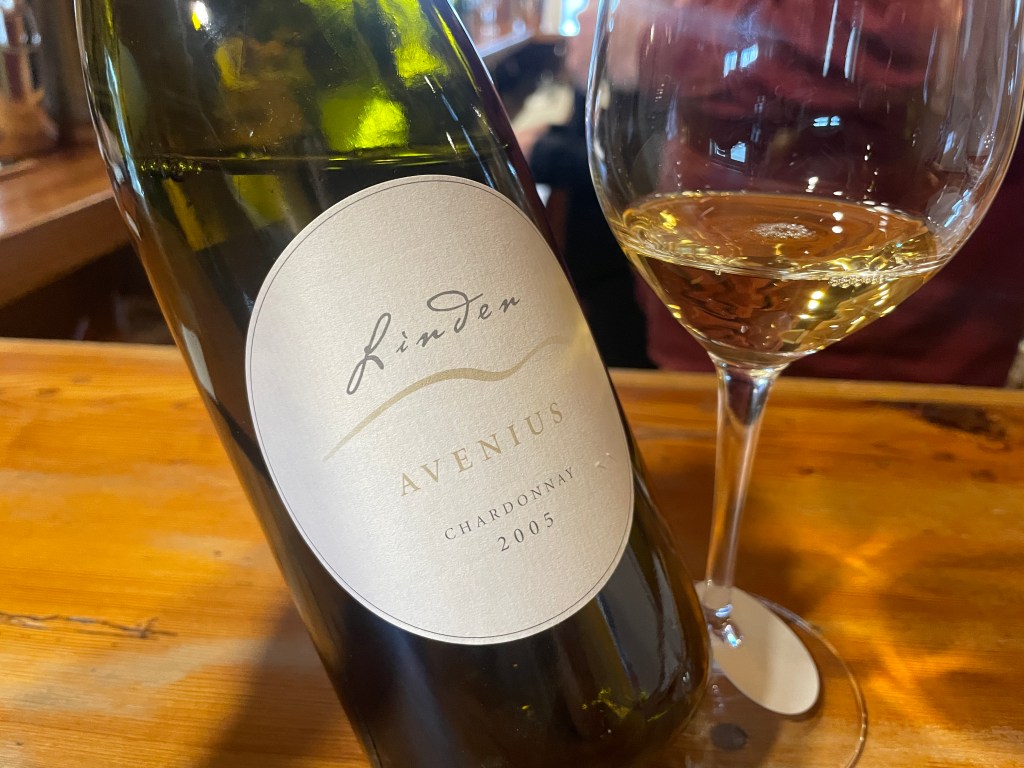
Comparative flight #1: 2009 Avenius Chardonnay, 2017 Avenius Chardonnay, and ‘bonus’ 2007 Avenius Chardonnay

The first flight included a 2009 and 2017 Avenius Chardonnays. Both were especially warm and dry years; arguably 2 of the best in the past 15 years. The 2009 was considerably darker compared to the 2017.

I bought a number of bottles from the 2017 vintage, so I know it’s great. Yet compared to the 2009, the 2017 just paled in comparison. It really didn’t seem fair to put 2009 compared to anything else, since 14 years of age just gave it so many extra layers.

By comparison, the 2017 was still tight, even if it was excellent. If in 8 years it turns into the 2009, then I’d be very happy.

On top of these bottles, Jim brought over a sample of the 2007 Avenius Chardonnay to make this flight a trio.

The 2007 was considerably softer but still provided plenty to savor. My friends who joined me for my 1st visited debated which was better. Some preferred the 2007 for its complexity, while the 2009 ‘was more delicious’.
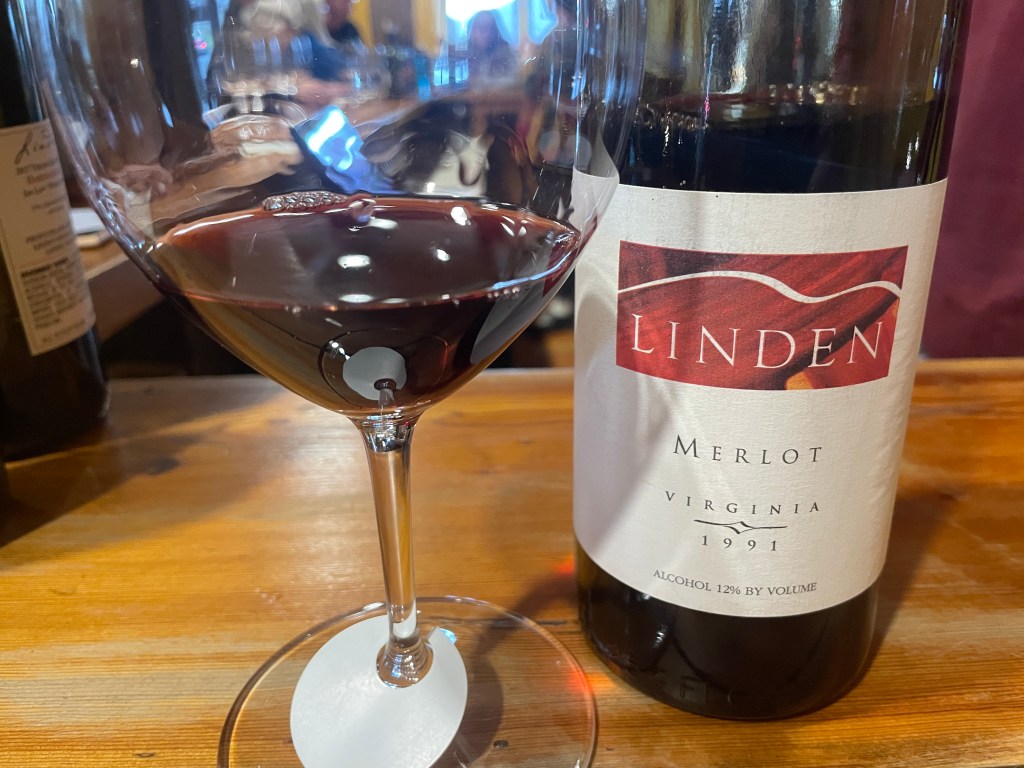
I ended up getting a glass of the 2009 Avenius to enjoy in the members room.

Comparative flight #2: 2009 Hardscrabble red and 2017 Hardscrabble red

To be fair, the 2017 Hardscrabble red is one of my all-time favorite Virginia wines ever. I’ve used it in blind tastings and wine professionals (including one born and raised in Bordeaux) insisted this was a Bordeaux wine. This bottle had maybe a tiny bit of brett in it, but only in a way that added to its complexity in a good way.

The 2009 was more leathery, no fruit but plenty of power. The rim was a little watery but it didn’t present as an ‘old’ wine.

“Bonus flight” #1: 1991 Merlot and 2001 Reserve

Neither of these bottles were on the original tasting. But when Jim opens a ‘bonus’ tasting, you just sit back and enjoy.

While drinking the 1991 Merlot I learned a new wine descriptor; ‘sanguine’. It directly translates as ‘bloody’, and is a reference to not just the color but the iron notes it exudes.

To me, if a red wine could be minerally, this is it. It also had some history to it, since the red label came from a finger painting of Jim’s daughter Sam (who now works at Linden full time).

Jim explained the 2001 Reserve was an example of him chasing the current trends of the time. He designed it to be all power, no finesse. It also seemed to predate his focus on vineyard-specific wines. Shockingly, it still had some fruit notes to it.

“Bonus flight” #2: 2005 Avenius Chardonnay, 2006 Avenius Chardonnay, and 1997 Reserve

During my 2nd visit I was able to get a new trio of wines; flight of 2005 and 2006 Avenius Chardonnays, and a 1997 Reserve.

The 2005 had very little fruit left; it was like biting into an old lemon that was becoming a husk. The 2006 was livelier. Of course, neither held a candle to the 2009 Avenius.

The 1997 Reserve was perhaps the best ‘old Virginia wine’ I’d ever had. There was still some fruit there, despite being 27 years old. Earthy but still drinkable.

Turns out Jim only made 2 ‘Reserves’; one in 1997 and one in 2001. Both were precursors to today’s Hardscrabble reds.

I enjoyed one last glass of the 2009 Chardonnay, then off to Walsh Family Wine.

Walsh Bar Takeover Blue Wall Cider and The Parallax Project

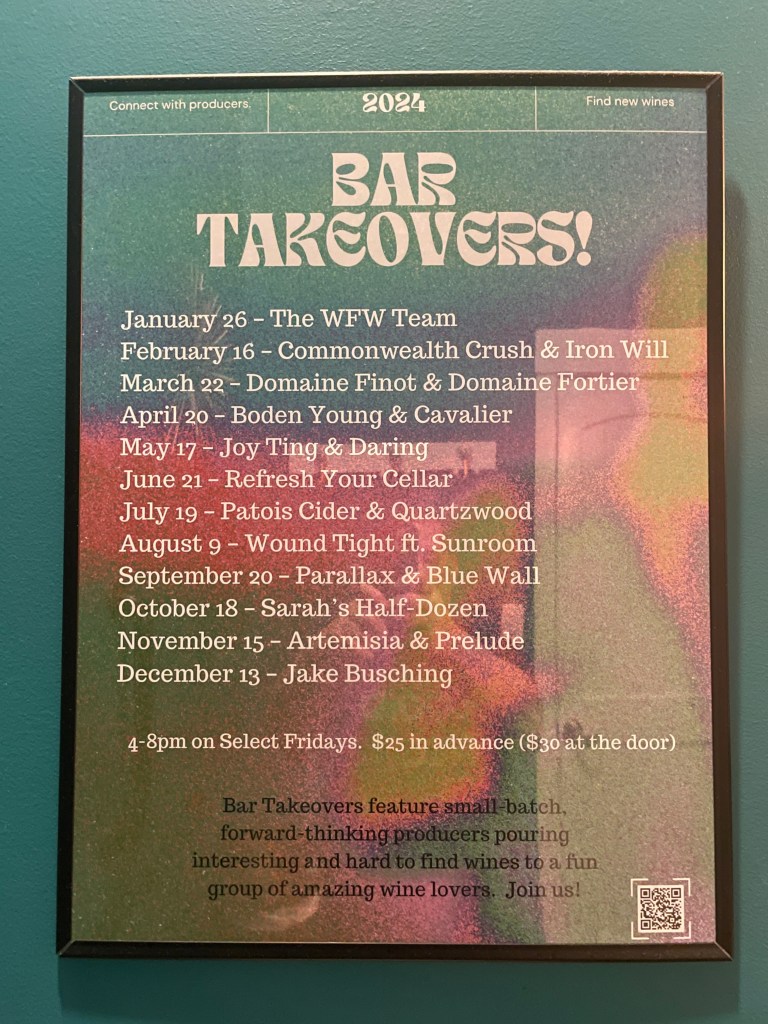
Last month (after a hard day of sorting grapes at Linden) I went over to Walsh for their latest Friday Bar Takeover. This event included a pair of new participants, The Parallax Project and Blue Wall Cider & Wine.

I’ve become accustomed to visiting old friends at these Bar Takeovers (looking at you, Jake Busching, Joy Ting, Daring Wine Co) but it’s exciting to try new, small brands. Some projects showcased here are actually produced at Walsh Family Wine, while others are what you might call ‘visiting friends’.

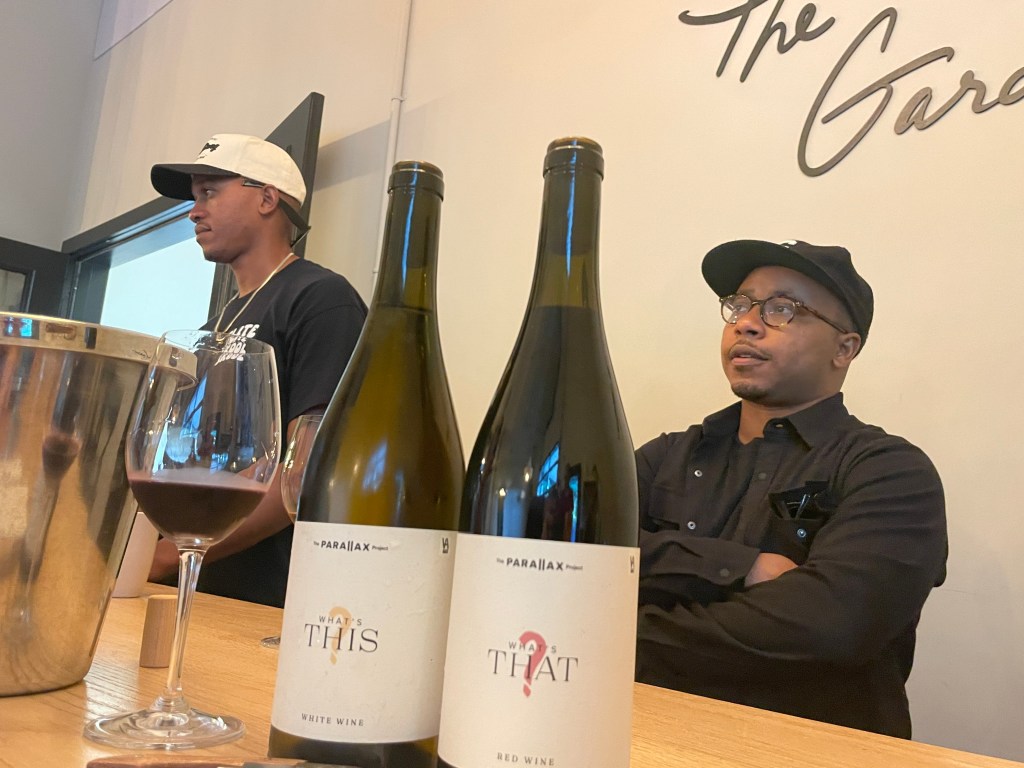
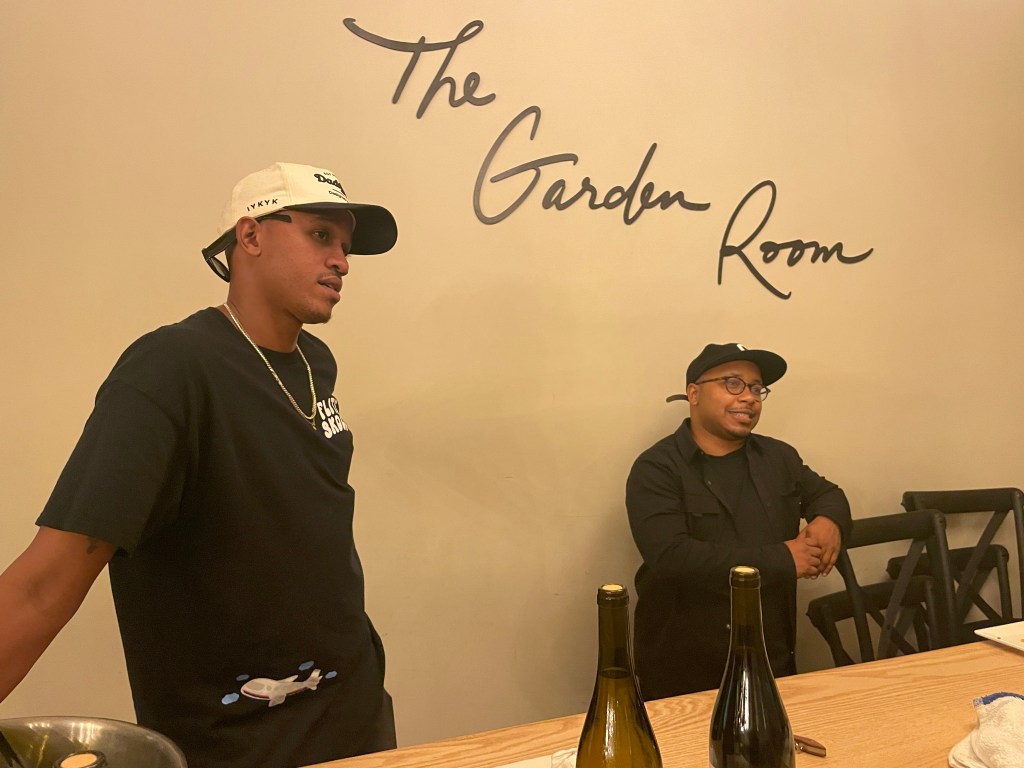
Parallax falls into the ‘visiting friends’ category. The brand is owned by entrepreneur and jack-of-all-trades Lance Lemon & “Virginia wine hype guy” Reggie Leonard, friends who decided to collaborate with Commonwealth Crush Co to create wines unique to them. These gents are also helping lead the charge for greater diversity in the Virginia wine scene.

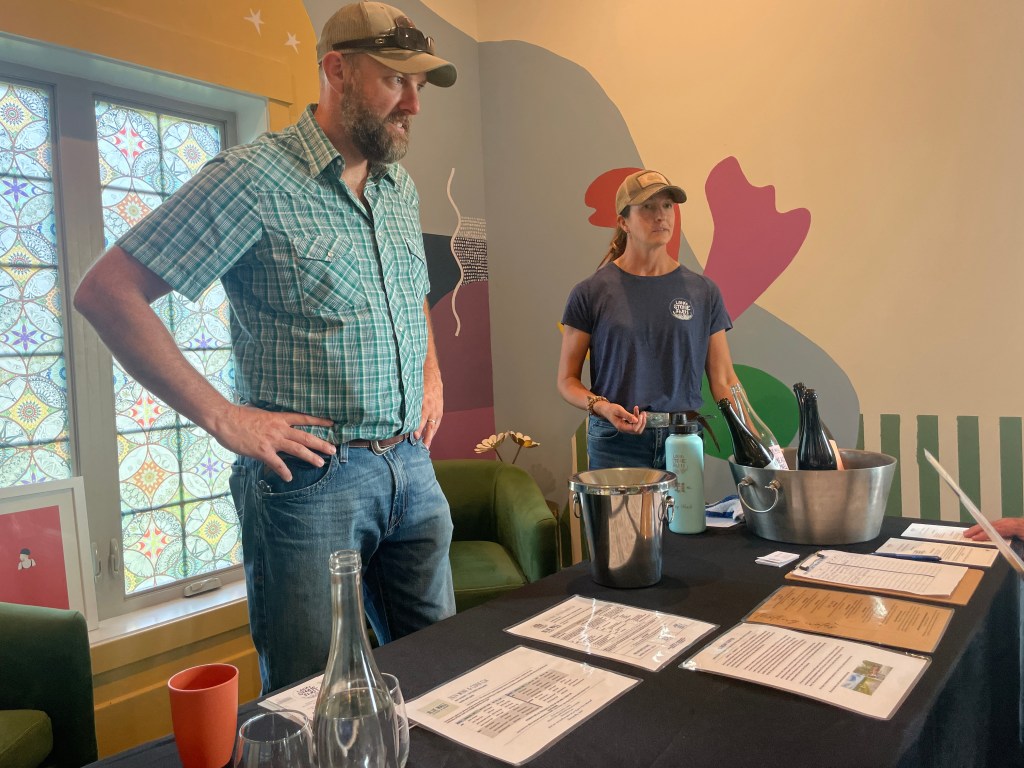
Blue Wall is owned by Justin and Casey Wisch, who also own nearby Long Stone Farm. Blue Wall is one of the many small projects that Nate Walsh and his winemaking team support. The Wisches source their apples from their estate orchard and grapes from Nate’s vineyards, all of which is made at Walsh Family and labeled under the Blue Wall brand name.

The Parallax Project

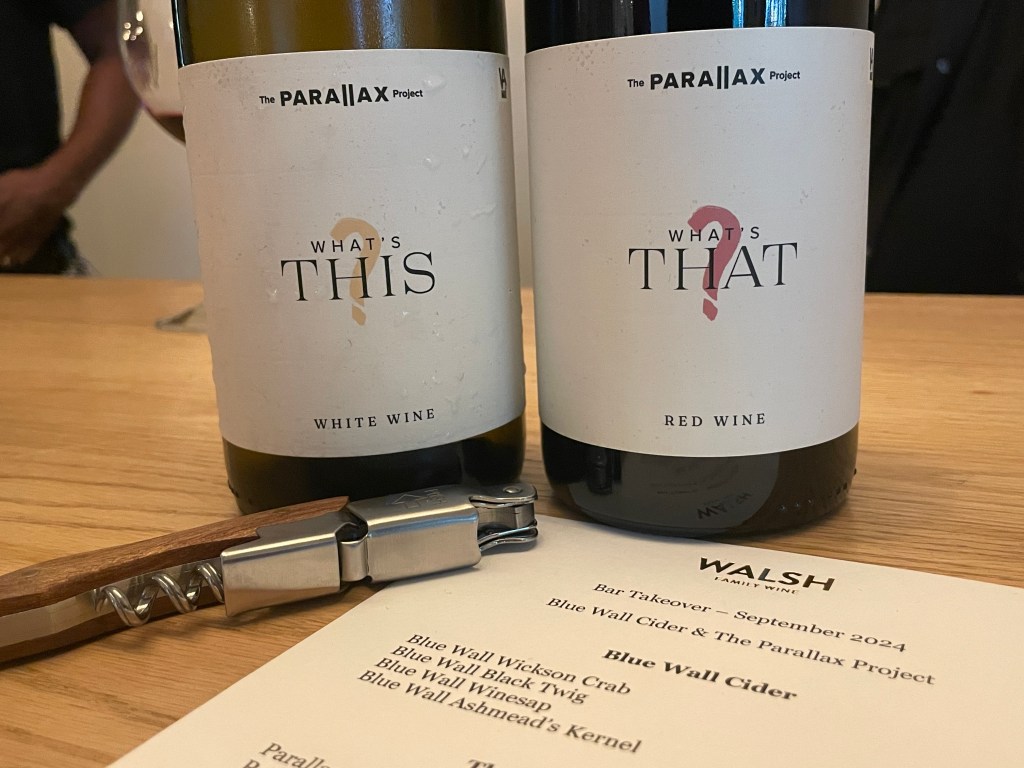
Kathy Wiedemann & I decided to start our visit with Parallax, who were hanging out in Walsh’s Garden Room. Reggie and Lance have so far produced two wines; “What’s This”, and “What’s That”.

The project’s name was inspired by what’s called “The Parallax Effect”, which is “a difference in the apparent position of an object when viewed along two different lines of sight”.

Lance and Reggie applied this principle to their wines. While one is a red wine and the other is a white, both were made using nearly the same grapes but in different blends and winemaking styles.

The 2023 “What’s This” is their white wine, a blend of 32% Vidal Blanc, 29% Chardonel, 29% Tannat (direct press), 6% Petit Manseng, 3% Traminette, 1% Albariño.

I’d never heard of a blend that even approaches this wine, and it was just as tasty as it was interesting; the kind of wine you need to keep sipping just to figure out what’s in your glass. Very floral with citrus notes (amongst others). I bought a bottle.

The 2023 “What’s That” is 83% Tannat, 8% Vidal Blanc, 7% Chardonel, 1% Petit Manseng, and 1% Traminette. While technically you could call this a ‘tannat’, it’s the farthest thing from one. Lower on the tannin, more fruit, and also highly aromatic.

The blending may seem odd – but they work. Both wines were designed to be enjoyed young and are very much in line with the off-beat style I’ve come to expect from their wine mentors, Ben and Tim Jordan of Commonwealth Crush.

Blue Wall Cider & Wine

In the main tasting room was Justin and Casey Wisch, who were pouring four of their ciders; Black Twig, Wickson Crab, Ashmead’s Kernel, and Virginia WineSap.

Blue Wall is actually just one component of Long Stone Farm, a sustainable farming operation that offers everything from CSA shares, a farm store for their meat and produce (which doubles as a wine/cider tasting room), even a monthly ‘Sunday Supper’.

The last is perhaps my favorite initiative of theirs, as it showcases everything that’s made at their farm but served by a local chef.

Blue Wall’s ciders are made in a ‘traditional’ style, which I nickname ‘wine cider’. No carbonation here; these ciders are meant to showcase the fruit they came from.

Wickson Crab was the ‘biggest’ of the four in terms of flavor, probably because it was barrel aged. It was my favorite of the more standard ciders.

Next up were Black Twig and Ashmead. Black Twig is off dry, while Ashmead is definitely the sweetest of the lineup. Had it been warmer the Ashmead would be a summer pounder outside (in fact it was when I attended their dinner).

But my favorite was Winesap, made as a sparkling pet-nat style cider. Very light and drinkable, and I suspect extremely food friendly. I got a bottle of this to go and will definitely open it with friends at dinner.

Special shout-out to Kathy’s husband, who brought the pizza that we ate outside.

Italy vs Virginia Nebbiolo Showdown

“Out of all the grapes, you must grow Nebbiolo. It’s beautiful, it’s the wine of kings”.

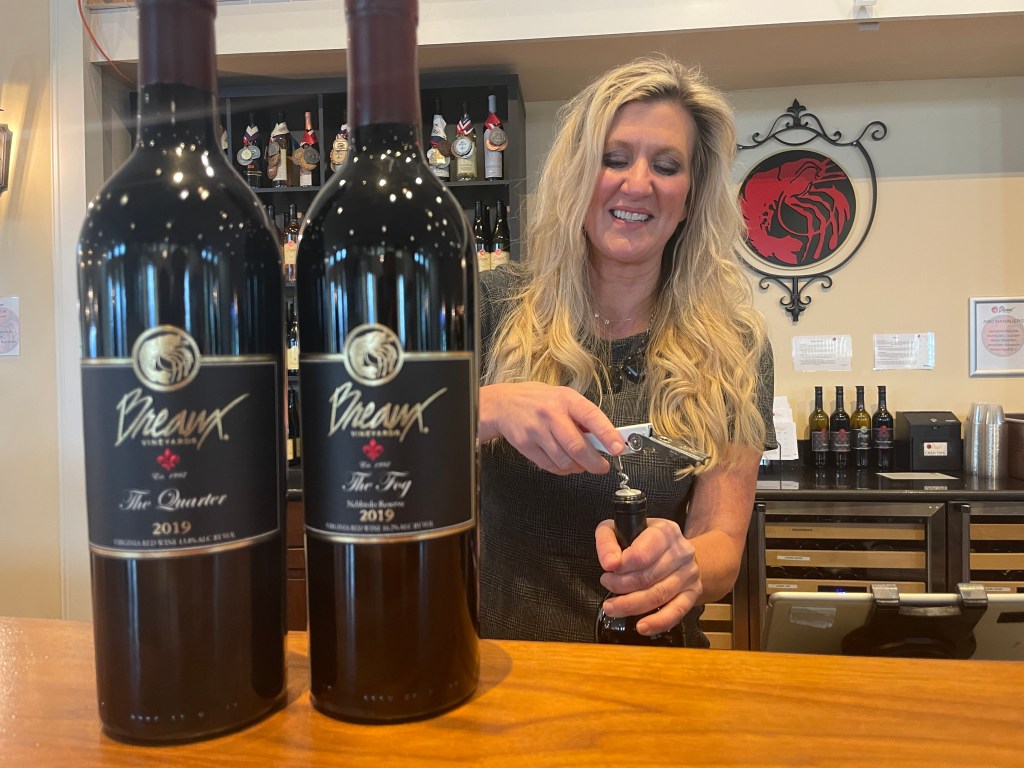
These words were spoken by an Italian winemaker (who’s identity is still unknown) to Paul Breaux during his 1996 research trip to Alba, Italy. This gentleman overheard Paul order a glass of wine with dinner and walked over to his table to insist he try Nebbiolo.

A long conversation ensued. Paul was so impressed by the wine and the man’s passion for it, he decided on the spot Breaux Vineyards needed this grape. It was a huge leap of faith for a variety that was then untested in Virginia.

This chance encounter had a profound impact on Breaux Vineyards. Jen Breaux went on to explain, “Nebbiolo has given us a name in Virginia wine. I truly believe that”.

I recount this story because not only does Nebbiolo evoke such passion, only winegrowers truly in love with this grape would be willing to deal with such a finicky, difficult to grow variety.

While the Italian Piedmont has the near-goldilocks conditions to produce the world’s finest Nebbiolos, it’s a far riskier proposition here in Virginia. Early budding, late ripening, and with inconsistent yields even when things go well, Nebbiolo flies in the face of any logical growing strategy. That’s likely why Virginia has only 39 acres of Nebbiolo planted, divided between about a dozen wineries.

I wrote an article on Nebbiolo a few years ago and asked winemakers – why take the risk?

Bill Gadino of Gadino Cellars gave one of my favorite answers. When deciding what red grape to plant, he approached Luca Paschina of Barboursville for advice. Luca told him, “If you’re going to pick one, go for the gold and grow Nebbiolo.”

Tasting & Scoring Methodology

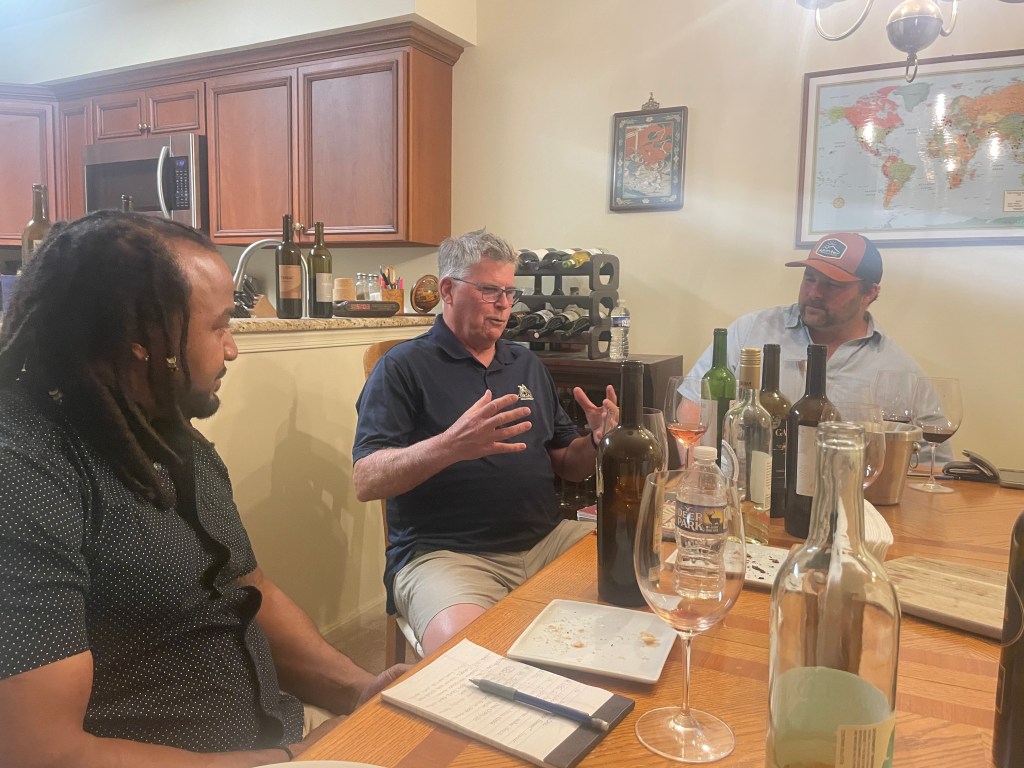
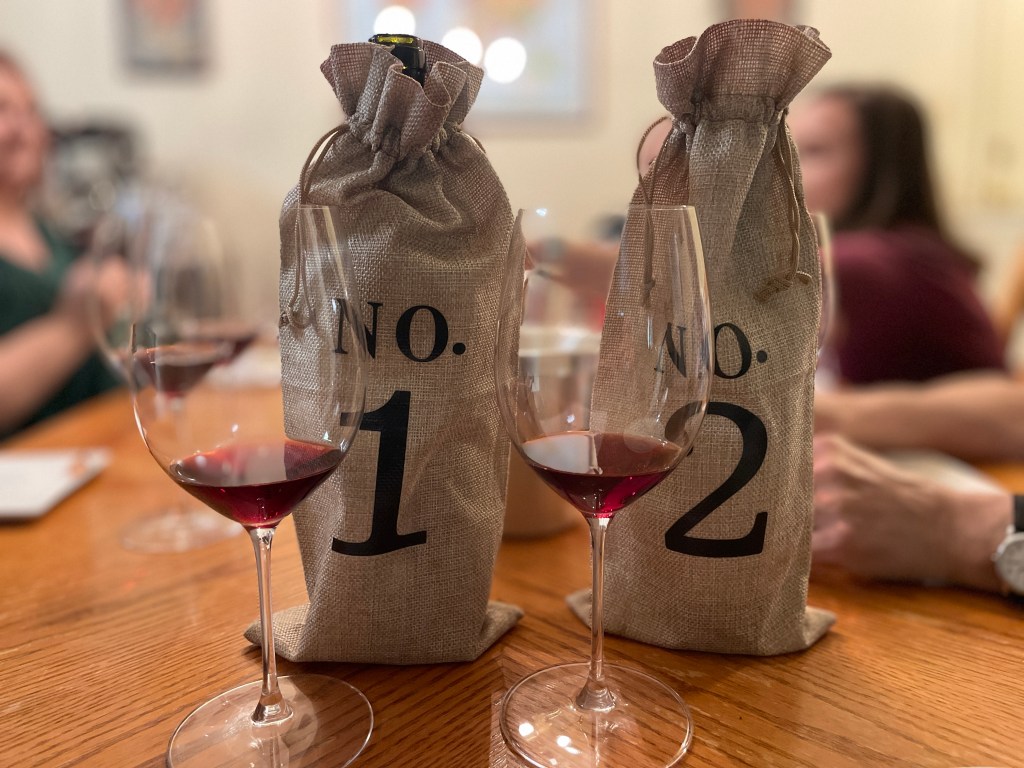
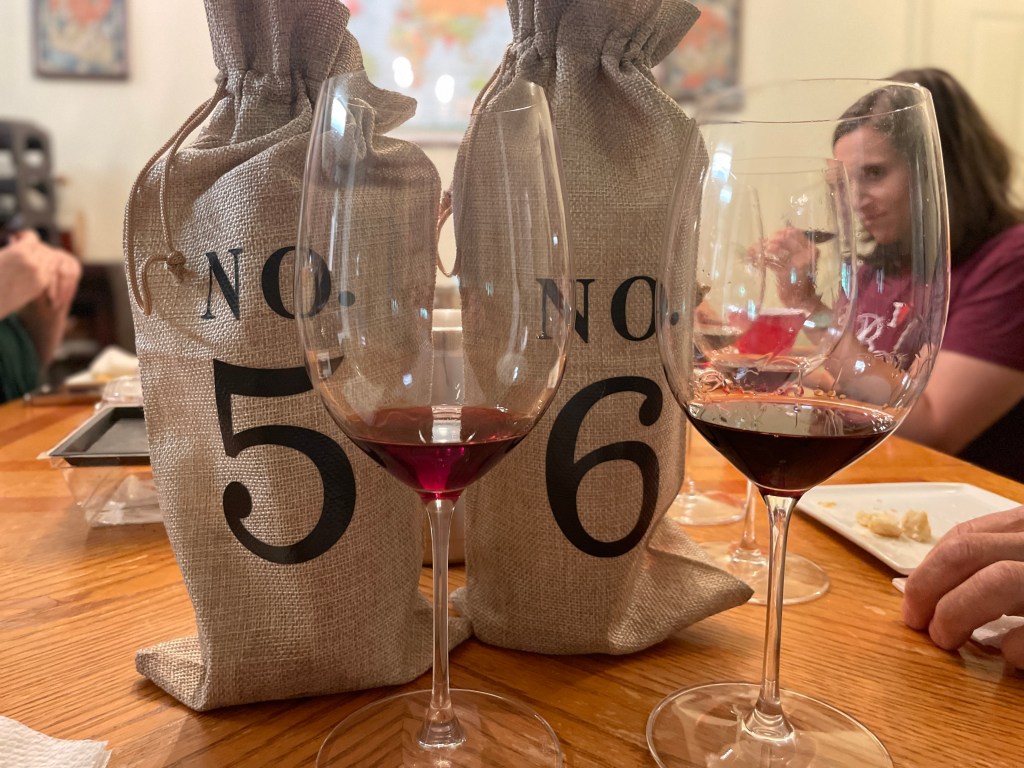
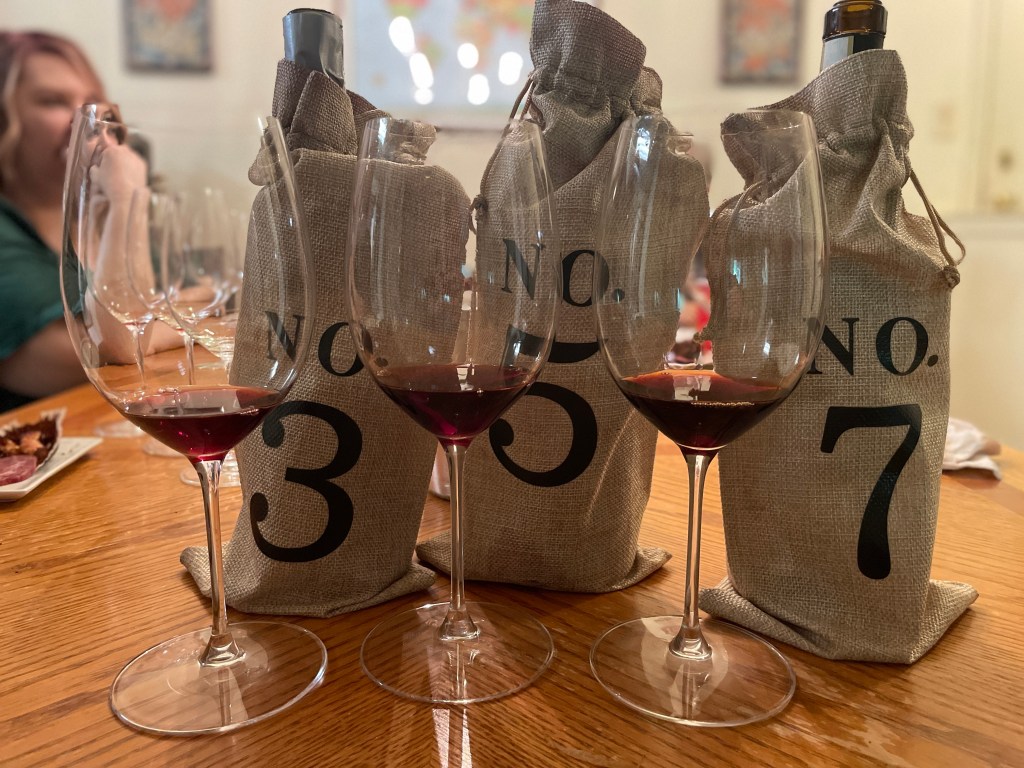
A group of friends & I blind tasted 8 wines in 4 comparison flights, youngest to oldest. All the flights were bagged blind.

3 of the 4 East Coast wines came from Virginia, and 1 was from Pennsylvania. The Italian wines included 1 Barbaresco and 3 Barolos, widely considered the best expressions of this grape. Except for a 2015 vs a 2017, all pairings were matched by vintage year.

The goal was to pick a ‘favorite’ in every flight, as opposed to rating them according to a sophisticated scoring system. After the 4 flights, we selected 3 bottles to go into a ‘finalist’ round. Our resident chef also prepared a meal that went with the wine.

It’s important to point out that ‘favorite’ was a very subjective term. It wasn’t a requirement we choose the most ‘varietally correct’ wine as a ‘favorite’. That said, my guests often used ‘varietally correct’ as part of their own criteria. To satisfy my curiosity, I also asked which wine they thought was from Italy.

The lack of Virginia producers greatly limited our options, especially when it came to finding older vintages. By contrast, you can pick up great Italian Nebbiolos anywhere.

No doubt this biased the outcome in favor of Italy. But hey – if you want to play in the big leagues, you come with the team you have!

The contenders:

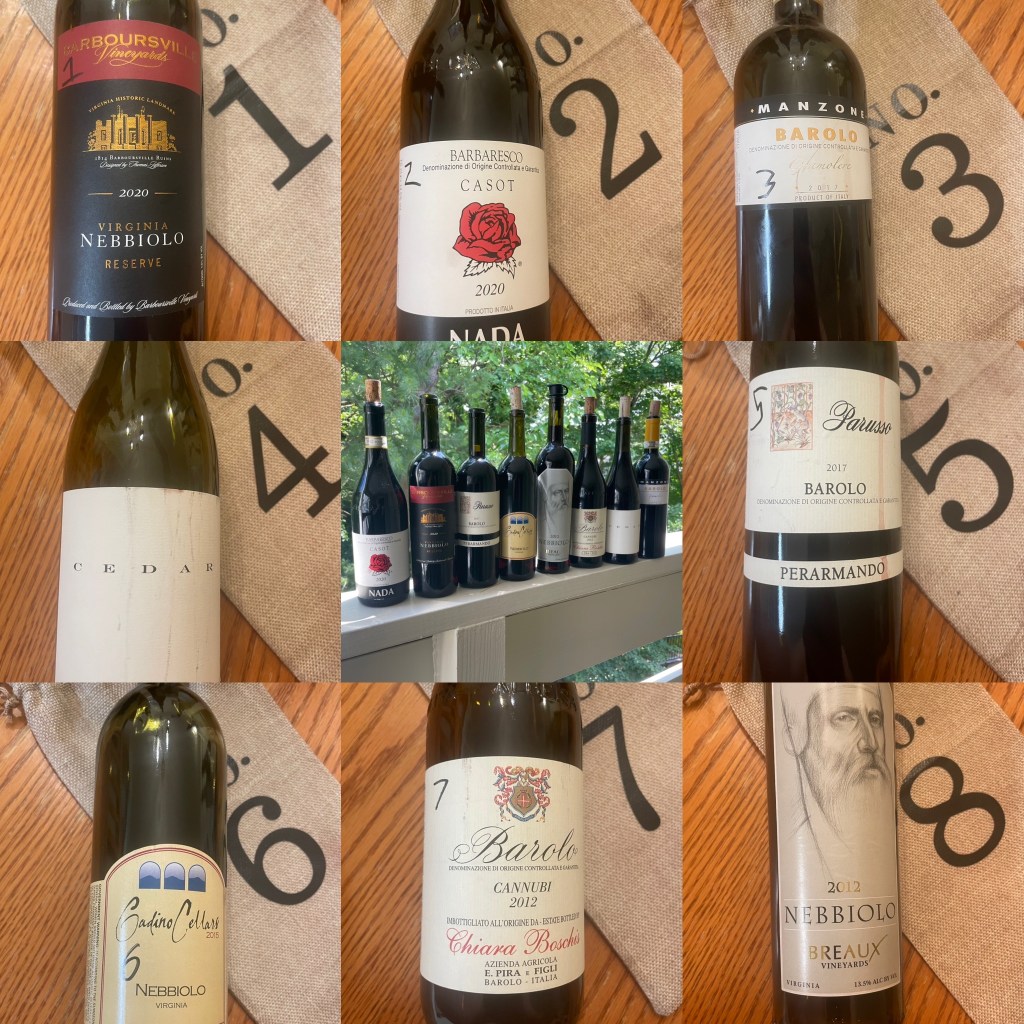
  1. 2020 Barboursville ($40 on website) vs 2020 Nada Giuseppe Barbaresco Casot ($49 Wine.com)
  2. 2017 Va La Vineyards ‘Cedar’ (~$50 for the current vintage?) vs 2017 Manzone Barolo Gramolere ($59 – $69.99 Wine.com)
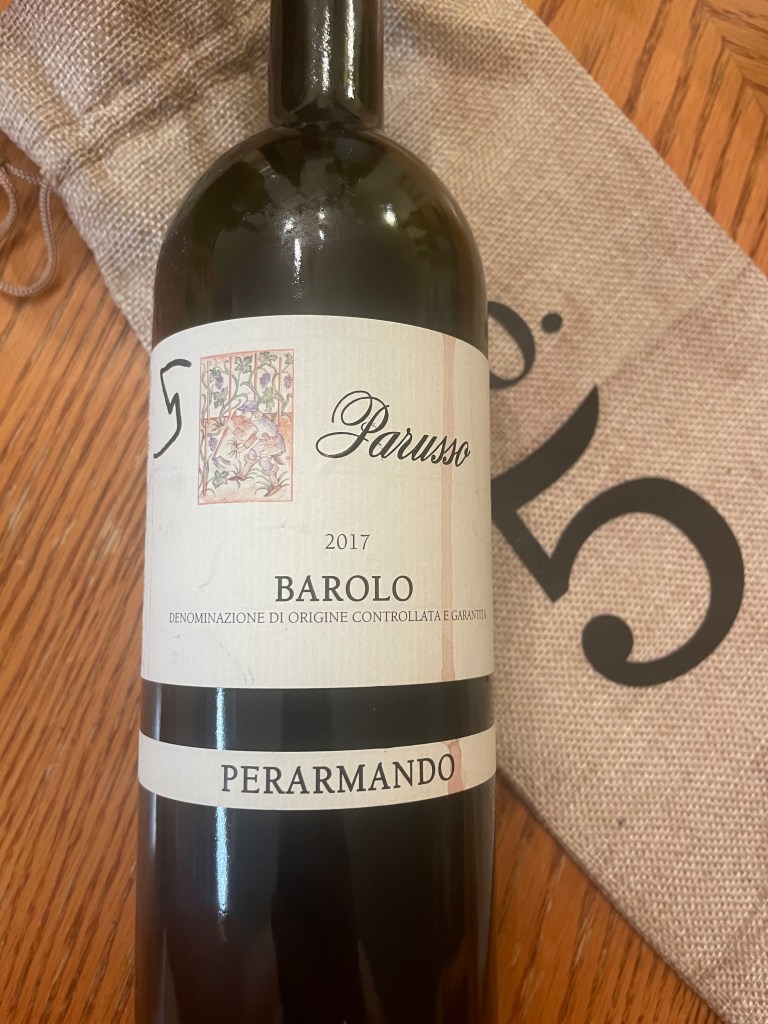
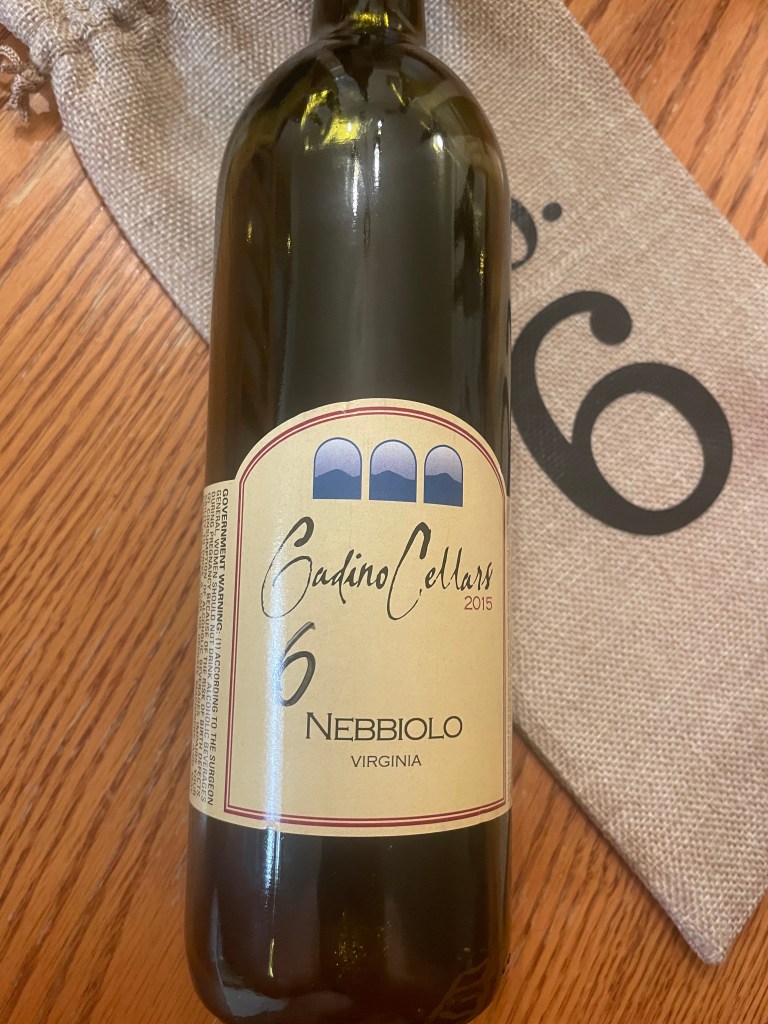
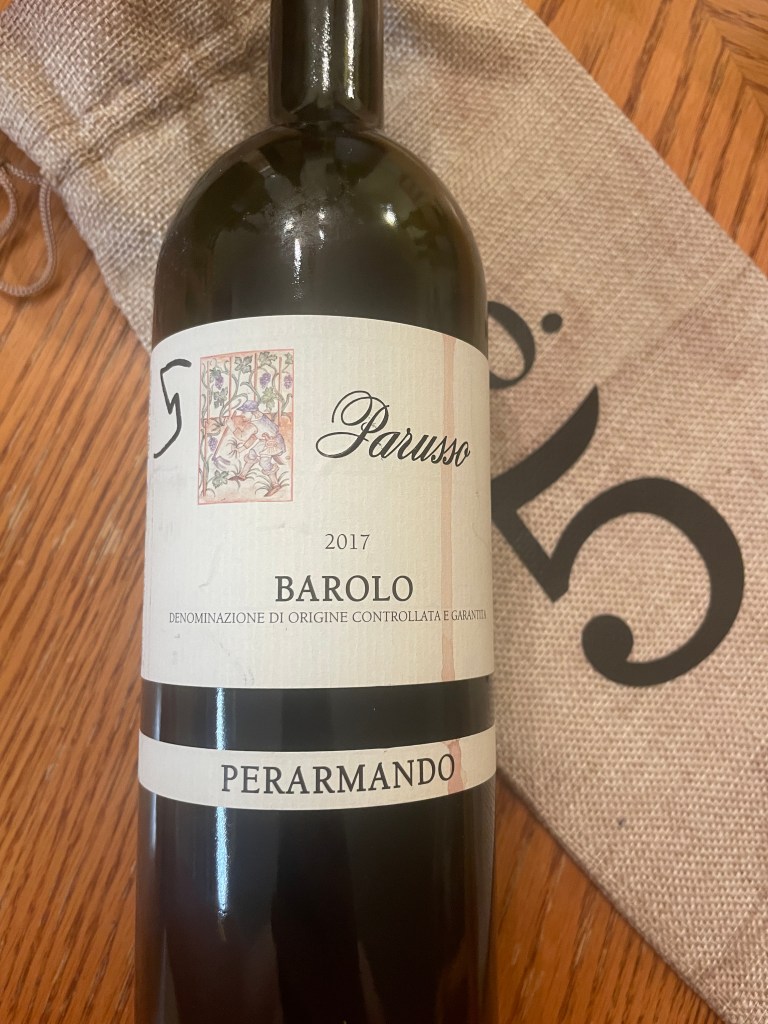
  3. 2015 Gadino Cellars ($51 on website) vs 2017 Parusso Barolo Perarmando ($65 Wine.com)
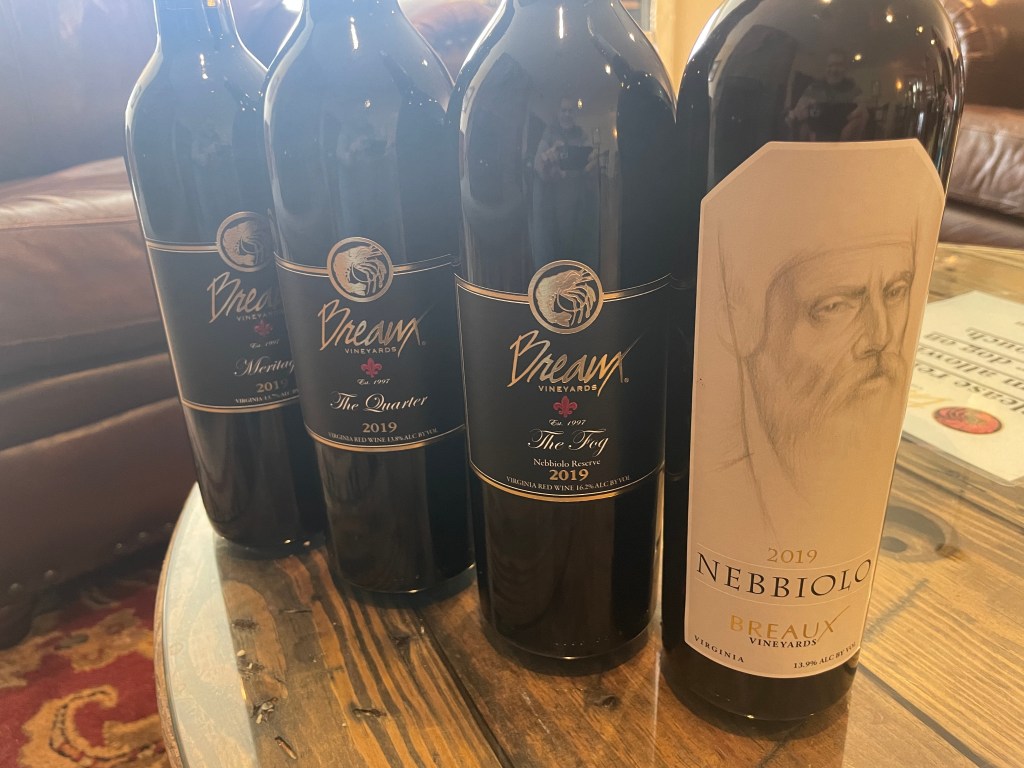
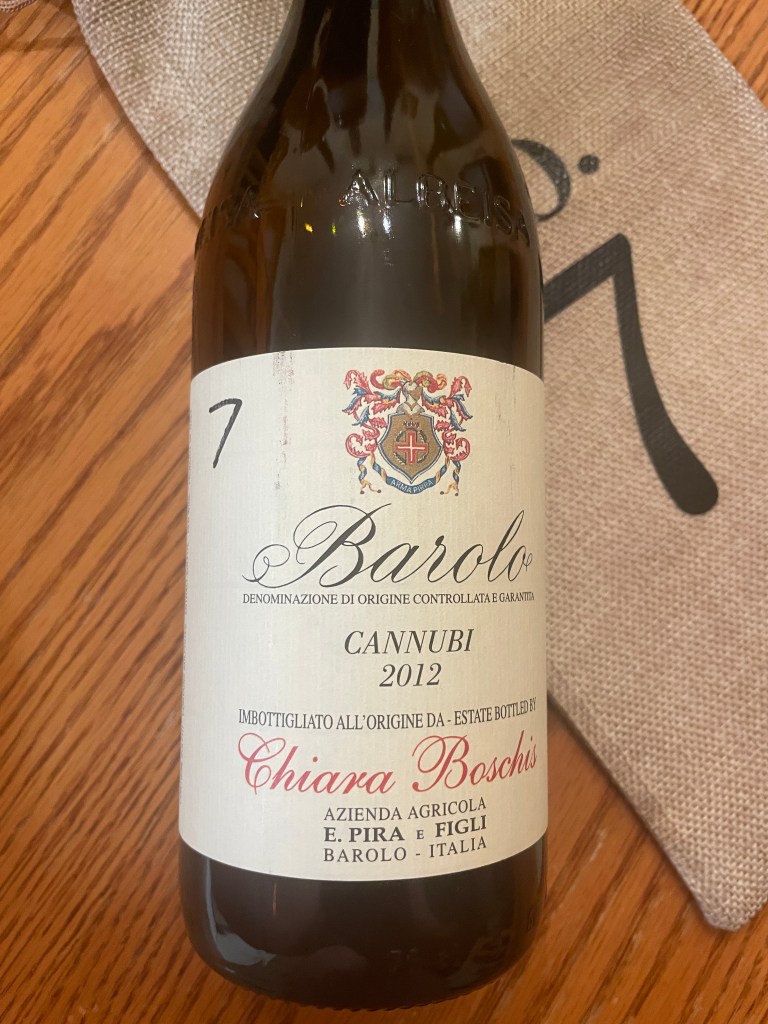
  4. 2012 Breaux ($80 on website) vs 2012 E. Pira Chiara Boschis “Cannubi” Barolo ($99.99 on Wine.Com, $84 at a nearby wine store)

Flight #1:

  • Bottle #1: 2020 Barboursville Nebbiolo (4 votes, round winner)
  • Bottle #2: 2020 Nada Giuseppe Barbaresco Casot (3 votes)

This was the closest matchup of the day in terms of votes. We needed to let these wines open up before we could fairly judge them, and the tasters wine went back-and-forth in selecting which was their ‘favorite’.

Eventually, 5 of 7 guests settled on #1 being Virginia, as those subtle pyrazine notes were suggestive of the East Coast. They weren’t prominent by any means, but ‘green’ notes of any type were so uncharacteristic of Nebbiolo that just a hint was enough to identify its origins. This trend continued over the course of the event.

Bottle #1 / 2020 Barboursville Nebbiolo (Virginia). Light but noticeable nose. Lots of pepper notes, with an undertone of pyrazines. Rustic. Complex, with earthy/leathery notes. Dried herbs also came up. Ruby colored.

Bottle #2 / 2020 Nada Giuseppe Casot (Barbaresco). VERY light, almost unnoticeable nose unless you swirled it a lot. Notes of anise was mentioned. “Smooth” tobacco came up. Garnet color.

  • Alex: Favorite was #1/2020 Barboursville and thought #1 was East Coast (correct). Loved the nose of #1 and thought it was ‘drink now’ while #2 needed more time.
  • Kathy: Favorite was #2/2020 Nada, and thought #1 was East Coast (correct)
  • Lindsay: Favorite was #2/2020 Nada, and didn’t guess country of origin.
  • Matt: Favorite was #1/2020 Barboursville and thought #1 was Italy (inaccurate). I thought #1 had an Old World quality to it while #2 was smoother & easy to drink, hence I thought #1 was Italy while #2 was Virginia.
  • Ryan: Favorite was #2/2020 Nada, and thought #1 was East Coast (correct)
  • Sarah: Favorite was #2/2020 Nada and thought #1 was East Coast (correct). Thought #2 had ‘deeper’ fruit.
  • Vincent: Favorite was #1/2020 Barboursville and thought #1 was East Coast (correct). Thought #1 was more complex.

Flight #2:

  • Bottle #3: 2017 Manzone Gramolere (Barolo) (5 votes, round winner)
  • Bottle #4: 2017 Va La Vineyards ‘Cedar’ (Pennsylvania) (2 votes)

Wine #4/Va La was noticeably different than anything else we had that day. Hard to put my finger on it…maybe it was the filtering (or lack of it)? It was a bigger & bolder wine than we were expecting. Wine #3/Manzone was one of the most ‘varietally correct’ wines of the day.

Bottle #3 / 2017 Manzone Barolo Gramolere. Very balanced and ‘classic’. Notes of dried roses and tar were mentioned, but they weren’t overwhelming. Very tannic. Ruby color.

Bottle #4 / 2017 Va La Vineyards ‘Cedar’. Oh boy, this wine was complex! Punch you in the face ‘big’. Acidic and ‘weird’ but in a good way. Garnet color.

#4 had the oddest descriptor I’ve heard in a long time; “caramel/chocolate/olive oil”.

  • Alex: Favorite was #3/2017 Manzone and thought #4 was East Coast (correct). Thought #3 was varietally correct while #4 was ‘interesting’.
  • Kathy: Favorite was #3/2017 Manzone and thought #4 was East Coast (correct)
  • Lindsay: Favorite was #3/2017 Manzone and didn’t guess the region. Went with #3 because of its balance.
  • Matt: Favorite was #4/2017 Va La and thought #4 was East Coast (correct). I thought #4 wasn’t varietally-correct but I didn’t care. I was completely fascinated by this wine so picked it as my ‘favorite’, even if arguably #3 was ‘better’.
  • Ryan: Favorite was #3/2017 Manzone and thought #3 was East Coast (inaccurate)
  • Sarah: Favorite was #3/2017 Manzone and thought #4 was East Coast (correct)
  • Vincent: Favorite was #4/2017 Va La and thought #4 was East Coast (correct). Thought the results were very close but leaned towards #4 because he thought it was denser and had more going on.

Flight #3:

  • Bottle #5: 2017 Parusso Perarmando (Barolo) (7 votes, round winner)
  • Bottle #6: 2015 Gadino Cellars Nebbiolo (Virginia)

This round was more of a blowout because #6 veered pretty dramatically away from varietal-correctness, to the point we thought it was almost a California Cab.

I was surprised when I unveiled the bottle and found it to be our 2015 Gadino. I’ve had this bottle before and didn’t remember it diverging from ‘traditional’ Nebbiolo characteristics, so I can’t quite explain it. Maybe the comparison showcased qualities we otherwise would have overlooked? Or was it something in my storage?

Bottle #5 / 2017 Parusso Barolo Perarmando. Light nose, looooong finish. Ripe fruit, with notes of liquorish. Spearmint gum or cedar on the nose, or maybe herbal notes (depending who you asked). Balanced.

Bottle #6 / 2015 Gadino Cellars. A little caramelly, with a tar nose. But we also found notes of toasted vanilla and blackberry. This was the least varietally correct wine of the day.

Votes:

  • Alex: Favorite #5/Parusso, thought #6 was East Coast (correct).
  • Kathy: Favorite #5/Parusso, thought #6 was East Coast (correct)
  • Lindsay: Favorite #5/Parusso, thought #6 was East Coast (correct)
  • Matt: Favorite #5/Parusso, thought #6 was East Coast (correct)
  • Ryan: Favorite #5/Parusso, thought #6 was East Coast (correct)
  • Sarah: Favorite #5/Parusso, thought #6 was East Coast (correct)
  • Vincent: Favorite #5/Parusso, thought #6 was East Coast (correct)

Flight #4:

  • Bottle #7: 2012 E. Pira Chiara Boschis “Cannubi” (Barolo) (5 votes, round winner)
  • Bottle #8: 2012 Breaux Vineyards Nebbiolo (Virginia) (2 votes)

This was the highlight of our 1 vs 1 comparisons. Our biggest challenge is Wine #7 had a ‘hot’ note caused some initial worry that maybe it was cooked during storage. Fortunately, after a short time that quality blew off and became much more enjoyable.

Bottle #7/ 2012 E. Pira Chiara Boschis “Cannubi” Barolo. Notes of cherry, blackberry, and menthol were mentioned, but stewed fruit, tar, dry cherry, and star anise came up even more. Not a lot of fruit on the palate but there was a tremendous depth of flavor. One person mentioned a note of bell pepper.

FYI – 97 points from James Suckling; 95 points Vinous.

Bottle #8 / 2012 Breaux Nebbiolo. “Light and well balanced” were the key descriptors, but there were a lot of other descriptors to go along with this. It was almost the complete opposite of #7.

Green pepper on the nose (and one person mentioned green pepper on the palate), with maybe a barnyard quality. At least one person said it was jammy on the palate with tighter tannins. Sweet tobacco on the palate was also mentioned. Char notes.

If this is what Virginia Nebbiolo can taste like after 12 years…sign me up! Very impressive.

Votes:

  • Alex: Favorite was #7/E. Pira Chiara, thought #8 was East Coast (correct). Went with the depth of flavor with #7.
  • Kathy: Favorite was #7/E. Pira Chiara, thought #8 was East Coast (correct). Thought this was the closest flight of the day.
  • Lindsay: Favorite was #8/Breaux, thought #8 was East Coast (correct)
  • Matt: Favorite was #7/E. Pira Chiara, didn’t guess the geographic region
  • Ryan: Favorite was #7/E. Pira Chiara, thought #7 was East Coast (inaccurate). Liked the nose of #7 but palate of #8.
  • Sarah: Favorite was #7/E. Pira Chiara, thought #8 was East Coast (correct). Detected some pyrazines on #8 but overall a good wine.
  • Vincent: Favorite was #8/Breaux thought #8 was East Coast (correct)

Finalist Round:

  • Bottle #3: 2017 Barolo Gramolere (Event Winner)
  • Bottle #5: 2017 Parusso Barolo Perarmando
  • Bottle #7: 2012 E. Piara Chiara Boschis (Runner Up)

We voted and collectively came up with our 3 ‘finalists’, based on the previous round winners. That said, it was a shame we didn’t include wine #8/Breaux Vineyards as one of the finalists, because it deserved to be there.

I didn’t take extensive tasting notes this round. In the end, #3/Barolo Gramolere was by far the consensus favorite of the day. It was nearly a toss-up between the next two for runner-up, but the #7/2012 Chiara came 2nd by a small margin.

Votes:

  • Alex: 5/3/7
  • Kathy: 5/3/7. #5 was ‘talking to me’
  • Lindsay: 3/7/5. #3 was balanced and classic
  • Matt: 3/7/5. Loved the nose and the rusticity of #3’s palate
  • Ryan: 3/7/5
  • Sarah: 7/3/5. Thought there was a lot going on with #7, and it was still getting better over time, while #3 had already peaked
  • Vincent: (absent)

Lessons Learned:

First off, I want to say that I’m really proud how Team Virginia (with an assist from Pennsylvania’s Va La Vineyards) showed here. While none made it to the final round (although we agreed the 2012 Breaux should have), the East Coast contenders brought their A-game.

But as good as they were, these East Coast wines went up against exceptional producers from one of the most highly regarded wine regions in the entire world. This tasting was the equivalent of a World Cup soccer match between Team America and Team Italy. While the US has some great players…come on…it’s ITALY we’re dealing with.

That said, the results were far closer than I could have expected. We uniformly enjoyed the East Coast wines, especially the ones from Barboursville and Breaux.

Two main lessons learned:

Point #1: Age matters – and the East Coast Nebbiolos showed they could do that. There were many compliments about how that 2012 Breaux was able to last 12 years. Having had older Barboursville vintages I could say the same for them as well.

Point #2: East Coast Nebbiolos (at least in this round) were rarely ‘varietally correct’. Out of the 7 of us, we almost always guessed the correct region for each of the 4 rounds. I’m convinced while the East Coast wines were consistently good, being ‘different’ lost them some points.

What made the East Coast wines easily-identifiable were the light pyrazine and overall earthy notes, which were suggestive of their non-Italian origin.

Loudoun’s “Pride in the Vines” Wine Trail (2024)

Starting June 1st, fifteen participating Loudoun County wineries are celebrating Pride Month with a special month-long wine trail. Passport holders for Pride in the Vines” who obtain ten different stamps will be eligible to win a prize drawing which includes private wine tastings, bottles of wine, gear, tickets to events, and tours of the vineyards and wineries.

Pride Month has its roots in the Stonewall riots, which started on June 28, 1969. Coincidentally, Pride in the Vines celebrates a movement that was galvanized at a drinking establishment.

Located in New York’s Greenwich Village, the Stonewall Inn was one of the few local bars that catered to an openly gay clientele despite state laws which made it risky for them to show affection in public. The Stonewall was run by the Mafia, who saw gay bars as a good business opportunity. Police raids against such establishments were common but corrupt officers would typically tip the managers off in advance, allowing business to continue with limited interruptions.

This time was different. Not only was the raid unannounced (possibly due to the police not getting sufficient kickbacks), the patrol wagon responsible for picking up arrested patrons took longer than usual to respond. The gathering crowd became increasingly agitated as they watched the police manhandle those they detained, including those arrested for violating the state’s gender-appropriate clothing statute.

The final trigger was a scuffle between a lesbian woman who was roughly escorted to the awaiting wagon. She fought back, calling on the crowd for support.

The resulting riots (Stonewall veterans prefer the term ‘uprising’) continued for several days. It was a turning point in the gay rights movement, leading to the formation of several new LGBT advocacy groups. The first gay pride parades were held on the 1st anniversary of the riots.

Top left: Paul Armstrong and Warren Richard, Virginia Wine Time

Top right: Paige Poprocky and Holly Richardson, Sips and Trips with Paige

Bottom left: Sydney and Bridgette Smith, Williams Gap and Greenhill wineries

Bottom right: Brian Pace and Chris Sexton, Maggie Malick Wine Caves

How Loudoun’s First Pride Wine Trail Started

The idea behind Pride in the Vines in Loudoun County blossomed with Two Twisted Posts Winery, which has hosted gay pride events since opening in 2014. For the family that owns it, namely Krista Cato, her partner Lynda Dattilo and fellow owners and parents, Theresa and Brad Robertson, the topic is a personal one.

“We wanted to create a safe space for people to gather regardless of their orientation or race,” explained Krista. “From Day 1, we hung a Pride flag. It wasn’t always a smooth journey and we received some hate.

My family decided to host an event to celebrate National Coming Out Day (October 11). We thought about celebrating Pride, but Pride is already a big event in D.C. and we didn’t want to overlap with another important celebration.

We advertised it in a local paper, and they came back to us and asked, ‘Do you really want to publish this?’ And we replied; ‘yes we do!’

So we posted the ad and put out flyers in local businesses. We found a lot of them were afraid to post them out of fear of creating animosity with their customers. But a few did.

Simple things like getting a food truck was difficult. The first two canceled but eventually we found one that would support us.

When the day came, Two Twisted Posts had over 200 people come out from all walks of life. Since it was so well received, we couldn’t imagine not continuing annually.”

More Wineries Involved Than Ever Before

Over time, more wineries joined Two Twisted Posts in celebrating gay pride events. In 2019, Bob and Teri Riggs of nearby Forever Farm Vineyard noticed the Pride flag and asked what they could do to get involved. They were soon joined by Williams Gap Vineyard.

The issue hit home for Bob and Teri, whose son is gay. Teri explained, “My participation is to get families involved. We’re all in it together.”

This trio of wineries hosted an informal Pride trail for several years. But as the world around them became more accepting, the idea of a larger wine trail took shape.

“One of the things we’re learning in this journey is there are other people out there who hear them and see them,” said Bridgette Smith, tasting room manager at Williams Gap Vineyard. “So when I brought it up at the Loudoun Wineries and Winegrowers Association (LWWA) I was surprised how many wineries wanted to participate. I think there are more people out there who are willing to speak out loud to support their neighbors than we realize.”

Krista added, “The support is like 300 times more than when we opened. In the beginning, I don’t remember seeing a Pride flag anywhere. When we started hosting events for National Coming Out Day, we were so focused on the event, we didn’t reach out to anybody.

With the partnership of Forever Farm Vineyard, Williams Gap Vineyard and now so many others, it’s safe to say this year’s Pride in the Vines Wine trail is indicative of the changes that have happened in Loudoun.”

Guests can acquire a passport at any of these participating wineries. For more announcements, see the LWWA webpage at https://www.loudounwine.org/new-events.

2024 Pride in the Vines participants

  1. 50 West Winery and Vineyard
  2. 8 Chains North Winery
  3. 868 Estate Vineyards
  4. Bleu Frog Vineyards
  5. Bozzo Family Vineyard
  6. Carriage House Wineworks
  7. Corcoran Vineyard and Cider y
  8. Fabbioli Cellars
  9. Farm de Vine
  10. Forever Farm & Vineyard
  11. Good Spirit Farm
  12. Hillsborough Winery
  13. October One Tasting Room
  14. Sunset Hills Vineyard
  15. Terra Nebulo Vineyards
  16. Two Twisted Posts Winery
  17. Walsh Family Wine
  18. Williams Gap Vineyard
  19. The Wine Reserve at Waterford
  20. Zephaniah Farm Vineyard