
I’d never thought I’d write a blog about sorting grapes at a winery – but here we are.
2024 was an odd year for Virginia wine. We had an abnormally hot and dry summer, to the point many winegrowers were openly hoping for an inch or two of rain to relieve their parched vineyards. While dry conditions will reduce the volume of wine they produce, it gifted vineyards with intensely flavored berries which (we hope) will result in high-quality wine.
Yet when the rain finally came, it came in torrents. Tough decisions had to be made whether to let the fruit hang on the vine in hopes of achieving additional ripeness, or bring it in, else risk the grapes falling apart in the vineyard.

Owner/winegrower Jim Law would have preferred to let his Cabernet Sauvignon hang for another week or two. But Mother Nature wasn’t cooperating, so it had to come in.
I had planned on making last Friday a leisurely wine-tasting day, but Linden Vineyards put out a last-minute request for assistance in sorting grapes that were being harvested that morning. They were short-staffed, the regular vineyard team was busy in the field, and Fridays are a tough day to get volunteers. I alerted a few like-minded friends about the opportunity, and we offered our services.
I told myself, “I’ve harvested grapes before; sorting them could be fun. How hard could it be?”.
It turns out – a lot.

So on a Friday morning, Linden harvested 10 tons of Cabernet Sauvignon from their estate ‘Hardscrabble’ vineyard. The harvest team was on the top floor with their destemmer, which separates vines and stems from the grapes. Those grapes would drop through a chute to the ground floor into a conveyor belt, where the rest of us stood ready to pick out bad grapes and smaller organic matter before they went into the grape bins.
If it sounds very “I Love Lucy at the Chocolate Factory”, that’s not too far off.

What is Sorting?
Sorting isn’t a sexy job, but it’s an important one. Alex Wilde, Jim Law’s son-in-law and newly-minted apprentice winemaker, related a story from one of Linden’s harvest interns. This intern asked Jim what was his most-important lesson-learned in improving wine quality during harvest.
Jim’s answer? ‘Good sorting’.
Alex gave us a quick lesson on what to look for. Priority should be given to tiny green berries (far too tart). Second priority were lightly colored berries (still too under-ripe to be helpful). Also watch out for the occasional grape with white-ish coating which indicated noble rot (good in some white wines, but not good for red grapes), grapes with insect punctures (they are also probably rotting), and grab any bugs that went along for the ride (be careful of yellow jackets!).


I tossed some bad grapes, but the vast majority of stuff we removed during sorting was green matter. This included tiny branches, some leaves, and stem fragments still attached to the grape which Alex called ‘stem jacks’. All of these contribute tannin; something important in small doses, but not the style Jim likes in his wine.
Alex assured us that there was no way we’d get 100% of this detritus, as there was simply too much even a group of 6 people (occasionally dropping to 3-4 people) working in concert could grab. Just do what you can, and don’t chase any grapes that gets away.
Since I’m a big fan of Linden’s Hardscrabble red blend, I had a vested interest in doing a good job. I’d quickly scan for objectionable material and toss the offender into the bucket next to me. Ideally, I’d remove stem jacks from the grape and send the grape back on its way. Occasionally, the pace was so fast it was easier to toss the entire berry out. Grab-yank-drop and repeat, usually for an hour on end.

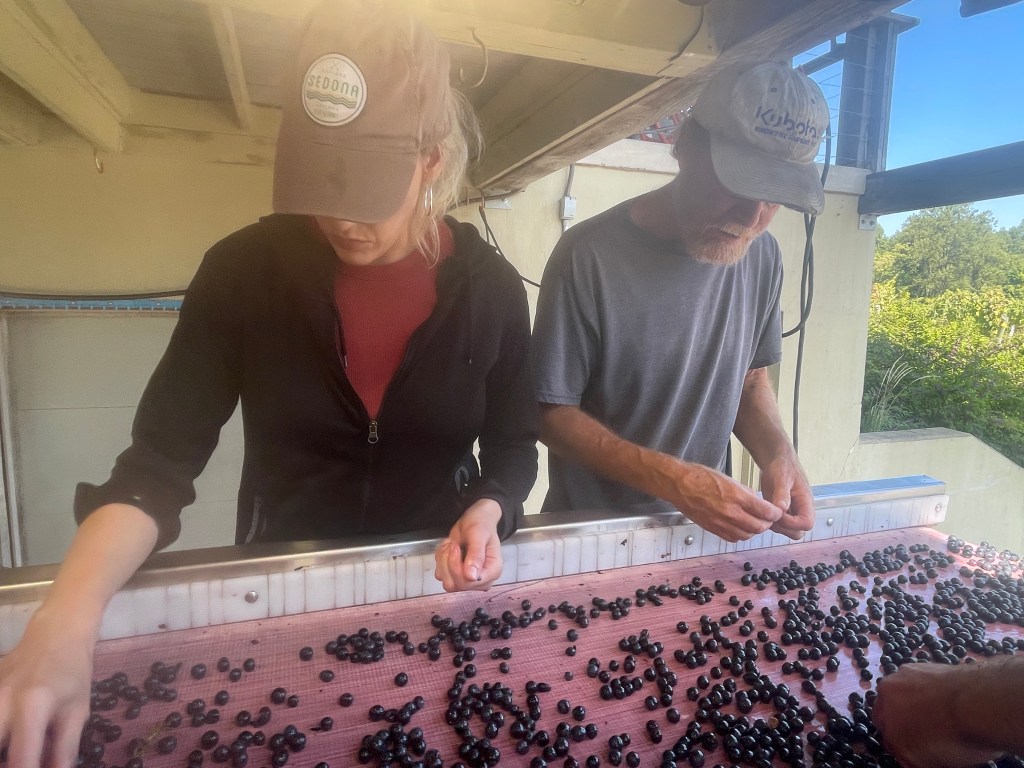
We had 6 bins of grapes come down the line, each with fruit that usually aligned to a different vineyard block. Seeing the fruit first-hand was a lesson in what Jim calls the ‘vine-soil relationship’.
Older blocks have deeper root systems, which generally protects them from rainwater penetrating the ground. By contrast, younger vines get their nutrients closer to the surface, which makes them more likely to absorb surface water. This meant younger block fruit was sometimes water-logged and sloppy, while fruit from older vines were fairly clean and dry.
Not every winery performs this labor-intensive task. While nearby RdV has a fancy optical sorter, most Virginia wineries (if they bother at all) rely on humans for the job. ‘Human optical sorters’, Alex joked.


Once the grapes dropped into the bin, they were off to the cellar to begin their transition into wine.
While I complained about how much my back hurt afterwards, you always learn something when talking with the team at Linden. Plus, helping out gives you a deeper respect for the hard work that goes on ‘behind the curtain’. Everyone who loves local wine should volunteer at a winery, even if only once.
Over the years I’ve poured wines at festivals, planted a new vineyard, harvested grapes, and now helped sort them. Anybody need a junior apprentice winemaker?
 Wine Trails and Wanderlust
ANY THING FOR A GLASS OF WINE.
LikeLike
These kinds of experiences, especially with masters of winemaking, are incredible. Well done!
LikeLiked by 1 person