
Virginia is enjoying a sparkling wine renaissance, especially in NOVA. A sparkling wine house named Petit Domaine recently opened in Loudoun, Stinson Vineyards has recently introduced a sparkling label named Lido Deck, and Stone Tower now has an entire facility dedicated to producing bubbly. These are just a few data points on what looks to be a shift from lower-cost sparkling formats such as pet-nats and charmat-style wine to higher-end, more ‘champagne’-style sparkings.
“High end” may be a bold statement. Champagne is still the default setting for high-end sparkling wine, and Virginia’s terroir is radically different from the world’s most famous sparkling region.
Moreover, I still think many Virginia sparkling producers are still tweaking their game. With the exception of a few standouts (looking at you, Thibault-Janisson, Trump Winery, and Veritas), most Virginia sparkling producers have only recently joined the ‘méthode traditionnelle’ club.
Even so, many VA sparklings are impressive, something I attribute to how Virginia performs well when it does its own thing. Virginia makes everything from sparkling Viognier from Horton, sparkling Rieslings, terroir-based Blanc de Noirs from the Blue Ridge and Shenandoah Valley, as well as more classic Blanc de Blanc or Brut wines using grapes associated with Champagne.
Most of these higher-end bottles price around $60, with Early Mountain Vineyards and Trump Winery amongst the most notable producers in this price range. Consumers can also find good quality $35-40 bottles from Thibault-Janisson, King Family, and broader cast of wineries.
Tasting & Scoring Methodology
A group of friends & I blind tasted 8 wines in 4 flights. All the flights were bagged.
To make it even more challenging, we mixed the French and Virginia wines up. This meant our rounds included France vs Virginia, Virginia vs Virginia, or France vs France, all depending on luck of the draw. After the last pairing, we voted on a “Top 2” from these 8 to go into the finalist round (as a last-minute change I added the 3rd favorite to join these finalists).
This mixing had the unexpected benefit of preventing us from obsessing over “Which is Virginia?”. We ended up spending more time on the actual wine, and less worrying where it came from.
I didn’t use a fancy scoring system. I did ask which was the favorite per round, but the goal was always to choose the “Top 2” of the day.
When I created this event, I specified the French sparklings be in the ~$50 range (although one of them was in the ~$70 range) and the Virginia bottles in the ~$60 range. This meant the comparing French bottles were lower-end champagnes and one higher-end cremant. I gave Virginia a higher price-point to account for how these are more boutique operations.
I figured this price range would even the playing field, keeping out the higher-end Champagnes but still having some strong contenders.
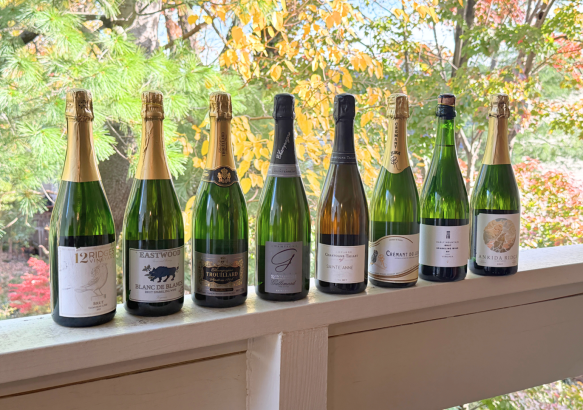
I ultimately selected 12 Ridges, Early Mountain Vineyards, Eastwood Farm (using a sparkling made by Thibault-Janisson), and Ankida Ridge, since these haven’t been in my earlier blinds.
All the participating bottles made in the traditional method, although the blends often differed.
The Contenders
- Crémant du Jura “Harmonie” by Domaine Pierre Richard (Jura; 100% Chardonnay; ~$30)
- Ankida Ridge Brut (Virginia; 50% Pinot Noir, 50% Chardonnay; $70)
- Champagne Gallimard Quintessence (Champagne; 100% Chardonnay; ~$47)
- Trouillard Brut Extra Selection (Champagne; blend of Pinot Noir, Chardonnay, and Pinot Meunier; $45)
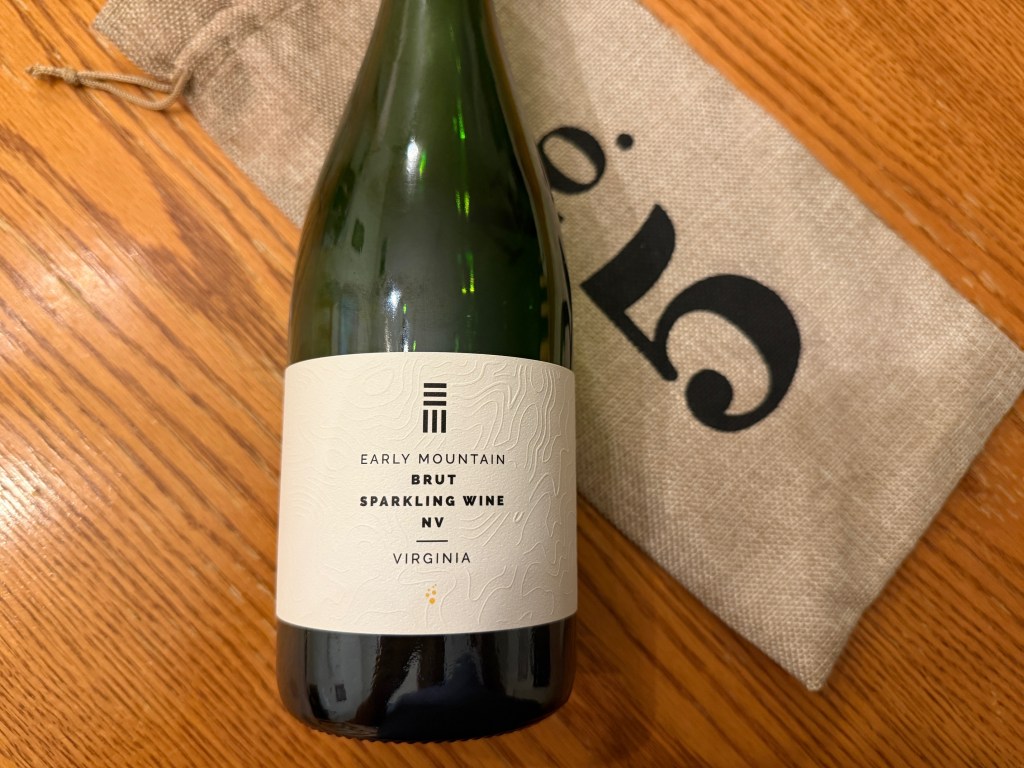
- Early Mountain Brut Sparkling (Virginia; 60% Chardonnay, 40% Pinot Gris; $60)
- Chartogne-Taillet Cuvée Sainte Anne Brut NV (Champagne; 45% Chardonnay, 45% Pinot Noir, 10% Pinot Meunier; ~$75)
- Eastwood Blanc de Blancs (Virginia; 100% Chardonnay; $40)
- 12 Ridges Brut (Virginia; 55% Pinot Gris, 45% Chardonnay, ~$65)

Flight #1
- Bottle #1: Crémant du Jura “Harmonie” by Domaine Pierre Richard (0 votes)
- Bottle #2: Ankida Ridge Brut (7 votes)
Our opening round was France vs Virginia. I wish the Ankida had gone up against a higher price point wine, but such is the nature of blind tastings that it randomly went up against the cheapest French wine in our group.

Bottle #1/Crémant du Jura “Harmonie“ by Domaine Pierre Richard: Lots of apple notes, including bruised apple, specifically yellow or green apple. Someone mentioned it was soft; maybe even tropical. Lower acidity. It was “pithy” and had a shorter finish.
Everything about this wine was on the up-front ‘attack’. If anything, it reminded me more of a sparkling cider than a sparkling wine.
Bottle #2/Ankida Ridge Brut: There was some funkiness on the nose initially, but that soon blew off. This wine had a longer finish, and presented as tart, with notes of toasty white bread, maybe back by some oak. We also found orchard and pear notes. Someone mentioned a hint of nutmeg.
#2 was higher in acidity than #1 but was not a tremendously high-acid wine. It was structured and ‘old world’ in nature. This also had a big initial ‘attack’, which isn’t the style some of us enjoyed. Comparatively speaking, we enjoyed this much more than #1.
I will say that while we *liked* this wine, we didn’t *love* it initially. We later discovered it needed time to open up, which made all the difference. When we re-tasted, especially with food, we liked this wine far more.
Flight #2
- Bottle #3: Champagne Gallimard Quintessence (0 votes)
- Bottle #4: Trouillard Brut Extra Selection (7 votes)

This round was a Champagne vs Champagne event. We enjoyed these two wines more than the previous round, at least on the first sips (although we later decided we enjoyed Ankida Ridge’s Brut more than the Gallimard).
#3 was a softer expression of sparkling wine; more like the kind of wine you bring to a party that everyone will likely enjoy it.
Bottle #3/Champagne Gallimard Quintessence: Blue cheese-like nose? This wine was YEASTY, almost pungent. Someone mentioned “antibiotics on steroids” on the palate. Another mentioned caramel corn or butter. Another said it had a bruised apple nose. Maybe notes of yellow apple on the palate.
On the flip side it had good balance, plus was fresh and clean. Everything was ‘up front’ for this wine.
Bottle #4/Trouillard Brut Extra Selection: Notes of ginger. Lots of positive notes including balanced, elegant, and layered. Flinty. Someone mentioned notes of strudel or pastry. Bright, maybe some honey on the nose. Another mentioned this was red fruit-driven.
This bottle also had more of the traditional autolytic characteristics you’d expect in Champagne, something we hadn’t seen thus far. We suspect it had a bit of age to it as well.
Flight #3
- Bottle #5: Early Mountain Brut Sparkling (7 votes)
- Bottle #6: Chartogne-Taillet Cuvée Sainte Anne Brut NV (0 votes)

The bubbles on both of these were FROTHY, especially #5. This was probably our highest-rated round of the day, although in this pairing we universally favored #5/Early Mountain.
Bottle #5/Early Mountain Brut Sparkling: Zingy; very bubbly and lively. Lemon-citrus notes; someone mentioned dragon fruit. Notes of citrus, but a ripe citrus. Good minerality and nice finish. Someone guessed it may have gone through a partial malolactic fermentation, but just a guess.
This was also a crowd pleaser of a wine, although it had lots of positive notes for wine snobs. One guest described this wine as ‘playful’, and I think that was the best description so far.
Bottle #6/Chartogne-Taillet Cuvée Sainte Anne Brut NV: Yeasty. Notes of pair; anise was also mentioned. High acidity and very bright. Notes of baking spice, even smoke, was mentioned. It seemed slightly on the higher alcohol side.
The flavor profile was very up front. Very rich; maybe backed by some oak? But overall, this wine was defined by its acidity. This was the most expensive Champagne of the day, so I’m glad it was compared to the EMV.
Flight #4
- Bottle #7: Eastwood Blanc de Blancs (2 votes)
- Bottle #8: 12 Ridges Brut (5 votes)
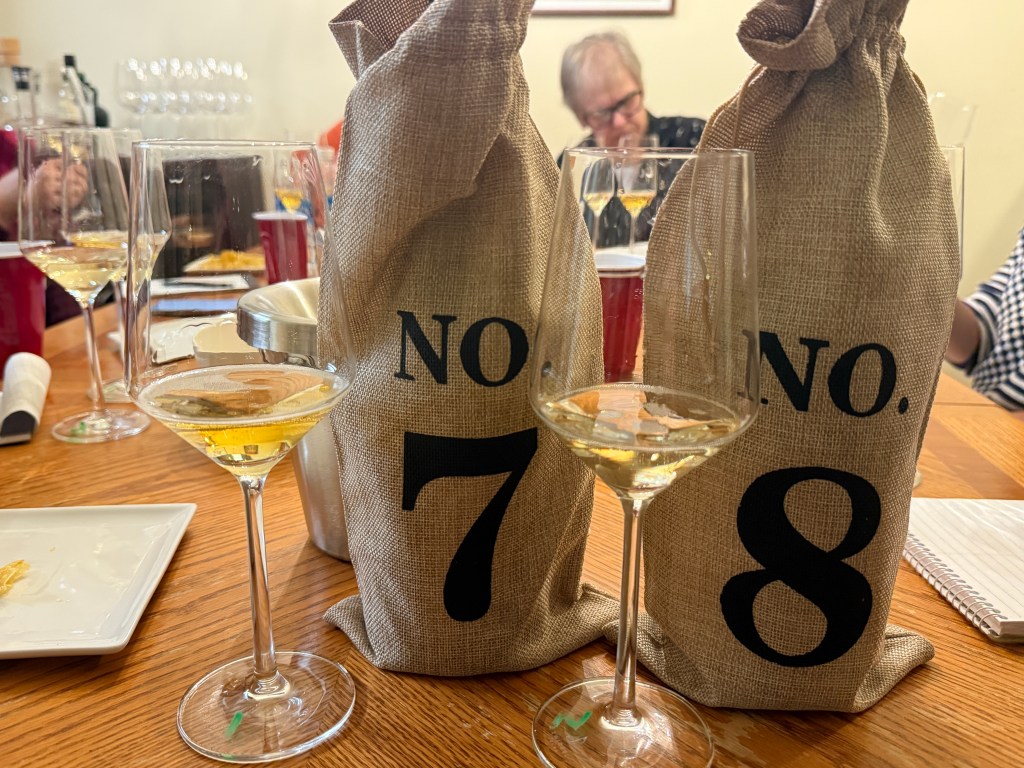
This round was Virginia vs Virginia. It also compared two very different wines; a moderately-priced Blanc de Blanc vs a higher price point from a unique vineyard situated at 3,300’ feet elevation.
Bottle #7/Eastwood Blanc de Blancs: Deep straw color. At least one guest mentioned a “fresh bread nose”. Several mentioned notes of spice, even turmeric. It was heavier bodied; maybe with a popcorn-quality to it. We suspected this might have been made in a warmer climate.
Initially we didn’t love this wine, but as it opened up we started to appreciate the richness of it more.
Bottle #8/12 Ridges Brut: Very clean and balanced, with a nice finish. Citrus palate. Good floral notes; reminded us of fresh flowers, even dried flowers.
One guest described it as a ‘baby champagne’, since it had all the notes you’d want in a champagne, but they were still learning to express themselves. Lots of potential here. Maybe it needs more time.
Finalist Round
- Bottle #2: Ankida Ridge Brut (3rd place)
- Bottle #4: Trouillard Brut Extra Selection (2nd place)
- Bottle #5: Early Mountain Brut Sparkling (1st place; overall winner)

I asked my guests for their “Top 3” favorites. I used data to narrow it down to two finalists, which we would retry.
Top 3 going into the finalist (but not the actual final vote)
- Chrisa: #4 (Trouillard) / #5 (Early Mountain) /#2 (Ankida Ridge)
- Jen: #4 (Trouillard) / #5 (Early Mountain) /#3 (Gallimard Quintessence)
- Kathy: #5 (Early Mountain) / #4 (Trouillard) / #2 (Ankida Ridge)
- Lieven: #4 (Trouillard) / #5 (Early Mountain) /#3 (Gallimard Quintessence)
- Matt: #4 (Trouillard) / #5 (Early Mountain) /#3 (12 Ridges)
- Sarah: #5 (Early Mountain) / #4 (Trouillard) / #2 (Ankida Ridge)
- Warren: #4 (Trouillard) / #5 (Early Mountain) /#3 (Gallimard Quintessence)
#4/Trouillard and #5/Early Mountain Vineyard were universally our top 2 picks. But picking a 3rd choice was difficult because these 3rd choices were a very distant preferences to the Top 2. I struggled to find a clear 3rd favorite myself.
Then I did something I’ve never done before. We put #4/Trouillard and #5/Early Mountain aside and started sipping the remainder of the wines. At that point, I realized #2/Ankida Ridge had totally changed.
At this point the Ankida was practically a different wine. So much so that if this was how it initially tasted, I may have selected this over one of my other picks. We liked it so much I put it into the finalist round, making it a trio of ‘finalists’.
After our food break we did a final tasting and voted. Here was the breakdown.
Finalist round (Listed as the judge’s Favorite, Second Favorite, and Third Favorite)
- Chrisa: #5 (Early Mountain) / #4 (Trouillard) / #2 (Ankida Ridge)
- Jen: #5 (Early Mountain) / #4 (Trouillard) / #2 (Ankida Ridge)
- Kathy: #5 (Early Mountain) / #4 (Trouillard) / #2 (Ankida Ridge)
- Lieven: #5 (Early Mountain) / #4 (Trouillard) / #2 (Ankida Ridge)
- Matt: #5 (Early Mountain) / #4 (Trouillard) / #2 (Ankida Ridge)
- Sarah: #5 (Early Mountain) / #4 (Trouillard) / #2 (Ankida Ridge)
- Warren: #4 (Trouillard) / #5 (Early Mountain) / #2 (Ankida Ridge)
Several guests who initially voted for #4 switched to #5 (Early Mountain). I’m not sure if the Early Mountain got better or the Trouillard started dying off. But we just loved Early Mountain even more in the finalist round.
Early Mountain’s Brut was the event winner.
Lessons Learned
I admit it; I wasn’t sure how this would play out. Topping Champagne in the sparkling category is a tall order. I made sure to exclude super high-end Champagnes to even the playing field, but even Champagne’s $50-range should have been hard to beat.
So imagine my surprise when Virginia came in with the 2 of the top 3, including the winner.
I have to give credit where credit is due. Early Mountain Vineyards makes exceptional wine. While it’s not known as a sparkling house, good winemaking goes a long way, so I shouldn’t be *too* surprised.
Ankida Ridge is another exceptional producer, plus they also have a very unique terroir. That shined through here. I love that the Vroomans came in as our 3rd pick.
When it comes to good sparkling, I’m a believer that there is a measurable difference between what you get in the $50-range vs the $75-range. This event gives me confidence that Virginia can compete against these lower to mid-priced Champagnes.
 Wine Trails and Wanderlust