
“Out of all the grapes, you must grow Nebbiolo. It’s beautiful, it’s the wine of kings”.
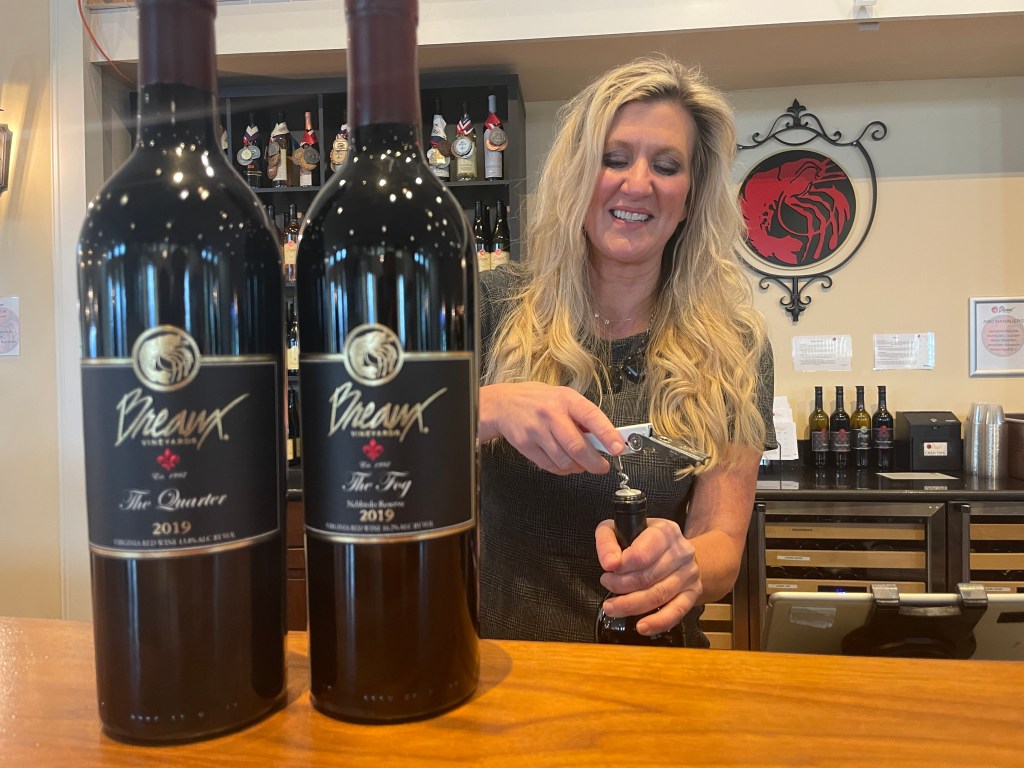
These words were spoken by an Italian winemaker (who’s identity is still unknown) to Paul Breaux during his 1996 research trip to Alba, Italy. This gentleman overheard Paul order a glass of wine with dinner and walked over to his table to insist he try Nebbiolo.

A long conversation ensued. Paul was so impressed by the wine and the man’s passion for it, he decided on the spot Breaux Vineyards needed this grape. It was a huge leap of faith for a variety that was then untested in Virginia.
This chance encounter had a profound impact on Breaux Vineyards. Jen Breaux went on to explain, “Nebbiolo has given us a name in Virginia wine. I truly believe that”.
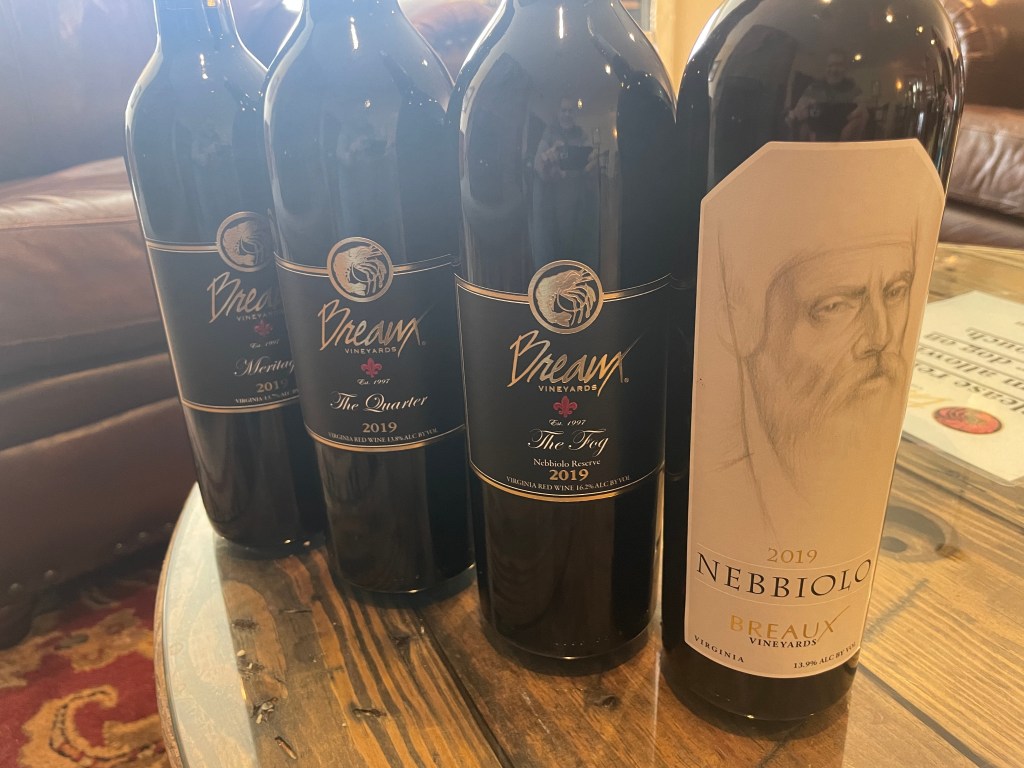
I recount this story because not only does Nebbiolo evoke such passion, only winegrowers truly in love with this grape would be willing to deal with such a finicky, difficult to grow variety.
While the Italian Piedmont has the near-goldilocks conditions to produce the world’s finest Nebbiolos, it’s a far riskier proposition here in Virginia. Early budding, late ripening, and with inconsistent yields even when things go well, Nebbiolo flies in the face of any logical growing strategy. That’s likely why Virginia has only 39 acres of Nebbiolo planted, divided between about a dozen wineries.
I wrote an article on Nebbiolo a few years ago and asked winemakers – why take the risk?
Bill Gadino of Gadino Cellars gave one of my favorite answers. When deciding what red grape to plant, he approached Luca Paschina of Barboursville for advice. Luca told him, “If you’re going to pick one, go for the gold and grow Nebbiolo.”
Tasting & Scoring Methodology
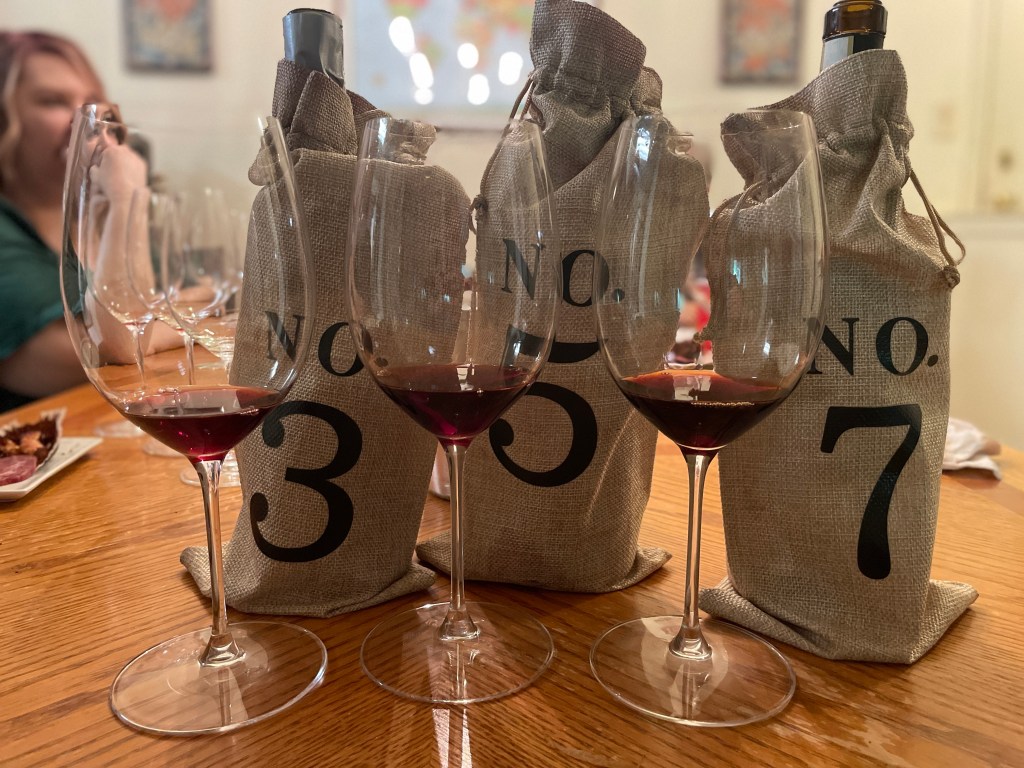
A group of friends & I blind tasted 8 wines in 4 comparison flights, youngest to oldest. All the flights were bagged blind.
3 of the 4 East Coast wines came from Virginia, and 1 was from Pennsylvania. The Italian wines included 1 Barbaresco and 3 Barolos, widely considered the best expressions of this grape. Except for a 2015 vs a 2017, all pairings were matched by vintage year.
The goal was to pick a ‘favorite’ in every flight, as opposed to rating them according to a sophisticated scoring system. After the 4 flights, we selected 3 bottles to go into a ‘finalist’ round. Our resident chef also prepared a meal that went with the wine.
It’s important to point out that ‘favorite’ was a very subjective term. It wasn’t a requirement we choose the most ‘varietally correct’ wine as a ‘favorite’. That said, my guests often used ‘varietally correct’ as part of their own criteria. To satisfy my curiosity, I also asked which wine they thought was from Italy.
The lack of Virginia producers greatly limited our options, especially when it came to finding older vintages. By contrast, you can pick up great Italian Nebbiolos anywhere.
No doubt this biased the outcome in favor of Italy. But hey – if you want to play in the big leagues, you come with the team you have!
The contenders:
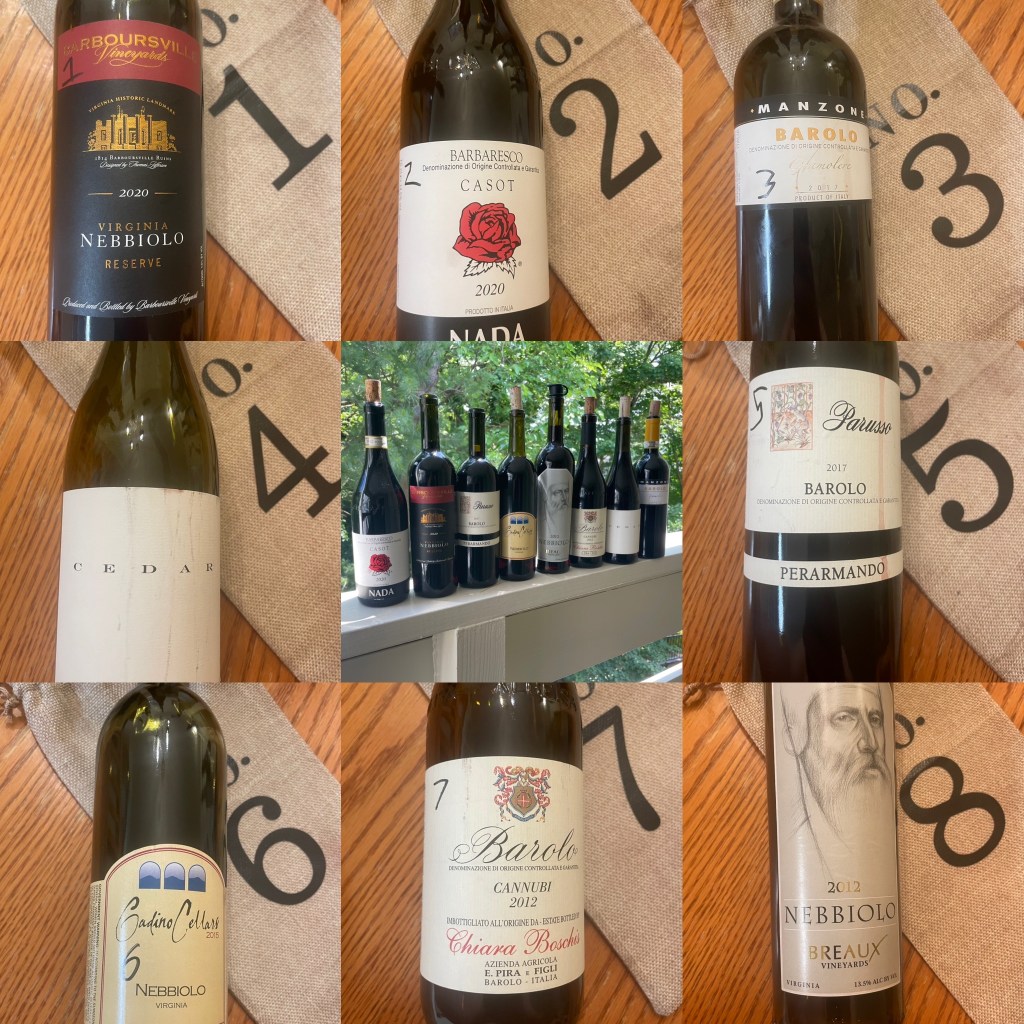
- 2020 Barboursville ($40 on website) vs 2020 Nada Giuseppe Barbaresco Casot ($49 Wine.com)
- 2017 Va La Vineyards ‘Cedar’ (~$50 for the current vintage?) vs 2017 Manzone Barolo Gramolere ($59 – $69.99 Wine.com)
- 2015 Gadino Cellars ($51 on website) vs 2017 Parusso Barolo Perarmando ($65 Wine.com)
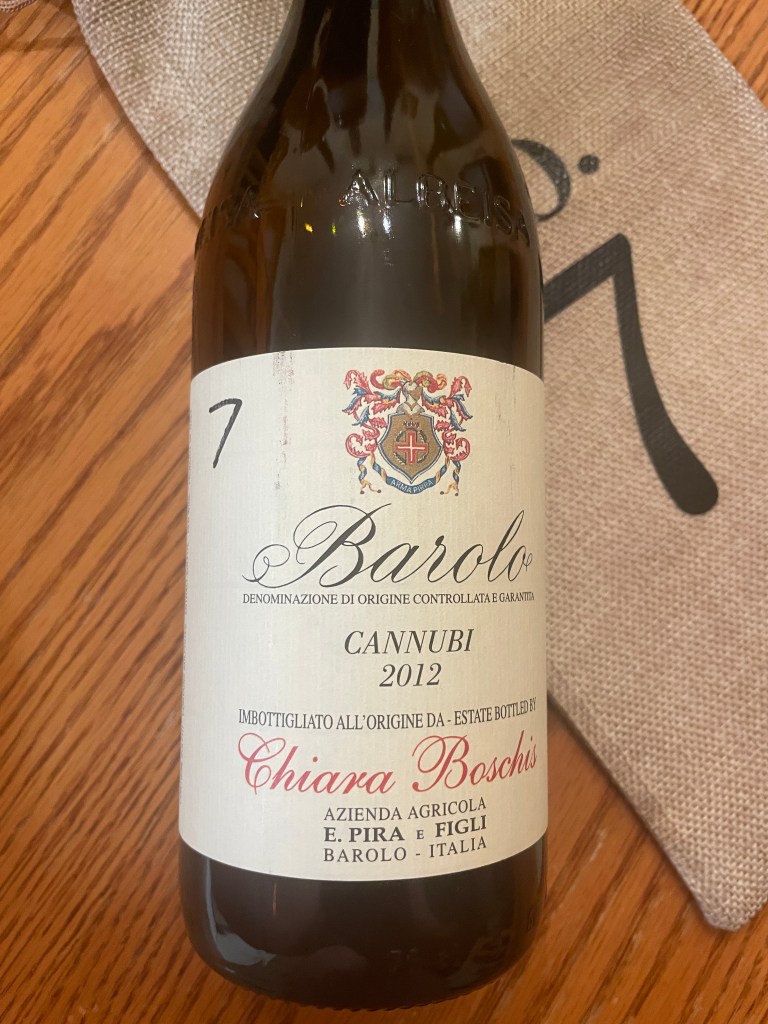
- 2012 Breaux ($80 on website) vs 2012 E. Pira Chiara Boschis “Cannubi” Barolo ($99.99 on Wine.Com, $84 at a nearby wine store)
Flight #1:
- Bottle #1: 2020 Barboursville Nebbiolo (4 votes, round winner)
- Bottle #2: 2020 Nada Giuseppe Barbaresco Casot (3 votes)


This was the closest matchup of the day in terms of votes. We needed to let these wines open up before we could fairly judge them, and the tasters wine went back-and-forth in selecting which was their ‘favorite’.
Eventually, 5 of 7 guests settled on #1 being Virginia, as those subtle pyrazine notes were suggestive of the East Coast. They weren’t prominent by any means, but ‘green’ notes of any type were so uncharacteristic of Nebbiolo that just a hint was enough to identify its origins. This trend continued over the course of the event.
Bottle #1 / 2020 Barboursville Nebbiolo (Virginia). Light but noticeable nose. Lots of pepper notes, with an undertone of pyrazines. Rustic. Complex, with earthy/leathery notes. Dried herbs also came up. Ruby colored.
Bottle #2 / 2020 Nada Giuseppe Casot (Barbaresco). VERY light, almost unnoticeable nose unless you swirled it a lot. Notes of anise was mentioned. “Smooth” tobacco came up. Garnet color.
- Alex: Favorite was #1/2020 Barboursville and thought #1 was East Coast (correct). Loved the nose of #1 and thought it was ‘drink now’ while #2 needed more time.
- Kathy: Favorite was #2/2020 Nada, and thought #1 was East Coast (correct)
- Lindsay: Favorite was #2/2020 Nada, and didn’t guess country of origin.
- Matt: Favorite was #1/2020 Barboursville and thought #1 was Italy (inaccurate). I thought #1 had an Old World quality to it while #2 was smoother & easy to drink, hence I thought #1 was Italy while #2 was Virginia.
- Ryan: Favorite was #2/2020 Nada, and thought #1 was East Coast (correct)
- Sarah: Favorite was #2/2020 Nada and thought #1 was East Coast (correct). Thought #2 had ‘deeper’ fruit.
- Vincent: Favorite was #1/2020 Barboursville and thought #1 was East Coast (correct). Thought #1 was more complex.
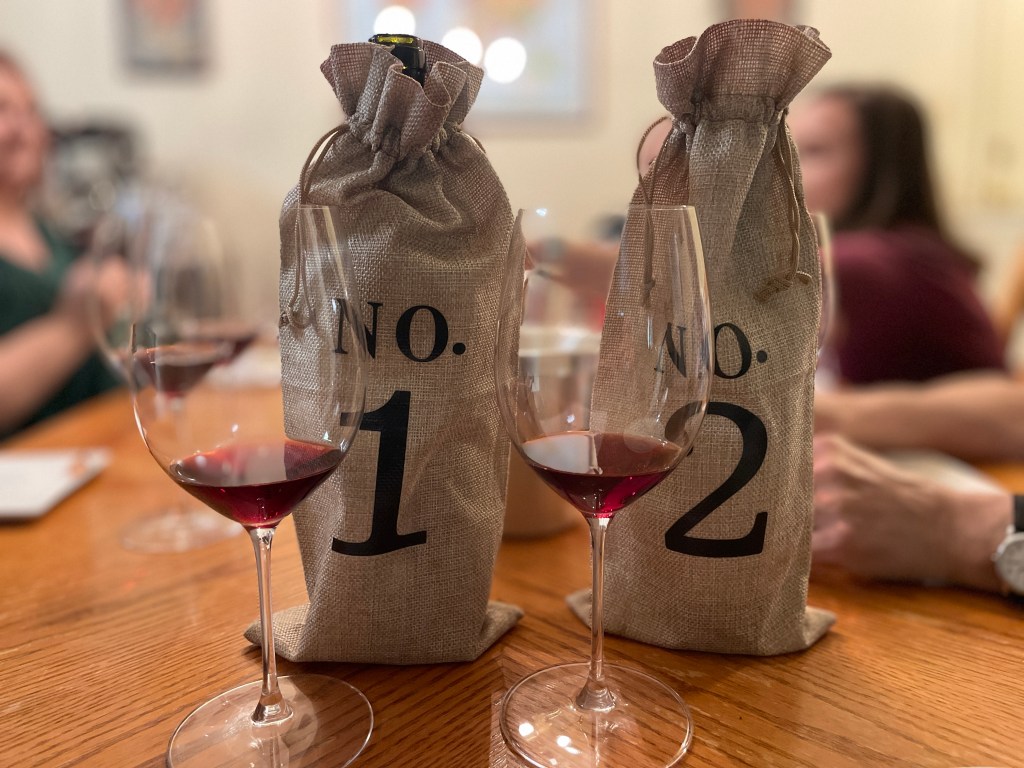
Flight #2:
- Bottle #3: 2017 Manzone Gramolere (Barolo) (5 votes, round winner)
- Bottle #4: 2017 Va La Vineyards ‘Cedar’ (Pennsylvania) (2 votes)


Wine #4/Va La was noticeably different than anything else we had that day. Hard to put my finger on it…maybe it was the filtering (or lack of it)? It was a bigger & bolder wine than we were expecting. Wine #3/Manzone was one of the most ‘varietally correct’ wines of the day.
Bottle #3 / 2017 Manzone Barolo Gramolere. Very balanced and ‘classic’. Notes of dried roses and tar were mentioned, but they weren’t overwhelming. Very tannic. Ruby color.
Bottle #4 / 2017 Va La Vineyards ‘Cedar’. Oh boy, this wine was complex! Punch you in the face ‘big’. Acidic and ‘weird’ but in a good way. Garnet color.
#4 had the oddest descriptor I’ve heard in a long time; “caramel/chocolate/olive oil”.
- Alex: Favorite was #3/2017 Manzone and thought #4 was East Coast (correct). Thought #3 was varietally correct while #4 was ‘interesting’.
- Kathy: Favorite was #3/2017 Manzone and thought #4 was East Coast (correct)
- Lindsay: Favorite was #3/2017 Manzone and didn’t guess the region. Went with #3 because of its balance.
- Matt: Favorite was #4/2017 Va La and thought #4 was East Coast (correct). I thought #4 wasn’t varietally-correct but I didn’t care. I was completely fascinated by this wine so picked it as my ‘favorite’, even if arguably #3 was ‘better’.
- Ryan: Favorite was #3/2017 Manzone and thought #3 was East Coast (inaccurate)
- Sarah: Favorite was #3/2017 Manzone and thought #4 was East Coast (correct)
- Vincent: Favorite was #4/2017 Va La and thought #4 was East Coast (correct). Thought the results were very close but leaned towards #4 because he thought it was denser and had more going on.

Flight #3:
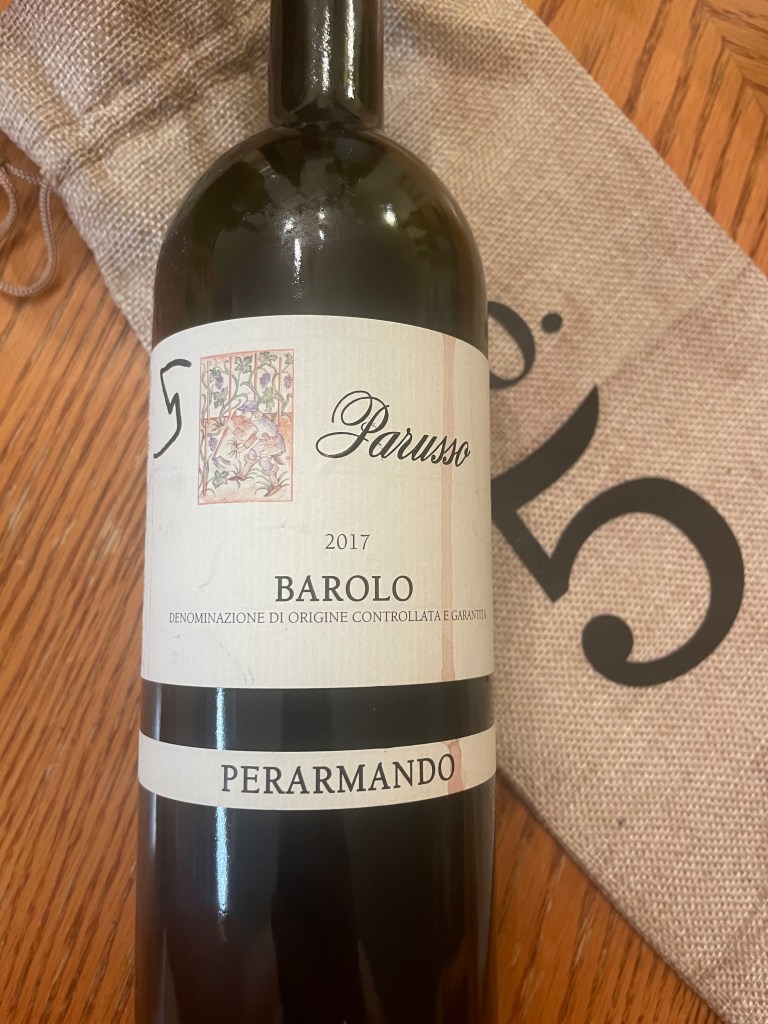
- Bottle #5: 2017 Parusso Perarmando (Barolo) (7 votes, round winner)
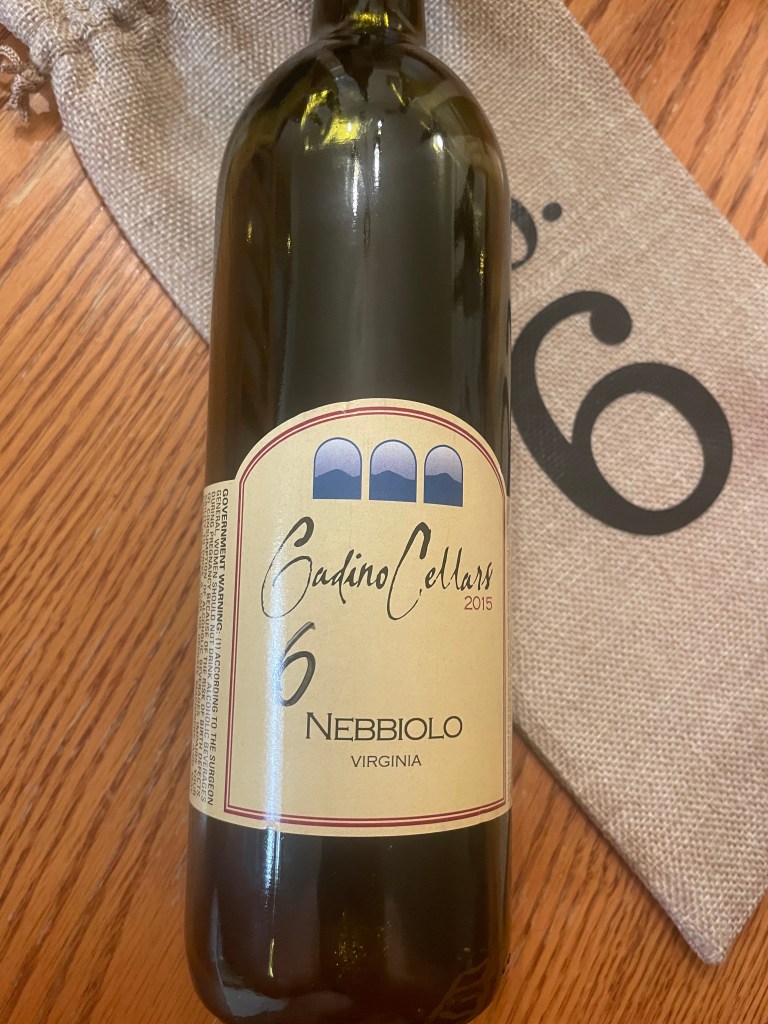
- Bottle #6: 2015 Gadino Cellars Nebbiolo (Virginia)
This round was more of a blowout because #6 veered pretty dramatically away from varietal-correctness, to the point we thought it was almost a California Cab.
I was surprised when I unveiled the bottle and found it to be our 2015 Gadino. I’ve had this bottle before and didn’t remember it diverging from ‘traditional’ Nebbiolo characteristics, so I can’t quite explain it. Maybe the comparison showcased qualities we otherwise would have overlooked? Or was it something in my storage?
Bottle #5 / 2017 Parusso Barolo Perarmando. Light nose, looooong finish. Ripe fruit, with notes of liquorish. Spearmint gum or cedar on the nose, or maybe herbal notes (depending who you asked). Balanced.
Bottle #6 / 2015 Gadino Cellars. A little caramelly, with a tar nose. But we also found notes of toasted vanilla and blackberry. This was the least varietally correct wine of the day.
Votes:
- Alex: Favorite #5/Parusso, thought #6 was East Coast (correct).
- Kathy: Favorite #5/Parusso, thought #6 was East Coast (correct)
- Lindsay: Favorite #5/Parusso, thought #6 was East Coast (correct)
- Matt: Favorite #5/Parusso, thought #6 was East Coast (correct)
- Ryan: Favorite #5/Parusso, thought #6 was East Coast (correct)
- Sarah: Favorite #5/Parusso, thought #6 was East Coast (correct)
- Vincent: Favorite #5/Parusso, thought #6 was East Coast (correct)
Flight #4:
- Bottle #7: 2012 E. Pira Chiara Boschis “Cannubi” (Barolo) (5 votes, round winner)
- Bottle #8: 2012 Breaux Vineyards Nebbiolo (Virginia) (2 votes)


This was the highlight of our 1 vs 1 comparisons. Our biggest challenge is Wine #7 had a ‘hot’ note caused some initial worry that maybe it was cooked during storage. Fortunately, after a short time that quality blew off and became much more enjoyable.
Bottle #7/ 2012 E. Pira Chiara Boschis “Cannubi” Barolo. Notes of cherry, blackberry, and menthol were mentioned, but stewed fruit, tar, dry cherry, and star anise came up even more. Not a lot of fruit on the palate but there was a tremendous depth of flavor. One person mentioned a note of bell pepper.
FYI – 97 points from James Suckling; 95 points Vinous.
Bottle #8 / 2012 Breaux Nebbiolo. “Light and well balanced” were the key descriptors, but there were a lot of other descriptors to go along with this. It was almost the complete opposite of #7.
Green pepper on the nose (and one person mentioned green pepper on the palate), with maybe a barnyard quality. At least one person said it was jammy on the palate with tighter tannins. Sweet tobacco on the palate was also mentioned. Char notes.
If this is what Virginia Nebbiolo can taste like after 12 years…sign me up! Very impressive.
Votes:
- Alex: Favorite was #7/E. Pira Chiara, thought #8 was East Coast (correct). Went with the depth of flavor with #7.
- Kathy: Favorite was #7/E. Pira Chiara, thought #8 was East Coast (correct). Thought this was the closest flight of the day.
- Lindsay: Favorite was #8/Breaux, thought #8 was East Coast (correct)
- Matt: Favorite was #7/E. Pira Chiara, didn’t guess the geographic region
- Ryan: Favorite was #7/E. Pira Chiara, thought #7 was East Coast (inaccurate). Liked the nose of #7 but palate of #8.
- Sarah: Favorite was #7/E. Pira Chiara, thought #8 was East Coast (correct). Detected some pyrazines on #8 but overall a good wine.
- Vincent: Favorite was #8/Breaux thought #8 was East Coast (correct)

Finalist Round:
- Bottle #3: 2017 Barolo Gramolere (Event Winner)
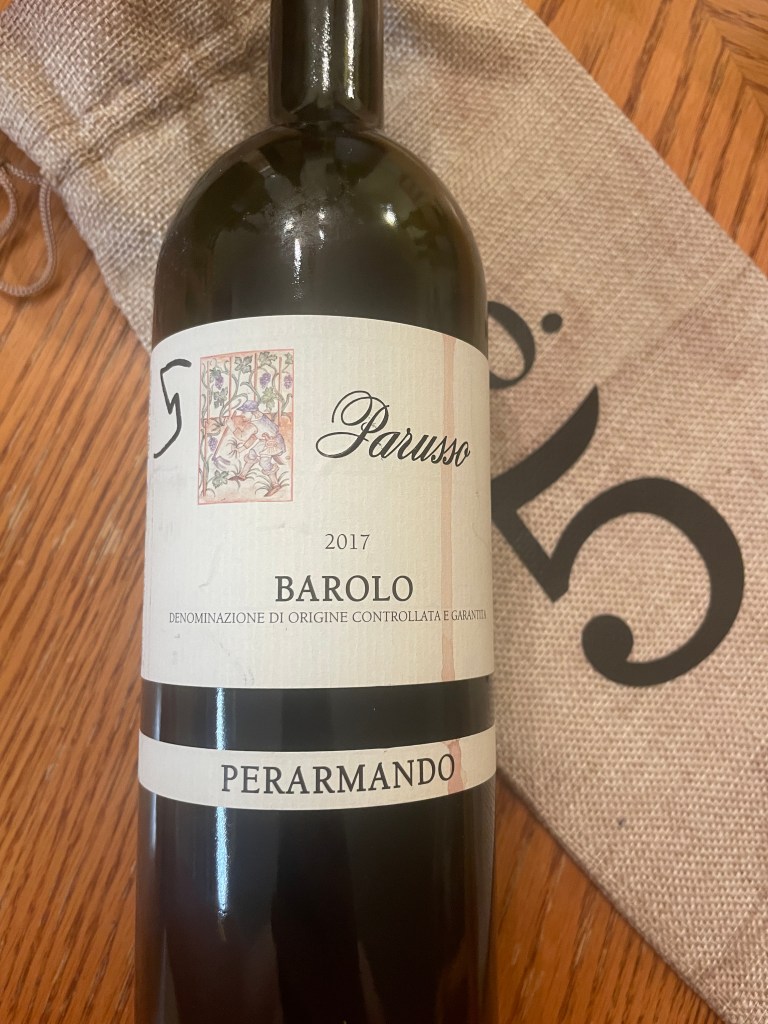
- Bottle #5: 2017 Parusso Barolo Perarmando
- Bottle #7: 2012 E. Piara Chiara Boschis (Runner Up)

We voted and collectively came up with our 3 ‘finalists’, based on the previous round winners. That said, it was a shame we didn’t include wine #8/Breaux Vineyards as one of the finalists, because it deserved to be there.
I didn’t take extensive tasting notes this round. In the end, #3/Barolo Gramolere was by far the consensus favorite of the day. It was nearly a toss-up between the next two for runner-up, but the #7/2012 Chiara came 2nd by a small margin.
Votes:
- Alex: 5/3/7
- Kathy: 5/3/7. #5 was ‘talking to me’
- Lindsay: 3/7/5. #3 was balanced and classic
- Matt: 3/7/5. Loved the nose and the rusticity of #3’s palate
- Ryan: 3/7/5
- Sarah: 7/3/5. Thought there was a lot going on with #7, and it was still getting better over time, while #3 had already peaked
- Vincent: (absent)
Lessons Learned:
First off, I want to say that I’m really proud how Team Virginia (with an assist from Pennsylvania’s Va La Vineyards) showed here. While none made it to the final round (although we agreed the 2012 Breaux should have), the East Coast contenders brought their A-game.
But as good as they were, these East Coast wines went up against exceptional producers from one of the most highly regarded wine regions in the entire world. This tasting was the equivalent of a World Cup soccer match between Team America and Team Italy. While the US has some great players…come on…it’s ITALY we’re dealing with.
That said, the results were far closer than I could have expected. We uniformly enjoyed the East Coast wines, especially the ones from Barboursville and Breaux.
Two main lessons learned:
Point #1: Age matters – and the East Coast Nebbiolos showed they could do that. There were many compliments about how that 2012 Breaux was able to last 12 years. Having had older Barboursville vintages I could say the same for them as well.
Point #2: East Coast Nebbiolos (at least in this round) were rarely ‘varietally correct’. Out of the 7 of us, we almost always guessed the correct region for each of the 4 rounds. I’m convinced while the East Coast wines were consistently good, being ‘different’ lost them some points.
What made the East Coast wines easily-identifiable were the light pyrazine and overall earthy notes, which were suggestive of their non-Italian origin.

 Wine Trails and Wanderlust
I’m betting once the east coast vines get more age on them they will show better (and the growers will know so much more about growing it well here!). Interesting comparison tasting!
LikeLike
Only BBV and Breaux have that kind of age. I did have an amazing 1998 Nebbiolo at Barboursville…but it was a once in a lifetime opportunity!
LikeLiked by 1 person